

Cashmere Quarter Zip Sweater Men: How to Choose One
You're comparing two listings for a cashmere quarter zip sweater men, and the photos look nearly identical. Same charcoal, same collar, same sale banner. One of those knits will still look tidy after a season of commuting. The other will fuzz under the arms before the month is out.
The finest micron number on the page is not the best buy. Fiber length, ply, knit density, and how the zipper rubs the cloth decide how long it lasts. I would score every candidate on those points before I look at the price.
Cashmere is a scarce fiber next to ordinary wool, which is why this layer sits on the premium rack. Scarcity still doesn't tell you whether this sweater survives a backpack strap and a seatbelt. The checklist does.
Table of Contents
- Quarter Zip Buying Checklist at a Glance
- Fiber, Ply and Making It Last
- Fit, Neckline and Warmth for Layering
- Styling a Cashmere Quarter Zip by Occasion
- What a Fair Price Looks Like for a Cashmere Quarter Zip
- Verify Origin Claims and Make the Final Pick
Quarter Zip Buying Checklist at a Glance
Say the two sweaters match on the product page. Same color, same collar height, same "soft hand" copy. After a season, one holds its shape. The other pills under the arms within weeks. A scorecard is the fastest way to separate them before you pay.
Run the same eight rows on every listing. A blank cell is a signal, not a small omission. A sweater described only as Grade A, with no micron figure, no staple length, and no ply, gives you nothing you can check.
| Criterion | Target to look for | Red flag |
|---|---|---|
| Fiber diameter | Stated range around 14-15.5 microns | Only a Grade A label, no micron figure |
| Fiber length | Stated staple length, longer is better | No length information given |
| Yarn ply | Two- or three-ply construction | Single-ply sold as long-wearing |
| Knit gauge | Fine gauge for dressier wear, heavier knit for standalone | Weight and gauge not stated |
| Zipper placket | Reinforced stitching, no gaps at zip ends | Thin stitching or puckering at the zip ends |
| Composition | 100% cashmere stated on the item's label | Blend or fiber content not disclosed |
| Origin and certification | Named country or region and the certification scope | Vague origin wording with no certification named |
| Recycled content | Stated percentage and blend ratio | Recycled claim with no percentage |
Fiber diameter is a softness target, not a promise that the sweater will last. Fiber length and yarn ply do more for wear. Knit gauge should match the job, fine under a jacket or heavier when the sweater stands alone. The zipper placket needs reinforced stitching and closed ends, because the pull catches loose loops. Composition should read 100% cashmere on that item. Origin and certification need a place and a named scope. If recycled content is claimed, you need the percentage and the blend.
Score all eight rows on each candidate first. Only then compare prices, so the choice rests on construction rather than the sale tag.
Fiber, Ply and Making It Last
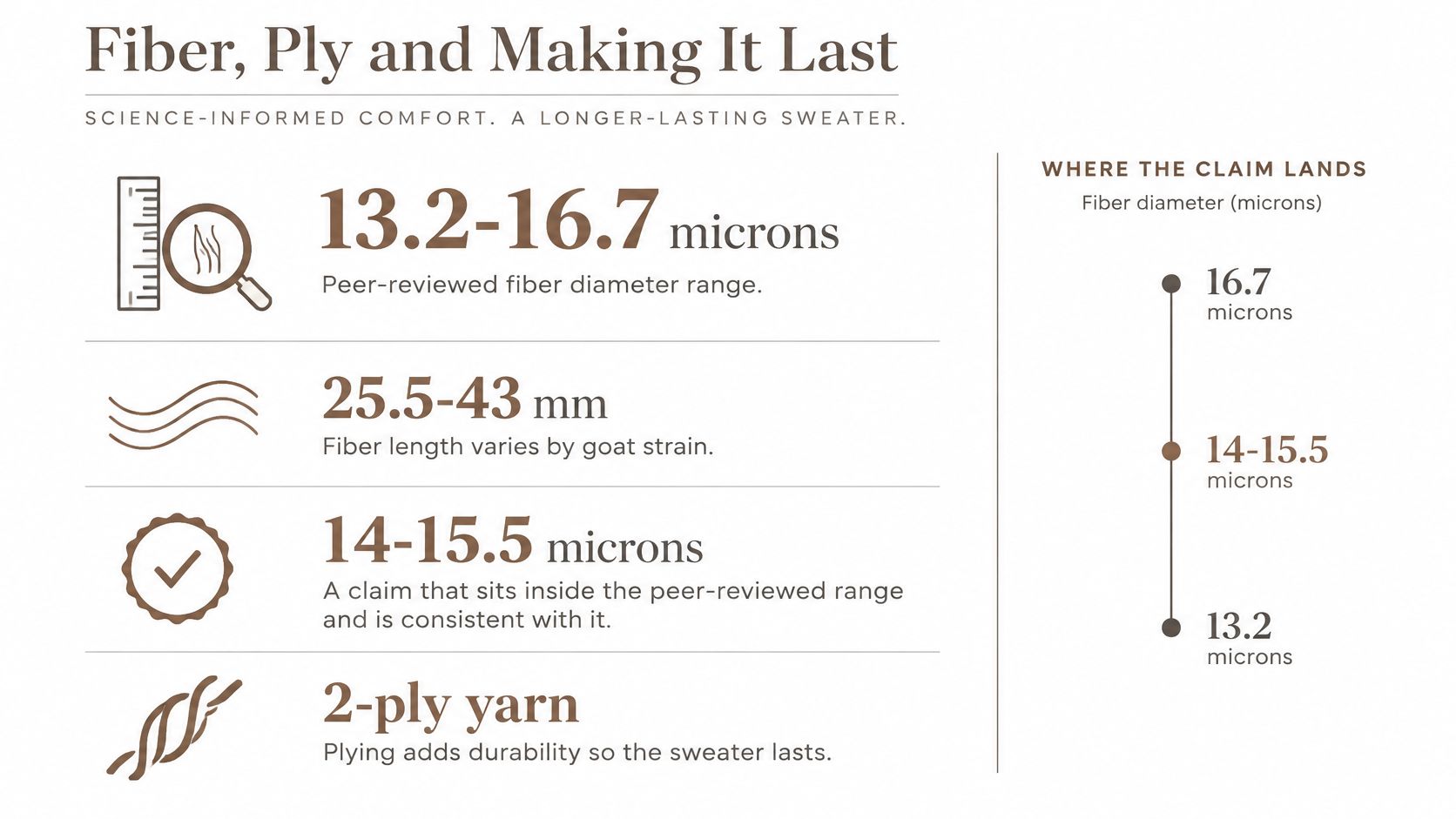
Fineness is the main reason a cashmere quarter-zip feels soft and still insulates at a light weight. Peer-reviewed textile research reports cashmere mean diameters of approximately 13.2–16.7 microns, with fiber lengths around 25.5–43 mm depending on goat strain, in this fibers journal study. A stated 14–15.5 micron claim sits inside that band and is consistent with premium softness. It does not tell you the sweater will hold up.
Finer fibers bend more easily against the skin. More of them fit in a yarn cross-section, and that network traps still air, so warmth comes without a heavy garment. The trade-off is blunt. Very fine, short fibers migrate to the surface and abrade faster. Preparation that aligns the fibers and removes the short ones is what governs pilling and shape.
What the diameter ranges actually tell you
The Food and Agriculture Organization fiber note put Chinese cashmere at about 12.5–16.0 microns, with 15.5 microns as a standard reference point, and Mongolian cashmere at about 16.0–17.5 microns, generally coarser but often longer.
| Source or origin | Diameter (microns) | What it means for buyers |
|---|---|---|
| Chinese cashmere (FAO) | 12.5-16.0 | Common origin; 15.5 is the standard reference point |
| Mongolian cashmere (FAO) | 16.0-17.5 | Generally coarser, but often longer fibers |
| Peer-reviewed study range | 13.2-16.7 | Fiber length around 25.5-43 mm depending on goat strain |
| Typical premium product claim | 14-15.5 | Consistent with ultrafine benchmarks; check length and ply too |
Longer staples generally make a stronger yarn and pill less. Cashmere fabric guidance is clear that two- or three-ply yarn typically outlasts single ply, and that pilling is most common in early wear. I would not take the finest advertised micron if the listing is silent on length and ply. A slightly coarser, longer, multi-ply yarn usually wins a daily commute.
The same checks, applied to any cashmere sweater and not only a zip neck, are laid out in this guide to how to choose a high-quality cashmere sweater.
Where a quarter-zip actually wears out
Friction is higher than on a plain crew. Watch the underarm panels, the shoulder seams where a bag or seatbelt rubs, and the zipper placket, where hardware catches the knit. Those three zones fail first when the yarn is short, loosely spun, or single ply.
If you already keep warm wool throws for minimalist homes in the same closet, give the sweater the same respect for staple length. A throw can hide a fuzzy patch. A quarter-zip worn to the office can't.
Practical rule: The lowest micron on the tag is a softness clue. Length, ply, and knit density decide whether that softness is still there in March.
Work through care in this order, for one reason each time.
- Wash gently. Hand wash in cool water with a cashmere-safe detergent, or dry clean if the label asks, because heat and agitation felt the fibers.
- Skip the wring. Press water out in a towel, because twisting stretches the knit.
- Dry flat. Keep it off radiators and out of direct sun, because heat pulls the shoulders out of shape.
- Store it folded. Don't hang it, and add cedar or lavender so moths stay out of the drawer.
- Comb pills one way. Use a cashmere comb rather than your fingers, because pulling tears live fibers out of the yarn.
Do this in the first months. A surface you comb early stays even much longer than one you ignore until the pills mat.
Fit, Neckline and Warmth for Layering
The quarter-zip began as military mid-layer clothing. Reporting in The Globe and Mail traces the zipper to field use, where it let wearers regulate temperature as conditions changed, then through army-surplus, collegiate, and casualwear phases before a 1990s peak.
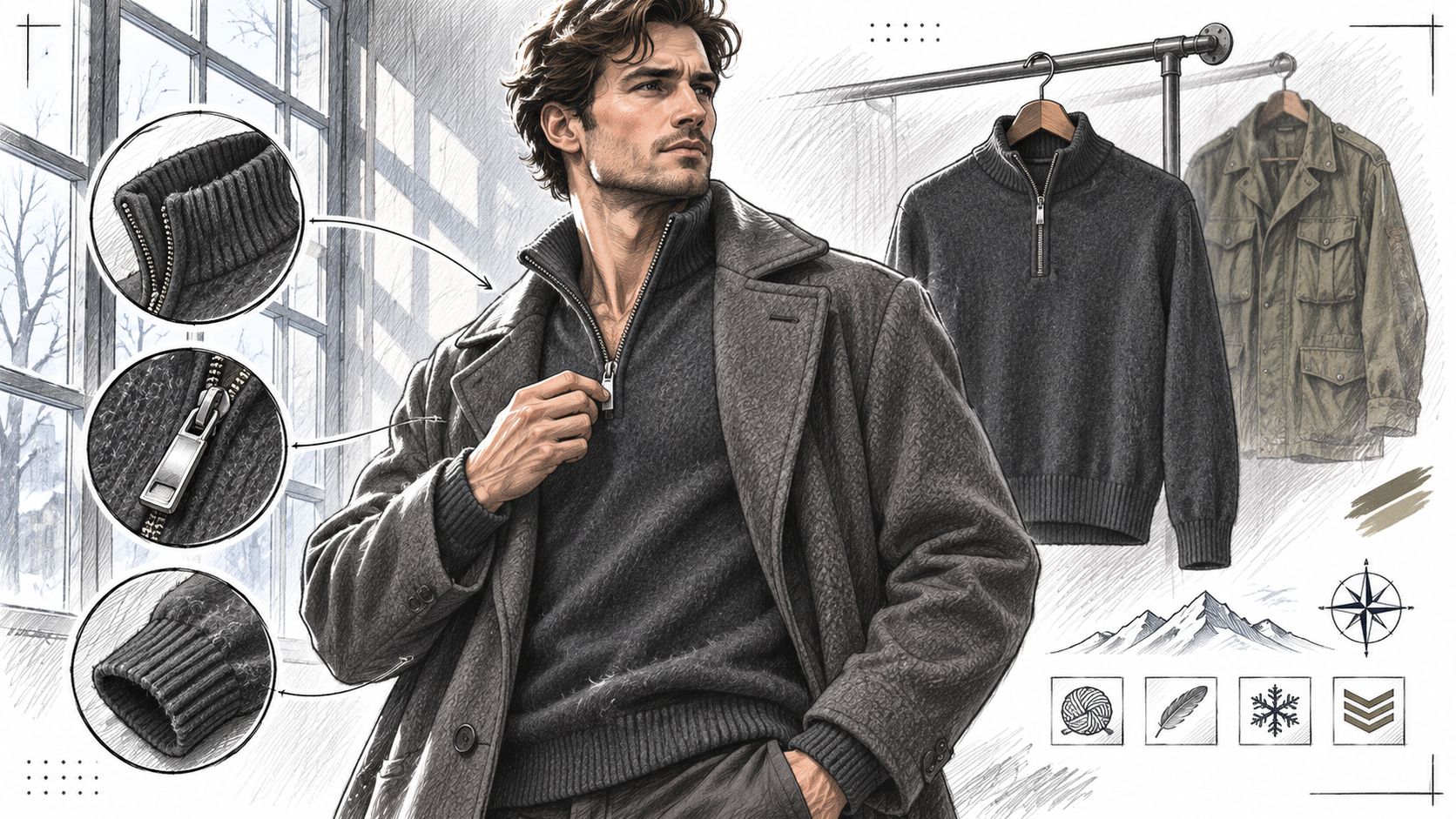
Treat the zip as a thermostat at the collar, not as a stand-in for how the cloth is engineered. Closing it adds coverage at the neck and upper chest and cuts convective heat loss. Opening it lets heat and moisture out. That is the hardware's whole job.
Research on goat fibers reports moisture regain near 14.04–14.10%, in this textile moisture study. The fiber takes up vapor without feeling wet right away, which helps between the street and a warm office. Absorbed moisture also slows drying, so a soaked commute is not a reason to toss the sweater on a hot radiator.
Fitting-room checks
- Use the actual shirt. Put the sweater on over the one you plan to wear with it.
- Check ease. Chest and shoulder should leave room for that base layer.
- Look under the arms. The cloth shouldn't bunch when your arms hang.
- Close the zip. The collar should meet without pressing the throat.
- Set the hem. It should sit near the hip so the layer stays put.
- Load the seams. Shoulder seams and underarms shouldn't strain when you reach forward.
A finer gauge sits under a sport coat with little bulk. A heavier knit adds texture and warmth when the sweater is the outer layer. If you want collar coverage without a zipper, a funnel neck cashmere sweater is the nearer alternative, and the same ease rules still apply.
A short fitting clip makes the collar and shoulder check easier to judge before you order your size.
Styling a Cashmere Quarter Zip by Occasion
Monday it's the office. Friday it's dinner. The same quarter-zip works on both if the layers change with the room.
The zip sets the formality. Closed, under a jacket, it reads polished. Open, over a tee, it reads relaxed. Buy the gauge for the one or two days you'll wear it.
| Occasion | Layer with | Best gauge | Styling note |
|---|---|---|---|
| Office, business casual | Under a sport coat or unstructured blazer | Fine gauge | Keep the collar closed for a sharper line |
| Commute, transitional weather | Under a topcoat or light shell | Medium gauge | Open the zip to vent during the commute |
| Weekend | Over a collared shirt or plain tee | Medium to heavy gauge | Pair with chinos or dark denim |
| Travel | Under a shell on the flight | Medium gauge | A compact knit that layers without bulk |
| Dinner or evening | Under a dark topcoat | Fine gauge | Solid colors read more formal than patterns |
A medium-gauge knit packs flatter than a heavy one and still layers under a shell on a flight. For evenings, solids read cleaner than patterns. Under a blazer, leave the collar closed so the chest line stays sharp.
If the weekend row turns into a round of golf, what to wear for golfing is a useful check on collars and layers that still move. Don't buy your office gauge for a windy tee box. On dressier nights, when a zip looks too sporty, a black V-neck men's sweater is the cleaner swap.
Pick those one or two occasions first. Then buy the gauge those rows call for.
What a Fair Price Looks Like for a Cashmere Quarter Zip
Sweaters and coats are the bulk of this market, so markdowns are a sales tool, not a quality grade. Grand View Research reported that sweaters and coats represented 50.7% of global cashmere-clothing market revenue in 2025. Its U.S. outlook estimated U.S. cashmere-clothing market revenue at $645.5 million in 2025 and projected $1,038.0 million by 2033, implying a 6.1% CAGR from 2026 to 2033. In a growing category, a low tag is common. It is not a spec.
| Retailer | Listed price | What the price proves |
|---|---|---|
| Everlane men's cashmere quarter-zip | $198 regular, $59 sale (70% off) | Markdown depth only; construction is not confirmed by price |
| Charles Tyrwhitt men's pure cashmere quarter-zip | $299, $269 multibuy | Full-price benchmark; check the spec against the checklist |
Everlane listed its men's cashmere quarter-zip at a regular price of $198 and a sale price of $59, a 70% discount, in 2026. That shows how far the tag moved. It says nothing about ply, length, or the zipper. Charles Tyrwhitt listed men's pure cashmere quarter-zip sweaters at $299, with a multibuy price of $269, in 2026. Use that pair as a full-price benchmark, then still read the label.
How to compare without getting fooled by the tag
- Write down the regular price. The sale price alone hides what the seller thinks the knit is worth.
- Read the spec. Look for micron range, fiber length, ply, and gauge, or note that they're missing.
- Match the rows. Compare only sweaters that score on the same checklist lines. A cheap single-ply and a three-ply near $299 are not the same purchase.
- Use the discount as a prompt. A markdown is a reason to verify, not a reason to skip verification.
A sale tag with no stated micron, length, or ply is not proof of value. It is proof the price moved.
Verify Origin Claims and Make the Final Pick
A responsible claim is several separate facts. Origin, animal-welfare certification, traceability, and recycled content each prove something different, and warmth copy on a product page covers none of them.
Ask the seller for the country or region, the certification name and its scope, the recycled percentage, the virgin-to-recycled blend, and proof the claim covers the finished garment rather than only the raw fiber. Ralph Lauren's 2025 corporate citizenship report states that 93% of its cashmere products were either Sustainable Fibre Alliance-certified or recycled. That is what a checkable disclosure looks like: a named program, a defined scope, and a number. A tag that says only "responsibly sourced" gives you none of the three.
Recycled fiber can come out shorter, and shorter fiber changes softness and strength. Recycled sits on equal footing with responsibly sourced virgin cashmere; the stated specs decide which wears better. For the wider frame around those labels, ethical sourcing in the fashion industry walks through what a sourcing claim should be asked to prove.
Run the list, then decide
Cashmere Boutique's Men's Pure Cashmere Half Zip Sweater is on sale for $149.00 USD, down from $299.00 USD, in three colors, and many of its men's pieces are listed as 100% pure cashmere. Because it is a half zip rather than a quarter zip, confirm the placket length and the composition line on that exact item before treating it as the same silhouette.
- Confirm the fiber facts. Micron range, staple length, and ply should appear on the listing or the label.
- Match gauge to the main occasion. Fine under a coat, heavier if the sweater stands alone.
- Confirm origin, scope, and composition. Vague "premium cashmere" wording fails this row.
- Set the price against the benchmark. A discount counts only after the rows match.
- Fit it over the shirt you'll wear. You want chest ease, a collar that doesn't press, and a hem near the hip.
I would walk away from a beautiful hand feel if the seller cannot name the ply or say whether the claim covers the finished sweater. A quarter zip earns its keep at the collar, where the zip hardware rubs the knit every time it moves, so a smooth placket matters as much as the fiber behind it. Softness you cannot trace is a gamble on the second season.
Cashmere Boutique has sold cashmere apparel and home textiles since 1999, including men's sweaters, zip layers, and coats with stated pure-cashmere compositions. If you're choosing a zip-neck sweater on fiber, ply, and fit rather than the markdown alone, start with the men's collection and read the composition on the exact piece. Visit Cashmere Boutique to compare colors, sizes, and care notes before you buy.