
Navy Cardigan Mens Guide to Style, Fit, and Care
You're standing in front of an overstuffed wardrobe, trying to choose one extra layer that can handle a coffee run, a casual office, and dinner without looking too relaxed or too formal. A navy cardigan for men often solves that problem better than another sweatshirt or a heavy jacket, but only if the fit, fiber, knit, and care requirements match how you actually dress.
The right choice comes down to four decisions. You need to measure the fit rather than trust a familiar size, select cashmere or merino for your routine rather than its luxury reputation, understand which outfits the color supports, and accept the care the garment requires. By the end, you'll know how to assess a product page and choose a cardigan you'll wear repeatedly.
Table of Contents
- Why a Navy Cardigan Belongs in a Man's Wardrobe
- The Military and Naval Roots Behind the Look
- How to Nail the Fit When Buying Online
- Cashmere vs Merino for a Navy Cardigan
- Outfits That Take a Navy Cardigan from Weekend to Office
- Care Routine That Keeps Navy Looking Sharp
- Bringing It All Together on Purchase Day
Why a Navy Cardigan Belongs in a Man's Wardrobe
A cardigan earns its place by working as a middle layer, not by competing with every other sweater in your wardrobe. Leave it open over a T-shirt, button it over an Oxford shirt, or wear it beneath a blazer when a waistcoat would feel too formal. The front opening lets you adjust warmth easily, while the knit structure gives an outfit more shape than a basic pullover.
Navy makes that flexibility easier. It sits between black and lighter blue, so it can look polished with gray trousers and still feel natural with denim. It also hides early signs of regular use more effectively than pale knitwear, though that doesn't make it immune to fading, pilling, or dye transfer.
Practical rule: Choose a cardigan you can wear with at least three existing outfits before you consider a more distinctive pattern or texture.
The garment's useful middle ground
A slim cardigan can replace a lightweight jacket in mild weather. A classic-fit version can sit over a shirt without pulling at the buttons. A heavier shawl-collar style can provide more visual structure, but it also takes up more space beneath outerwear.
That range explains why the style can work for men who don't normally wear knitwear. You aren't committing to a particular age group or dress code. You're choosing an open-front layer that can shift with the rest of your clothing.
The color also supports a broad palette. White, gray, khaki, denim, and structured neutrals create clear combinations without making the cardigan look repetitive. A navy cardigan with white and denim feels relaxed; the same shade with gray trousers and a shirt looks considered.
Four checks before you buy
Use this order when comparing options:
- Fit: Can you wear it over the layer you usually choose?
- Material: Do you value next-to-skin softness, resilience, or easy maintenance most?
- Style: Does the collar and knit weight suit your existing clothes?
- Care: Will you follow the washing and drying instructions?
A well-chosen navy cardigan isn't an old-fashioned fallback. It's a practical foundation for modern layering, provided the proportions and fiber suit your daily life.
The Military and Naval Roots Behind the Look
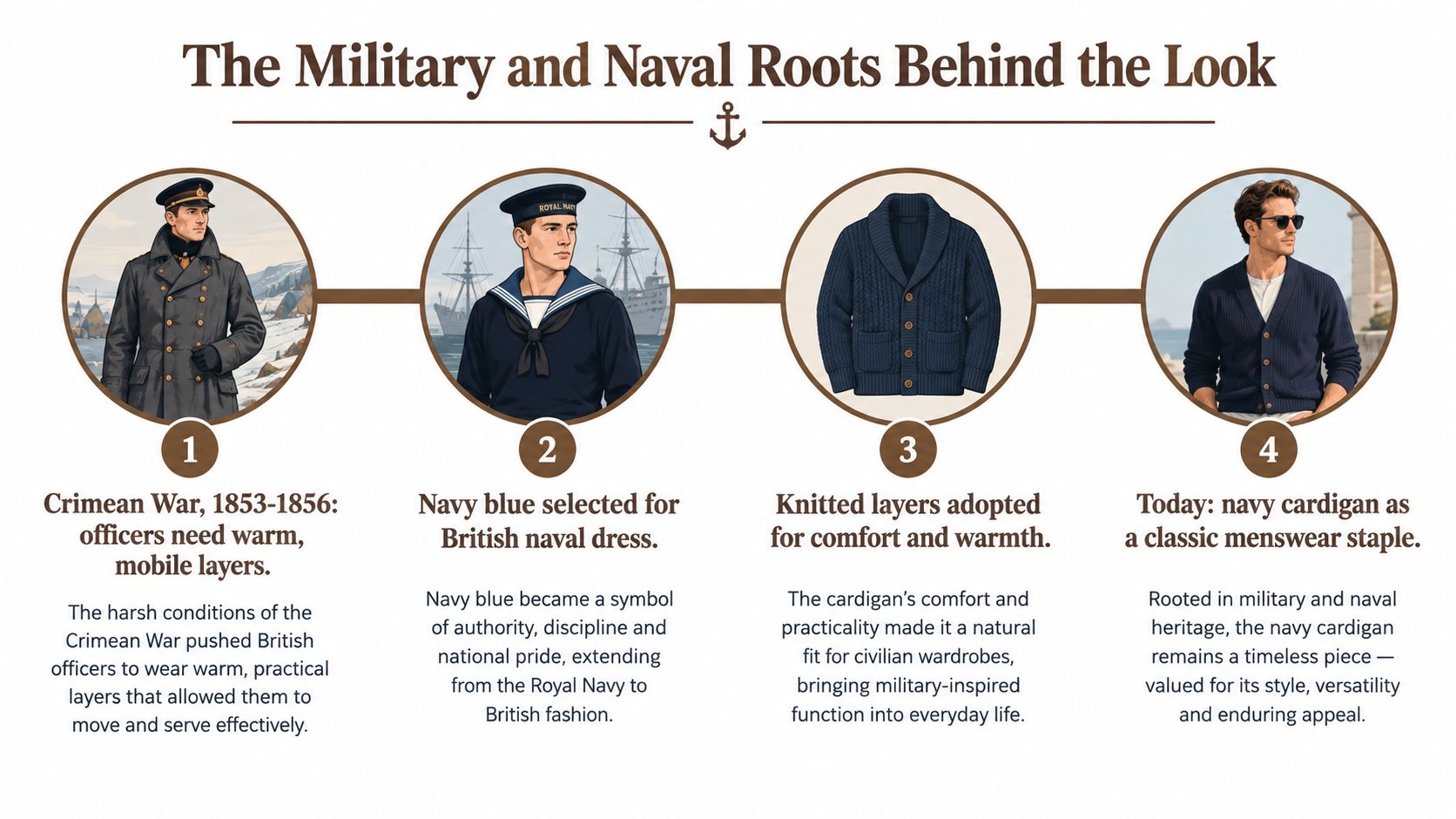
The cardigan's history explains why it can look functional and refined at the same time. During the Crimean War, fought from 1853 to 1856, James Thomas Brudenell, the 7th Earl of Cardigan, led the British Light Brigade at the Battle of Balaclava in October 1854. British officers used knitted wool waistcoats and jacket-like layers to retain warmth while preserving arm movement in cold conditions, as documented by The Atlantic's history of the cardigan's military origins.
The earliest garments were often sleeveless knitted waistcoats. The long-sleeved form had emerged by approximately 1864, and by the 1910s it had become more common than the vest version. By the mid-to-late 1920s, cardigans had established a place in both men's and women's wardrobes.
Why navy feels more formal than other blues
Navy blue carries a separate uniform history. When British naval uniform was introduced in 1748, authorities selected dark blue for officers' dress, creating the association that produced the term “navy blue,” according to the National Portrait Gallery's account of naval uniform and male fashion.
That color later moved into civilian clothing. Its low-saturation appearance offers more softness than black while retaining a sense of authority and order. The combination is powerful: a knitted layer associated with military mobility, paired with a shade rooted in naval dress.
Turning the history into modern outfits
You don't need military-inspired clothes to use this heritage. The history clarifies why a navy cardigan looks comfortable without becoming sloppy. Over a white T-shirt, it adds contrast and structure. Over a shirt, it creates a relaxed alternative to a jacket. Under a blazer, it can act as a warm, flexible layer between a shirt and structured outerwear.
Navy also gives you more room to combine textures. Denim, brushed cotton, gray flannel, khaki chino cloth, and smooth tailoring all sit comfortably beside it. The result feels lasting because the color and garment shape each carry a practical origin rather than relying on a short-lived trend.
How to Nail the Fit When Buying Online
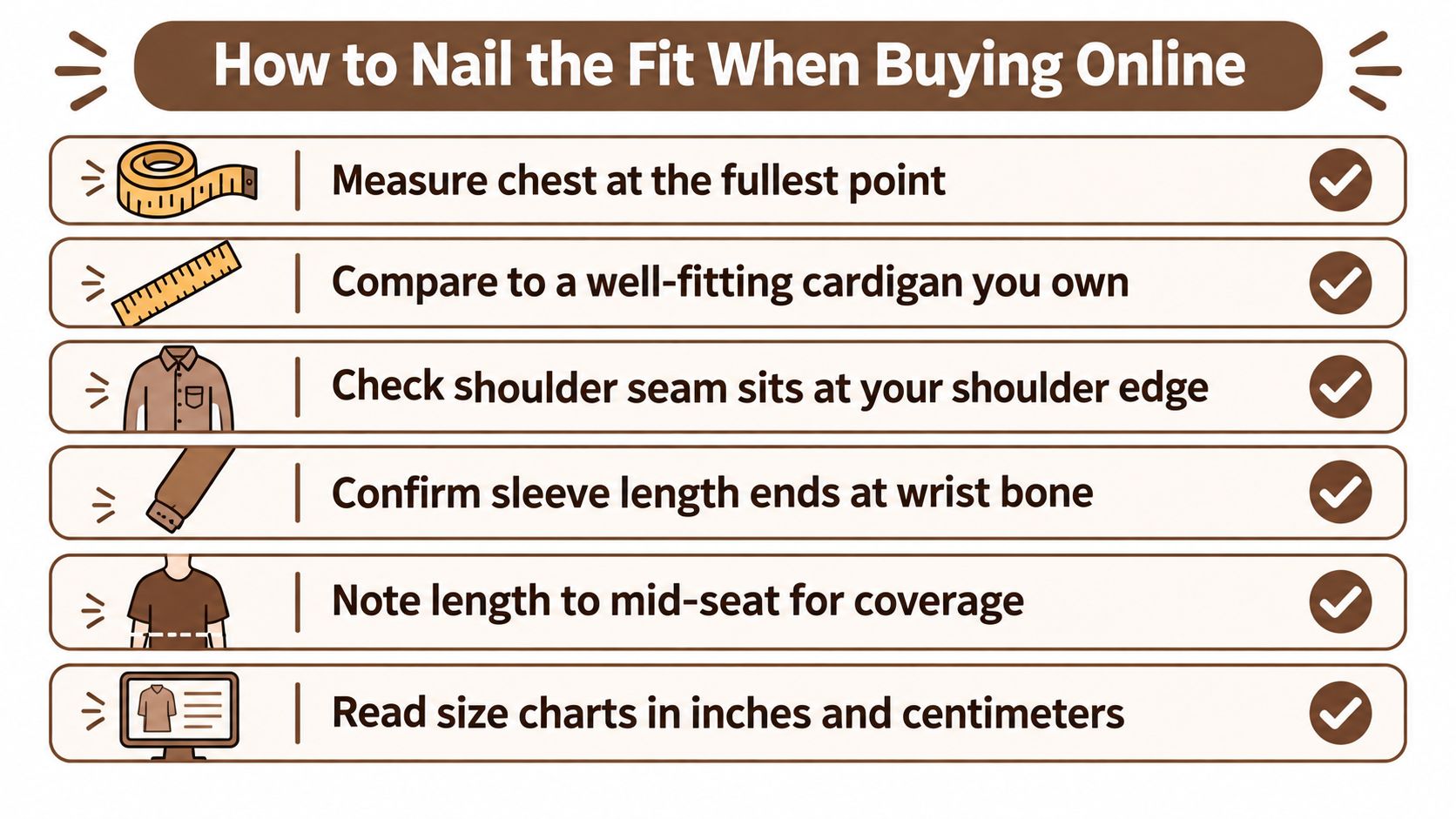
Online shopping becomes much easier when you stop treating the size label as the measurement. A medium from one brand may not match a medium from another, so compare the product's measurements with a cardigan or sweater that already fits you well.
Start by laying that garment flat without stretching it. Measure the chest across the garment below the armholes, then compare the result with the product page. If the retailer lists the body's full circumference rather than the flat measurement, make sure you're comparing like with like. The Cashmere Boutique size guide can help you interpret a product chart before ordering.
Measure the points that change the result
Check the cardigan in this order:
- Chest: Compare the fullest part of your body with the garment's chest measurement. Leave enough ease for the layer beneath. A T-shirt needs less room than an Oxford shirt, and a shirt worn beneath a blazer needs more freedom than either.
- Shoulders: The shoulder seam should finish near the edge of your shoulder. If it sits far beyond that point, the cardigan may look intentionally relaxed or just too large.
- Sleeves: Decide whether you want the cuff to finish at the wrist bone or slightly beyond it. A sleeve that ends above the wrist can look short when you reach forward.
- Body length: A standard cardigan usually offers coverage around the seat without hanging dramatically below it. A longer hem can look elegant, but once the knit becomes substantial and the body extends well past the seat, it starts to function more like a sweater coat.
Choose ease for the way you layer
Trim fit works over a T-shirt or thin base layer. It should still allow the front panels to lie flat when buttoned. Classic fit gives you room for an Oxford shirt and is usually the safest starting point for a first purchase. Relaxed fit creates a more contemporary silhouette and can accommodate heavier layers, but it needs deliberate proportions elsewhere.
A dark color can visually narrow the torso, yet that effect isn't a reason to buy a smaller size. Insufficient ease causes button strain, diagonal pulling, and distorted front panels. A shawl collar adds bulk around the neck and chest, so a relaxed shawl cardigan may look heavier than a V-neck cardigan in the same size.
Fit test: If the buttons pull apart when you stand naturally, the cardigan isn't slim. It's too small.
Read the measurements in both inches and centimeters, check the fabric's stretch, and review the return policy before ordering. A few minutes with a tape measure is more reliable than guessing from a model's proportions.
Cashmere vs Merino for a Navy Cardigan
Cashmere and merino can both make excellent navy cardigans, but they solve different problems. Cashmere prioritizes softness and a light, luxurious hand. Merino usually gives you a more resilient everyday layer with useful moisture management and temperature regulation.
Cashmere's softness comes from fine fibers. Cashmere is technically distinguished from ordinary wool by a mean fiber diameter no greater than 19 microns, while a U.S. goat-fiber dataset reported a mean diameter of 15.34 microns and a strong negative relationship between mean diameter and the proportion of fibers exceeding 19 microns, as reported in this Frontiers in Materials study of cashmere fiber characteristics. Cashmere specified around 14 to 15.5 microns can feel exceptionally soft against a shirt or bare neck, but finer fibers are more vulnerable to abrasion and surface pilling.
| Factor | Cashmere | Merino Wool |
|---|---|---|
| Hand feel | Very soft and smooth, especially in fine grades | Soft, with a broader range of textures |
| Durability | Needs careful handling because fine fibers can abrade | Generally better suited to frequent wear |
| Moisture and temperature | Warm and comfortable, but less forgiving of rough use | Useful for temperature regulation and moisture management |
| Maintenance | Gentle washing, careful drying, and thoughtful storage | Still needs proper care, but often tolerates everyday use better |
| Best match | Office layering, gifting, and low-friction wear | Commuting, travel, humid conditions, and regular rotation |
Match the fiber to your routine
Choose cashmere when the cardigan will spend much of its time in an office, at home, or in controlled social settings. It works particularly well when you value softness and won't repeatedly wear it beneath a rough jacket or backpack strap.
Merino makes more sense for travel, active commuting, humid climates, or a wardrobe that depends on frequent rotation. Its performance advantages can matter more than its slightly less delicate hand feel when the garment needs to handle movement and changing conditions.
The environmental question also deserves attention. Industry reporting describes cashmere and wool as having unusually high methane intensity relative to their share of fashion materials, so a premium fiber isn't automatically the lowest-impact choice. Longer ownership, careful laundering, repair, and traceable or recycled fibers can reduce the pressure associated with replacing garments.
For more detail on evaluating fiber, construction, and quality claims, use this guide to choosing a high-quality cashmere sweater. The practical conclusion is simple: cashmere is the softness choice, merino is often the hard-working choice, and neither is universally superior.
Outfits That Take a Navy Cardigan from Weekend to Office
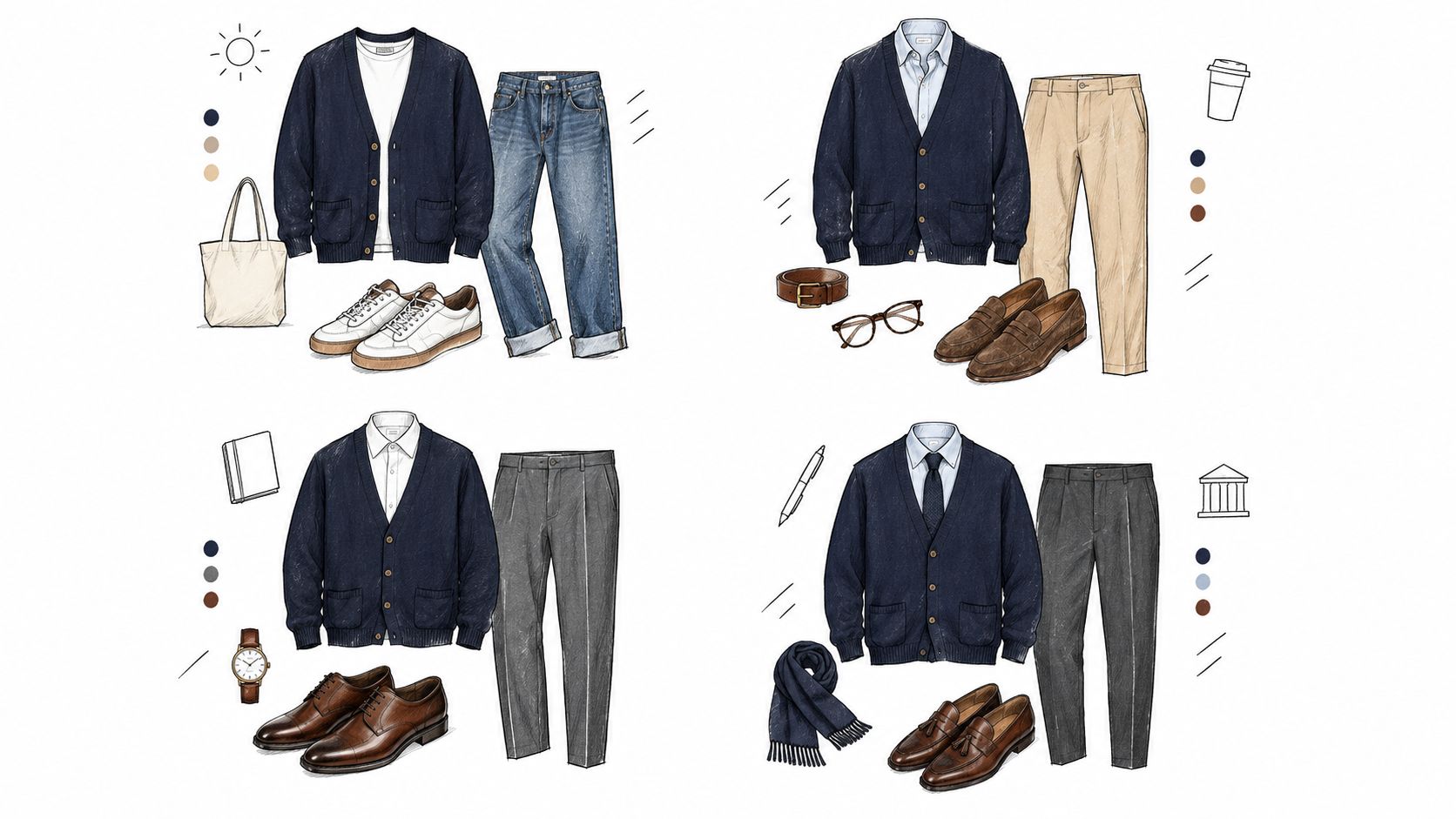
A navy cardigan becomes more useful when you build outfits around its contrast rather than treating it as a complete look by itself. Start with clean color relationships, then adjust texture and formality.
Weekend with white and denim
Wear the cardigan open over a white crewneck T-shirt, then add selvedge denim and leather sneakers. White gives the navy a crisp edge, while denim repeats the blue family without demanding an exact color match. Choose a cardigan with a clean V-neck or simple round neckline if you want the outfit to remain understated.
Relaxed office with an Oxford shirt
Layer it over a light Oxford button-down, chinos, and suede desert boots. The shirt introduces structure, the chinos soften the combination, and suede keeps the boots from looking too formal. Khaki works especially well because it contrasts with navy while retaining a practical, workwear-influenced feel.
Business casual beneath tailoring
For a more polished office outfit, wear the cardigan under a fitted blazer with gray trousers and a knit tie. The open-front knit can replace a waistcoat by adding a narrow visual layer without the stiffness of a full three-piece arrangement. Gray keeps the outfit balanced, while the knit tie repeats the cardigan's texture.
Give the cardigan enough room for the blazer. A trim cardigan that looks fine over a T-shirt may bunch beneath blazer sleeves.
The same layering logic can support an evening outfit:
Evening with a roll neck
Use a fine merino roll neck beneath the cardigan, then add dark trousers and clean leather loafers. The roll neck creates a continuous dark foundation, while the navy cardigan adds depth without introducing a bright contrast. Keep the knit fine and the shoes sleek so the shawl or buttoned front doesn't become visually heavy.
The most reliable approach is to let one item provide texture and keep the other pieces quiet. Navy already offers enough character to support white, gray, khaki, denim, and dark tailoring without adding a competing pattern.
Care Routine That Keeps Navy Looking Sharp
Dark blue needs more attention than its dependable appearance suggests. Navy dye can show weakness through fading, rubbing, perspiration marks, or transfer onto a pale shirt. Heat, prolonged soaking, alkaline detergent, friction, and mixed-color washing increase the risk.
Fine cashmere also needs protection from abrasion. A shoulder strap, rough coat lining, or repeated rubbing against a desk can create surface fuzz even when you wash the cardigan correctly.
Wash with less force
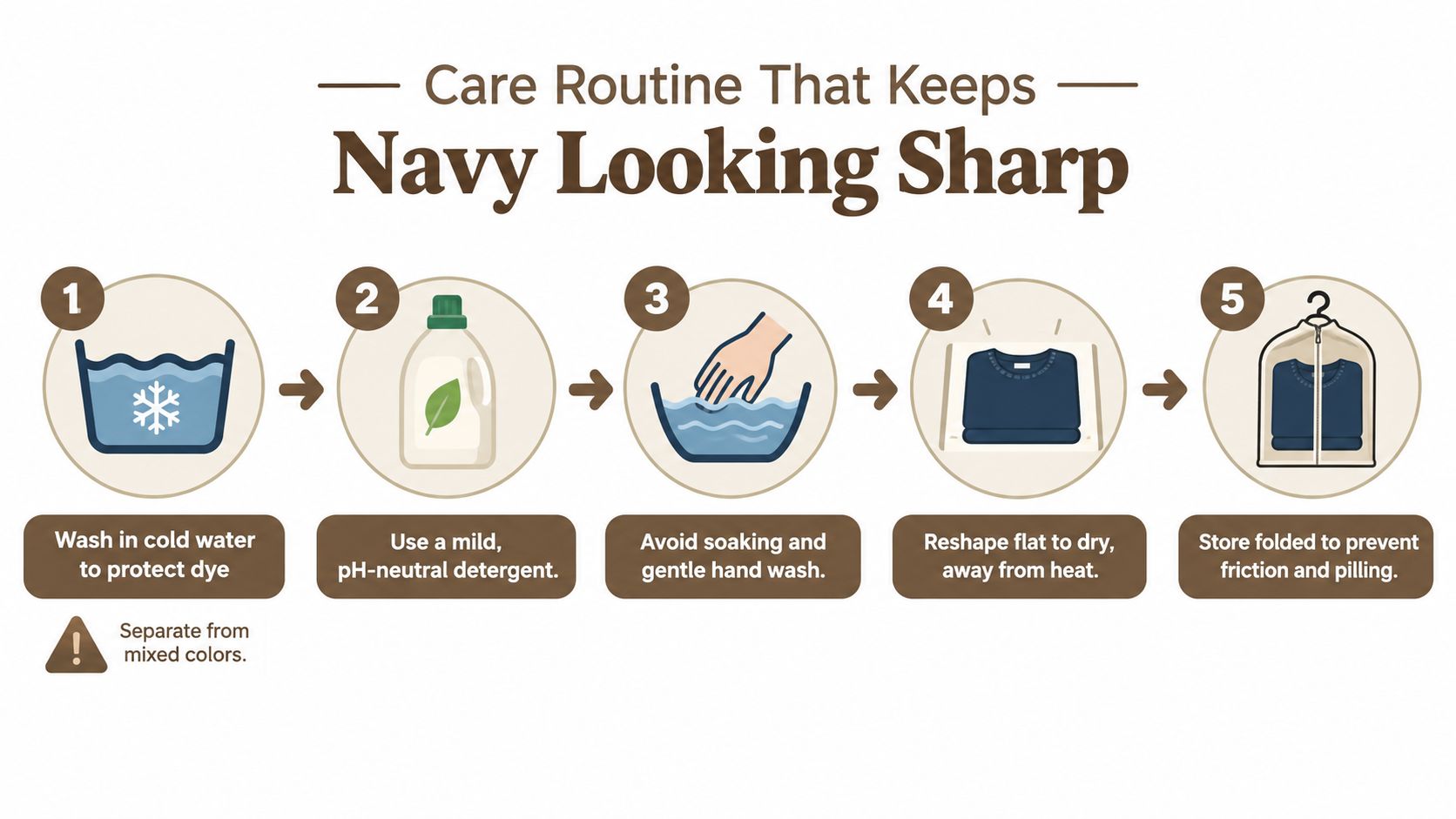
Follow this sequence:
- Separate the load: Wash the cardigan with similar dark colors rather than pale garments.
- Use cool water: Choose cold or lukewarm water and a detergent intended for protein fibers.
- Reduce agitation: Use a gentle cycle or careful hand washing, and don't leave the knit soaking.
- Skip the wringer: Press out water without twisting or wringing.
- Reshape immediately: Align the shoulders, sleeves, cuffs, and hem while the cardigan is damp.
- Dry flat: Place it on a towel away from direct heat and sunlight. Never hang it wet, because the shoulder weight can lengthen the body.
The Cashmere Boutique care instructions provide a useful reference when comparing product guidance. A clear label should identify fiber content, washing method, drying orientation, and any dry-cleaning limitations.
Deal with pilling carefully
Use a cashmere comb or fabric shaver with a light touch. Don't pull pills by hand, since that can draw out surrounding fibers. Store the cardigan folded in a breathable bag with cedar nearby, rather than on a hanger that can stretch the shoulders.
Professional cleaning may be appropriate for stubborn stains or a structured cardigan with special finishing. Check the label first, and test any spot treatment on an inconspicuous area. Good care doesn't make fine knitwear indestructible, but it slows the problems that make a navy cardigan look tired.
Bringing It All Together on Purchase Day
You now have four decisions to make. Confirm the fit with measurements from a sweater you already like, choose cashmere or merino according to your actual use, test the cardigan against the outfits you already own, and read the care label before paying.
Avoid two common mistakes. A slim fit with too little ease will strain at the buttons and distort the front panels. Pure cashmere will feel soft, but it won't be maintenance-free, especially if you wear it frequently or expose it to rough outerwear.
Use this short checklist:
- Measurements: Chest, shoulder, sleeve, and body length compared with a known-good garment.
- Layering plan: T-shirt, shirt, blazer, or heavier outerwear.
- Primary use: Office, commuting, travel, evenings, or occasional wear.
- Fiber choice: Cashmere for softness, merino for resilience and active use.
- Care review: Washing method, drying instructions, storage, and return policy.
Cashmere Boutique offers men's cashmere cardigans alongside other cashmere apparel, with product information, size support, and care guidance for shoppers comparing navy layering options. Visit Cashmere Boutique to review the available styles and choose a cardigan that fits your wardrobe and maintenance routine.