
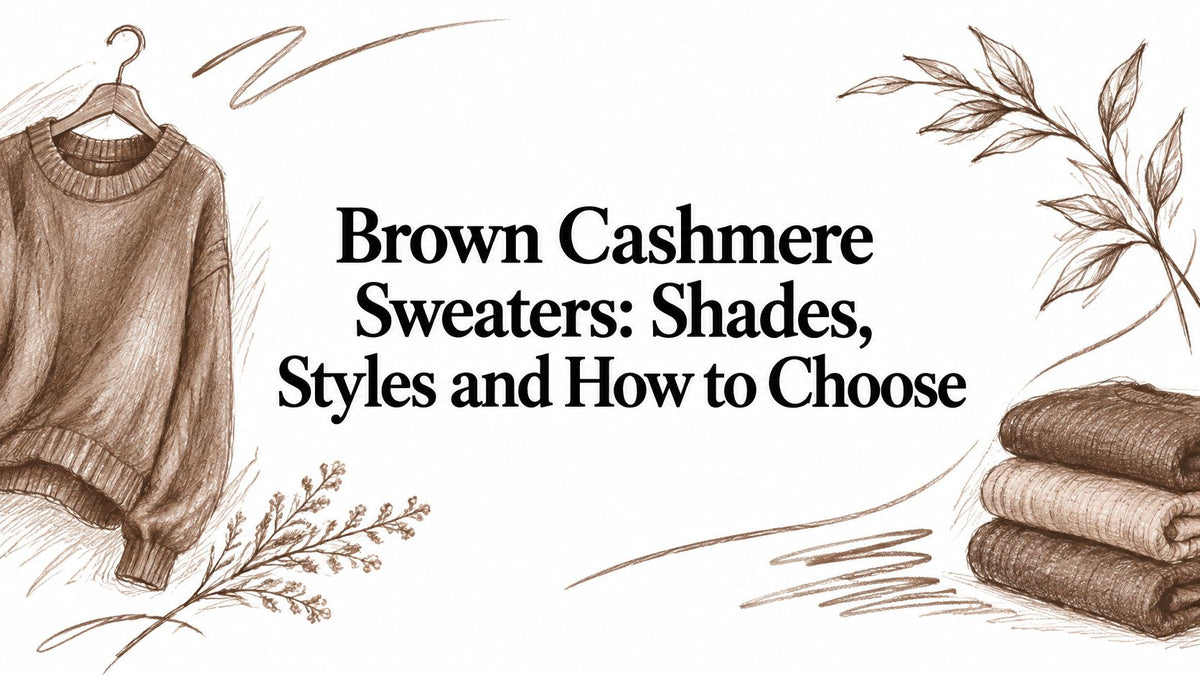
Brown Cashmere Sweaters: Shades, Styles and How to Choose
The usual advice about brown cashmere sweaters is to pick a rich chocolate shade and wear it with cream trousers. That's an outfit suggestion, not a buying strategy. Start with the sweater's job, its fiber specifications and the colors you already wear, then choose the brown.
A beautiful shade won't rescue an uncomfortable neckline, a flimsy knit or an unverifiable sourcing claim. Buy the right construction in a compatible undertone, and you'll have something more useful than a seasonal color purchase.
Table of Contents
- Brown Cashmere Sweater Styles at a Glance
- Sizing and Fit Before You Order
- How to Judge Cashmere Quality Beyond Color
- Choose a Brown Shade That Works With Your Wardrobe
- Brown Cashmere Gifts and Home Pieces That Coordinate
- How to Wash and Care for Brown Cashmere
- Sustainability Claims and a Pre-Purchase Check
Brown Cashmere Sweater Styles at a Glance
Brown cashmere sweater styles and where each works best
| Style | Best use | Fit and layering note | Shade note |
|---|---|---|---|
| Crew neck | Everyday layering under coats | Hides most of a shirt collar; easiest all-rounder | Chocolate and camel read most neutral |
| V-neck | Office and smart layering | Shows a collared shirt; slimmer neckline | Espresso adds polish at work |
| Turtleneck | Cold weather, worn alone | Greatest neck coverage; check collar fit | Deep brown suits winter outfits |
| Cardigan | Travel and overheated rooms | Easy on and off; open front layers over tees | Light camel suits daytime |
| Half-zip or zip cardigan | Smart casual and weekends | Structured collar; sporty finish | Mid brown pairs with denim |
| Polo sweater | Collared look without a shirt | Tailored collar; check chest ease | Two-tone shades add detail |
| Twin set | Dressier evenings | Matching sweater and cardigan | One shade keeps the set cohesive |
| Oversized or boyfriend | Relaxed everyday wear | Wide drape; wear over a slim base | Warm brown reads soft |
Choose a crew neck if you want the simplest everyday option. A V-neck is better when a visible shirt collar is part of your work uniform, while a polo gives you a defined neckline without another shirt underneath.
For changeable temperatures, buy a cardigan rather than a heavy pullover. A half-zip works well for weekends, but check that the zip sits smoothly rather than buckling across your chest.
Match the construction to the occasion
A turtleneck offers coverage, not a substitute for proper outerwear in severe cold. Twin sets suit dressier evenings because the matching layers look deliberate, while oversized cuts work best when the layer underneath doesn't add more volume.
The material matters as much as the silhouette. An IntechOpen chapter on cashmere describes its fine, lightweight insulating fibers and identifies brown as a naturally occurring cashmere color, which can reduce the need for bleaching or heavy color correction.
That doesn't mean every brown sweater uses undyed yarn. Check the description rather than inferring the finishing process from a natural-looking shade.
Fiber diameter and fabric weight aren't interchangeable. Gauge, yarn count, ply and fabric mass influence how opaque, substantial and drapey the finished sweater feels. A lightweight, fine-gauge crew can slip under a blazer; a chunky turtleneck needs room inside your coat.
Buying rule: Choose the silhouette for your main activity, then select the fabric weight. Don't buy a bulky winter knit for an office where you'll spend the day overheating.
Sizing and Fit Before You Order
Measure a sweater you already enjoy wearing, not just your body. Lay it flat without stretching it and record chest width, shoulder width, body length and sleeve length, using the same measurement points shown in the retailer's guide.
Compare those measurements with garment measurements, not merely a letter size. A fitted V-neck and a boyfriend sweater can carry the same size label while creating completely different shapes.
Check the places that restrict movement
- Shoulders and chest: Reach forward as though you're holding a steering wheel. The fabric shouldn't pull tightly across your upper back.
- Neckline: Check a turtleneck's collar height and opening against one you find comfortable. A collar that presses beneath your jaw won't become a better purchase because the color is right.
- Layering space: Try crews and V-necks over your intended shirt. Leave additional room beneath a half-zip if you'll wear a substantial collar underneath.
- Hem position: Check where the sweater ends against your usual trousers or skirts. A twin set needs separate measurements for its inner sweater and cardigan.
Oversized styles are already drafted generously. Don't automatically size up, and don't size down unless the measurements still give you the intended drape.
Online ordering also requires separating a fit decision from a color decision. Giorgi Bros. Furniture's advice to avoid furniture color mismatches online offers a useful cross-category reminder: don't treat a screen image as a physical sample.
Save your sweater measurements in your phone. For an unknown gift size, choose an adjustable wrap rather than gambling on shoulder fit.
How to Judge Cashmere Quality Beyond Color
Color is not quality. A deep, even brown tells you nothing about fiber length, the proportion of coarse fibers or whether the finished knit will suit daily wear.
A product description should help you distinguish the raw material from its construction. Softness alone isn't enough, and a high ply count doesn't automatically mean the sweater contains finer cashmere.
Read diameter and length together
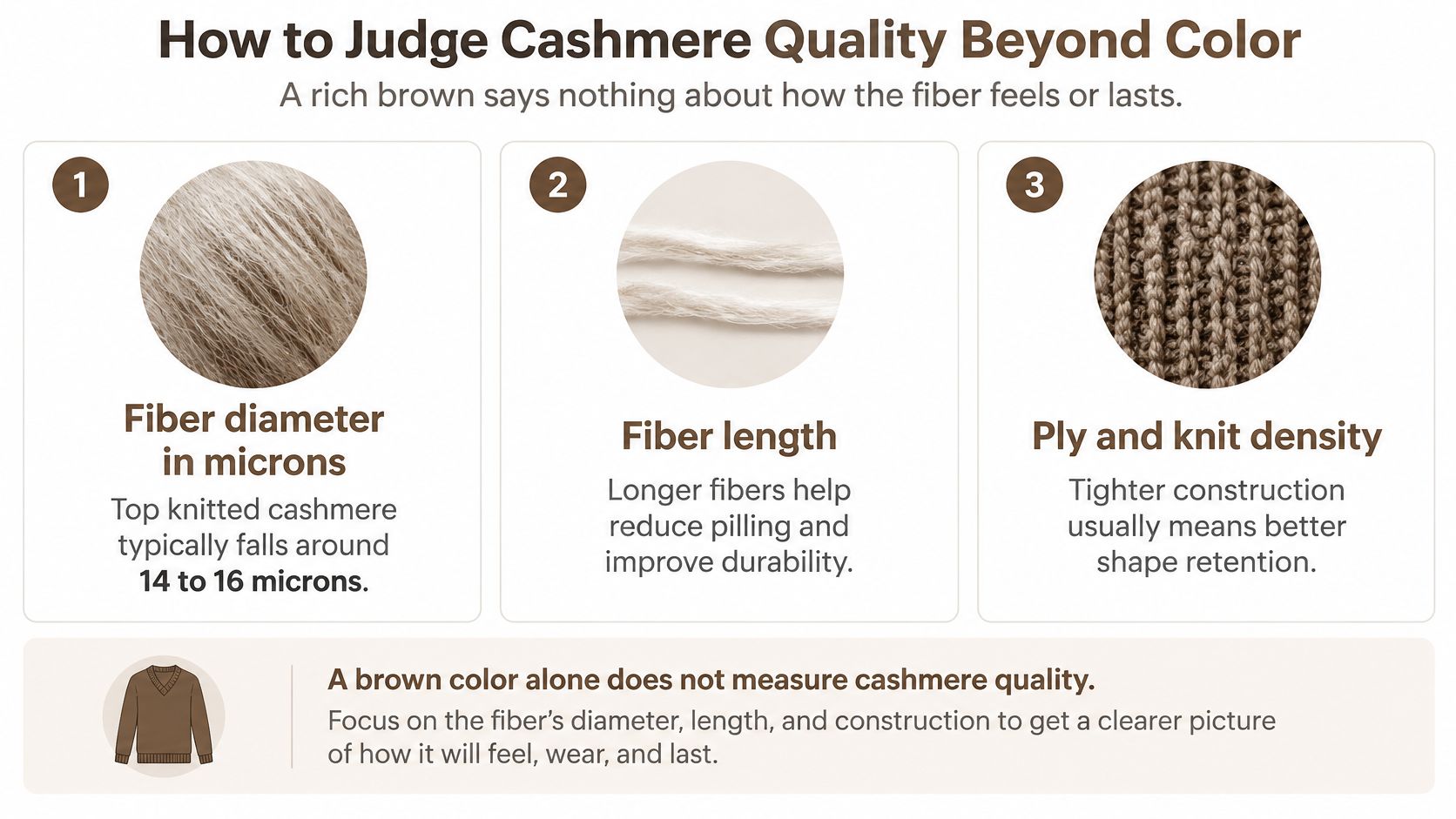
A peer-reviewed cashmere study describes top-quality cashmere for knitted garments at approximately 14–15 microns, identifies fibers below 18 microns and longer than 40 millimeters as commercially suitable for knitting, and reports a Mongolian sample averaging 16.1 microns in diameter and 44.9 millimeters in length.
The practical reading is straightforward: fineness supports softness, but a diameter figure needs context. Don't reject a sweater solely because its stated diameter falls outside the finest category, and don't assume the finest available fiber guarantees the strongest garment.
Length matters because a yarn made with longer fibers has fewer loose ends available to work out of its surface. Ask for a fiber-length specification when comparing expensive sweaters, particularly lightweight styles intended for frequent wear.
The share of coarse fibers also matters. An average can conceal variation, so a supplier specification describing the distribution is more informative than a vague promise of exceptional softness.
Examine the finished knit
Hold the sweater toward the light without stretching it. Look for an even structure rather than unexpectedly thin patches, then inspect the shoulder seams, underarms and joins around the neckline.
Gently stretch a cuff and release it. You want elastic recovery, not a ribbed edge that remains flared, and seams should lie comfortably rather than forming hard ridges against your skin.
Use these questions to read the specification sheet:
- Is the micron figure stated? A measurable specification is more useful than luxury adjectives.
- Is the full fiber composition disclosed? Check every component, including any wool, silk or synthetic fiber.
- Does the description name the knit gauge or explain its construction? Ply describes strands twisted into yarn, not a complete quality score.
Our guide to choosing a high-quality cashmere sweater provides another practical reference when comparing descriptions.
The best everyday sweater balances softness with a stable knit. Don't sacrifice usable construction just to buy the lowest micron figure.
Choose a Brown Shade That Works With Your Wardrobe
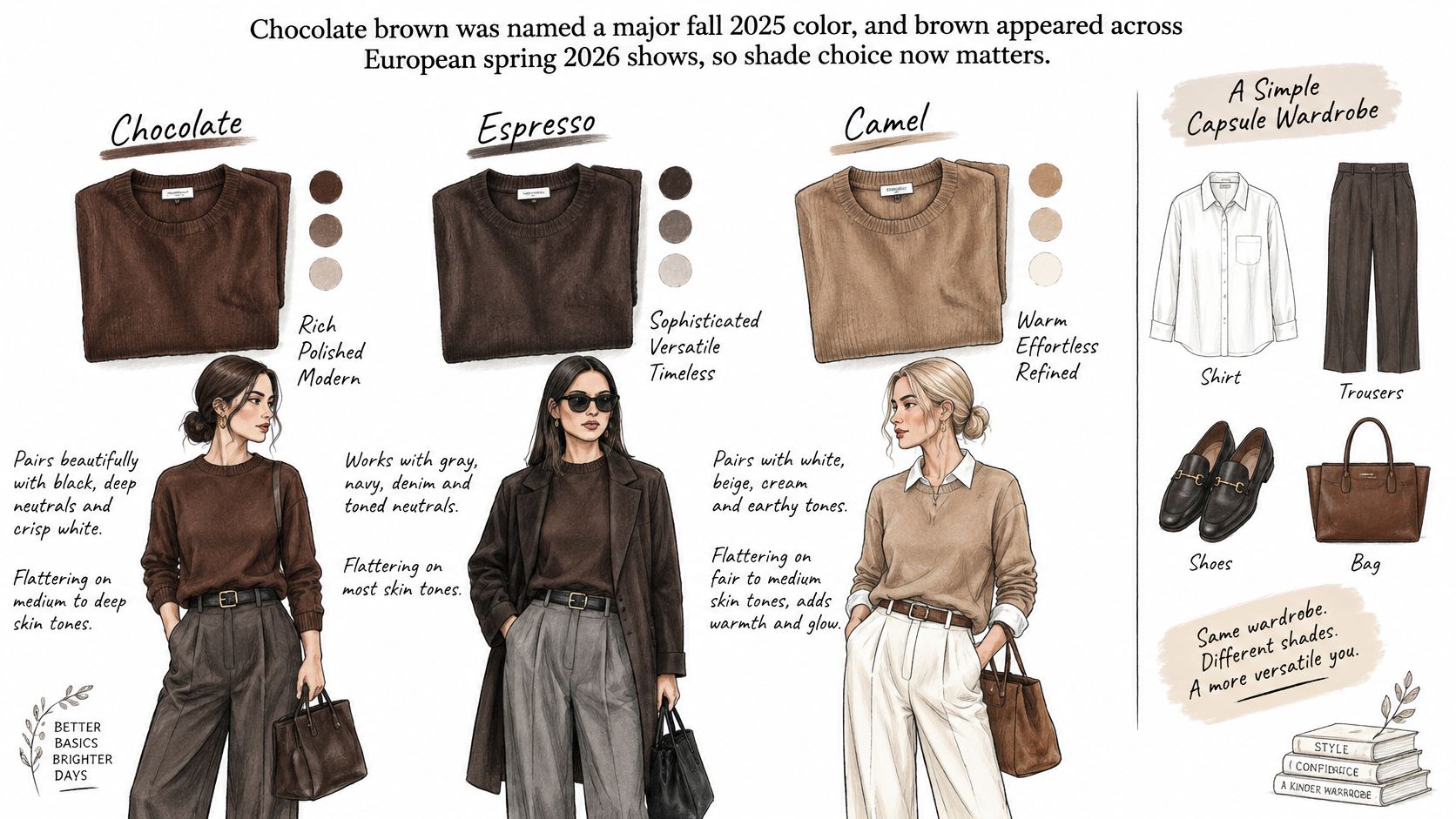
Chocolate brown was identified as a major fall 2025 color, with brown also prominent in European spring 2026 collections, in The New York Times' brown fashion coverage. That makes brown visible, not automatically right for your wardrobe.
Brown shades compared by undertone and pairings
| Shade | Undertone | Pairs best with | Best use |
|---|---|---|---|
| Chocolate | Warm, rich | Cream, navy, camel, denim | Office and winter layering |
| Espresso | Deep, slightly cool | Gray, black, white, dark denim | Minimal wardrobes and evenings |
| Camel | Warm, light | Navy, cream, olive, gray | Everyday wear and travel |
| Taupe | Gray-leaning, soft | Gray, black, white, navy | Cool palettes and minimal looks |
| Cinnamon | Warm, reddish | Olive, denim, cream, black | Fall statement pieces |
| Reddish brown | Warm, high chroma | Black, cream, gray | Accent piece against neutrals |
Treat those shade names as starting points, not standardized color specifications. One brand's chocolate can look redder than another's, and espresso can lean warm despite its near-black depth.
Use undertone and contrast deliberately
Pull out the coat, trousers and shoes you'll wear with the sweater. If your wardrobe centers on charcoal, crisp white and cool navy, begin with taupe or a cooler espresso; if it centers on ivory, olive and tan leather, try chocolate or camel.
Your coloring matters, but don't turn undertone into a rigid personal-color rule. Hold the shade near your face and decide whether you like the effect, especially without makeup or accessories compensating for it.
Contrast makes combinations look intentional. Camel against navy creates a clear distinction, while espresso against black needs enough difference in texture or depth to avoid looking like an accidental mismatch.
For lighter options, our camel-colored sweater guide offers a focused styling reference. Choose cinnamon or reddish brown when you want the sweater to be the accent rather than the background.
Check the actual color
Compare possible shades in daylight, ideally beside an existing garment. Request a swatch when available, or check exchange conditions before ordering an unfamiliar brown.
The same comparison principle appears in Critelli Furniture's online color guidance for design-conscious homeowners: evaluate a color in relation to what surrounds it. For a first brown sweater, choose camel or chocolate; choose espresso when your wardrobe is predominantly dark and minimal.
Brown Cashmere Gifts and Home Pieces That Coordinate
A sweater is the riskiest cashmere gift when you don't know the recipient's size. Start with a scarf, wrap or shawl instead, then choose a color close to something they already wear.
For a colleague or relative, a brown scarf offers warmth without requiring knowledge of shoulder width or preferred sweater length. Hats, gloves and socks can complete a cold-weather gift, but check their sizing rather than assuming every accessory is universal.
Choose by recipient
- A partner or close friend: Buy a crew or V-neck only when you know their preferred fit. Look at the garments they repeat, not the style you wish they'd wear.
- A frequent traveler: Choose a wrap or compact throw that can serve as an extra layer in transit. Consider packed bulk as well as softness.
- A corporate gifting group: Organize by practical budget tiers, with small accessories for broad distribution and wraps or shawls for more substantial gifts.
- A key client: A sweater and coordinating throw can work when sizing and personal preferences are known. Otherwise, a generously sized wrap avoids an awkward fit exchange.
A matching gift doesn't need to be an identical color. A lighter throw beside a darker sweater often looks more considered than a near-match that's visibly wrong.
Coordinate by room
In a living room, compare the throw with upholstery and cushions rather than matching it to a product photograph of the sweater. In a bedroom, decide whether you want a decorative accent or enough coverage for the bed before choosing a blanket.
For an earthy bedroom palette, Tip Top Furniture & Mattresses bedroom tips provide useful context for combining brown and green. Our guide to decorating with cashmere throws can help you think through placement and texture.
Check the actual dimensions, including how much coverage you want around the sides. Before sending any gift, confirm sizing or choose a size-flexible item, match the recipient's existing undertones and include an exchange-friendly gift receipt where available.
How to Wash and Care for Brown Cashmere
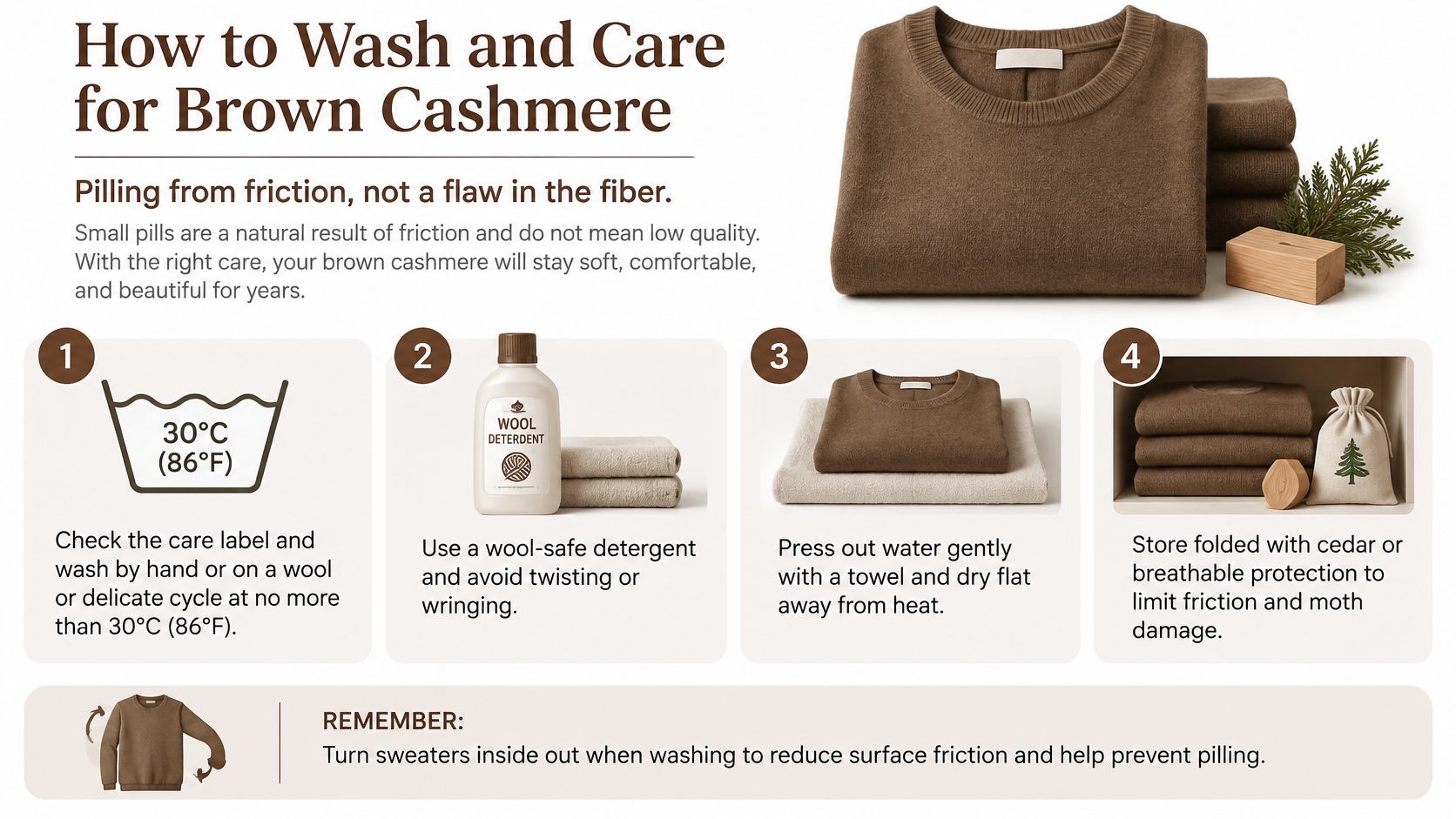
Pilling usually begins with friction, as loose fibers work toward the surface and entangle. It isn't, by itself, proof that a sweater is defective, though persistent heavy pilling deserves closer attention.
Use The White Company's cashmere care guide as a practical reference for gentle cleaning, including washing at no more than 30°C, avoiding wringing and drying flat. The garment's own care instructions take priority when they require a different treatment.
Follow a gentle cleaning routine
- Read the label before wetting the sweater. Hand-wash when permitted, or use an approved wool or delicate machine cycle, turning the garment inside out.
- Use a specialist, non-biological detergent suitable for cashmere. Dissolve it in cool water before adding the sweater so concentrated detergent doesn't sit against the fabric.
- Wash dark brown separately from pale pieces initially. Loose color can transfer, so don't test an unfamiliar dark knit alongside a cream shirt.
- Move the sweater gently through the water, then rinse without scrubbing. Press out water instead of rubbing, twisting or wringing, which can distort the knit.
- Support the wet garment with both hands. Lay it on a clean towel, roll gently to absorb moisture and reshape it to its intended outline.
- Dry flat away from radiators and direct heat. Don't drape the wet sweater over a rail, where its weight can stretch the fabric.
- Comb pills lightly after the sweater is dry. Support the area on a flat surface and use a cashmere comb without digging into the stitches.
- Store clean sweaters folded rather than hung. Use breathable storage and inspect stored knitwear regularly for pest damage.
Reduce rubbing during wear
Look beneath the arms, along the side seams and wherever a bag strap or seat belt touches the sweater. A rough bag edge can repeatedly abrade the same patch, so change how you carry it rather than repeatedly removing the resulting pills.
Maintenance check: Remove pills, then inspect the underlying knit. A tidy surface matters less than whether the fabric beneath it remains sound.
Aim for an even surface, stable seams and the original shape over time. Don't expect permanent freedom from pills, and don't keep combing an area that's becoming thin.
Sustainability Claims and a Pre-Purchase Check
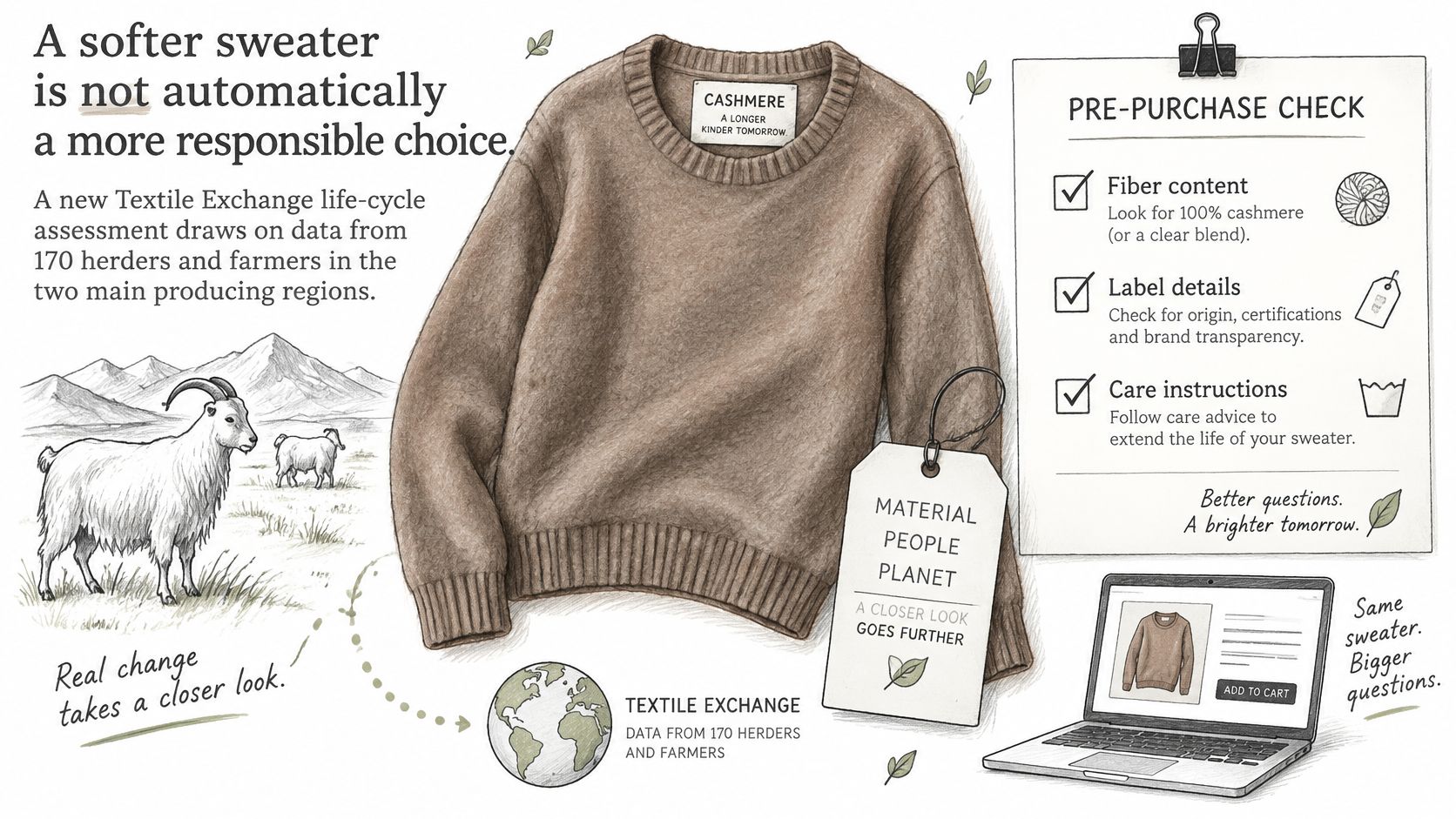
The softest sweater isn't automatically the most responsible purchase. A credible assessment needs to consider sourcing, animal welfare, land management and how long you'll use the garment.
A Textile Exchange cashmere life-cycle assessment, described by Texdata, draws on information from 170 herders and farmers across the leading producing countries and considers soil health, livelihoods and human rights alongside environmental impacts. A pleasant handle or attractive brown color cannot answer those questions.
Common cashmere claims and what to ask for
| Claim | What it tells you | What to ask for |
|---|---|---|
| Grade-A cashmere | A grade description, not sufficient evidence by itself | A stated micron range and fiber-content line |
| Pure cashmere | Fiber content, not origin or ethics | The complete composition label |
| Micron count | Fiber fineness | A supplier specification, not an adjective |
| Sustainable | A broad claim requiring a defined scope | The production stage covered and supporting evidence |
| Recycled cashmere | Some fiber has been recovered for reuse | The recycled percentage and complete blend |
| Certification | A check against a particular standard | Certificate name, scope and validity period |
| Country of origin | A location whose meaning needs clarification | Raw-fiber origin and the processing stages covered |
For a concrete disclosure example, Asket's light-brown recycled-cashmere sweater listing specifies 97% recycled cashmere and 3% recycled wool. That tells you the blend; it doesn't independently settle every environmental or welfare question.
Buy for continued use
Ask whether the sweater can be repaired and whether the retailer provides useful construction and care information. No seller can guarantee your personal years of wear, but repairable seams, a usable fit and a suitable fabric weight give you better reasons to keep it.
Our Women's Pure Cashmere V-Neck Boyfriend Sweater is on sale for $129.00 USD, regularly $259.00 USD, with 5 colors available. Treat the price and color selection as shopping details, not evidence of sourcing or durability.
Before paying, choose the style for your main use, compare the shade with your wardrobe, examine the material specifications and verify any sourcing claims that matter to you. Confirm the fit and make sure you're willing to follow the care routine.
Cashmere Boutique offers women's and men's cashmere sweaters, along with scarves, wraps and home textiles for personal use and gifting. Visit Cashmere Boutique to compare silhouettes and available colors, then choose the brown that works with your wardrobe rather than buying by shade name alone.