
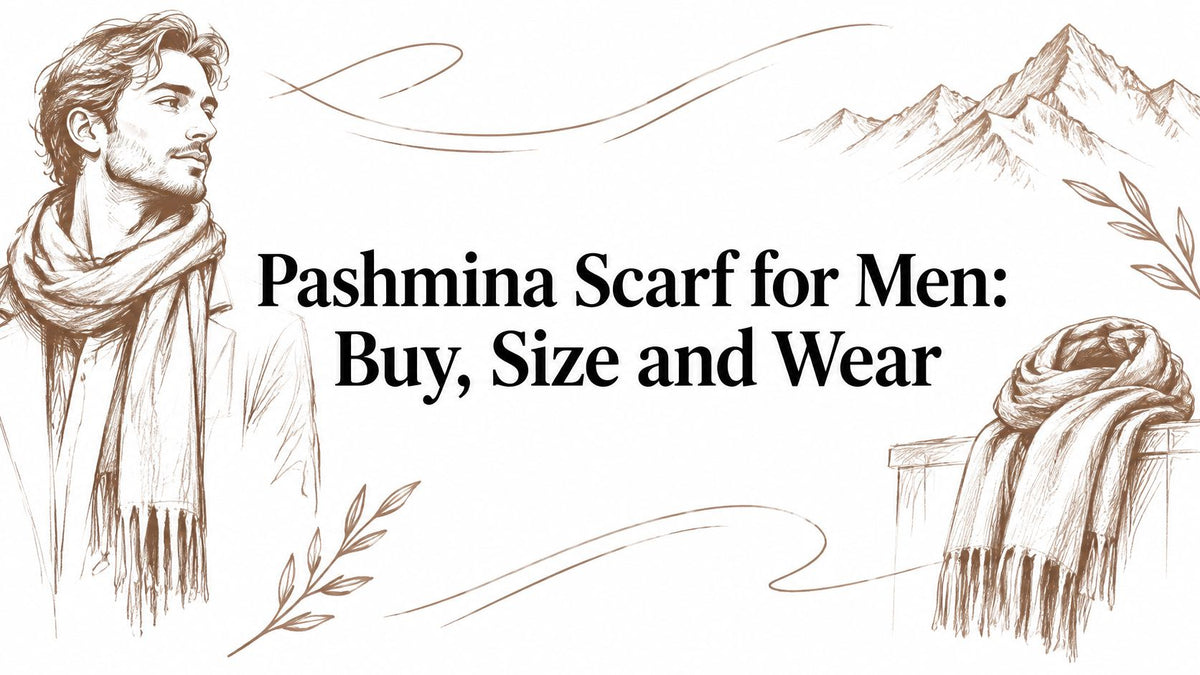
Pashmina Scarf for Men: Buy, Size and Wear
You're standing on a platform or stepping out of an office building, coat buttoned, and the cold still finds the one gap your shirt collar leaves at the throat. A thick muffler would fix it, but it would also bunch under your overcoat and fight your lapels all morning. That's the exact problem a good Pashmina scarf for men solves, if you pick the right weight and length. Pick by the coat and climate you'll face, not by chasing the purest or heaviest cloth in the shop.
Table of Contents
- The Right Men's Pashmina for Each Climate
- Pure Cashmere Versus Silk Blends and Why They Warm Differently
- Checks That Separate Real Pashmina from a Name
- Knots, Colors and Outfits That Work With Menswear
- Care That Protects Softness and Shape
- Order the Row You Picked
The Right Men's Pashmina for Each Climate
Your neck is warm, your collar sits flat, and nothing bulges when you button the coat. That's the test on a cold commute under a wool overcoat. A larger wrap in the shop may feel impressive in your hands, but too much cloth at the throat is useless once you're wearing a suit or a slim topcoat. Start with the decision, then read the labels.
Men's pashmina by climate and outfit
| Use | Fiber and weight | Size to look for | How to wear it |
|---|---|---|---|
| Heated office or mild spring | Pashmina-silk, about 65 to 70% pashmina and 30 to 35% silk, light | About 12 x 60 to 70 in | Loose drape or single loose knot |
| Cold commute | 100% cashmere, denser weave | About 12 to 14 x 70 to 80 in | Once around, ends tucked inside the coat |
| Suit, blazer or topcoat | 100% cashmere, medium weight | Neck scarf, not a 28 x 80 in shawl | Flat Parisian or tucked knot under the lapel |
| Travel or outdoor layer | 100% cashmere wrap | About 28 x 80 in plus short tassels | Over the shoulders under a jacket |
| Gift | Unisex 100% cashmere scarf | Classic neck length | Neutral color, recipient chooses the knot |
Read the Table in One Pass
For heated offices and mild spring days, the light silk blend gives you a finished collar without cooking you indoors. Wear it loose, because a tight knot defeats the point of the lighter cloth. For a cold commute, you want the denser pure cashmere looped once, with both ends fed inside the coat so wind can't lift them.
With a suit, blazer, or topcoat, the same pure fiber needs a medium weight so the knot lies flat under the lapel. A full shawl size is too much fabric at the throat for tailoring. Save that larger wrap for travel and outdoor layering, where it can sit over your shoulders under a jacket, cover your chest on a train, or double as a light blanket. If you're buying a gift, a unisex pure scarf in a neutral that works with navy, grey, and camel removes the guessing about his coat.
Why This Is a Wardrobe Choice, Not a Novelty
This kind of fit-first thinking matters because men are now a stable part of the scarf market, not an afterthought. According to the Dataintelo global scarf market report, men accounted for 25.4% of global scarf-market value in 2025 and the segment is projected to grow at 5.5% annually through 2034. Demand is also moving from purely functional winter use toward menswear and active-lifestyle uses. That is why a sizing guide built around climate and coat is more useful than one built around a style name.
Pick your row first: Climate plus coat decides fiber, weight, and length. The label only confirms the choice after that.
Two related decisions come up often. First, if you like the extra coverage of a travel wrap at home too, our guide to using a cashmere blanket scarf shows where that blanket-scale idea works and where a neck scarf is cleaner. Second, don't confuse a personal, fitted purchase with a volume buy for an event. For event volumes you'd look at something like bulk scarves for cold-weather giveaways from Dirt Cheap Headwear, which is a different job from one scarf chosen to sit under your own coat collar every day.
Choose the row that matches the coat you wear most. Everything else, color, knot, and brand, gets easier once the row is fixed.
Pure Cashmere Versus Silk Blends and Why They Warm Differently
Put the two cloths side by side before you think about styling. One is matte and a little fluffy in the hand. The other feels denser and smoother, with a faint sheen when you turn it under light. They're both sold as pashmina, but they do different jobs for men.
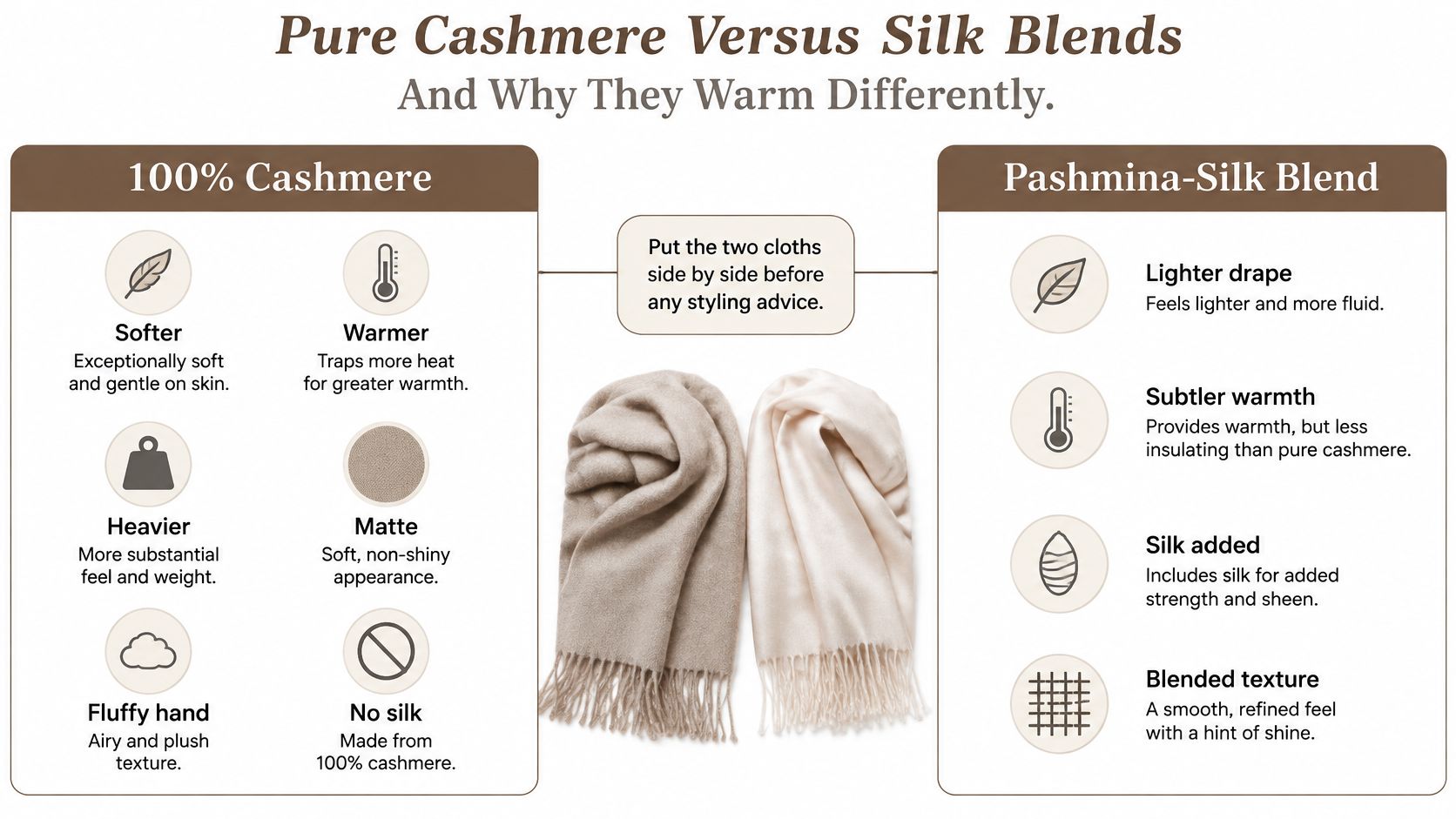
Pure pashmina versus pashmina-silk
| Trait | 100% cashmere pashmina | Pashmina-silk blend |
|---|---|---|
| Typical content | 100% cashmere, no silk | About 65 to 70% pashmina and 30 to 35% silk |
| Hand | Softer and fluffier | Denser, with a light sheen |
| Warmth and weight | Warmer and heavier | Lighter, better for mild weather |
| Weave clue | Matte cashmere yarn | Silk runs the length, cashmere the width |
| Best men's job | Cold commute, medium neck scarf or large wrap | Office, spring and low-bulk layering |
| Risk if mischosen | Bulk at a suit collar if the piece is shawl-sized | Not enough warmth in hard cold |
First, a word that confuses buyers. Pashmina is the Indian/Persian name for cashmere, and there's no difference between pashmina and cashmere as a fiber. The difference in the table is content: pure means cashmere only, while the blend mixes cashmere with silk. In a typical blend, silk runs along the length of the cloth and cashmere runs across the width, which helps explain the denser feel and light sheen.
Warmth Comes From Still Air, Not Thickness
The warmth you feel at your neck doesn't come from thickness alone. It comes from how crimped fibers trap still air in many small pockets close to the skin. Fine fibers pack into a light yarn with lots of those pockets, so the scarf insulates without needing bulk.
As Woolmark explains in its guide to the wool fibre, fiber crimp traps static air and creates a temperature-regulating microclimate next to the body. It also notes that wool fibers can absorb up to 35% of their weight in moisture without feeling wet. On a real commute that matters, because you're warm on the train, then cold on the street, then warm again in the office. The cloth handles a little perspiration vapor without turning clammy against your neck.
Sheen is not warmth. A silk blend can look richer in the hand and still be the cooler cloth.
That air-trapping system has clear limits. A single scarf is not a windproof layer, so it can't replace your coat in hard wind. If the weave is soaked, crushed flat under a tight collar, or woven very openly, the trapped air escapes and the insulation drops. That's why dimensions and weave belong in the same comparison as fiber content. A denser, larger scarf gives more coverage, while a lighter open weave packs smaller for travel and breathes better in spring.
What Micron Actually Tells You
Micron is the diameter of the raw fiber. According to Sustainable Fibre Alliance guidance on what makes cashmere cashmere, cashmere fibers commonly measure about 15 to 19 microns, while some superfine fibers reach approximately 14 microns. Finer fibers bend more readily, so the ends are less likely to press into skin and feel prickly. That's why a fine scarf feels soft directly on the neck even when it's thin.
Finer isn't automatically better for daily wear. Broader fibers generally tolerate abrasion better, while finer fibers prioritize comfort. If you'll wear the scarf under the same coat collar five days a week, you want that soft hand paired with a stable woven structure. An ultra-fine, loosely woven piece can snag on a zipper or wear thin where the collar rubs.
Don't let a micron number stand in for the finished scarf. Micron describes the raw fiber, not the scarf's final warmth, opacity, or resistance to pilling. Yarn construction, weave density, and finishing decide those. For most men, a medium woven scarf built from fiber in that general fine range gives the right balance of low bulk, skin comfort, and practical layering.
The raw material also explains the price and careful handling. Pashmina is the soft underbelly down of the Capra Hircus goat, found at elevations of 14,000 feet and above where winter temperatures rarely rise above minus 30 degrees centigrade. The fiber is collected every spring and spun by hand on a spinning wheel locally known as Charkha. That fine down is what lets a light cloth hold so much still air.
So match the cloth to the job. Choose pure cashmere for cold commutes, a medium neck scarf under a peacoat, or a large wrap for travel. Choose the silk blend for offices, spring evenings, and low-bulk layering under a jacket. And reject any claim that a silk blend is warmer than pure cashmere. The sheen tells you silk is present, not that the cloth holds more warm air.
Checks That Separate Real Pashmina from a Name
The touch test fails almost everyone. A soft scarf can be a blend, a different fiber finished to feel smooth, or genuine cashmere in a loose weave that won't last. The word pashmina on a swing tag tells you even less, because sellers use it as a fiber claim, a regional craft term, and a plain product name. You need to separate those three ideas before you pay.
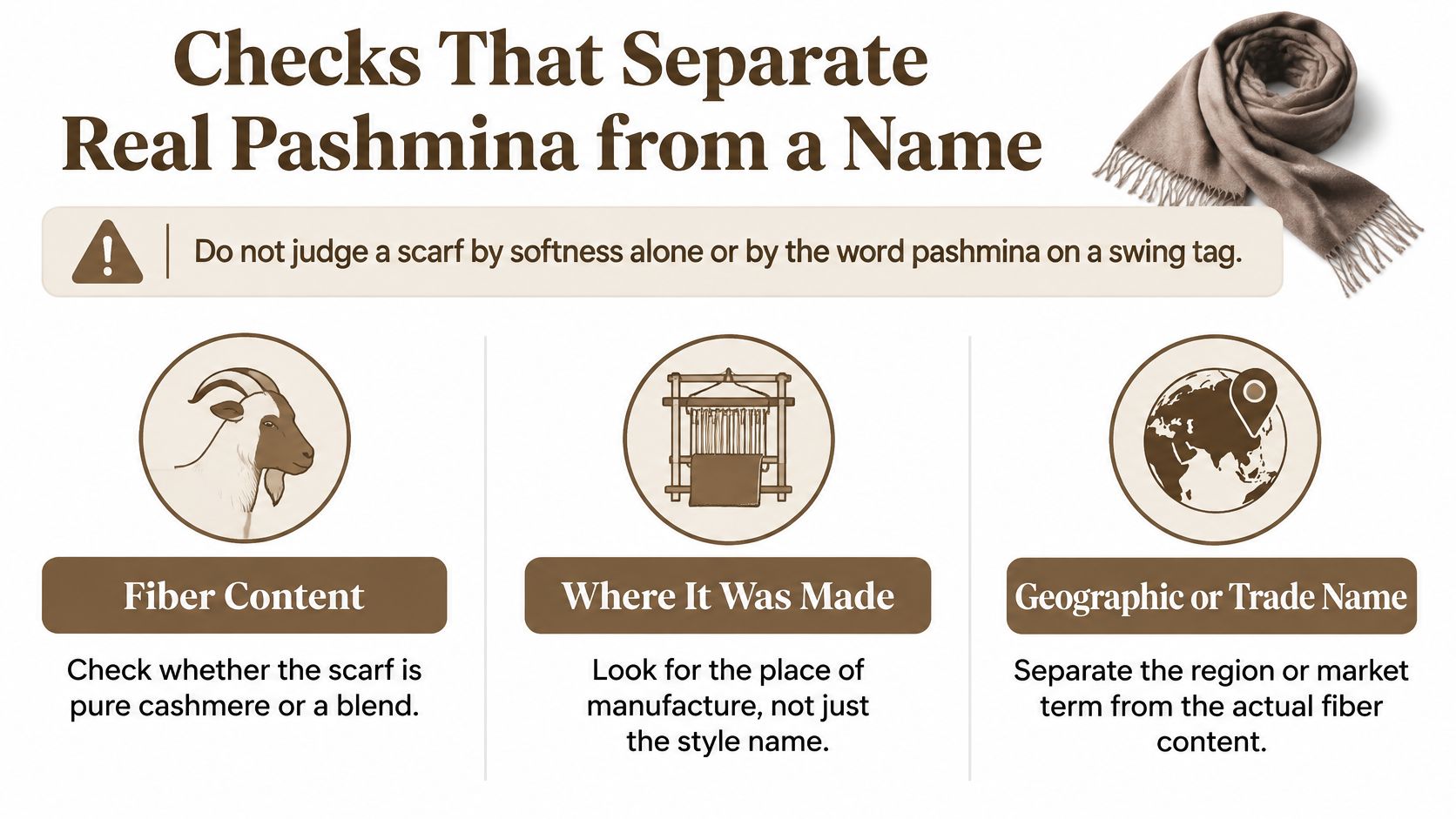
Ask Four Questions in This Order
- Exact fiber percentage: Ask for the number, such as 100% cashmere or a stated cashmere and silk split, rather than accepting a vague luxury blend description.
- Micron range if available: A seller who states a range is describing the raw fiber, which helps you judge next-to-skin softness but doesn't tell you how thick the finished scarf is.
- Country of manufacture: Nepal or India on a handwoven piece tells you where it was made. It's useful context, not proof of purity by itself.
- Independent standard: Ask whether any chain-of-custody or animal-welfare credential applies to that specific product.
Our own pashmina FAQs on styles, fiber and care are published so you can check composition and care notes in writing. If a seller can't state the percentage, you're not comparing products, you're guessing.
Geographic marks need the same careful reading. A geographical indication can support place and production method. It doesn't automatically answer every question about fiber composition or every step in the supply chain. A GI label therefore doesn't replace the fiber percentage when you're comparing pure cashmere with a silk blend.
Traceability marks are worth asking about now, but they work the same way. As reported in Pashmina.com editorial coverage of cashmere and traceability, the Good Cashmere Standard reported more than 1.2 million labeled garments in 2025, with 71 brand and retail partners across 13 countries and a year-on-year partner increase of more than 20%. A standard with that reach is a real question to raise with a seller. It still isn't a blanket guarantee for an unlabeled scarf on a rack.
Craft details can support a claim when they sit beside the numbers. Traditional pashmina shawls are woven on handlooms because pashmina yarn is too fragile for power looms, and that weaving process has been passed down over generations. Look at the ends too. The tassel of a pashmina shawl is hand twisted and knotted, and it takes the weaver a couple of hours to fringe each shawl.
Ask for the percentage first, the place second, and the mark third. Softness comes last.
Knots, Colors and Outfits That Work With Menswear
Cloth decided, now stand in front of the mirror with the coat you own. The knot that looks neat with a peacoat will lump under a blazer, and a color that disappears into charcoal can look sharp against camel. Start with the outfit, not the scarf.
A beige scarf adjusted in a mirror shows the check you should copy: collar flat, ends even, no bunching at the back of the neck.
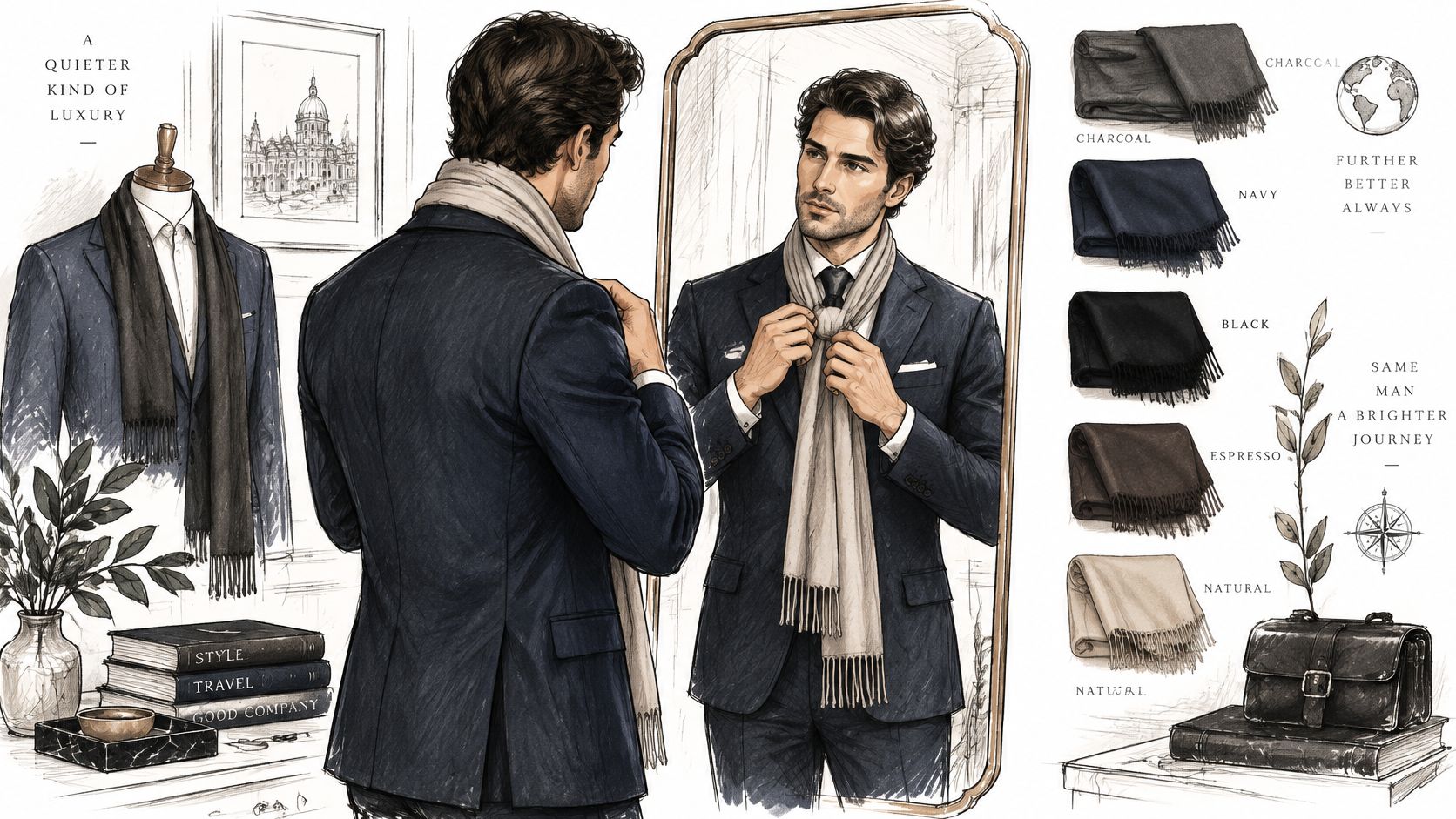
Color by Coat
With a navy or charcoal suit, choose charcoal, navy, black, espresso, or natural. Keep the pattern quiet or solid so it doesn't compete with a tie or a patterned shirt. You're adding texture at the collar, not a second focal point.
Camel, olive, and burgundy belong with tweed, knitwear, and casual coats. They warm up a crew sweater and denim without looking like business dress. If the jacket already has strong texture, such as a heavy tweed or a bold check, keep the scarf solid and let the jacket carry the pattern.
Knot by Coat
For a peacoat on a cold day, use a once-around loop. It closes the gap at the throat and stays put when you walk. Feed the ends inside the coat if the wind picks up.
For a blazer or topcoat, use a flat Parisian knot. Fold the scarf in half, lay the fold at one side of your neck, and bring one end through the loose loop. Flatten it with your hand before you close the coat. The result sits under the lapel without a lump.
For an open overcoat or mild weather, use a simple drape. Set the scarf around your neck and let both ends hang in front. That works especially well with a silk blend, where you want the look of a finished collar rather than maximum insulation. Our notes on how to wear a cashmere scarf cover those base positions if you want to practice the fold once at home.
If you'd rather watch the hand movements once before trying them, this short demonstration helps you see the loop and drape without stopping to re-read steps.
Three Outfits That Show the Choices
Say you're wearing a grey flannel suit and a white shirt for the office. A navy pure scarf in a flat knot gives contrast at the collar and vanishes once the topcoat closes. Nothing fights the tie.
Say it's the weekend, with a camel overcoat over a charcoal crew sweater. An espresso scarf looped once adds depth between the light coat and the dark knit. Leave the loop slightly looser than you would at work, so it reads relaxed rather than sealed against weather.
Say you're traveling in spring with an unstructured jacket. A sage silk-blend scarf, draped with the ends hanging, finishes the jacket without warming you too much in the terminal. When the cabin cools, you can loop it once, then open it again at arrival. If this is a gift rather than your own coat, it's also the moment to think beyond scarves and find premium gifts he'll actually use from Essentia Perfume, so the piece fits his routine instead of sitting in a drawer.
Three mistakes spoil the effect. A thick double wrap under a slim suit pushes the collar up and makes your neck disappear. A long fringe left loose near a zipper gets caught and pulls fine yarn. A bright, busy pattern over a textured jacket makes both pieces look cheaper. Leave tassels free rather than cutting them, since they're part of the hand finish, but keep them inside the coat when you zip or button up.
Name one knot and one color for the coat you wear most. If you can say, flat Parisian in navy with my charcoal topcoat, you're ready to wear it without fussing in the mirror each morning.
Care That Protects Softness and Shape
A fine scarf doesn't need frequent washing. It needs air, flat drying, and protection from rubbing. Each step below prevents a specific kind of damage.
- Air it after wear: Hang the scarf loosely over a chair back for a few hours, then fold it. Spot-clean small marks with a damp cloth instead of washing the whole piece every week, which wears the fibers for no benefit.
- Wash cold and gently: Use cold water and a wool wash, either by hand with a press-and-release motion or on a wool cycle inside a mesh bag. The pressing motion cleans without twisting the yarn out of shape.
- Never wring, rub, or use heat and harsh products: Don't wring or scrub the cloth, and don't use hot water, bleach, or fabric softener. Those flatten and coat the fibers that hold warm air, so the scarf comes back less soft and less insulating.
- Dry flat and reshape: Press water out by rolling the scarf in a clean towel. Then lay it flat away from radiators and direct sun, and straighten the ends so the fringe dries even rather than kinked.
- Store folded, not hanging: Fold the scarf loosely in a drawer or breathable bag. Don't hang a wet or heavy wrap on a hook, because the weight can stretch handloom cloth while it dries or sits.
- Deal with pills and snags quickly: Use a sweater comb or fabric shaver lightly on pills. Keep the scarf away from rough Velcro, bag straps, and jewelry that can catch fine yarn and pull a loop loose.
Silk blends need one extra bit of attention. They can show water spots more readily, so dry them flat and don't leave them damp and bunched inside a coat. Let the blend dry fully before you fold it away.
How often you wash depends on how you wear it. A pashmina that lives under a collar most days picks up little dirt and needs less washing than one used as a travel wrap across seats and shoulders. Judge by odor and visible marks, not by a weekly schedule.
Simple rule: Clean rarely, dry flat, and store folded.
Order the Row You Picked
You've already done the hard part by picking a row. Now match that row to one product and stop comparing everything else.
For the daily neck scarf row, the Pure Cashmere Unisex Scarf is $69.00 USD on sale from $139.00 USD, in 14 colors. It's the classic neck length for commuting and suit coats. For the lighter office and spring row, the Pashmina and Silk Wrap is $109.00 USD on sale from $219.00 USD, in 28 colors.
For the shoulder and travel row, the Pure Pashmina Wrap is $119.00 USD on sale from $239.00 USD, in 17 colors. It's 100% cashmere, 3 ply, 28 by 80 inches with about 3 inches of tassel at each end, and it's made in Nepal. Treat it as the travel and outdoor layer, not the knot for a heated office.
If you're buying a gift and want more than one piece, the unisex pure cashmere scarf, hat and gloves set is $129.00 USD on sale from $259.00 USD, in 8 colors. A neutral from that set works with navy, grey, and camel coats, which covers most winter wardrobes without guessing at a fashion color.
We've been online since 1999 and publish fiber and care notes for each piece, so you can check content before you order. Complimentary continental U.S. shipping and a published returns policy let you check the hand and length at home against your own coat. Choose the scarf before any extra sweater or coat purchase, because the scarf has to fit the collar you already own. Order the row you picked, not the heaviest cloth on the page.
At Cashmere Boutique you'll find pure cashmere scarves in classic neck lengths, lighter pashmina and silk wraps for mild weather, and full-size pure wraps for travel, each listed with its fiber content and care notes. Pick the row that matches your coat and climate, choose a neutral you'll wear weekly, and order that piece first so you can test the hand and length at home.