
How to Wear Cashmere Scarf: 6 Knots and Drapes That Work
You're halfway out the door, your coat is buttoned, and your scarf is bunched under the collar or sliding off one shoulder. The right way to wear it depends less on a complicated knot than on your coat, your bag and how long you'll be outside.
Choose the wrap before you tie the scarf. A loose loop often keeps you warm without crushing the cashmere; a snug double wrap may block more wind, but it also adds pressure and rubbing. The best style is the one that stays comfortable and in place through the day.
Table of Contents
- Choose Your Wrap by Coat, Weather and Scarf Length
- How to Tie the Once-Around and Parisian Loop
- Drapes and Outfit Pairings for Work, Weekends and Evenings
- Protect Cashmere From Friction While You Wear It
- Washing, Resting and Storage
Choose Your Wrap by Coat, Weather and Scarf Length
Two decisions come first: the scarf's length, and what your coat's collar leaves room for. A shorter scarf works best as a once-around or Parisian loop. A longer scarf can take extra wraps, though the added fabric tends to crowd a closed collar. Settle the length fit first, then weigh warmth against how much the wrap rubs.
Check three things before tying: the collar's shape, what you'll carry, and your hours outdoors. A stiff, high collar leaves space for a Parisian loop sitting above it. A shoulder bag or backpack puts a strap over loose ends, so tuck the ends inside your coat or switch to a triangle drape.
| Method | Best coat | Warmth | Friction risk | Best for |
|---|---|---|---|---|
| Once-around wrap | Open coat or light jacket | Medium | Low | Daily commute in mild cold |
| Parisian loop | Coat with a stiff or high collar | Medium to high | Low to medium at the collar | Office days and cold walks |
| Snug double loop | Open coat with no collar | High | High from compression | Windy, very cold spells outdoors |
| Triangle shoulder drape | Any coat, scarf worn over the shoulders | High for a large shawl | Low | Bag-free days and dinners |
| Ends tucked inside coat | Structured or belted coat | Medium | Low | Carrying a shoulder bag or backpack |
| Waist wrap | Over a dress or long knitwear | Low | Low | Styling rather than warmth |
Use the table to weigh trade-offs for your day. The snug double loop gives the most coverage in wind, yet pulling it tight compresses the fibers and presses on one spot for hours. Warmth comes from coverage and trapped air; a loose wrap that stays put usually beats a tight one you keep adjusting. Cashmere Boutique advises keeping cashmere away from rough clothing, metal necklaces, bracelets, belts and rough leather items such as crocodile leather bags, since rubbing causes pilling. A bag strap counts. If it rests on the scarf, tuck the ends away.
Give the layers room, too. When choosing a coat to wear over sweaters or other layers, Cashmere Boutique advises allowing enough room for comfortable movement instead of going by the usual dress size alone. If you're still deciding on outerwear, the guide to men's cashmere coats for warmth and style covers the main silhouettes.
Practical rule: Choose a wrap you can wear loosely for the whole day. A tight knot that feels warm at first may become uncomfortable and rub the same area repeatedly.
Let fabric weight settle close calls. Fine, lightweight cashmere folds neatly into a single loop or Parisian fold. A large shawl has enough surface to cover the shoulders, so let it drape instead of forcing it into a small knot.
How to Tie the Once-Around and Parisian Loop
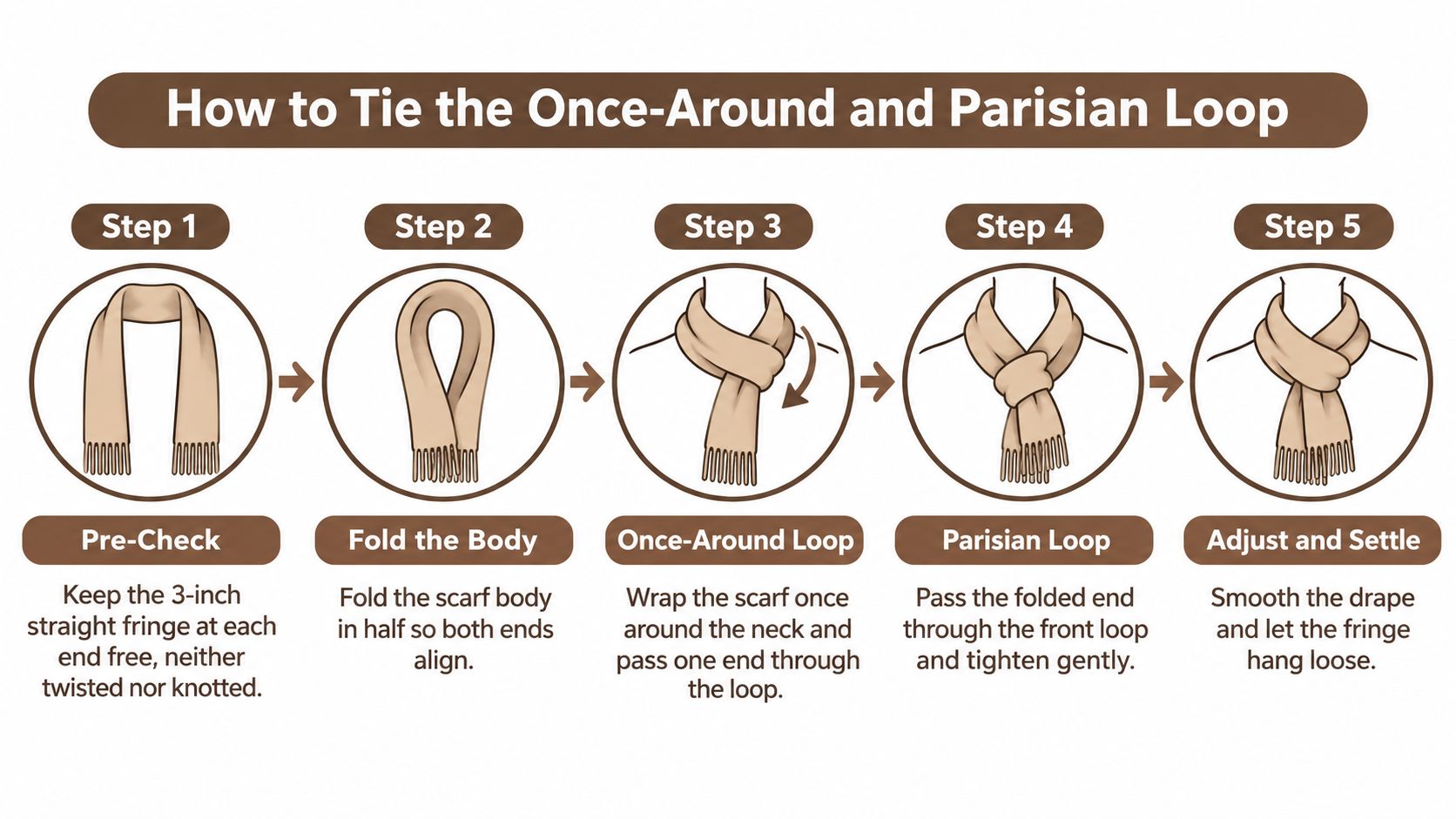
Start at the fringe. Cashmere Boutique's 4-ply cashmere scarves and cashmere plaid scarves have a 3-inch straight fringe at each end, neither twisted nor knotted. Tie the body of the scarf and let the fringe hang free rather than working it into the knot.
Pick the wrap by length first, as noted earlier. Scarves up to about 65 inches suit the once-around and Parisian loop, while scarves up to 72 inches can go three times around the neck. Extra wraps can backfire, because the added fabric bunches under a collar and compresses the loft that holds heat.
| Scarf length | Suited wrap | Note |
|---|---|---|
| Up to about 65 inches | Shorter fashion styling, once-around or Parisian loop | Keep ends short enough to stay off the lapel |
| Up to 72 inches | Three wraps around the neck | Longer scarves turn bulky under a collar |
Once-around wrap
- Drape the scarf behind your neck with one end hanging longer than the other. The longer end does the wrapping.
- Bring the longer end once around your neck and back to the front. Keep the loop broad and flat so the scarf keeps its drape.
- Let both ends fall over your chest and adjust them until they hang roughly even. Loosen the loop until it sits below your throat without pressing on it.
The once-around traps a pocket of warm air at the neck, and only the wrapped section touches your collar. That makes it the gentler option for daily wear under a coat.
Parisian loop
- Fold the scarf lengthwise in half, bringing the ends together. The fold forms the loop, so the fringe never passes through a knot.
- Place the folded scarf around your neck with the loop open on one side. Rest it above the coat collar rather than packing it beneath a stiff one.
- Pass both loose ends through the loop. This anchors the wrap without twisting the scarf into a narrow rope.
- Snug the loop gently below your chin and leave enough slack to turn your head freely.
The Parisian loop sits closer and holds up better in wind, though the doubled fabric adds bulk at the throat. Keep it loose enough that the fold rests on your chest rather than squeezing your neck.
Triangle shoulder drape and waist wrap
For a large shawl, fold it corner to corner into a triangle and drape it over your shoulders with the point down your back. Bring the ends forward and secure them loosely behind your neck, keeping them even so the drape stays put. Nothing wraps the neck, so there is no friction point at the collar at all.
For a waist wrap, set the scarf at your natural waist over a dress or long knitwear and tie the ends loosely at one side. Check that the knot does not pull the garment across your hip.
Common errors: a loop parked directly under your chin, sharply twisted fabric, and loose ends caught under a bag strap all make a scarf slide, bunch or pill where it rubs. After tying, smooth the fabric over your collarbone and check that coat closures are not pressing on one spot.
Drapes and Outfit Pairings for Work, Weekends and Evenings
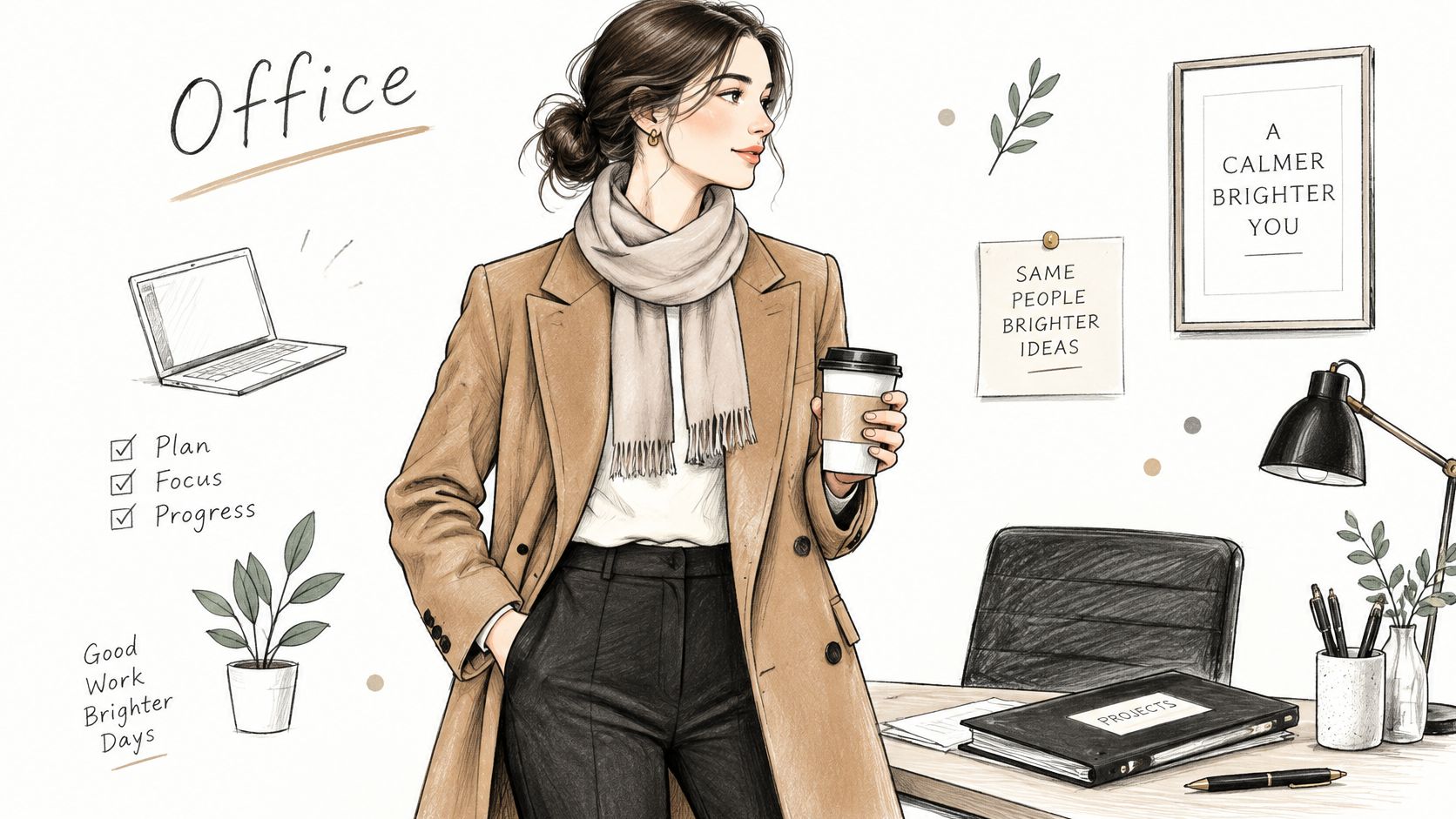
- Office: Pair a structured coat with a fine scarf in a neutral shade, worn once-around or in a Parisian loop. Shorter ends keep the scarf from competing with the lapel, while a close tonal match creates a quiet, polished look.
- Weekend: Wear a looser once-around over an open coat or sweater with jeans. A contrasting shade adds definition; if your knit is chunky, choose a wider scarf because a thin one can disappear against the texture.
- Dinner or evening: Drape a large shawl over the shoulders with the ends falling evenly. The wider shape works well over a simpler outfit and avoids adding a bulky knot at the neck.
- Over a dress: Tie the scarf loosely at the waist like a belt over a dress, coat or long knitwear. This makes the scarf a styling feature rather than a warmth layer.
Cashmere shawls have served as formal layers, and both shoulder drapes and waist ties draw on that versatility (a history of cashmere scarves and shawls). Keep the balance in mind: a heavily layered outfit usually needs a lighter, simpler scarf treatment, while a plain coat can carry a wider shawl or a bolder contrast.
For more ways to wear a wrap over a sweater, suit or coat, explore pashmina shawl styling ideas.
A short video can also help you see how the fabric moves as you tie and adjust it.
Protect Cashmere From Friction While You Wear It
Cashmere pills when loose surface fibres rise and tangle after repeated rubbing. Before you tie the scarf, check where the outfit will press or scrape against it. Cashmere Boutique advises avoiding contact with rough clothing, metal necklaces, bracelets, belts and rough leather items to help prevent pilling.
- Inspect the coat collar, backpack strap, seatbelt, jewellery and anything rough near your neck. A coarse collar or stubble can keep rubbing the same patch.
- Choose a loose once-around or shoulder drape instead of twisting the scarf into a tight rope. Less compression means less repeated rubbing where the layers meet.
- Spread the scarf over a broad area so friction isn't concentrated along one narrow fold.
- Remove it by lifting the loop away from your neck. Dragging the fabric across your skin or collar adds avoidable friction.
- Let the scarf rest before wearing it again. A cashmere-care guide recommends resting garments between wears and removing pills early with a cashmere comb.
| Symptom | Likely cause | Fix |
|---|---|---|
| Pills under the chin | Coarse coat collar or stubble rubbing the same spot | Switch to a loose once-around and comb off pills |
| Pills on one shoulder | Bag strap rubbing the same place repeatedly | Alternate shoulders and use a triangle drape or tuck the ends inside the coat |
| Scarf keeps slipping | Smooth fabric with a single loose wrap | Add a loop or Parisian fold to anchor it |
| Neck feels hot or tight | Double loop pulled too snug | Loosen the second wrap or wear one loop |
| Scratchy feel at the neck | Pilled surface or rough layer underneath | Comb off pills and wear it over a soft knit |
| Ends snag or fray | Caught on a zipper, bag clasp or jewellery | Unhook slowly, and don't pull the fabric taut |
Use the table by finding the symptom, checking the likely cause, then changing the wrap or removing the source of friction. Don't rub, wring or repeatedly cinch the scarf to fix its position. Judge a successful style by whether it stays secure, lets you move your neck freely, keeps its drape and avoids concentrated abrasion.
Washing, Resting and Storage
Give cashmere time off between wears. Cashmere Boutique recommends resting a garment for two to three days after a day's wear; a care guide suggests 24–48 hours between wears. For the full approach, see Cashmere Boutique's care instructions.
Hand-wash gently
- Wash by hand in lukewarm water with a little hair shampoo. Gentle handling reduces agitation on the fibres.
- Rinse with hair conditioner. This follows Cashmere Boutique's home-washing guidance.
- Wash coloured pieces separately to avoid colour transfer.
- Never bleach cashmere. Bleach can damage the fabric.
- Squeeze gently to remove water. Don't twist or wring, because that can distort the scarf.
- Dry it flat, away from direct heat and sunlight. Heat can shrink or dull the fabric's hand.
- After drying, press from the inside with a damp cloth and a cool iron. The cloth helps keep the iron from pressing directly against the surface.
| Task | How often | How to do it |
|---|---|---|
| Rest between wears | After each day of wear | Give it two to three days, with 24–48 hours as the minimum |
| Pill removal | As pills appear | Use a cashmere comb with light strokes in one direction |
| Hand wash | When visibly soiled | Use lukewarm water and hair shampoo, then rinse with hair conditioner |
| Flat drying | After every wash | Lay flat away from direct heat and sunlight |
| Pressing | After drying | Use a damp cloth and cool iron from the inside |
| Summer storage | Seasonally | Fold in tissue inside a sealed, see-through plastic box in a dry closet |
Store the scarf folded or packed in tissue paper or a plastic bag, in a closet away from light, dust and dampness. For summer storage, use a well-sealed, see-through box in a dry place rather than leaving the scarf exposed on a shelf.
Cashmere Boutique offers cashmere and silk scarves, wraps, pashminas, coats, sweaters, accessories and home textiles. Choose a scarf that suits the way you dress and the layers you wear, then visit Cashmere Boutique to explore the collection.