
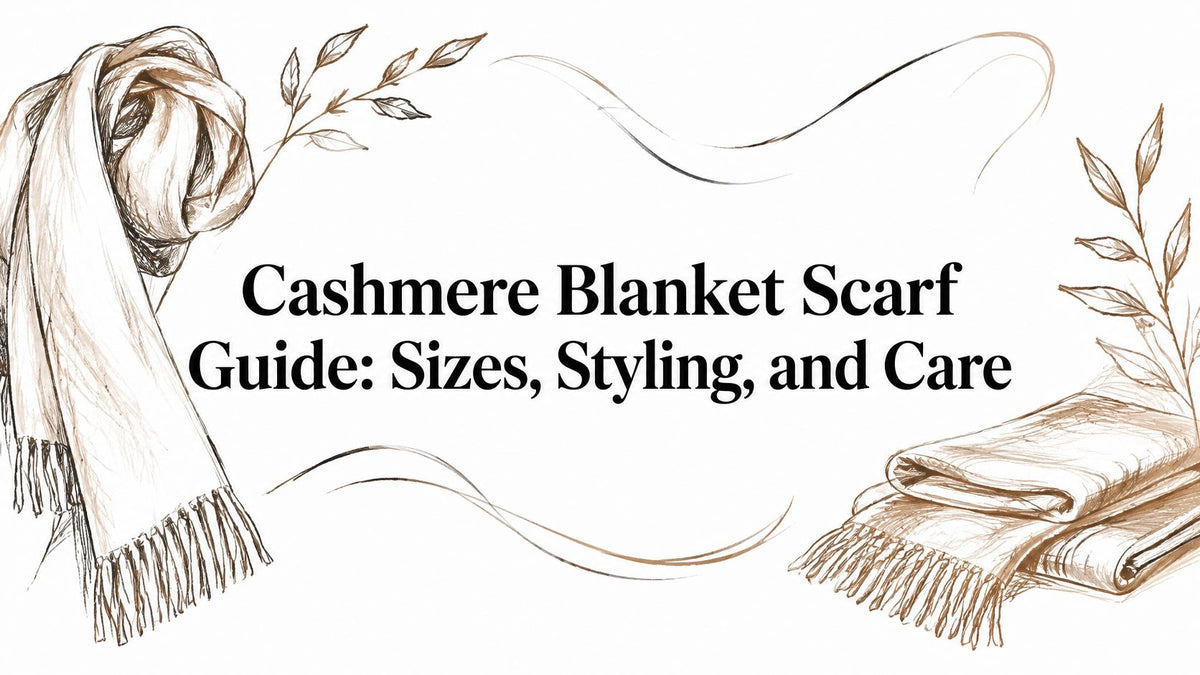
Cashmere Blanket Scarf Guide: Sizes, Styling, and Care
You're standing at the door on a cold morning, coat on, bag over one shoulder, second guessing the thin scarf in your hand. It'll warm your neck on the train, but it won't help in a chilly office, on a flight, or when the temperature drops on the way home. That's the gap a cashmere blanket scarf is meant to fill, and it's also why buying one well matters more than buying one quickly.
Softness is easy to judge in a shop. Durability isn't. This guide walks you through size, fiber, ply, and care in that order, so you can tell whether an oversized scarf will still look good after a season of commuting, travel, and repeated wrapping, or whether it'll pill, stretch, and disappoint you by midwinter.
Table of Contents
- Why a Cashmere Blanket Scarf Earns Its Place
- What Counts as a Blanket Scarf
- Reading Fiber, Ply, and Weight Specifications
- Styling a Blanket Scarf Three Ways
- Choosing Between Pure Cashmere, Blends, and Pashmina
- Caring for a Cashmere Blanket Scarf
- Matching a Blanket Scarf to Travel, Gifting, and Home Use
Why a Cashmere Blanket Scarf Earns Its Place
On that same cold morning, imagine reaching for one large piece instead of three smaller ones. You loop it close for the walk to the station, open it across your shoulders at your desk, and later spread it over your knees on the train home. That single purchase replaces a winter scarf, a shoulder wrap, and a light travel throw, which is the case for the format.
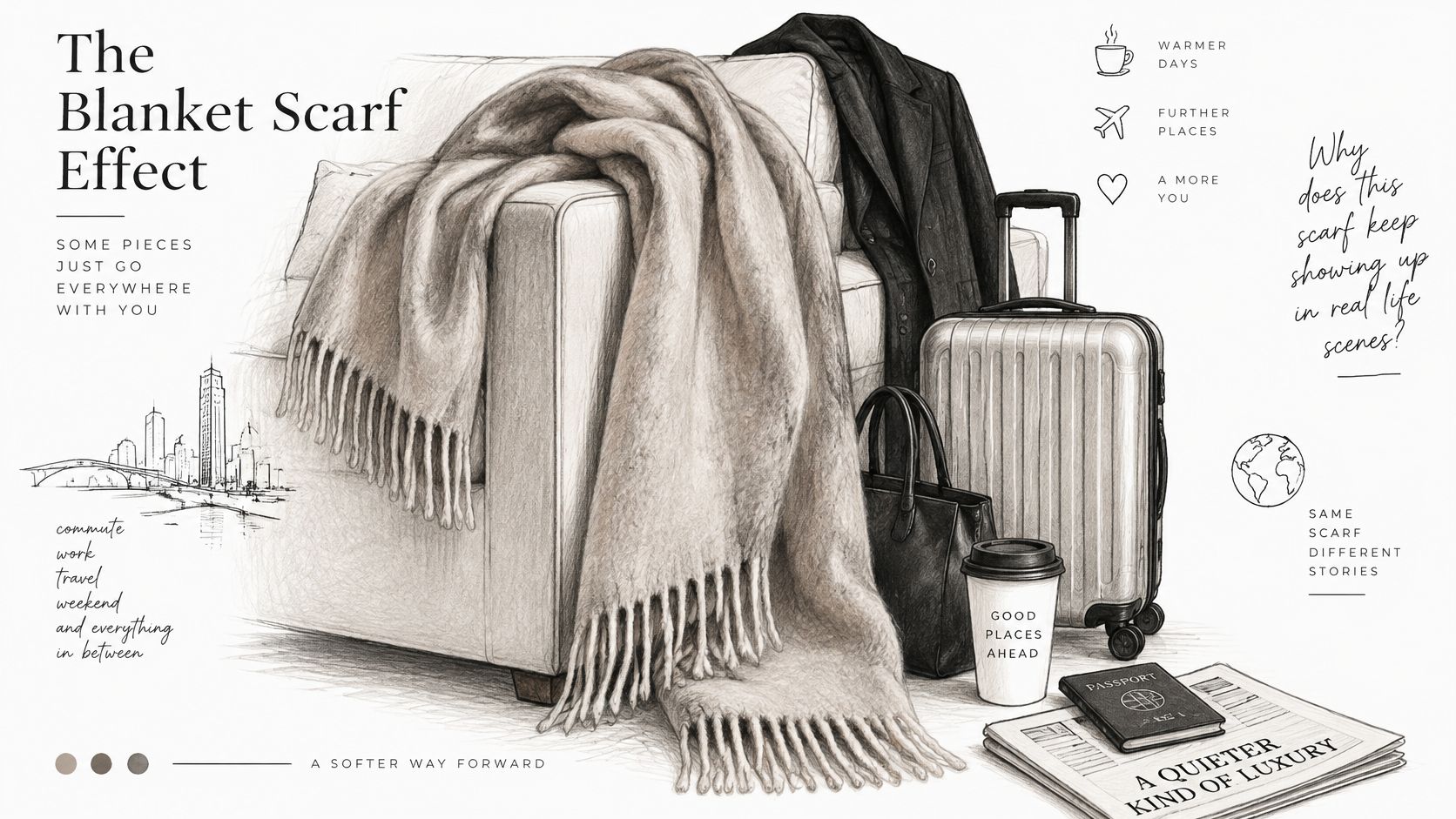
You see these scarves everywhere now, on commuters, in airport photos, draped over sofa arms. Popularity alone doesn't tell you if one suits your life. A blanket scarf earns its place only if you use its size, if its weight matches your climate, and if you're willing to give fine fiber a little more care than you'd give an ordinary wool scarf.
Four Questions Worth Answering First
- How big should it be? Large enough to cover your shoulders without slipping, but not so bulky that you stop wearing it as a scarf.
- How heavy should it feel? Warmth comes from loft and coverage, not weight alone, a point the fiber section below explains in detail.
- What does fiber quality mean? Diameter, length, and construction tell you more than words like luxury or premium.
- How do you keep it looking new? Friction, washing, and storage decide that, long before age does.
There's an honest trade-off to accept at the start. An exceptionally fine, soft scarf can ask for gentler handling, while a slightly sturdier construction may give you better cost per wear if you'll use it daily. Neither choice is wrong. Matching the scarf to your routine is what makes the money well spent.
A blanket scarf is a good buy when one piece does the work of three, and a poor buy when its size or delicacy keeps it folded in a drawer.
What Counts as a Blanket Scarf
Shoppers mix up four terms constantly, and product pages don't always help. The differences aren't about fashion labels. They're about width, length, and what the piece can physically cover.
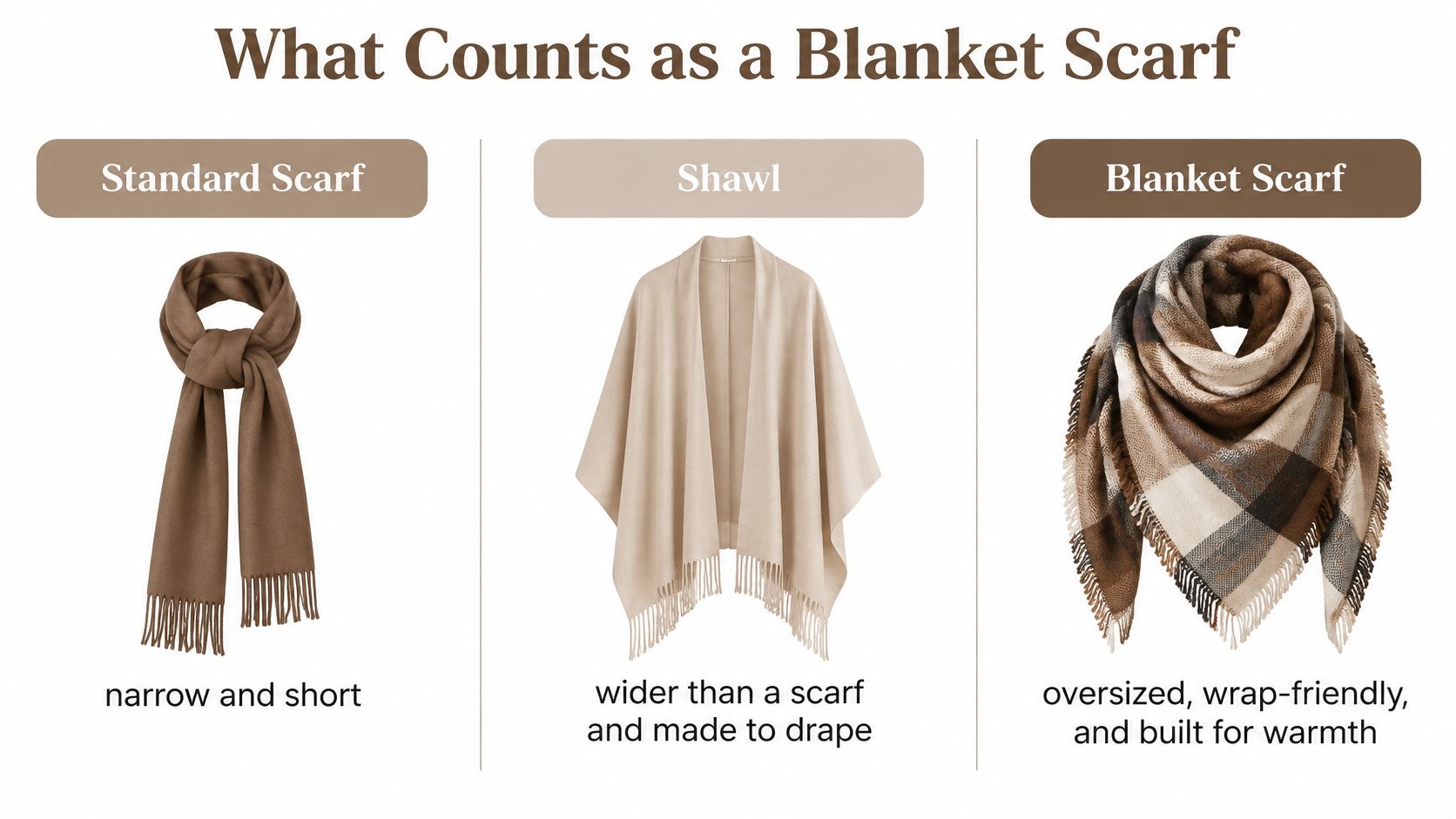
A standard scarf is narrow and relatively short, made to wrap your neck. A shawl is wider, often squarer, made to drape over shoulders and arms. A wrap sits between the two. A throw is sized for furniture and laps at home, not for wearing out of the house. A blanket scarf is the largest wearable format, wide enough for your shoulders and long enough to loop, drape, or belt.
The comparison below gives you a quick visual shortcut for those three wearable formats.
A Simple Test You Can Use on Any Product Page
Ask what the piece covers. If it covers your neck only, it's a scarf, whatever the name says. If it covers your shoulders and upper arms comfortably, you're in shawl or wrap territory. If it does both, and can also cover your lap like a light blanket, it's functioning as a blanket scarf. Dimensions and fabric weight decide this, not the word blanket in the title.
That distinction matters when you're choosing color as well. A piece this large becomes part of an outfit in a way a narrow scarf doesn't, so it's worth thinking about the tones you already wear. If your wardrobe leans warm and muted, you might explore brown toned casual chic for ideas on pairing those shades before you commit to a color you'll see every day.
One more source of confusion is shape. Most blanket scarves are plain rectangles, which is what makes them so flexible. Pieces with armholes, sleeves, or shaped necklines stay in place better but do fewer jobs, because you can't fold or belt them as freely. If versatility is your priority, choose the simple rectangle and learn a few ways to wear it. The styling section covers those configurations.
Reading Fiber, Ply, and Weight Specifications
Adjectives don't predict performance. Specifications do. You need four of them, and they answer different questions.
Fiber diameter is measured in microns and tells you how fine the individual hairs are. The Cashmere and Camel Hair Manufacturers Institute defines cashmere as the dehaired undercoat of the cashmere goat with a mean fiber diameter of no more than 19 microns, and that same definition limits fibers thicker than 30 microns to 3% by weight. Finer fibers bend more easily against skin, so they generally feel less prickly than coarser wool.
Length Matters as Much as Fineness
Staple length, the length of those fibers, is the durability counterpart. Short fibers work loose from yarn more easily, migrate to the surface, and tangle into pills. Longer fibers stay anchored. That's why a softness claim alone can't tell you how a scarf will age.
Pilling puts numbers behind that risk. Typical cashmere pilling sits around grade 2 to 3 on the ISO 12945-2 scale, compared with higher, more resistant grades for cotton and linen, and longer fibers in roughly the 38 to 42 mm range pill less than short-fiber cashmere. Treat those figures as a reminder to ask about length and testing, not as a pass or fail score for one product.
| Specification | What It Measures | Practical Effect |
|---|---|---|
| Fiber diameter | Fineness of each fiber in microns | Softness and prickle against skin |
| Staple length | Length of each fiber | Resistance to pilling and surface wear |
| Ply | Number of yarn strands twisted together | Thickness, warmth, and drape |
| Weave or knit density | How tightly the fabric is constructed | Air volume trapped, stability, and stretch |
| Finishing and edges | Surface treatment and border construction | How the scarf drapes and holds its shape |
Ply describes how many strands are twisted into one yarn. Higher ply generally means a thicker, warmer, less fluid fabric, while lower ply drapes more easily around the neck. Neither is better in the abstract. A commuter who loops a scarf tightly may prefer a lighter construction, while someone buying mainly for shoulder coverage may prefer more body.
Warmth, finally, comes from structure. Fine fibers in a lofty knit or weave trap still air, and that trapped air insulates you. A tightly compressed or very thin fabric can use excellent fiber and still feel cool. Read diameter, length, ply, and density together.
Practical rule: Fiber fineness tells you how a cashmere blanket scarf feels on day one. Staple length, ply, and construction tell you how it'll look after a season of use.
Styling a Blanket Scarf Three Ways
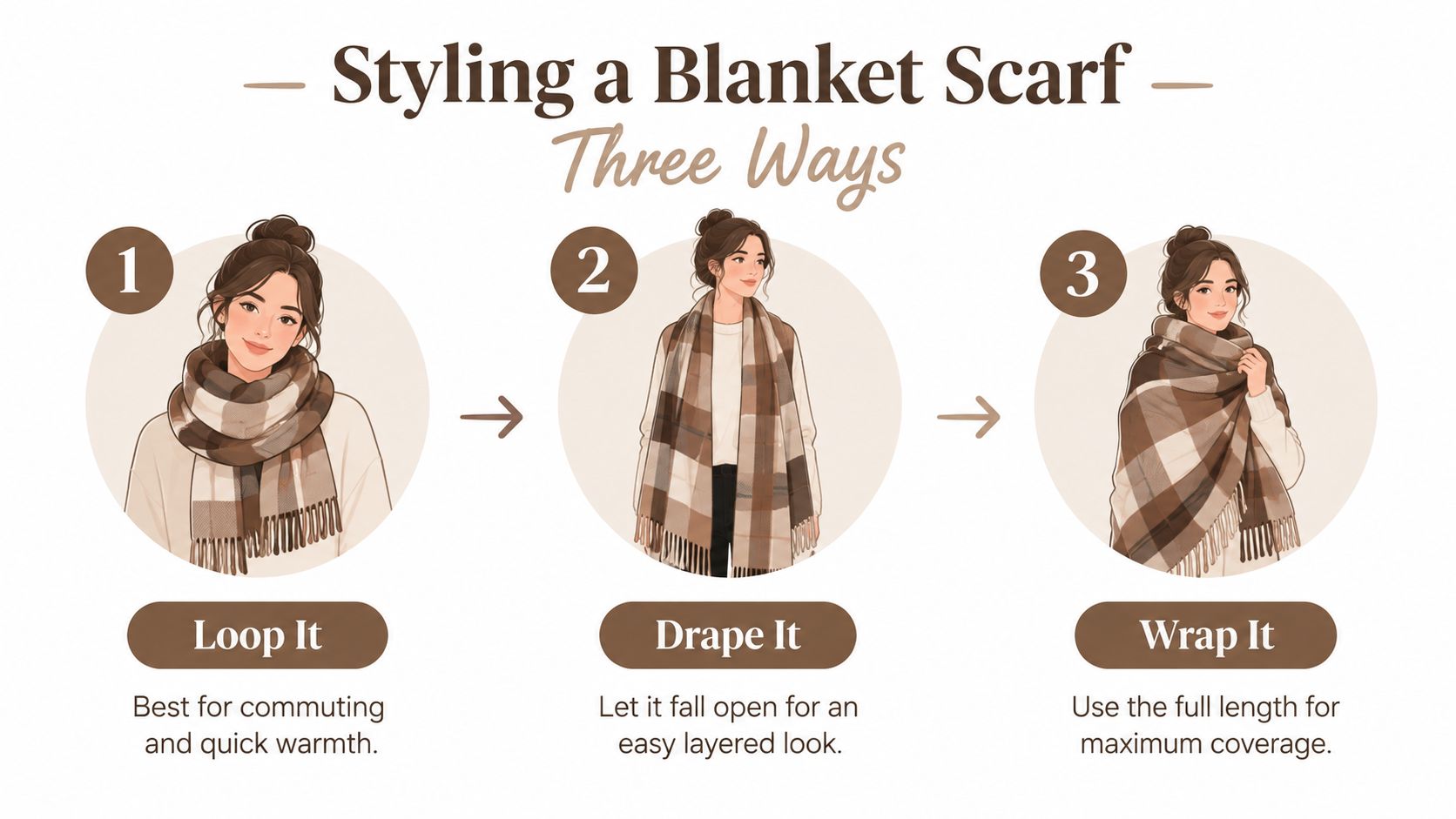
Start with the way you'll wear it most, then check whether the size supports it. Three configurations cover almost everything.
The visual below summarizes the sequence before you work through each one.
The Looped Scarf for Commuting
Fold the scarf lengthwise to reduce width, loop it once, and pull the ends through or let them hang inside your coat. This is the warmest neck configuration and the most secure in wind. It needs length more than width, and it works best with a fabric that isn't so thick that it bunches under your chin. If you commute daily, this is also the highest friction use, because collars and straps rub the same area each time.
The Shoulder Wrap for Offices and Evenings
Open the scarf fully and settle it across your shoulders, letting the ends fall in front. Width does the work here. A wrap that's too narrow slides off and needs constant adjusting, which is the complaint people have when they buy a standard scarf and expect it to behave like a shawl. A little weight helps it stay put, and a clean edge or short fringe keeps the line tidy over a dress or sweater.
The Belted Drape Over a Coat
Drape the scarf open over a coat or dress and belt it at the waist, poncho style. This needs generous width and a squarer proportion, so the fabric covers your arms instead of hanging in two narrow panels. It reads as an intentional layer rather than an accessory, and it's useful when you want warmth without another bulky garment underneath.
This short video shows how those folds and drapes look in motion, which is easier to follow than written steps alone.
The fourth use needs no styling at all. Spread flat, the same piece becomes a travel throw on a plane, a lap layer in a car, or an extra covering in a hotel room. If travel is your main reason for buying, prioritize full coverage and a weight that packs without filling your bag.
Choosing Between Pure Cashmere, Blends, and Pashmina
Don't start with the most expensive option. Start with how you'll use the scarf, because each material handles friction, drape, and care differently.
The chart below sets the three choices side by side so you can compare trade-offs at a glance.
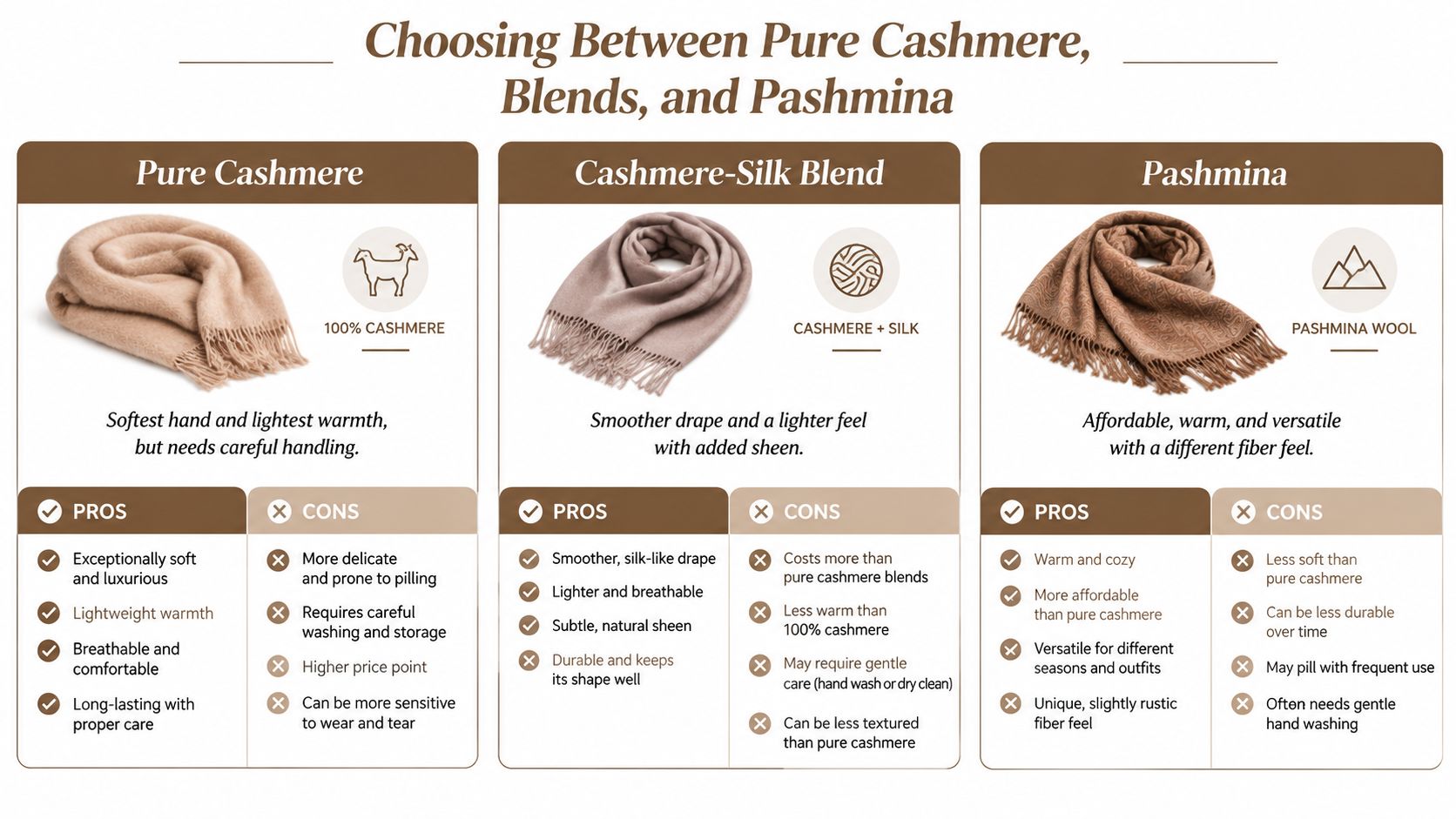
Pure cashmere gives you the softest hand and light warmth for its weight. It also asks the most of you. Daily contact with rough coats, bag straps, and seat belts will show on the surface sooner than it would on a sturdier textile, so pure cashmere suits buyers who'll rotate how they wear it and follow the care routine in the next section.
Cashmere and silk blends feel smoother, show a gentle sheen, and often hold a draped shape a little more crisply. That makes a blend a sensible choice if you mostly want a shoulder wrap or an evening layer and care about how the fabric falls. You give up some of the matte, lofty character of pure cashmere, and you gain a more polished surface.
Pashmina needs a word of explanation, because the term is used loosely. Historically, it belongs to fine shawls made from cashmere goat fiber in the Kashmir tradition, and annual cashmere production represents less than 0.01% of the world textile market, with China and Mongolia together accounting for roughly 60 to 70% of global production. Today, many products labeled pashmina describe a style of wrap rather than a verified fiber, so check the composition list instead of trusting the name. If you're drawn to that format, these reasons to add a pashmina shawl to your wardrobe cover how people use one day to day.
Whatever the label, read the micron figure in context. A fiber described as approximately 14 to 15.5 microns falls well inside the recognized cashmere range, but softness and durability still depend on fiber length, dehairing, yarn construction, weave, and finishing. A number confirms the fiber category. It doesn't guarantee thickness, warmth, or how the finished scarf was made.
Sustainability claims need the same care. Recent industry reporting describes a widely accessible cashmere life-cycle assessment using primary data from 170 herders and farmers across major producing regions, which points toward measured farm-level data rather than vague natural claims. Natural, handmade, Grade-A, and country of origin are not interchangeable environmental certifications. Separate animal welfare, land pressure, traceability, and longevity, and remember that keeping one versatile scarf in use for years is itself part of the footprint calculation.
Caring for a Cashmere Blanket Scarf
A large scarf is a high friction accessory. It rubs against coat collars, shoulder straps, seat belts, and rough upholstery, and that contact, repeated in the same spots, is what ages it. Care starts with reducing that friction, not with washing.
Reduce Wear Before It Shows
- Rotate the fold: Change which section sits at your neck and under straps, so one area doesn't take every rub.
- Mind hardware: Keep the fabric away from rough bag fittings, exposed zips, and abrasive outerwear where you can.
- Comb, don't pull: Lift pills with a cashmere comb laid flat. Pulling by hand tears out longer fibers and thins the fabric.
Don't panic about early surface fuzz. New cashmere often sheds a light halo in the first wears as loose short fibers leave the yarn. Persistent pilling is different, with tight balls returning in the same friction zones after combing. Specialist guidance links higher pilling to fibers shorter than 34 mm and to rubbing, wringing, hot water, and harsh detergent during washing, which is why handling matters as much as fiber grade.
Wash Gently and Dry Flat
Cashmere fibers have an elliptical cross section, lack a medullary canal, and carry approximately 60 to 80 scales per millimeter on the surface, a structure that supports a soft hand and a lofty fabric that traps still air. Water conducts heat far more effectively than still air, so a damp scarf loses insulating performance until it dries. Wash only when needed, in cool water with gentle detergent, following our care instructions for the specific piece. Don't wring it. Press water out, roll it in a clean towel, then dry it flat away from direct heat so the rectangle keeps its shape.
Fold for storage instead of hanging, because a heavy, damp or even dry knit can stretch under its own weight on a hanger. Keep it clean before storing, and let it rest between wears when possible. Frequent users should comb lightly and often, occasional wearers should focus on clean, folded storage, and travelers should air the scarf after each trip before putting it away.
Most damage happens in small, repeated moments, a strap rubbing here, a hurried wash there. Slow those moments down and the scarf lasts.
Matching a Blanket Scarf to Travel, Gifting, and Home Use
Your main use should settle the last decisions, because each situation rewards a different combination of size, material, and care commitment.
For travel, choose coverage first and packability second. You want a piece that loops as a scarf in transit, opens as a wrap in cold cabins and air-conditioned rooms, and spreads as a throw at your destination. Accept the care reality too. If hand washing on a trip sounds unlikely, plan to air the scarf during travel and wash it properly at home.
For gifting, think about the recipient's climate, wardrobe colors, and willingness to care for fine fiber. A versatile neutral in a generous format is easier to use than a delicate statement piece, and presentation matters because the scarf should feel considered, not generic. The same principle applies to other personal gifts, and if you're pairing items, this guide on how to make candle gifts feel more personal shows how small, specific choices change how a gift is received.
For home use, be honest about whether you want a wearable piece or furniture textile. If it'll live on a sofa, a larger throw format serves you better, and these ideas for how to decorate your home with our luxury cashmere throws help you match size and color to a room.
A Short Decision Checklist
- Daily commuting: Prioritize staple length, stable construction, and a fold you can rotate.
- Travel: Prioritize full shoulder and lap coverage at a weight you'll carry.
- Evenings and offices: Prioritize width, drape, and an edge finish that looks tidy worn open.
- Gifting: Prioritize a versatile color and a care level the recipient will realistically maintain.
Ply can help you choose a format once you've chosen a use. Cashmere Boutique products are offered in 2 ply for hats, gloves, and socks, 3 ply for shawls, wraps, and ponchos, 3 and 4 ply for scarves, robes, throws, sweaters, and cardigans, and 4 ply for blankets and overcoats, across collections that include scarves, shawls, pashmina wraps, travel accessories, throws, and blankets for women and men. Use that kind of mapping to compare like with like instead of comparing a light wrap with a heavy blanket and wondering why they feel different.
If you're ready to choose a cashmere blanket scarf based on size, ply, and intended use rather than softness alone, browse the scarves, wraps, throws, and blankets at Cashmere Boutique and compare the formats side by side. Pick the construction that matches your commute, your travels, or your home, and you'll own one piece you'll reach for constantly instead of three you use occasionally.