
Cashmere Shawl Collar Cardigan Fit and Style Guide
You're heading out on a cool morning, then going straight from the commute to dinner. A jacket feels too formal indoors, but a thin sweater won't keep your neck comfortable outside. A cashmere shawl collar cardigan can bridge that gap, provided its collar feels good against the skin, sits smoothly under a coat, and still looks composed when you take the coat off.
That wide, folded neckline is the feature people see and touch first. To choose well, look beyond the softness in a product description: fiber fineness affects how the collar feels, while yarn stability, fit, and care influence how it holds up to repeated layering.
Table of Contents
- Why a Cashmere Shawl Collar Cardigan Belongs in the Wardrobe
- What the Shawl Collar Adds to a Cashmere Cardigan
- How to Judge Cashmere Quality Beyond the Label
- Fitting and Layering with Robes and Coats
- Styling Looks from Casual Days to Dressy Evenings
- Caring for the Collar So It Stays Polished
- Choosing a Cardigan and Taking the Next Step
Why a Cashmere Shawl Collar Cardigan Belongs in the Wardrobe
On the way to work, you leave the cardigan open under a coat. Later, you take the coat off for dinner, fasten a button, and the same knit looks finished without needing a tie, blouse, or structured jacket. That kind of quiet versatility is the appeal: the collar frames the face, adds warmth around the neck, and gives a simple outfit a clear focal point.
Cashmere's light feel helps make this silhouette useful across changing settings. The collar has more presence than a crewneck, but it needn't feel like a heavy wool jacket. It can sit open like a soft scarf, close around the neck for comfort, or relax at home over lighter clothes.
Why the fiber's origin matters
Cashmere is a small, geographically concentrated part of the fiber supply, one reason cashmere garments are positioned as luxury knitwear. A 2020 review estimates annual raw-cashmere production at nearly 8,000 metric tons, with China accounting for more than 70% of output and Mongolia contributing about 20%. The figures vary depending on whether an estimate counts raw fiber or cleaned, dehaired cashmere, so those stages shouldn't be treated as interchangeable. (Review of cashmere production and processing)
The same review describes a later industry assessment in which production reached 25,611 tons of greasy fiber in 2023, while cashmere remained about 0.02% of global fiber production. That combination of limited supply and concentrated sourcing makes provenance worth asking about, but an origin label alone doesn't tell you how the cardigan feels or wears.
Before choosing a piece, check whether its description identifies the fiber as pure cashmere or a blend, and whether a stated weight refers to raw or finished material. Those details make comparisons clearer. They also help you decide whether the collar's texture, structure, and role in your wardrobe justify the premium.
What the Shawl Collar Adds to a Cashmere Cardigan
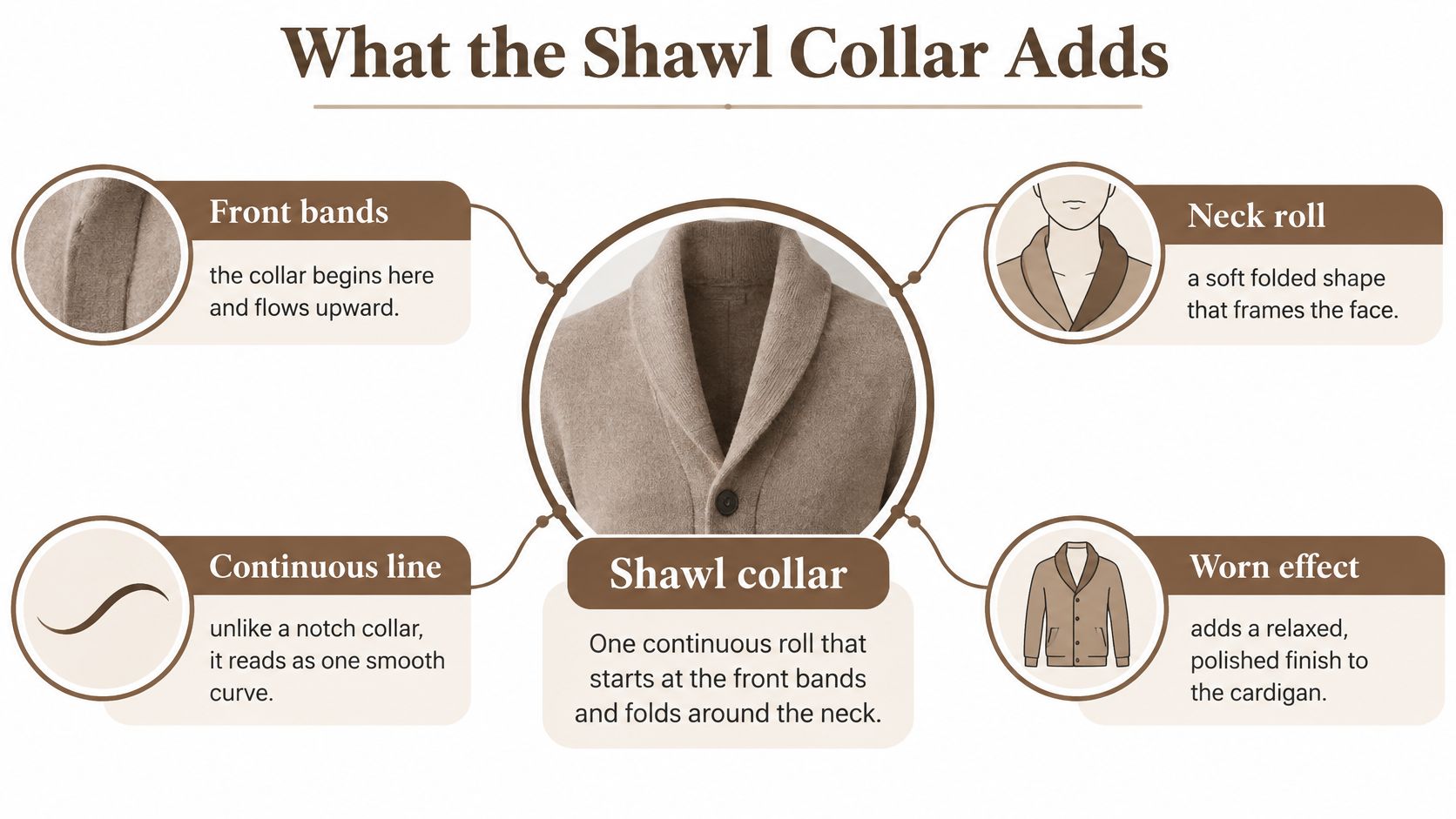
A shawl collar is a continuous fold that starts at the front bands and rolls around the neck. Unlike a notched lapel, it has no sharp break in the line; unlike a crewneck, it leaves a wider frame around the face. Think of it as a soft edge built into the cardigan, rather than a separate, stiff jacket collar.
Read the roll, not just the label
The roll can sit open, creating a relaxed scarf-like shape, or fold closer to the neck for more coverage. A well-made collar should look intentional both ways. When the cardigan is fastened, its two front sides should still meet neatly rather than pulling the collar out of shape.
Fineness matters here because the collar rests against the neck and is prominent in the garment. The Food and Agriculture Organization reports that Chinese cashmere commonly measures 12.5–16.0 microns, with 15.5 microns regarded as a standard benchmark. Mongolian cashmere is generally about 16.0–17.5 microns and often longer, while fibers from Iran and Afghanistan are typically about 17–21 microns. International textile guidance commonly places cashmere's upper limit at 19 microns. (FAO guidance on cashmere fiber)
Those comparisons help explain why a finer collar can feel smooth against the skin and still be knitted into a dense, insulating shape without the bulk of coarser animal hair. But the micron figure doesn't describe the whole garment. Fiber length, color, cleanliness, dehairing, yarn construction, and finishing also affect how the collar drapes and whether stray fibers irritate the neck.
When you inspect a cardigan, let your hand and eye move along the neckline. Look for a consistent roll, an even knit, and a front edge that falls smoothly instead of twisting or standing away from the body. That close look tells you more about the collar's everyday comfort than a style name by itself.
How to Judge Cashmere Quality Beyond the Label
A grade name can offer a starting point, but it isn't a complete quality guarantee. For the softness of a cashmere shawl collar cardigan, fiber fineness is an important technical measure: research identifies about 14–19 microns as an appropriate average diameter for processed cashmere. It also identifies fibers below about 18 microns and longer than 40 mm as commercially suitable for knitted garments. (Research on cashmere fiber properties)
A stated 14–15.5-micron range is finer than the 17–18-micron fibers more commonly used in woven systems. That points toward a softer handle and a lower risk of skin irritation, particularly around the neck. For a broader explanation of what to consider beyond a grade label, see this guide to choosing a high-quality cashmere sweater.
Ask what the specification leaves out
Micron diameter doesn't tell you how long the fibers are, how uniform their thickness is, or how well the yarn holds together. Staple length, variation in diameter, elasticity, strength, and crimp can all affect the cardigan's feel and its ability to keep a clean surface through wear. A fine average is less useful if the fiber composition or yarn preparation isn't clear.
Blending in coarse guard hair can also undermine comfort, even when a fine micron claim sounds impressive. Ask for the average micron range and the fiber composition, then look for information about construction and care. A grade or number should help set expectations, not replace those checks.
Make the choice with your neck and eyes
Try the collar directly against your neck if you can. Does it feel smooth, or does it prickle? Does the knit look even around the fold? Is the fiber statement clear about what's in the garment? Those are practical checks you can use before color and price take over the decision.
A premium cardigan should make its specifications understandable. If a seller provides only a broad grade label without describing composition or care, you have less information for judging comfort and wear. The aim isn't to chase the lowest micron figure, but to match the fiber, construction, and finish to how often and where you'll wear the cardigan.
Fitting and Layering with Robes and Coats
A shawl collar needs room to roll, but the cardigan shouldn't swim around the shoulders. Check that the shoulder seams sit at your shoulder points, sleeves cover the wrists without swallowing your hands, and the body fastens without tugging at the buttons. Then try it open and closed. The collar should remain even, rather than standing away from your chest or collapsing into a bulky rope.
| Pairing | What the collar should do | Fit check |
|---|---|---|
| Cashmere robe | Sit as a lighter inner layer without crowding the robe's own neckline. | The combined collars should lie flat, with no thick ridge at the neck. |
| Coat or topcoat | Show a soft neckline finish while fitting inside the coat's lapels. | Fasten or open the coat and check that the collar isn't trapped in hard folds. |
| Worn on its own | Frame the face and hang comfortably whether open or buttoned. | Check the shoulder line, sleeve length, and smooth fall of the front bands. |
Choose the layer by its job
Under a cashmere robe, the cardigan works best as a light, comfortable layer for home or travel. If both pieces have substantial shawl collars, too much fabric can bunch around the neck. A slimmer knit reduces that crowding and makes the robe easier to wear open or belted.
Under a coat, the collar becomes more visible when you remove your outer layer. Check that it settles inside the coat without being crushed or folded sharply against the lapel. A guide to cashmere coats for warmth and style can help you think about the coat as part of the pairing, not as an afterthought.
Fit also affects friction. If the front edges gape or the collar shifts constantly, you may keep adjusting it and rubbing the same areas. Belts, shoulder bags, and seat belts can press against the cardigan, too. Choose a fit that leaves comfortable chest ease while keeping the knit stable enough to move with you.
Styling Looks from Casual Days to Dressy Evenings
A casual version is easy to repeat: wear the cardigan with dark denim or straight trousers, a simple inner knit or fine shirt, and a flat leather or suede shoe. Leave the collar open so it reads like a soft scarf. Keep other details around the neck quiet, allowing the roll to stand out.
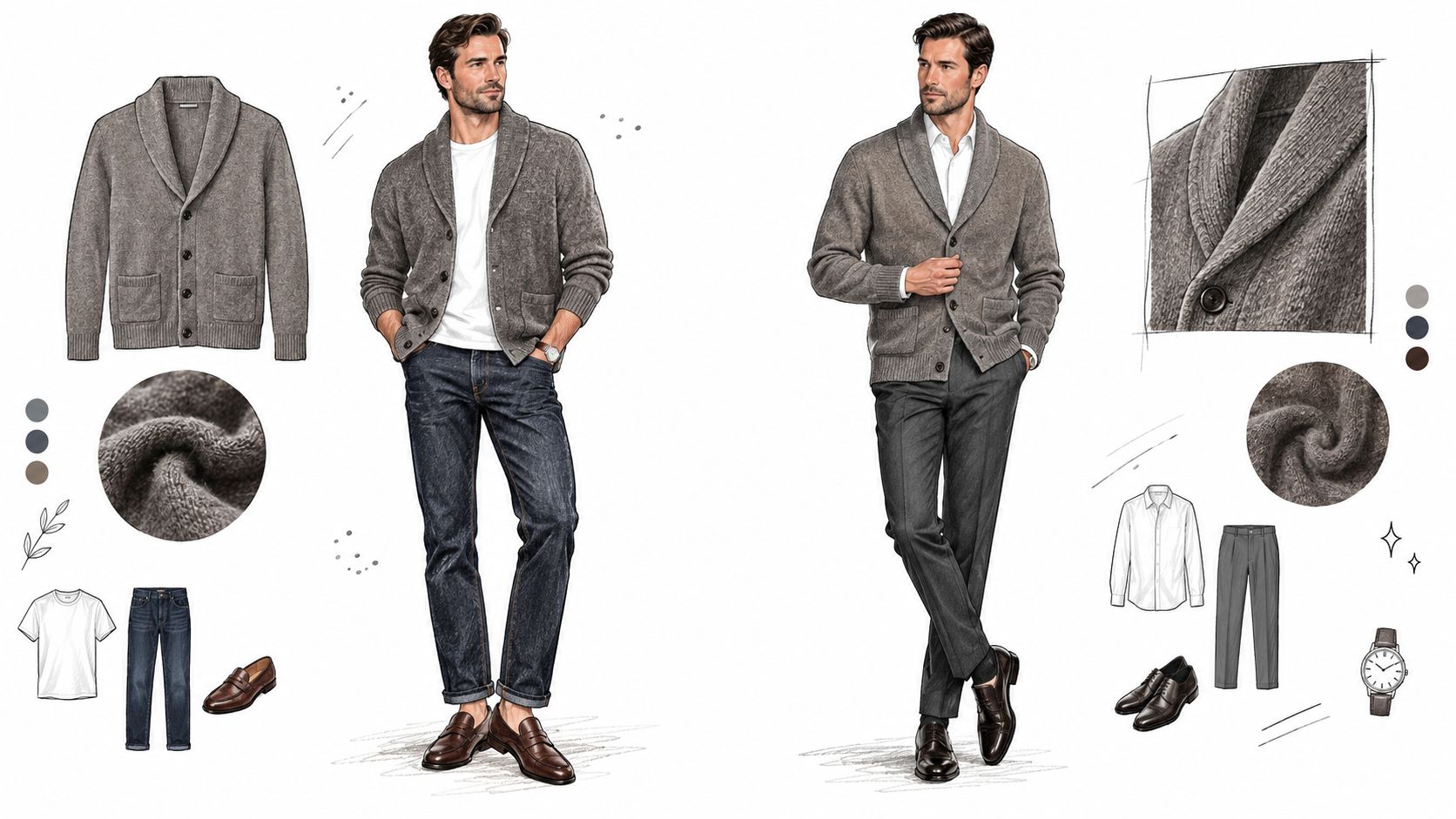
For a dressier evening, keep the cardigan but change what sits underneath it. Try it over a slip dress, a silk blouse, or sleek trousers with a fine shirt. Fold the collar closer to the neck, then add a restrained piece of jewelry if you like. The outfit feels different because the neckline and the fabric underneath have changed, not because the cardigan has to become formalwear.
Use contrast without crowding the neckline
The same principle works for men. A collared shirt gives the cardigan a composed finish for a weekend meal; beneath a sport coat, it can suit a setting that feels formal without calling for black tie. Choose a shirt collar that sits cleanly inside the shawl roll, and avoid adding a bulky scarf unless the weather calls for it.
Cashmere's lightness makes the cardigan useful when a day moves between chilly outdoor air, office air-conditioning, and a dinner room. It can provide warmth without automatically requiring another jacket indoors. For another way to add a soft layer, consider how a pashmina shawl can fit into a wardrobe, while keeping the cardigan's neckline as the main feature.
A simple rule helps both outfits: let one soft layer frame the neck, and keep the rest of the look from competing with it. That keeps the collar from feeling crowded and makes the cardigan look considered rather than over-styled.
The following video offers another visual look at wearing a shawl-collar cardigan.
Caring for the Collar So It Stays Polished
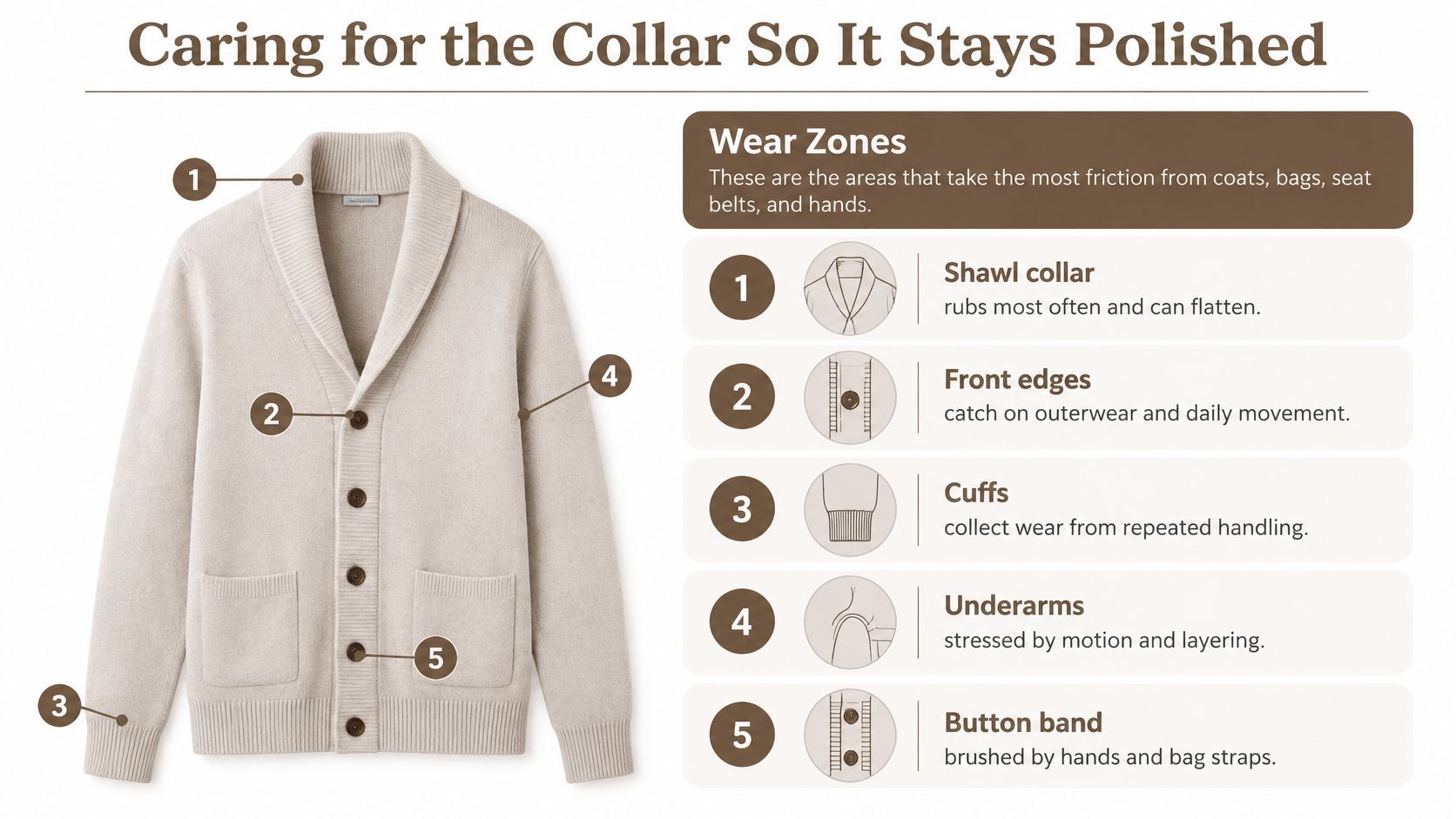
A shawl collar earns its keep at the neckline, which is also where wear shows first. Coats, bag straps, seat belts, and repeated smoothing all rub the same curved edge, so judge the collar as a high-friction, highly visible construction rather than by a grade or origin claim alone. Early fuzz does not prove poor make; fiber fineness, staple length, yarn stability, knit density, layering, and care all shape what the surface does next.
Research links pilling in cashmere especially to fibers shorter than about 7.5 mm. Short fibers can work free from the yarn and tangle on the surface under rubbing. Longer, more uniform fibers and a compact, even knit can help hold the surface together, while heavy brushing may leave extra loose fibers available to pill. (Textile research on cashmere pilling)
Wash gently and protect the roll
Water, detergent, and agitation can change a knit's dimensions, so keep washing infrequent and movement low. Use a gentle detergent, press out excess water without twisting, and dry the cardigan flat while shaping the collar back into its roll. Avoid hanging a wet cardigan, since the added water weight can pull the shoulders and neckline out of position.
Practical rule: Use a cashmere comb lightly to remove pills. Pulling them by hand can draw more fibers out of the yarn.
Check the spots that take friction
After regular wear, inspect five places: the collar roll, front edges, cuffs, underarms, and button band. These areas show whether the surface is staying calm and whether the shape is holding under your robe, coat, or bag strap. If you carry a shoulder bag, shift it from time to time, and rotate knits so the same section is not rubbed every day.
A little early fuzz can be normal. A collar that stops holding its roll, or front edges that twist after drying, points to construction, fit, or care rather than something a comb can fix.
Choosing a Cardigan and Taking the Next Step
A higher price or a Grade-A label doesn't automatically mean a cardigan has a lighter environmental footprint. A recent life-cycle assessment found no significant climate-impact difference between nomadic and farmed cashmere production when measured per kilogram of clean, dehaired fiber. It also identified primary production as the largest contributor across climate change, water use, ecotoxicity, and land-use indicators. (Cashmere life-cycle assessment summary)
Instead of treating a label or country of origin as proof, ask what the seller can substantiate. Look for information on fiber traceability, herd or grazing management, recycled content when claimed, expected durability, and repair or resale options. A well-chosen cardigan that stays in rotation can be a more thoughtful purchase than a series of replacements.
Match the garment to your actual wardrobe
Before buying, use the questions below to keep the decision grounded in how you'll wear the piece:
- Fiber: Is the micron range stated, and does the product say whether it's pure cashmere or a blend?
- Construction: Does the collar roll evenly, and does the knit look compact and consistent?
- Fit: Can you button it without pulling, and will the collar sit comfortably under your robe or coat?
- Care: Can you follow the care guidance, and do you have a suitable place to dry it flat?
- Sourcing: Can the seller explain traceability and production practices beyond a grade or origin label?
Then consider what the cardigan needs to do. If it's mainly for home, prioritize an easy layer under a robe. If you'll wear it under outerwear, check the neckline with your coat and pay attention to friction from straps and fastenings. Comfort at the collar, stable construction, and clear product information matter more than an impressive-sounding label on its own.
Cashmere Boutique offers cashmere cardigans alongside robes, coats, wraps, and scarves, with product details, size charts, and care information to support your choice. Visit Cashmere Boutique to compare a shawl-collar cardigan with the robe or coat you plan to wear it with, check the fiber and fit details, and choose the pairing that suits your daily routine.