
Brushed Cashmere Sweater Guide: Process, Feel, and Care
You're standing in front of a sweater rack, reaching past smooth knits toward the softest one. Its surface has a gentle fuzzy halo, and it feels almost cloudlike under your fingertips. The label says “brushed cashmere,” but that doesn't tell you whether the softness comes from finer fiber, a finishing step, or both.
That distinction matters when you're deciding what to buy and how to care for it. A brushed finish changes a sweater's surface, not the identity or quality of the fiber underneath. Knowing what that means can help you choose between a soft, relaxed look and a cleaner, more structured knit, and tell normal surface change from a problem.
Texture can be easier to understand when you compare how different fabrics feel and look. The Sofa Cover Crafter's fabric tips offer useful context for noticing texture in everyday textiles. For cashmere, the key is to separate the fiber's natural fineness from the finish added during manufacturing.
Table of Contents
- What a Brushed Cashmere Sweater Actually Feels Like
- What Brushing Means in Cashmere
- How a Brushed Cashmere Sweater Is Made
- Brushed vs Unbrushed Cashmere
- How a Brushed Sweater Wears Over Time
- Caring for a Brushed Cashmere Sweater
- Buying a Brushed Sweater You Will Still Love Next Year
What a Brushed Cashmere Sweater Actually Feels Like
A brushed cashmere sweater often feels softer and airier at first touch than a compact, unbrushed knit. Its surface looks slightly hazy rather than sharply defined, as if a fine layer of fibers has been lifted over the stitches. That raised texture gives the garment a relaxed, cozy character, but it doesn't tell you by itself how fine or durable the cashmere is.
Think of the difference between a smooth stone and one covered in soft moss. The underlying shape is still there, but the surface changes the way it feels in your hand. Brushing does something similar to knitwear: it brings loose fiber ends to the surface, creating a soft halo that you can see and feel.
What your fingers can and can't tell you
The first touch is useful, but it can be misleading. Softness may come from the fine fibers themselves, from the brushed finish, or from a combination of the two. A very fuzzy surface isn't proof that a sweater uses finer cashmere, and a smoother surface isn't proof of poorer quality.
Look closely as well as touching. An intentional brushed nap usually appears fairly even across the garment. Pills, by contrast, are small tangles or balls of fibers that often gather where fabric rubs against itself or another surface.
A useful first check: Ask whether the softness feels like an even surface finish or whether it comes from small, irregular tangles.
A brushed knit may feel especially inviting against bare skin, but it has a more open-looking surface than a compact sweater. That quality can be part of its appeal, and it also means you'll want realistic expectations about friction and maintenance. The finish is a design choice, not a promise that the sweater will stay looking exactly the same with wear.
What Brushing Means in Cashmere
Brushing is a mechanical finishing step. A tool moves across the knitted fabric and lifts some fiber ends from the yarn, creating a raised, fuzzy surface. Picture a soft brush traveling across a velvet ribbon in one direction: the underlying material stays the same, but its surface takes on a more visible nap.
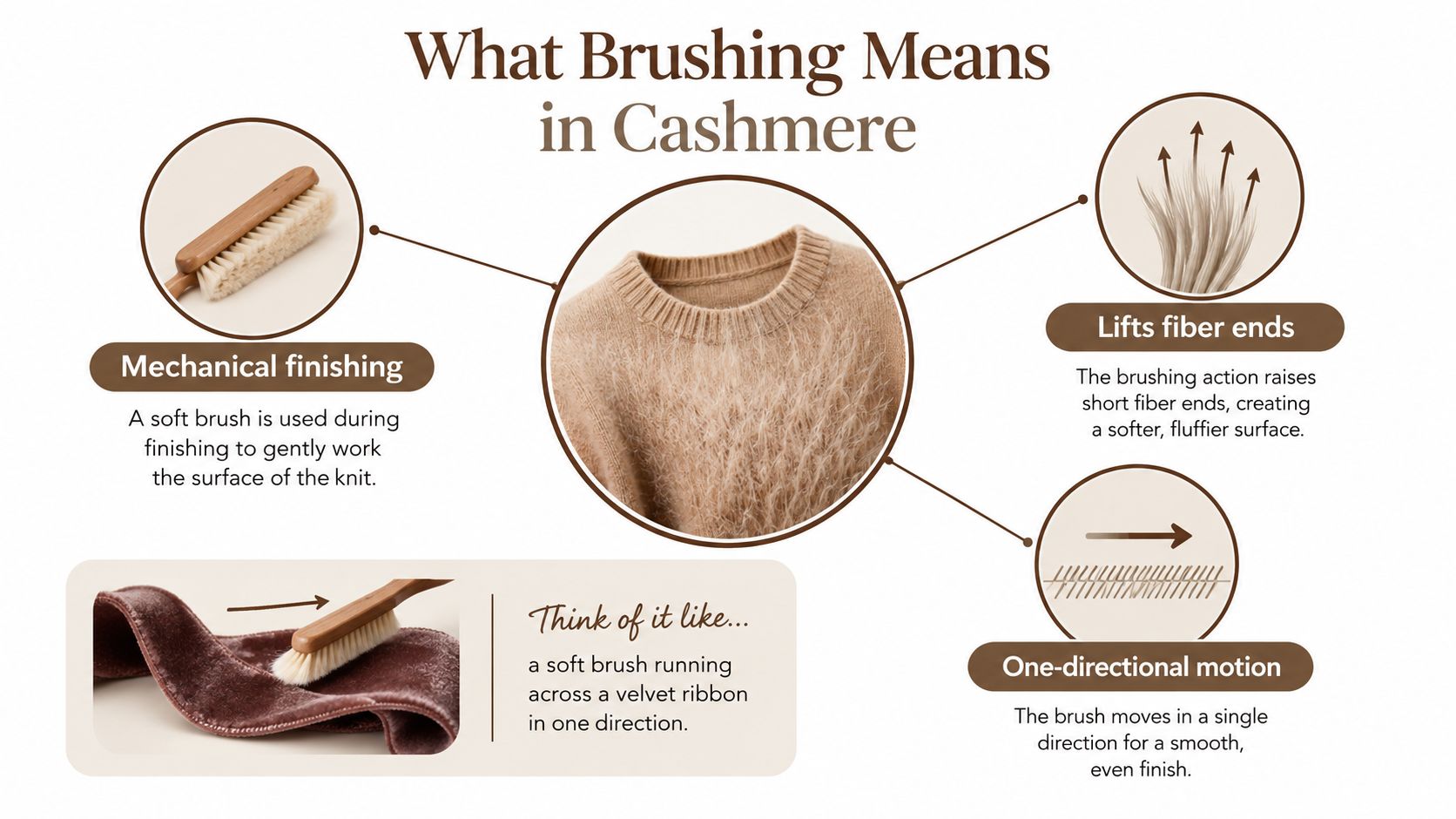
This distinction makes product descriptions easier to interpret. “Cashmere” describes the fiber; “brushed” describes a finish. Brushing doesn't turn another fiber into cashmere, nor does it automatically make cashmere finer or better. It changes how the knitted surface looks and feels.
The role of fiber fineness
Fiber diameter is one useful clue to cashmere's natural softness. A 2025 peer-reviewed study of Inner Mongolian Alpas goats measured average cashmere-fiber diameter at 14.13 micrometers, compared with 17.29 micrometers for ordinary cashmere in its comparison group. The study links fiber fineness with differences in the fiber's proteins, helping explain why softness isn't just a matter of finishing or marketing language (the study of cashmere-fiber structure).
For shoppers, the practical point is straightforward: finer fibers generally bend more easily and feel gentler against skin. Brushing adds surface loft on top of that natural softness. A sweater made with fine cashmere can feel soft without brushing, while brushing can make its surface feel even plusher.
How to read the wording
When you see “brushed cashmere,” treat it as a description of the finishing process, not a complete quality specification. Look for fiber details separately. A stated micron value can help you understand fineness, while details about yarn and construction help fill in the rest of the picture.
How a Brushed Cashmere Sweater Is Made
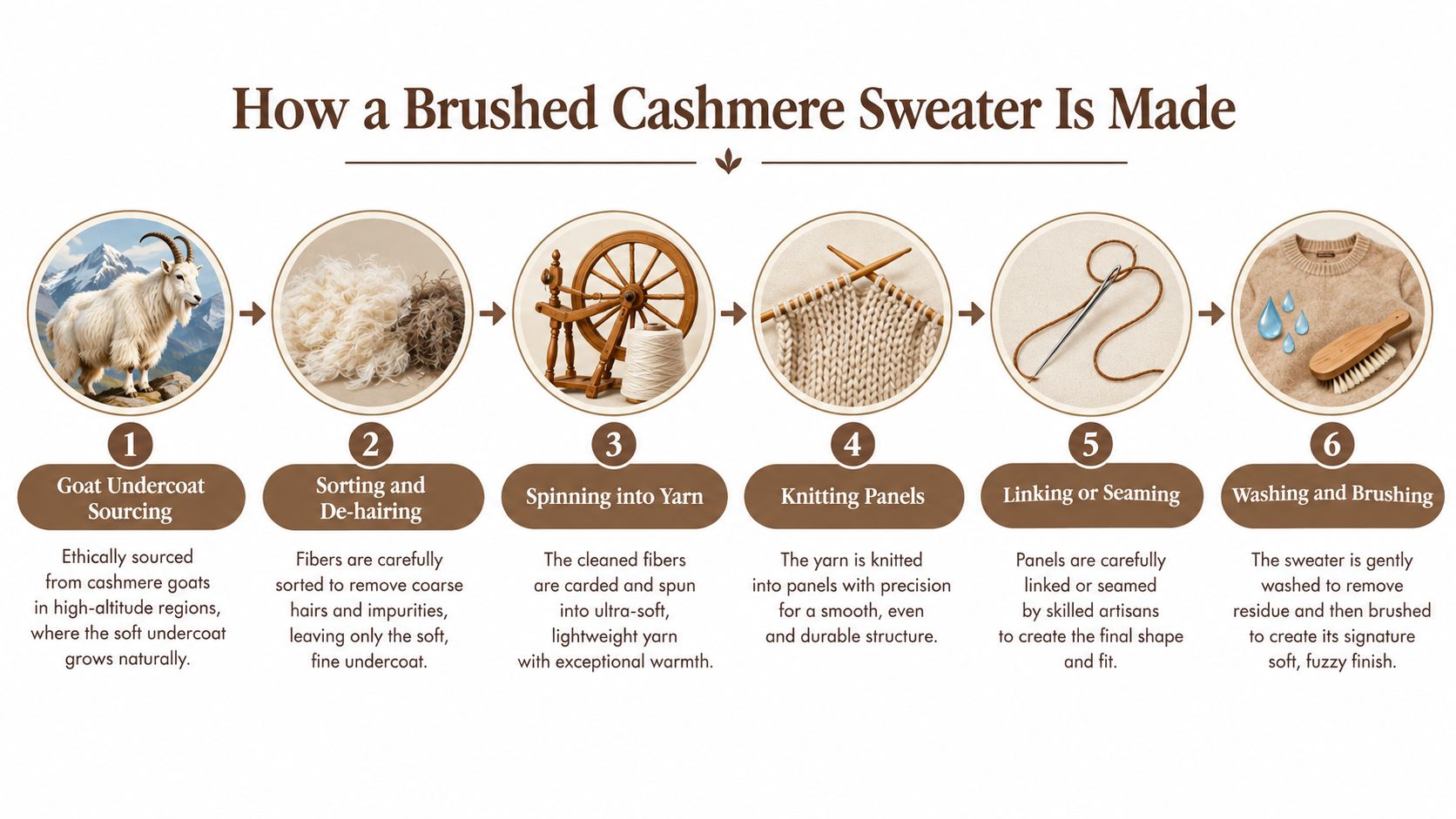
A brushed sweater starts as raw cashmere fiber, not as a finished knit. The material comes from the soft undercoat of cashmere goats. Before it becomes yarn, the fiber is sorted and cleaned to separate cashmere from coarser material.
The sorted fiber is spun into yarn. That yarn is then knitted into garment pieces, which are joined by linking or seaming. The assembled sweater is washed and finished; brushing comes late in the process, after the knit has taken its garment shape.
Where brushing fits
In production, brushing is a controlled surface treatment. Equipment with fine teasels or an abrasive surface moves over the completed knit, lifting some fiber ends without replacing the yarn or changing its fiber type. The amount of brushing can be adjusted, so two sweaters carrying the same “brushed cashmere” label may have noticeably different levels of fuzz and loft.
That's why product photos and close-up fabric views are helpful. A light brushing may leave the stitch pattern easy to see, while a stronger, more visible nap can make the knit look cloudier. The finish's appearance depends on how the sweater is made and how it's treated at this stage.
Where the fiber comes from
Cashmere production is concentrated in a relatively small number of regions. A United Nations Development Programme overview reported that China and Mongolia together accounted for roughly 90% of the global supply in its cited estimates. The same overview connects the fiber to the livelihoods of herders and farmers in remote, semi-arid areas, so origin can provide useful context beyond the sweater's look and feel (UNDP's overview of the cashmere value chain).
For a shopper, the production chain offers a simple mental picture: animal undercoat becomes sorted fiber, fiber becomes yarn, yarn becomes a knitted garment, and brushing creates the final fuzzy surface. Each stage contributes something different. The finish is only one part of the sweater.
Brushed vs Unbrushed Cashmere
Put a brushed and an unbrushed cashmere sweater side by side, and the surface gives away the difference. The compact, unbrushed knit tends to show its stitches more clearly and look cleaner or more polished. The brushed version appears softer around the edges, with a lifted surface that feels airier to the touch.
Neither finish is automatically the better choice. The right one depends on what you want the sweater to do in your wardrobe. If you prefer a crisp look under a jacket or want the knit structure to stand out, compact cashmere may suit you. If you want a softer, cloudier appearance and a more relaxed hand, a brushed finish may feel more appealing.
| Attribute | Brushed Cashmere | Unbrushed (Compact) Cashmere |
|---|---|---|
| Surface | Raised, fuzzy nap | Smoother, more compact |
| Appearance | Soft-edged and slightly cloudy | Cleaner stitch definition |
| Hand feel | Airy and plush | Smooth and structured |
| Style impression | Relaxed and cozy | Polished and neat |
| Surface maintenance | Watch for tangles in high-friction areas | Less visible surface fuzz, though still needs gentle care |
A brushed finish can feel warmer at the surface because it adds loft, but the garment's overall warmth also depends on its fiber, yarn, and construction. Don't choose on the finish alone. Think about how you'll layer the sweater and whether you prefer a defined knit or a soft halo.
If you're comparing natural fibers for a particular wardrobe use, this guide to an extra-fine merino wool sweater can help clarify how a different material may fit your preferences. For cashmere, the practical decision is simple: choose compact for a more structured look, or brushed for a softer-looking surface.
How a Brushed Sweater Wears Over Time
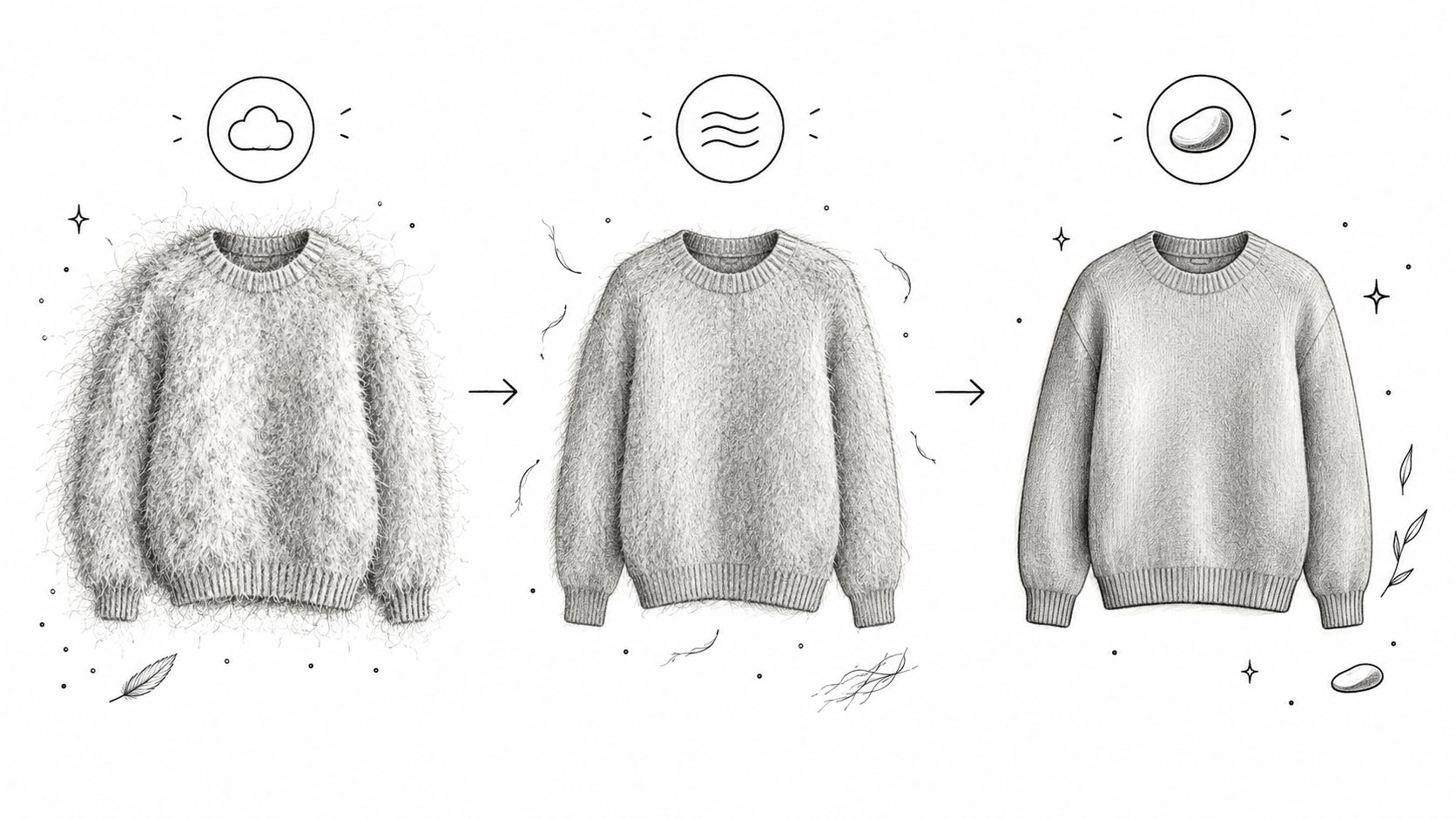
A new brushed sweater often has an even, velvety-looking nap. With wear, friction can shift loose fibers across the surface. Those fibers may tangle into pills, especially where fabric meets fabric or rubs against a bag, coat, or seat belt.
The process comes down to fiber movement. Short fibers can work their way out of the yarn and become entangled with neighboring fibers. A peer-reviewed study of cashmere knitted fabrics identified fibers shorter than approximately 7.5 mm as a dominant contributor to pilling in the tested materials (the study of pilling in cashmere knitted fabrics).
Reading the surface as it changes
At first: The nap may look uniform, with individual fiber ends creating a fine halo. That's the brushed finish doing its job.
During early wear: You may notice a few pills or loose fibers in high-contact places, such as the underarms, cuffs, and areas beneath a bag strap. Early pills don't automatically mean the garment is defective. They can form as loose surface fibers work free and tangle.
With continued use: A brushed sweater's surface may settle into a less freshly fluffed appearance. Occasional pills can be part of normal wear, but rapid or persistent pilling deserves a closer look. It may point to a high proportion of short fibers, weak integration of the yarn, or repeated abrasion.
Check where the pills appear and how quickly they return after gentle removal. Localized pills where a strap rubs suggest friction is playing a part. Widespread or recurring tangles may be a sign to ask the seller about fiber-length information and yarn construction.
Cashmere fibers are fine and can flex or migrate under friction. Brushing exposes more fiber ends at the surface, which makes that movement easier to notice. The trade-off is honest: a brushed sweater offers a soft, relaxed hand, but its visible surface may need more attention than a smooth, compact knit.
Caring for a Brushed Cashmere Sweater
Gentle care helps protect both the knit and its raised surface. Wash only when the sweater needs it, and avoid rough handling that can move fibers around or distort the garment. Follow the care label first, since construction and finishing can vary from one sweater to another.
Washing and drying
Use cold water with a mild, neutral detergent made for wool or cashmere. If washing by hand, let the garment soak gently rather than rubbing it. Don't wring or twist it to remove water.
If you use a washing machine, place the sweater in a mesh laundry bag and select a gentle wool cycle. After washing, press out excess water carefully, then lay the sweater flat to dry away from direct heat. A flat surface supports the knit as it dries and helps limit stretching.
De-pilling without flattening the nap
Pills can be tempting to pull off by hand, but tugging may disturb the yarn. If you use a cashmere comb, test it on an inconspicuous area first, then make light, one-directional passes over the surface. The goal is to lift pills gently, not scrape away the brushed finish.
Aggressive razors and rotary shavers can cut yarn loops, so they're risky on a lofty surface. If you're unsure whether an area is intentional nap or a pill, pause before using a tool. For more general garment-care details, consult these cashmere care instructions.
This short video offers another look at gentle cashmere care:
Storage and wear habits
Fold cashmere rather than hanging it, and store it clean in a breathable cotton bag. Cedar or lavender can help deter moths. Giving a sweater a rest between wears also reduces repeated rubbing in the same places.
Keep this quick checklist near your laundry area:
- Wash gently: Cold water and mild wool or cashmere detergent.
- Handle lightly: Don't rub, wring, or pull pills by hand.
- Dry flat: Keep it away from direct heat.
- Protect the nap: Test a cashmere comb first and use minimal pressure.
- Reduce friction: Rotate wear and watch for rubbing from bags and rough layers.
Buying a Brushed Sweater You Will Still Love Next Year
A brushed label describes the surface finish, not the whole sweater. To judge how a garment may wear, look beyond its fuzziness and check what the seller says about the fiber and construction.
Start with fiber specifications. A stated micron value gives you a useful clue to fineness, and information about staple length or short-fiber content can help you understand pilling risk. If the listing explains yarn construction or knitting density, you have more to go on than “brushed cashmere” alone.
Then inspect the surface in product photos. Intentional brushing usually looks even across the garment. Early pilling tends to gather in small tangles, often around contact points. If you can see the sweater in person, look at the underarms, cuffs, and places where a bag strap would rest.
A guide to choosing a high-quality cashmere sweater can help you assess broader quality details. For outfit planning, a tartan and colour scarf guide can also help you think about how a cashmere knit might work with other textures and patterns.
FAQ
Does brushing mean the sweater is higher quality? No. It describes the finish. Fiber fineness and yarn construction are separate considerations.
Should I shave a brushed sweater? Avoid aggressive tools. Test a cashmere comb on a hidden area and use light pressure, because removing the fuzz may also change the intended nap.
Is a little pilling always a defect? Not necessarily. Check whether it's localized at friction points or quickly recurring across the garment.
Cashmere Boutique offers cashmere sweaters, scarves, wraps, and other apparel and accessories, with product information to help you compare fiber specifications and care needs. If you're choosing a brushed knit, explore the collection at Cashmere Boutique and look for the details that matter to how you want your sweater to feel and wear.