
Bomber Jacket Navy
You're heading out for dinner, the light's fading, and there's a chill you didn't dress for this morning. A heavy coat feels like too much. A hoodie doesn't feel like enough, at least not in the way you want to look. That's the exact gap a bomber jacket navy style fills so well. It's easy to throw on, it holds its shape, and it makes a simple outfit look intentional without trying too hard.
Table of Contents
- Why the Navy Bomber Jacket Belongs in Your Wardrobe
- The Military Heritage of the Navy Bomber
- Materials and Construction Quality Explained
- Finding the Right Fit for Your Body Type
- How to Style a Navy Bomber Jacket
- Seasonal Wear and Layering Strategies
- Common Misconceptions About Navy Bombers
- Final Thoughts on Choosing Your Navy Bomber
Why the Navy Bomber Jacket Belongs in Your Wardrobe
You're standing by the door on a cool autumn evening. There's a light drizzle outside, you're meeting friends in twenty minutes, and your closet is giving you two bad options. The wool coat feels formal and a little heavy for a casual place. The sweatshirt is comfortable, but you'll look underdressed the moment you walk in.
That's where the navy bomber jacket earns its place. You zip it over a plain tee or a soft knit, and the outfit suddenly has structure. The short body keeps your proportions clear, the ribbed hem sits neatly at your waist, and navy does the quiet work of pulling everything together. It doesn't shout for attention. It just looks right.
Why Navy Works So Often
Navy sits in a useful middle ground. It's softer than black against most skin tones and against lighter layers, so you don't get that harsh contrast. At the same time, it's dark enough to handle everyday wear without showing every mark the way pale colors do. You can wear it with dark denim, grey trousers, white sneakers, or tan chinos and rarely feel mismatched.
If you're shopping online and trying to picture how a jacket fits into a wardrobe, looking at casual lifestyle visuals for e-commerce can help you judge proportion and pairing in a real setting, rather than on a stark product background. You're not just buying a color. You're buying how it moves with jeans, knits, and shoes you already own.
A good navy bomber shouldn't need a special occasion. If you can wear it three days in a row with different layers and still feel put together, you've chosen well.
This isn't a trend piece you'll tire of next season. The shape comes from flight clothing built for function, and that practical origin is why it still works. You'll reach for it for coffee runs, travel days, and evenings when you want warmth without bulk. Once you understand its history, materials, and fit, you'll see why so many people treat it as a wardrobe staple, not an extra.
The Military Heritage of the Navy Bomber
A lot of readers assume navy is just a fashion color added later to sell more jackets. That's the first confusion to clear up. Navy has a direct line back to naval aviation, and that history explains details you still see today.
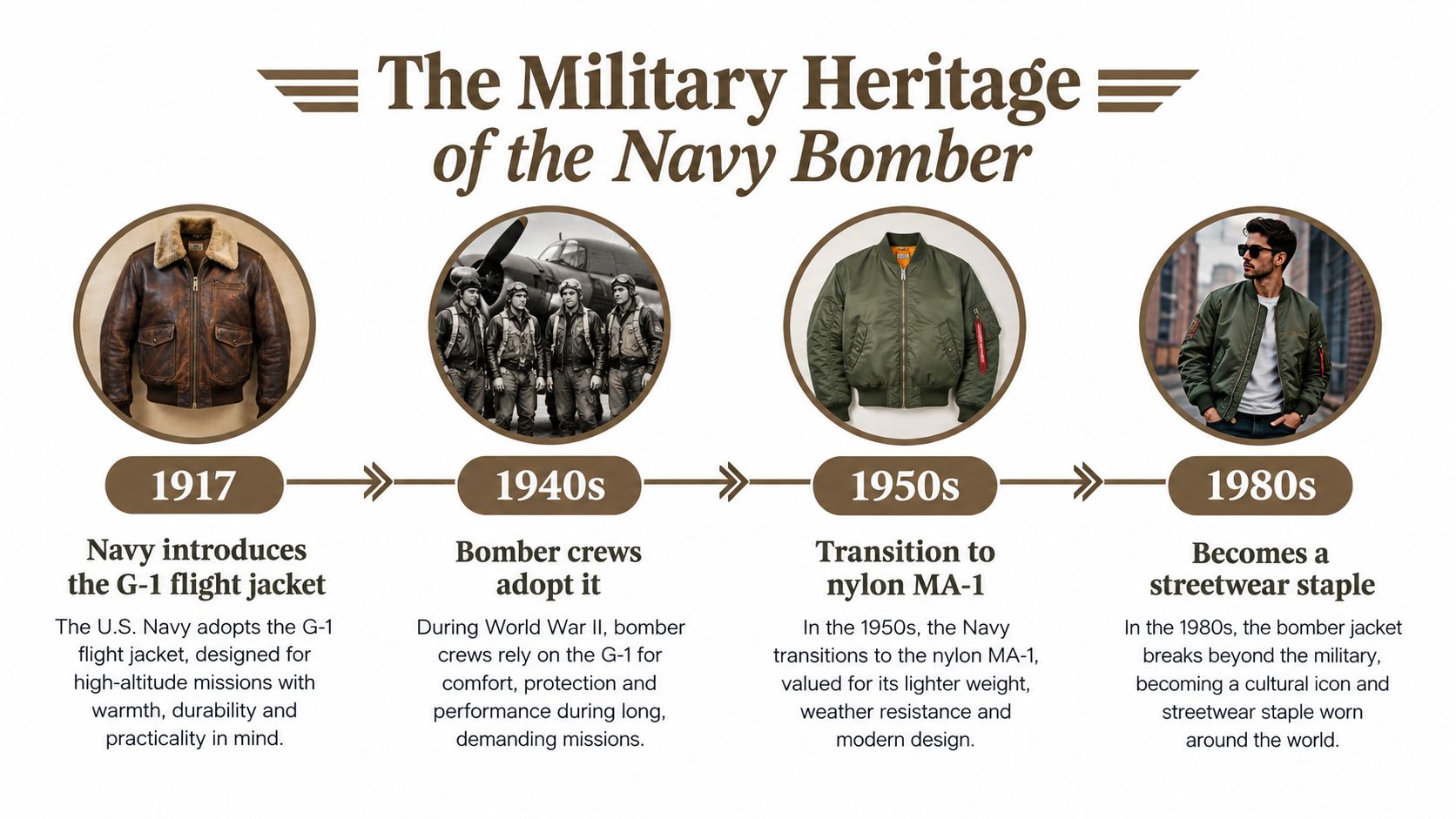
The story starts with leather, not nylon. The modern navy bomber is rooted in the G-1 flight jacket, which evolved from the Navy's M-422A issued from 1943 and received the G-1 designation in 1947, as traced in this history of WWII bomber jacket types and the G-1 lineage. That jacket belonged to naval aviators. Its distinctive fur collar wasn't decoration. It was a practical response to cold, high-altitude cockpit conditions, where keeping warmth around the neck mattered on every flight.
From Leather G-1 to Nylon MA-1
The G-1 represented the Navy's leather flight jacket tradition, distinct from what came next. As aircraft changed, so did the clothing. Jet cockpits were cramped, and bulkier leather became harder to work in. Pilots needed something lighter that wouldn't catch or bunch when they moved.
The MA-1 was introduced to the U.S. military in 1949 and developed during the following decade for Air Force and Navy pilots and flight crews under specification MIL-J-8279, according to the MA-1 bomber jacket history and specification record. Early versions appeared in midnight blue, which is why navy is historically authentic for this silhouette. The color later shifted toward sage green or olive, largely because those tones offered better camouflage if aircrew reached the ground.
- G-1 character: Leather body, fur collar, naval aviator heritage, built for cold cockpits.
- MA-1 character: Lighter nylon shell, rib-knit trims, compact body suited to jet aviation.
- Shared DNA: Short length, close seals against cold air, and a fit designed for movement.
The MA-1 also added a reversible high-visibility orange lining. A pilot could turn the jacket to expose the bright side and help search teams spot them. You probably won't need that function, but it explains why so many modern bombers still use a contrasting lining. When you buy a navy version today, you're not borrowing a random military look. You're wearing a civilian descendant of equipment that had to work under pressure, and navy was there early.
Materials and Construction Quality Explained
Two navy bombers can look identical in photos and feel completely different after a month of wear. The difference usually isn't the color. It's the shell material and, equally, how the jacket is finished at the edges where cold air gets in.
Start with the shell and match it to how you'll live in it.
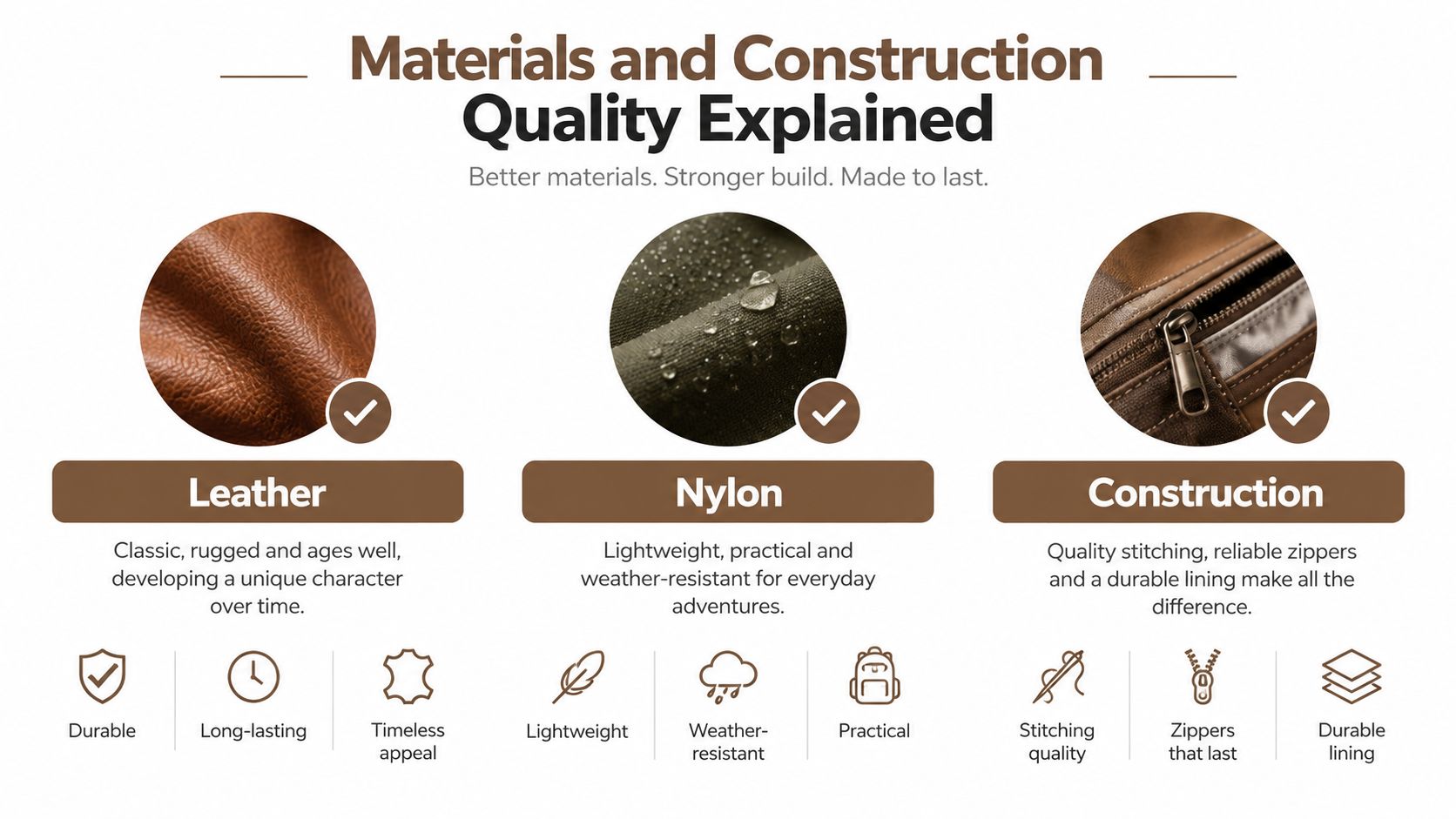
- Leather: Classic and rugged, with a weight that feels substantial. It suits cooler weather and a more heritage look, and it develops character with wear.
- Nylon: Lightweight and practical, closest to the MA-1 idea. It's easy to pack, easy to layer, and a sensible choice if you want a jacket for travel or changeable days.
- Wool or cashmere blends: Softer and more refined, with a finish that looks polished over knitwear. If you're comparing warmer dressier options too, this guide to men's cashmere coats for warmth and style is a useful companion for understanding how fine fibers change the feel of outerwear.
The Rib Trims Do the Thermal Work
Most shoppers are surprised by this. Warmth doesn't come from the shell alone. Thermal performance depends heavily on closure engineering, and the rib-knit collar, cuffs, and waistband form elastic seals that reduce convective heat loss at the neck, wrists, and hem. That's why the silhouette is short with close-fitting trims instead of an open, shirt-style hem that lets air rush up your back.
When you're checking quality in person or reading a product description closely, use this simple sequence.
- Stretch and release the cuff. It should recover promptly instead of staying loose.
- Run your hand around the waistband. Look for twisting or exposed seam allowances.
- Inspect stress points. Check around pocket openings and both ends of the zipper, where pulling shows first.
For concrete benchmarks in one place, technical guidance identifies 2×2 or 1×1 rib structures with 5–10% spandex for recovery, plus roughly 12–14 stitches per inch on shell stress seams and 10–12 stitches per inch on ribbed trims, as set out alongside Rothco's MA-1 flight jacket construction details. Treat those figures as production targets to compare against, not as a pass or fail law.
Practical rule: If the cuffs feel tired on the hanger, they'll feel worse after a season of pushing sleeves up and down.
Don't overlook pockets either. Front slash pockets, internal storage, and a sleeve utility pocket let you carry small essentials without a bulky bag. A well-made bomber jacket navy piece should feel as considered inside as it looks outside. Smooth lining, a zipper that runs without catching, and trims that snap back are the signs you'll still enjoy wearing it next year.
Finding the Right Fit for Your Body Type
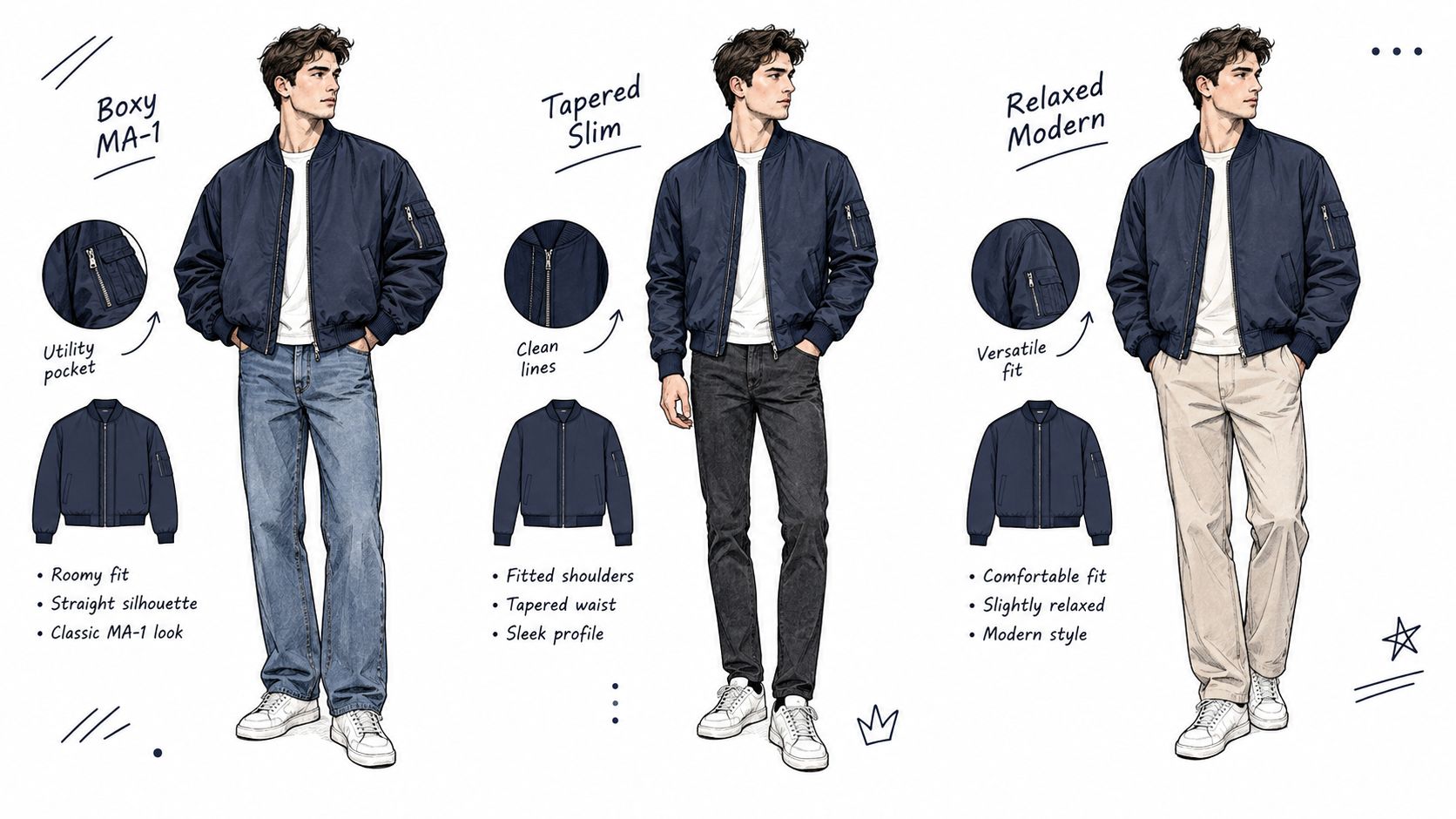
Fit is where a bomber either flatters you or swallows you. Because the jacket is short by design, small differences in shoulder width, body length, and volume show up quickly. The good news is that you have real choices, from a roomier classic cut to a slimmer modern one.
The classic MA-1 shape is boxier through the body. It gives you space for a sweater and carries that original flight jacket character. A modern-cut bomber sits closer, with less puff and a cleaner line over a shirt. Neither is better in the abstract. The right one depends on your frame and how you plan to layer.
Three Fit Checks That Matter Most
- Shoulders: The seam should sit at or just past your natural shoulder point. If it droops far down your arm, the whole jacket reads oversized, even if that wasn't your intention.
- Body length: The ribbed hem should land around your waist or the top of your trousers. Much longer and you lose the bomber proportion. Much shorter and it'll ride up when you sit.
- Sleeves: They should end around your wrist bone, with the ribbed cuff holding them there comfortably. You shouldn't have to keep pulling them down.
Your body type can guide the volume you choose. If you're broader through the chest and shoulders, a classic cut often feels more natural and won't pull when you zip it. If you're slimmer, a trim silhouette usually keeps the jacket from looking borrowed. If you're shorter, pay extra attention to body length, because excess length shortens your legs visually. Taller wearers should check that the hem doesn't creep too high when they raise their arms.
Always try it the way you'll wear it. Put on the knit or shirt you'd normally layer underneath, zip the jacket fully, sit down, and reach forward as if you're driving or picking up a bag. You should be able to move without the hem climbing or the chest straining. For a smart layering test, a long sleeve button down shirt as a base layer shows you quickly whether the bomber sits cleanly over a collar or bunches at the shoulders.
If you have to choose between perfect over a tee and comfortable over a sweater, choose the sweater fit. That's how you'll wear it on the coldest, most frequent days.
Avoid the most common mistake, which is sizing up for comfort and ending up with dropped shoulders and a ballooning body. A bomber should feel close and sealed, not tight. That close fit is both the look and the warmth.
How to Style a Navy Bomber Jacket
Styling a navy bomber is easier once you think of navy as a neutral with depth. It pairs with white, grey, cream, olive, tan, and other blues without much effort. What changes the mood isn't the jacket. It's what you put under it and what you wear on your feet.
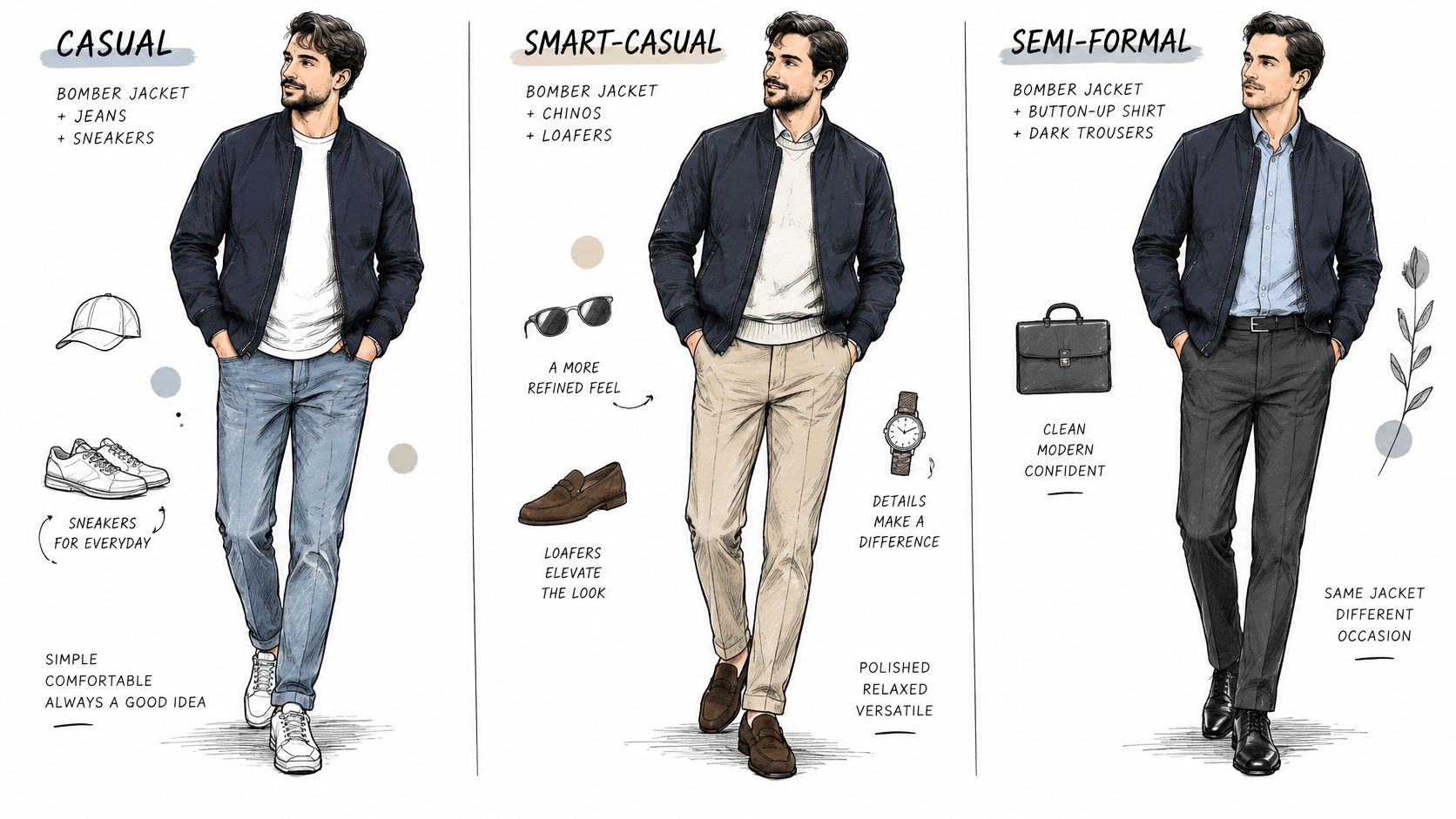
Here are three outfit directions side by side, so you can see the range at a glance.
Casual Without Looking Careless
For an everyday look, wear your bomber open over a white or grey tee with dark denim and clean sneakers. The jacket gives the outfit edges and structure, so the basics underneath don't need to work hard. On cooler days, swap the tee for a crewneck sweater. A cream cashmere crewneck under a navy bomber with dark denim is a reliable combination because the light knit lifts the dark jacket and the textures feel rich together.
Chinos work just as well when jeans feel too expected. Tan or stone chinos warm up the navy, while olive keeps the outfit grounded and a little more rugged. Keep the top underneath simple and let the contrast between trouser and jacket do the styling.
Smart Casual and Semi Formal
To dress it up, button a shirt underneath and zip the jacket partway so the collar sits neatly. A fine-gauge knit, especially in cashmere, gives you the same polished effect with more comfort. Grey trousers, a light blue shirt or a charcoal knit, and leather shoes move the bomber into smart casual territory for dinners or a relaxed office.
If you're building outfits from pieces you already own and want a framework for mixing them, these wardrobe rules for real outfits can help you test combinations before you commit to buying anything new. The principle is simple. Change one element at a time, shoes, trouser, or layer, and watch how formal the same jacket feels.
Watch how a stylist builds those transitions in real time in the video below, then borrow the moves that suit your closet.
One warning on blue on blue. Navy over denim works best when the shades are clearly different. Pair a deep navy bomber with either much darker or noticeably lighter jeans, so the pieces read as separates rather than a uniform. Add a light layer between them if you're unsure. That single break in tone is usually all you need for a polished bomber jacket navy outfit.
Seasonal Wear and Layering Strategies
A navy bomber earns its keep when you stop thinking of it as a single-season jacket. The same silhouette can work across much of the year. What changes is the shell you choose and the weight of what you wear underneath.
In spring, treat a lightweight nylon bomber as your outer layer over a tee or a thin long-sleeve top. It takes the edge off a breezy morning and comes off easily by afternoon. Because it's short and light, you won't feel burdened carrying it over your arm when the day warms up.
Autumn is its natural home. Layer it over a fine knit and you get warmth without the commitment of a full coat. This is also where cashmere makes a real difference. A soft knit traps warmth close to your body while the bomber's ribbed trims seal the edges, so the combination feels warmer than either piece alone.
Making It Work in Winter
Winter asks more of the jacket, and honesty helps here. A thin, unlined fashion bomber won't replace a heavy coat in serious cold. A leather or wool-blend version, or a nylon style with room for layers, goes much further. Wear it over a chunky knit or a cashmere turtleneck and add a scarf to close the gap at the neck that the short collar leaves open.
If you like a higher neckline under a short jacket, a funnel neck cashmere sweater for layered warmth is worth considering, since that raised neck does the job a scarf would do while keeping the outfit tidy. The funnel sits inside the bomber's collar without bulk spilling over it, which keeps the line clean.
- Mild days: Tee or light shirt, bomber open, sneakers.
- Cool days: Fine-gauge cashmere or merino knit, bomber zipped, boots or leather shoes.
- Cold days: Heavier knit, scarf or funnel neck, and a bomber with enough room to move.
If you live somewhere with sharp swings between seasons, look for a roomier fit or a removable lining. That flexibility lets one jacket cover more of the calendar. Buy for the layering you'll do most often, not for the single coldest day of the year, and you'll wear your bomber far more often.
Common Misconceptions About Navy Bombers
A few myths keep people from choosing navy, and most of them don't hold up once you wear the jacket for a week. Clearing them up now will save you from buying a color you like less for the wrong reasons.
Myth one is that navy is less versatile than black. In practice, navy often works with more of your wardrobe because it creates lower visual contrast than black. Black can look stark against cream knits, tan chinos, and softer colors. Navy sits comfortably beside all of them, and beside denim, grey, and olive too. If your closet leans warm or light, navy is frequently the easier dark neutral.
Myth two is that bombers are only casual. The origin is military and the shape is relaxed, so the assumption makes sense. But the jacket's formality follows its fabric and company. A nylon bomber over a tee is casual. A clean wool-blend or leather bomber over a button-down or a fine cashmere knit, with slim-cut trousers and leather shoes, reads smart in most social settings. You're not dressing the jacket up against its nature. You're choosing the version that matches the occasion.
The Fading and Dye Transfer Worry
Myth three is that navy will fade or stain your lighter clothes. Any heavily dyed garment deserves a check, and that's the practical point. Dye transfer risk rises with moisture, friction, and poor finishing, especially against light cashmere on a damp day. That doesn't mean you should avoid the pairing. It means you should read the care label, check colorfastness guidance, and be sensible about wearing a brand-new, heavily dyed jacket over a cream sweater in the rain before the first proper clean.
Don't fear the color. Respect the care label, and test new pairings on a dry day first.
Once those concerns are handled, what's left is a jacket that's easier to wear, easier to pair, and more adaptable than its reputation suggests.
Final Thoughts on Choosing Your Navy Bomber
If you take one idea from this guide, let it be this. A navy bomber works because its design was never arbitrary. The short body, sealed trims, and practical pockets came from flight clothing that had to keep people warm and mobile. Modern versions keep that logic and soften it for everyday life, which is why the jacket feels both relaxed and finished.
When you're ready to choose, work through three decisions in order. First, pick your material based on climate and how formal you want the finish to look. Leather leans heritage, nylon leans practical, and wool or cashmere blends lean refined. Second, get the fit right over the layers you'll wear most, with shoulders in place and the hem at your waist. Third, check the construction details you'll touch every day, cuff recovery, a smooth zipper, and tidy stitching at stress points.
A Simple Way to Decide
- Choose nylon if you want one light jacket for travel and changeable weather.
- Choose leather if you want the closest link to the naval flight tradition and a jacket that ages with you.
- Choose a refined blend if you'll wear it most over shirts and fine knits for dinners and work.
Then style it with confidence. Pair it with denim and a tee when you want ease. Layer it over cashmere when you want comfort that looks refined, because the softness of the knit against the structure of the bomber is exactly the bridge between heritage and modern dressing that makes this piece special.
A well-chosen bomber jacket navy style isn't another jacket in the closet. It's the one you'll reach for when you don't want to think too hard and still want to look like you did. Choose quality, fit it properly, and let it work across your wardrobe for years.
Complete your navy bomber with the layer it deserves by exploring cashmere crewnecks, turtlenecks, scarves, and refined knits made for comfortable, refined everyday dressing at Cashmere Boutique. Browse the collections for women and men, find the color that lifts your jacket best, and build outfits you'll reach for all season.