
Extra Fine Merino Wool Sweater or Cashmere
Buying the softest-sounding sweater is bad advice. So is assuming cashmere automatically beats an extra fine Merino wool sweater on warmth, comfort, and value. Fiber names tell you where to start, not what to buy. The right choice depends on your skin, your climate, how you'll layer it, and how often you'll wash and wear it.
Table of Contents
- Why Your Sweater Choice Matters More Than Fiber Name
- Understanding Extra Fine Merino and Cashmere
- Comparing Warmth Comfort and Durability
- How to Judge Sweater Quality Before Buying
- Washing Drying and Long-Term Care
- Which Sweater Fits Your Everyday Use
- Making Your Final Sweater Decision
Why Your Sweater Choice Matters More Than Fiber Name
Most shoppers make the same mistake. They read extra fine on a label, feel a smooth sleeve in the store, and treat that as a verdict on quality. Or they pick cashmere because it sounds luxurious, then wear a delicate, loosely knitted sweater three days a week under a seat belt and wonder why it pills.
Neither reaction helps you. A sweater is a system. Fiber diameter, yarn twist, knit density, finishing, and garment construction work together, and a weakness in any one of them shows up on your body. A very fine fiber in a loose, open knit can feel airy and elegant for one evening, then snag, lose shape, and look tired fast. A slightly less fine fiber in a dense, well-finished knit can feel less cloudlike in the shop and perform far better over a season of commuting.
Match the Sweater to the Job
Ask what job you're hiring this sweater to do. A next-to-skin layer under a blazer needs low prickle, a clean finish, and enough breathability for a heated train. A standalone sweater for cold walks needs fabric weight, wind resistance from a denser knit, and cuffs that hold their shape. A dressier piece for dinners needs drape and a refined surface more than abrasion resistance.
Those are different briefs. One fiber name can't answer all of them.
If you can't name the layer, the climate, and the weekly wear frequency, you're not ready to judge softness.
Cashmere can be the better match when you want a polished, lightweight sweater for lower-friction wear and you'll rest it between outings. Merino can be the better match when you need repeat wear, close layering, and comfort across changing temperatures. Reverse those conditions and the recommendation can reverse too.
Buy the specification, not the story. Check the stated micron range where it's offered, look at fabric weight and knit structure, inspect seams and cuffs, and be honest about care. If you hate hand washing, airing garments, and de-pilling, that's not a character flaw. It's buying information. Use it before you pay a premium for a sweater that doesn't fit your routine.
Understanding Extra Fine Merino and Cashmere
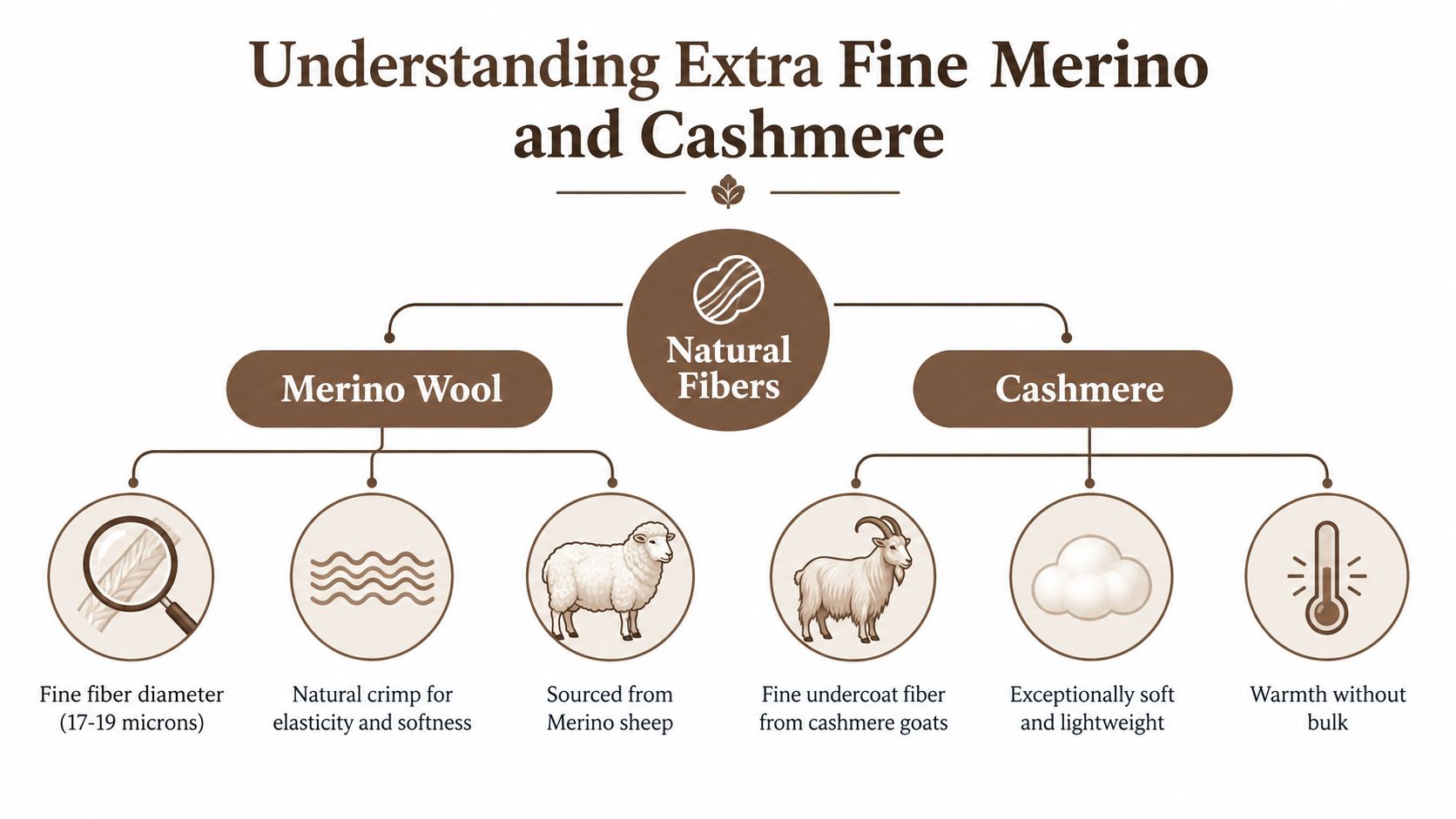
Merino is wool from Merino sheep, valued because it can be produced at much finer diameters than ordinary wool and because the fiber has natural crimp. Cashmere comes from the fine undercoat separated from cashmere goats. That distinction matters. You're not comparing two marketing words for the same material. You're comparing two different fibers with different supply, handle, and care expectations.
What Extra Fine Actually Means
For Merino, start with fiber diameter, measured in microns. The Woolmark specification for Extrafine Merino sets the maximum mean fiber diameter at 19.5 microns, with an absolute testing limit of 19.75 microns allowing 0.25 microns for measurement error. Woolmark's broader classification places ultrafine Merino at 14.6 to 16.5 microns and superfine Merino at 16.6 to 18.5 microns in that same specification.
Don't treat those categories as a softness league table. Classifications vary by source, which is exactly why a stated average diameter beats a label. One wool classification resource places extra-fine Merino at 14.5 microns or finer, with ultrafine at 14.6 to 16.5 microns and superfine at 16.6 to 18.5 microns, as set out in the Learn About Wool secondary fact sheet. If a retailer won't state a range, you're being asked to trust an adjective.
Context helps, too. Australia's Merino industry grew from 26 Spanish Merino sheep introduced from South Africa in 1797, and in 2020 Australia accounted for less than 10% of the global sheep population but produced more than 50% of the world's Merino wool, according to the National Film and Sound Archive history of the Australian wool industry. That long, specialized supply chain is why fine Merino is widely available at verified grades.
Where Cashmere Fits
Cashmere retailers often publish a grade and a micron specification for their fiber, and you should look for that disclosure rather than assuming every cashmere sweater shares one standard. A commercial grade from one seller doesn't automatically apply to another seller's garment. Read it as that retailer's stated specification, then judge the knit in front of you.
Microns explain a lot about prickle. They don't explain warmth, pilling, drape, or how a cuff behaves after repeated wear. Use the number to narrow the field. Don't let it finish the decision for you.
Comparing Warmth Comfort and Durability
Judge both fibers by the same criteria. An extra fine Merino wool sweater typically uses fibers below 19.5 microns, and Woolmark identifies typical Merino diameters from below 17.5 microns through approximately 22 to 24 microns in its guide to what the wool fiber is. That range is your clue. The lower end suits fine knitwear and close contact. The upper end points toward outerwear, where a firmer hand is less of a problem.
Finer fibers bend more readily against skin, so they generally feel less prickly than coarser wool. Merino's natural crimp also creates insulating air spaces and supports breathability, while its inner structure absorbs water vapor without immediately feeling wet. Cashmere's appeal is different. In a well-made knit it gives you a soft, refined surface and warmth without visual bulk, which is why it reads dressier over a shirt or under a coat.
Extra Fine Merino and Cashmere Compared
| Evaluation criterion | Extra fine Merino wool sweater | Cashmere sweater | What to inspect |
|---|---|---|---|
| Next-to-skin comfort | Strong when the micron range is verified and the knit is smooth | Often exceptionally soft in a quality knit | Stated diameter, surface finish, your sensitivity |
| Warmth and layering | Breathable, useful across changing temperatures | Warm, light, polished as a mid or top layer | Fabric weight, knit density, intended layer |
| Moisture comfort | Built for vapor management and repeat layering | Comfortable, but usually chosen for feel and drape first | Fit, since compression reduces the air layer |
| Pilling and abrasion | Depends heavily on yarn twist, fiber length, and density | Needs realistic expectations under straps and seat belts | High-friction zones, seam and cuff finishing |
| Shape and drape | Crimp supports resilience in fitted knits | Fluid, elegant drape in dressier styles | Ply, tension, rib quality, garment weight |
Practical rule: Finest describes a fiber measurement. Best describes a match between construction and use.
Durability is where shoppers get misled. Lower micron generally reduces prickle, but finer fibers can give up some of the strength associated with coarser wool. That means a very fine sweater isn't automatically better for frequent wear than a slightly heavier knit in a higher micron range within the extra-fine category. Yarn twist matters. So does knit density. A tighter knit usually gives you better wind resistance and a cleaner surface, while a looser knit feels airier and exposes yarn to more abrasion.
Apply the same honesty to cashmere. Its softness is real, but it doesn't cancel physics. Repeated friction at the sides, under bag straps, and where sleeves rub a desk will show on any fine knit. If you'll wear the sweater hard, prioritize dense construction, strong seams, and reinforced cuffs over the softest possible first touch. If you'll wear it for dinners, office days with a coat over it, and occasions where drape matters, cashmere's hand feel earns its place.
Decide your priority in plain language. If it's breathable, repeat layering, choose Merino construction carefully. If it's refined softness and drape, choose cashmere construction carefully. Don't ask either fiber to win every category.
How to Judge Sweater Quality Before Buying
Use a fixed inspection order. It stops a soft sleeve or a prestige label from hijacking your judgment, and it works whether you're buying Merino or cashmere.
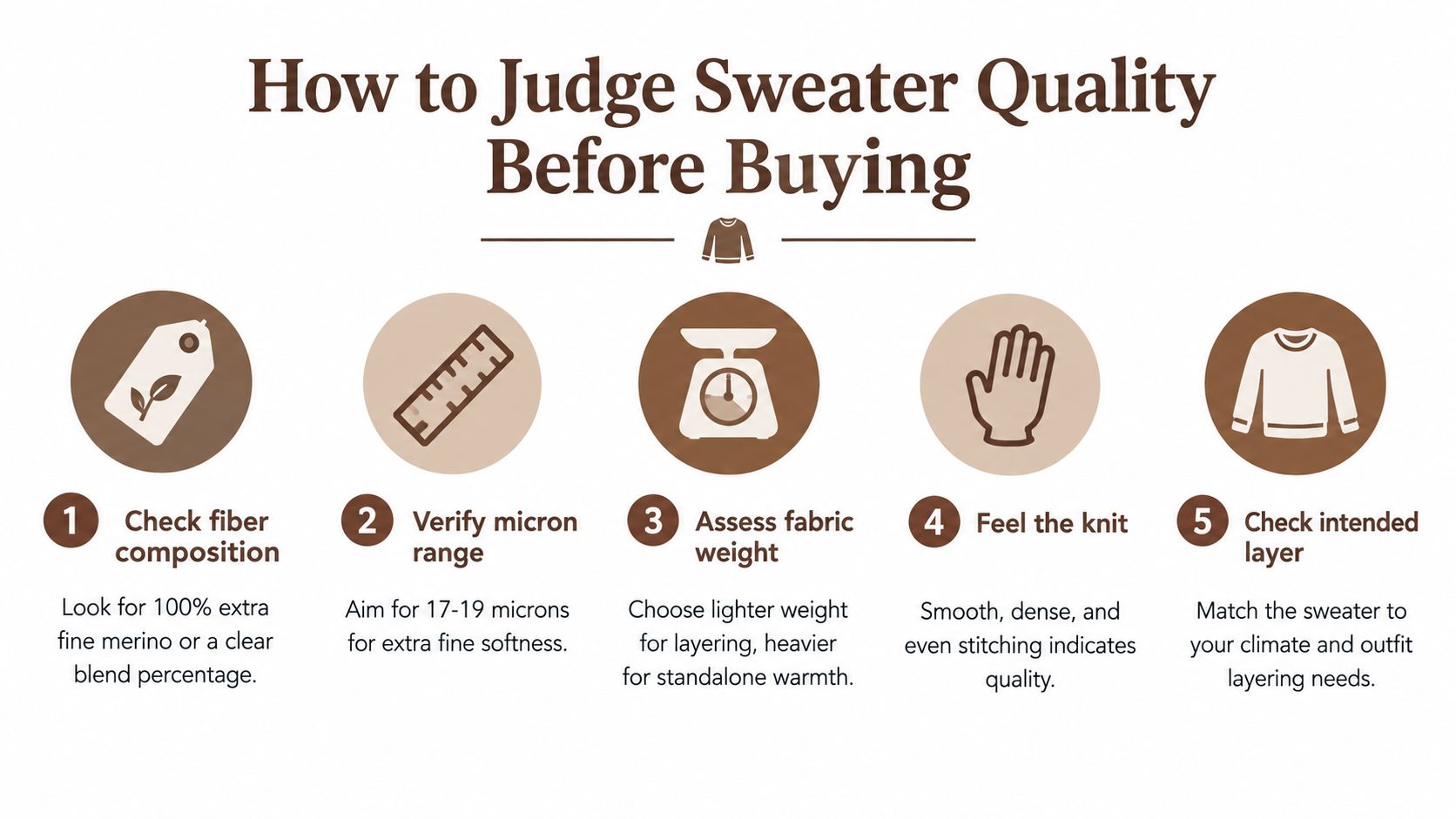
A Five Part Check
- Verify composition and micron range: Look for a clear fiber percentage and, for Merino, a stated average diameter rather than extra fine alone.
- Identify the intended layer: A lightweight, close knit suits skin contact and jackets. A denser, heavier knit suits standalone wear.
- Assess yarn and knit density: Hold the fabric to light and feel for evenness. Loose, open structures drape and breathe, but they're more exposed to snagging and abrasion.
- Inspect cuffs, hems, and seams: These areas take repeated stretching and friction. Neat, firm finishing matters more to lifespan than a tiny difference in micron count.
- Read the care label before you fall in love: If the routine doesn't fit your life, the sweater doesn't fit your life.
Yarn twist and ply influence resilience, surface clarity, and how the garment recovers after wear. You won't always get full technical detail from a product page, so use what you can verify. Fabric weight, visible stitch density, the firmness of ribbing, and the quality of linking at seams tell you a great deal in person. Online, ask customer support direct questions about composition, weight, and sizing, and treat evasive answers as information.
For cashmere specifically, work through the same checks with extra attention to knit evenness and finishing, as outlined in this guide to choosing a high-quality cashmere sweater. Don't pay for fiber prestige and accept sloppy construction. Good cashmere in a poor knit is still a poor sweater.
One final test clarifies almost everything. State where the sweater will sit in an outfit, how many days a week you'll wear it, and what will rub against it. If the garment's weight and construction don't match that sentence, walk away, however soft it feels.
Washing Drying and Long-Term Care
Follow the garment's own label first. Care instructions aren't interchangeable across fibers, blends, dyes, and constructions, and a routine that suits one sweater can distort another. Within that limit, both Merino and cashmere reward the same habit. Wash when needed, not on autopilot.
Why Fewer Washes Can Make Sense
Merino manages moisture vapor well. Wool can absorb up to 35% of its own weight in moisture vapor before feeling wet, and it absorbs approximately twice as much vapor as cotton and 30 times as much as polyester, as described in Woolmark's overview of the wool fiber. That helps moderate clamminess when you move between cold streets and heated rooms. It doesn't make a sweater rainproof, and it doesn't remove soil, perfume buildup, or heavy perspiration.
Air a sweater after wear, away from direct heat, and let it rest before wearing it again. Wash it when odor stays after airing, when the underarms or collar feel soiled, when you've sweated heavily, or when the surface looks dull from contact with skin and outerwear. Visual cleanliness isn't the only test.
Use a gentle, low-agitation approach the label allows, avoid unnecessary heat, and dry flat while reshaping the garment to its original measurements. That flat, patient method protects shape better than hanging a wet knit, which lets gravity pull on the fabric. The same respect for low abrasion applies across natural materials, which is why safe sheepskin washing tips are useful background on gentle handling, even though a sheepskin product and a knitted sweater need their own label-specific routines.
Pilling Storage and Repair
- De-pill gently and early: Use a suitable comb or fabric tool on a flat surface, especially at sides and underarms.
- Store folded, clean, and dry: Hanging can stretch shoulders, and storing a soiled knit invites problems.
- Rotate wear: Resting a sweater between wears helps the knit recover and reduces concentrated friction.
- Repair small damage promptly: A loose thread or small hole is cheaper to address before it spreads.
For brand-specific washing and storage detail, check the retailer's care instructions for cashmere garments against your sweater's label rather than relying on memory.
Be balanced about sustainability, too. Washing less often can reduce routine laundering, but natural doesn't mean zero impact and fiber release during washing still matters. Your strongest lever is longevity. Buy a construction you'll wear for years, wash it gently and only when needed, and repair it instead of replacing it at the first sign of wear.
Which Sweater Fits Your Everyday Use
Scenarios settle arguments that fiber names can't. Run your own week through these examples and notice where your routine lands.
A sensitive commuter leaves home in the cold, stands on a warm train, then sits in an office that swings between heating and air conditioning. For her, an extra fine Merino wool sweater in a lightweight, smooth knit deserves first consideration. It layers cleanly under a jacket, manages vapor during the commute, and won't look bulky at a desk. She should still test the neckline against her skin, because personal sensitivity can override a good specification.

An office wearer who wants polish for client meetings has a different brief. Cashmere over a collared shirt, or a fine Merino crew under a blazer, can both work. If the sweater will be the visible top layer most of the day, cashmere's drape and surface often read more refined. If it'll sit under tailoring and be worn repeatedly through the week, Merino's layering comfort becomes more persuasive. Neckline choice matters here as well, and a funnel neck cashmere sweater for structured cold-weather dressing shows how silhouette can change the same fiber's role from soft layer to outfit anchor.
Travel Cold Weather and Gifts
Frequent travelers should think in outfits, not single garments. A fine knit that works alone at dinner, under a coat outdoors, and over a shirt on a flight earns its suitcase space. If you're building relaxed, layered looks for a trip, browsing oversized sweater outfit ideas for 2026 can help you test proportions before you commit to a fitted or oversized cut. Then choose the fiber by climate and laundry access, not by the photograph.
In sustained cold, separate base layer from outer layer. A fine, close Merino knit belongs near the skin. A denser sweater, in either fiber, belongs over it, with a coat doing the wind protection a knit alone shouldn't be asked to provide.
For gifts, buy for the recipient's habits. Give cashmere to someone who'll appreciate and maintain it. Give a well-specified Merino sweater to someone who wants an elegant layer they'll reach for constantly. Generosity isn't the price tag. It's choosing a sweater that survives the life it'll live.
Making Your Final Sweater Decision
Choose an extra fine Merino wool sweater when next-to-skin comfort, breathable layering, and frequent wardrobe use lead your list. Verify the micron information, then confirm the knit is dense and smooth enough for the friction it'll face. Choose cashmere when luxurious hand feel, refined drape, and dressier wear matter most, and when you'll rotate it, rest it, and maintain it properly.
Don't force a universal winner. A slightly heavier Merino knit can outperform a finer one where abrasion is the main threat. A finer Merino knit can be the right answer for direct skin contact under tailoring. A cashmere sweater can be an excellent investment for polished, lower-friction wear and a frustrating one as an everyday workhorse under straps and seat belts.
On environmental claims, keep your expectations precise. A 2025 review reports that wool and cotton can release more microfibers because of their physical properties, while a separate analysis reports that wool knit clothing shed 37% fewer microfibers than polyester knit clothing and that 20 to 23% of wool fibers degraded in seawater within 90 days, as summarized in Mons Royale's summary of nature's performance fiber research. Those findings don't support a zero-impact claim. They support careful washing and long garment life.
Your Final Checklist
- Fiber verified: Composition is clear, and Merino micron data is stated where available.
- Weight matched: Light for layering, denser for standalone warmth.
- Knit inspected: Even, appropriately dense, with firm cuffs, hems, and seams.
- Use defined: Layer, climate, sensitivity, and weekly frequency are explicit.
- Care accepted: Washing, drying flat, de-pilling, and storage fit your routine.
- Longevity realistic: Construction suits the friction and rotation you expect.
If a sweater passes those checks, buy it with confidence, whatever the fiber. If it fails two or more, softness won't rescue it. That discipline will serve you better than any label, including extra fine.
Explore cashmere sweaters, wraps, robes, and home textiles with published fiber specifications, size guidance, and care support at Cashmere Boutique. Compare the construction and intended layer of each style against your checklist, then choose the piece that fits your climate, routine, and wardrobe.