
Emerald Green Cardigan Sweater Style Guide
You're in the fitting room with an emerald cardigan held up beside your face. In one mirror it looks crisp and flattering; under the overhead lights, it seems too bright, and you wonder whether it'll work with anything you already own. Don't buy it just because the color is beautiful. Buy it if the shade, silhouette, fiber, and care needs suit your life.
I'd assess an emerald green cardigan sweater in that order. Start with the cut, then judge the color against your skin and wardrobe, inspect the knit and label, and consider whether you'll care for it properly. Emerald can be a useful wardrobe color, but it isn't automatically flattering or easy to wear. The right choice should make getting dressed simpler, not leave you hunting for a special occasion.
Table of Contents
- The Emerald Green Cardigan Sweater Decision
- Cardigan Silhouettes and How to Choose
- Reading Cashmere Quality on an Emerald Cardigan
- Why Emerald Is Not Automatically Flattering
- Outfit Formulas for Every Occasion
- Caring for an Emerald Cardigan So It Lasts
- Your Emerald Cardigan Buying Checklist
The Emerald Green Cardigan Sweater Decision
At the mirror, check what the green does to your face before admiring the sweater on its own. If your skin looks clear and your eyes seem more defined, the shade may be working. If the color dominates, emphasizes shadows, or makes you look tired, try a softer or darker green before deciding that emerald itself is the problem.
Then look at the shape. A cardigan that pulls across the buttons or bunches under a coat won't become a favorite because its color is perfect. Consider where the hem lands, how it sits over the layers you wear, and whether you want a fitted top, an easy mid-layer, or a long piece for extra coverage.
Four questions to ask before you buy
- Does the silhouette suit your outfits? A cropped cardigan has a different role from a long-line duster. Match the length and fit to your trousers, skirts, dresses, and outerwear.
- Does the color belong in your wardrobe? Test it with your usual neutrals and denim, not only with the black trousers provided in the fitting room.
- Can you verify the fiber? A soft handfeel is useful, but it doesn't replace a clear composition label or a credible fiber specification.
- Will you care for it? Cashmere needs thoughtful cleaning, drying, and storage. If those steps feel unrealistic, choose a knit you'll wear and maintain comfortably.
A good purchase should pass all four tests. You don't need to talk yourself into a shade that drains you or a shape that fights your closet. When the color works, the fit feels natural, and the quality is clear, the cardigan can move easily between everyday layers and more polished outfits.
Cardigan Silhouettes and How to Choose
Fit decides whether a cardigan looks intentional. Before choosing emerald, think about where you want the hem to fall, how much room you need for layers, and whether you'll wear the piece open or buttoned.
Four cuts, four different jobs
Cropped button-front. This shape ends near the waist and works especially well with high-rise trousers, skirts, and dresses. It can define the waist without adding much length through the torso. For a polished outfit, wear it buttoned over a simple shell with high-waisted trousers. Over a midi skirt, check the proportions carefully: if both the cardigan and skirt cut across the body at awkward points, the outfit can feel visually crowded.
Long-line duster. A longer cardigan creates a vertical line and provides coverage over a slim top and trousers or a simple dress. It's useful for travel, relaxed office settings, and layering when you want more movement than a short sweater offers. Keep the layer beneath relatively neat so the extra length doesn't add bulk. For ideas on choosing and wearing this shape, see this guide to cashmere duster cardigans.
Relaxed boyfriend. This looser cut suits shoppers who prefer ease through the shoulders and body. It layers comfortably over a tee or fine blouse, and its casual feel pairs naturally with straight-leg denim. If you want it to look deliberate rather than oversized by accident, balance the volume with a neater base layer or a more defined trouser shape.
Fitted V-neck. A close-fitting V-neck works as a top on its own or over a thin camisole. The open neckline can make a compact silhouette feel less closed-in, while the slimmer body layers neatly beneath a jacket. It's a practical choice for work or dinner when you want a cardigan to read more like a knit top.
Cardigan silhouettes at a glance
| Silhouette | Best on | Layer with | Occasion |
|---|---|---|---|
| Cropped button-front | High-rise bottoms and defined waists | Shell, tank, or fine tee | Work or smart casual |
| Long-line duster | Shoppers who want length and coverage | Slim top and straight trousers | Travel or relaxed layering |
| Relaxed boyfriend | Those who prefer room through the body | Tee or lightweight blouse | Weekend |
| Fitted V-neck | A close-to-body fit and open neckline | Camisole or thin shirt | Office or evening |
Button placement and neckline depth change how formal a cardigan feels. A higher neckline with buttons fastened reads neat and contained; a deeper V-neck or open front feels more relaxed. For a useful perspective on layering with a cardigan, consider the thickness of every piece together, not just how the outfit looks while standing still.
Reading Cashmere Quality on an Emerald Cardigan
Fall for the color second. Read the fiber first. I've watched clients buy emerald cardigans on the strength of the shade alone, then watch the knit pill within a season because nobody checked what was under the dye.
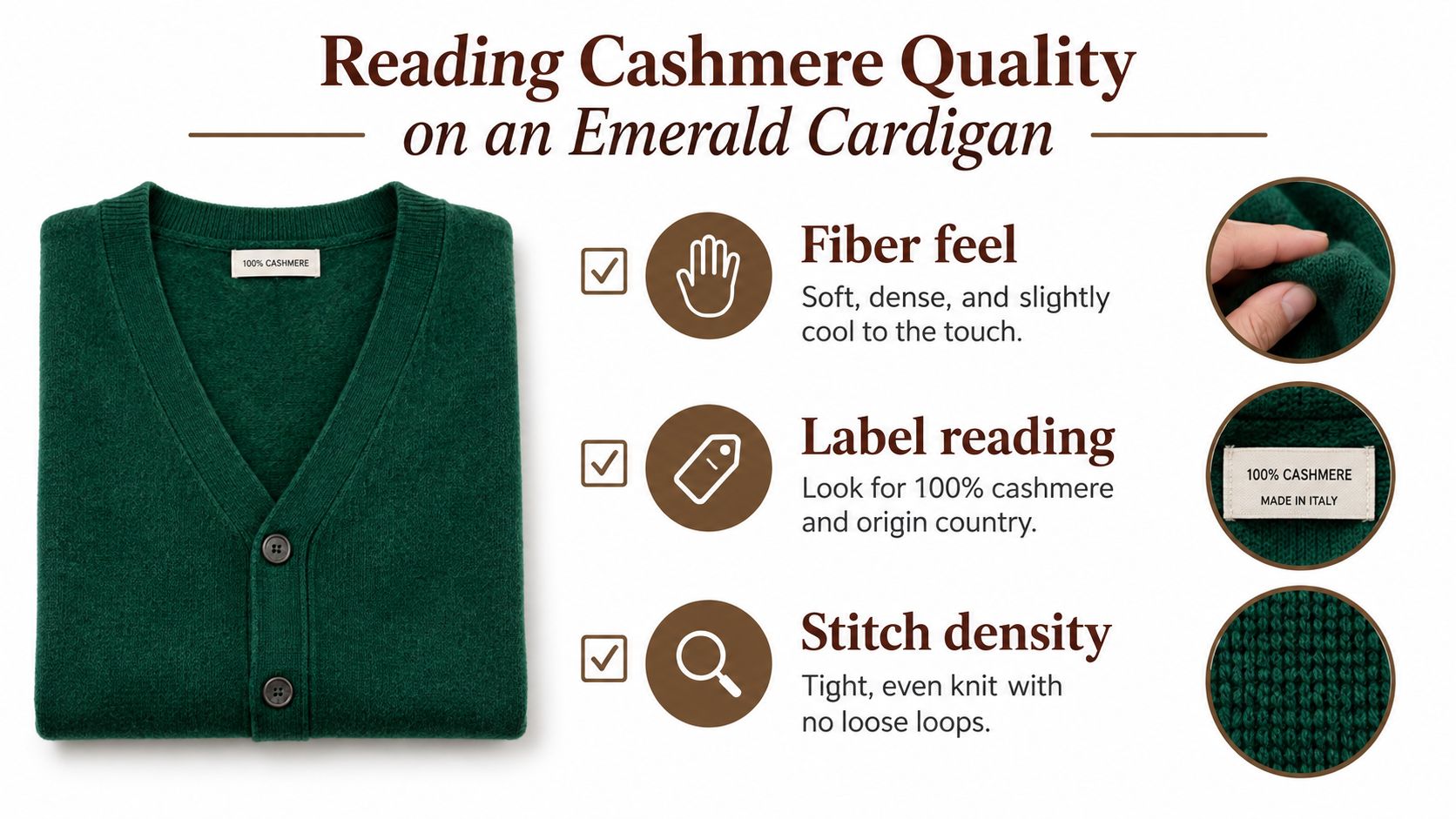
The number that matters is fiber fineness. Research on cashmere puts fibers from Chinese and Mongolian goats at approximately 14.5–16.5 microns, while Iranian cashmere typically runs 17.5–19.5 microns. Finer fibers bend more readily, which is why they feel less prickly against your neck and wrists. For a cardigan worn next to skin, ask for an average diameter near 14–15.5 microns, and treat that figure as real only when supplier testing backs it up. A label saying "Grade A" is marketing, not measurement. (Cashmere fiber and knit research)
Inspect the finished knit, not just the label
Here's the detail that gets missed with emerald specifically. Dyeing doesn't change what the fiber is, but dye color and dyeing conditions can affect how a knit pills. A saturated green also hides surface fuzz in store lighting and product photos, so judge construction rather than hue. A sufficiently twisted yarn in a tighter, even knit generally resists fiber migration better than a loose, low-twist one.
Three checks before you buy:
- Composition and fiber claim. Confirm the cashmere percentage and ask whether a micron spec is supported by testing. "Ultra-soft" and "premium" are descriptions, not data.
- Surface and stitches. Look for even knitting with no loose loops, thin patches, or irregular panels. Touch helps, but a brief feel can't prove how the knit wears after a full winter.
- Care requirements. A delicate sweater is worth buying only if its washing routine fits yours.
Emerald flatters conditionally, and quality follows the same rule: buy the fiber you can verify, not the color that photographs well. For knits built around practical layering rather than softness alone, it helps to find cozy riding sweaters and study how they're constructed for repeated wear. When you want the full rundown of material details worth checking, this guide to choosing a high-quality cashmere sweater covers the rest.
Why Emerald Is Not Automatically Flattering
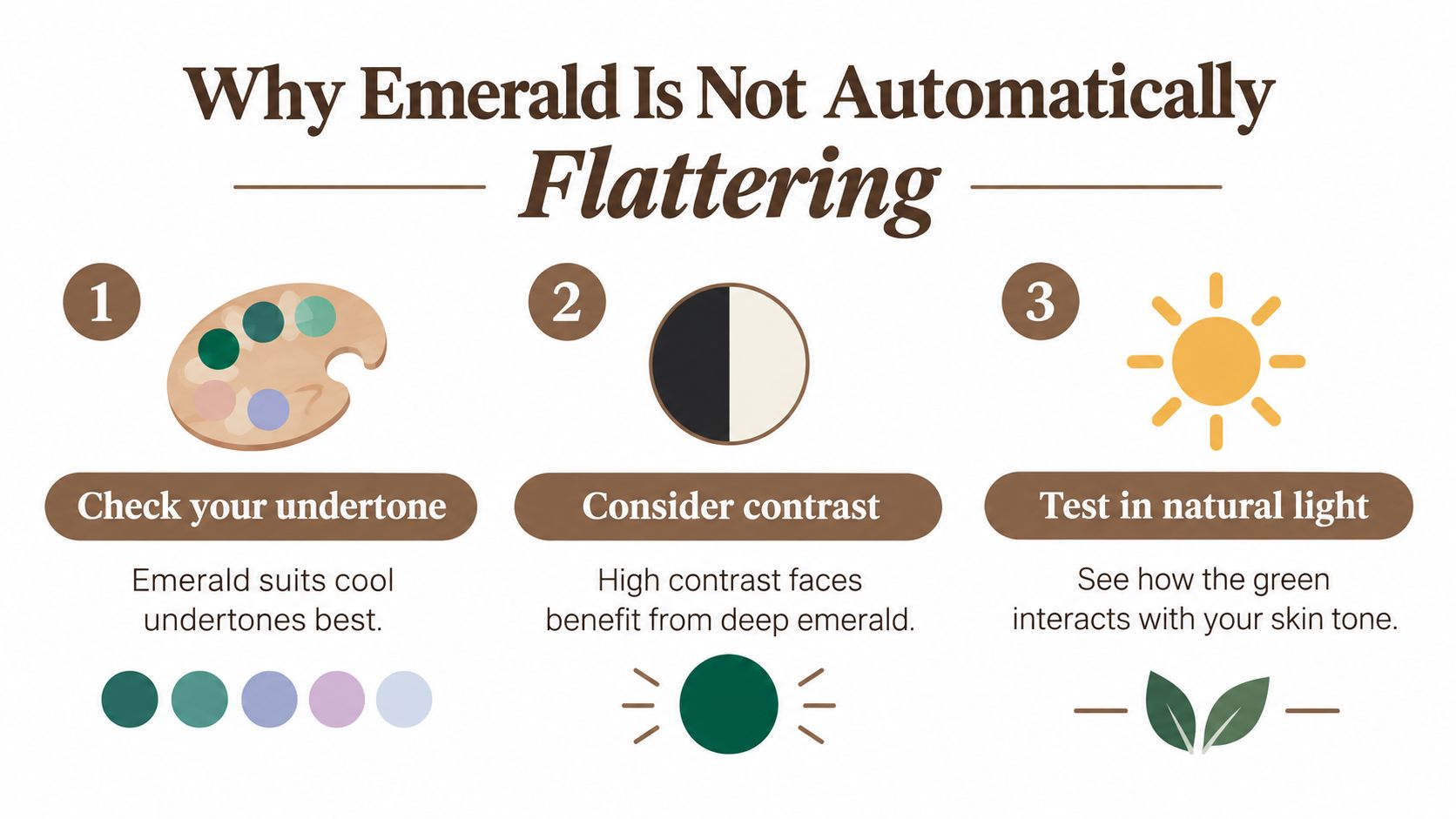
Emerald has presence. That's an advantage when you want a clear accent, but a saturated green can compete with your face or look disconnected from a muted wardrobe. Research on clothing color found that green and blue were among the colors associated with purchase intention, and the emotions linked with green included trust, tranquility, freshness, harmony, optimism, and energy. The same study reported that color-related emotion explained 51% of purchase behavior for hoodies. Those findings describe responses in that study, not a guarantee that emerald will suit every wearer or outfit. (University of Malta apparel experiment)
Choose the effect, not the fashion rule
The same green can look calm and wearable when it's darker or less saturated, then read bold and high-contrast when it's vivid. Research on clothing colors also found a preference for blue-green shades, with lower brightness and purity generally favored. For a cardigan you plan to wear often, a softened emerald may coordinate more easily than a highly bright one.
Warm, cool, and neutral undertones are useful starting points, not rigid rules. A cooler emerald may sit comfortably beside a cool complexion and silver-toned jewelry, while a warmer green may feel more balanced with cream, cognac, or gold. If your coloring is neutral, test both directions. The actual shade, lighting, and colors next to your face matter more than a simple undertone label.
Try the cardigan with a plain white tee, then with the jeans you wear most. Check it in natural light before deciding, since fitting-room lighting can make a green look sharper or duller than it does outdoors. Also test it beside your usual neutrals: charcoal, cream, navy, denim, or warm brown.
My rule: If you have to build an entirely new wardrobe around the color, don't call it versatile. Buy it as a statement piece, or leave it.
Emerald doesn't have to flatter everyone to be worth considering. It does have to work for you. A beautiful sweater that stays unworn because you dislike the color near your face is not a good wardrobe investment.
Outfit Formulas for Every Occasion
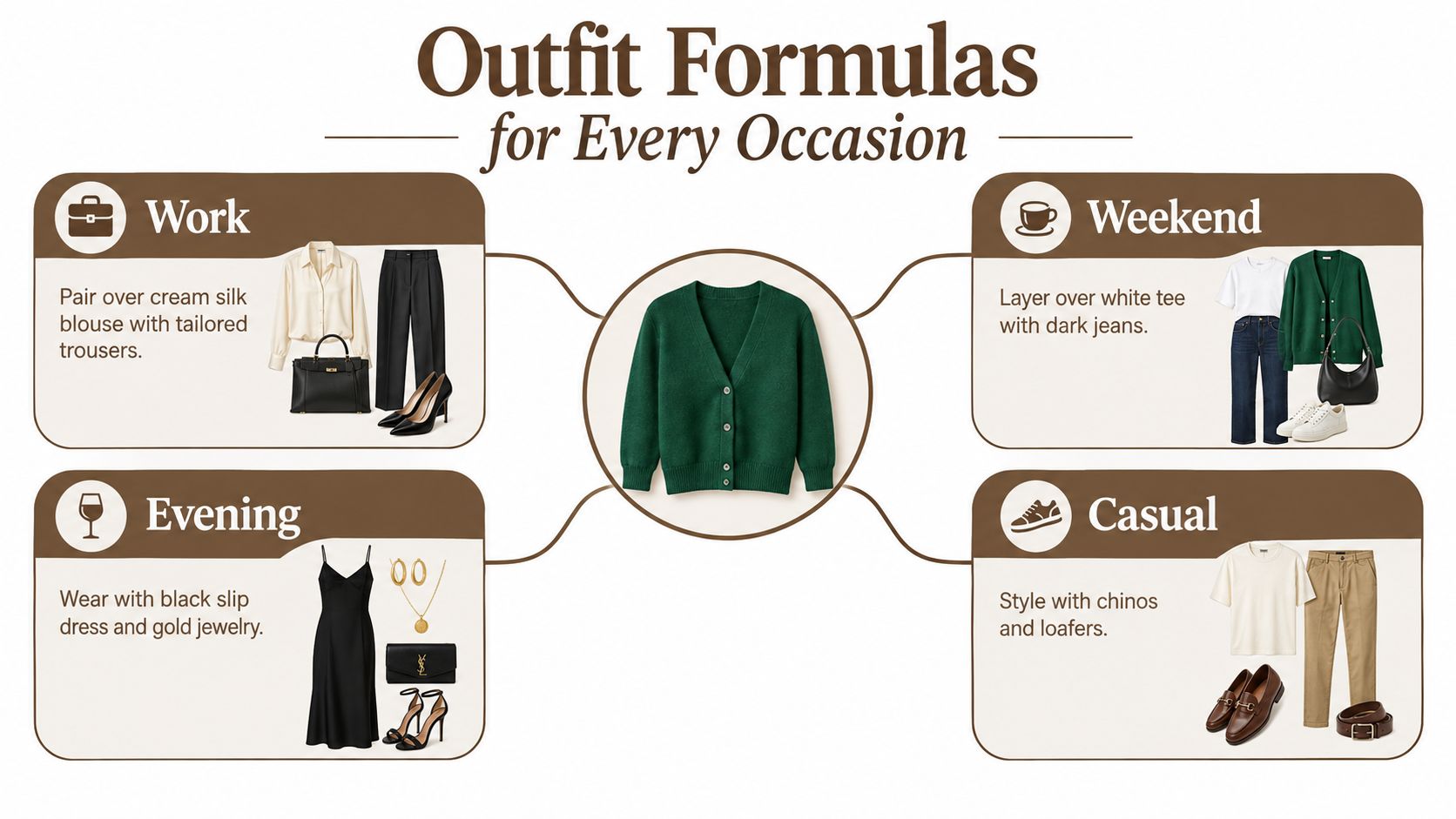
The easiest way to wear emerald is to give it supporting colors with a clear role. Cream and charcoal make it feel composed; denim and white make it casual; black sharpens it for evening; cognac and stripes give it a relaxed travel feel. Pick a formula that fits how you dress, then adjust the shoes and jewelry to suit the setting.
Work
Wear a fitted emerald cardigan over a cream silk shell, with charcoal slim trousers and matte gold jewelry. Choose loafers or a low heel in black, charcoal, or dark brown. The cream softens the contrast near your face, while charcoal keeps the outfit grounded. Button the cardigan neatly if it works as a top; leave it open when the shell has a neckline you want to show.
Weekend
Layer a relaxed cardigan over a white tee and straight-leg denim. White sneakers keep the look uncomplicated, and a simple leather belt can make the outfit feel finished without adding another strong color. If your emerald is vivid, dark denim offers a steadier contrast than pale jeans.
Evening
Wear the cardigan over a black slip dress and add pearl or brushed-silver accessories. A slim cardigan with a clean neckline is easiest here because it won't overwhelm the dress. If the green is the main accent, keep the rest of the outfit restrained and choose a shoe that suits the dress, such as a black flat or a simple heel.
Travel
Pair the cardigan with a striped Breton top, comfortable trousers, and cognac loafers. Cognac warms the outfit, while the stripes break up the solid green. Choose a cardigan that layers without bunching under a coat, and keep a light top beneath it so you can adjust when the temperature changes.
For a simple color check, place your pairings on a warm-to-cool line: cream, cognac, and gold feel warmer; white, charcoal, and silver feel cooler. Denim and black can work between those ends, depending on their shade and finish. Use the video below as an additional visual reference for styling a cardigan across different outfits.
Caring for an Emerald Cardigan So It Lasts
Cashmere's softness is only part of its value. A lifecycle review notes that cashmere can resist odors and last well, which may reduce the need for frequent washing or early replacement. It also identifies energy-intensive processing, chemical wastewater from cleaning and dyeing, livestock-related impacts, and waste from shrinkage, moth damage, and premature disposal. A fiber's natural origin alone doesn't prove that a garment has a low-impact supply chain. (Cashmere lifecycle review)
Make care decisions based on the garment
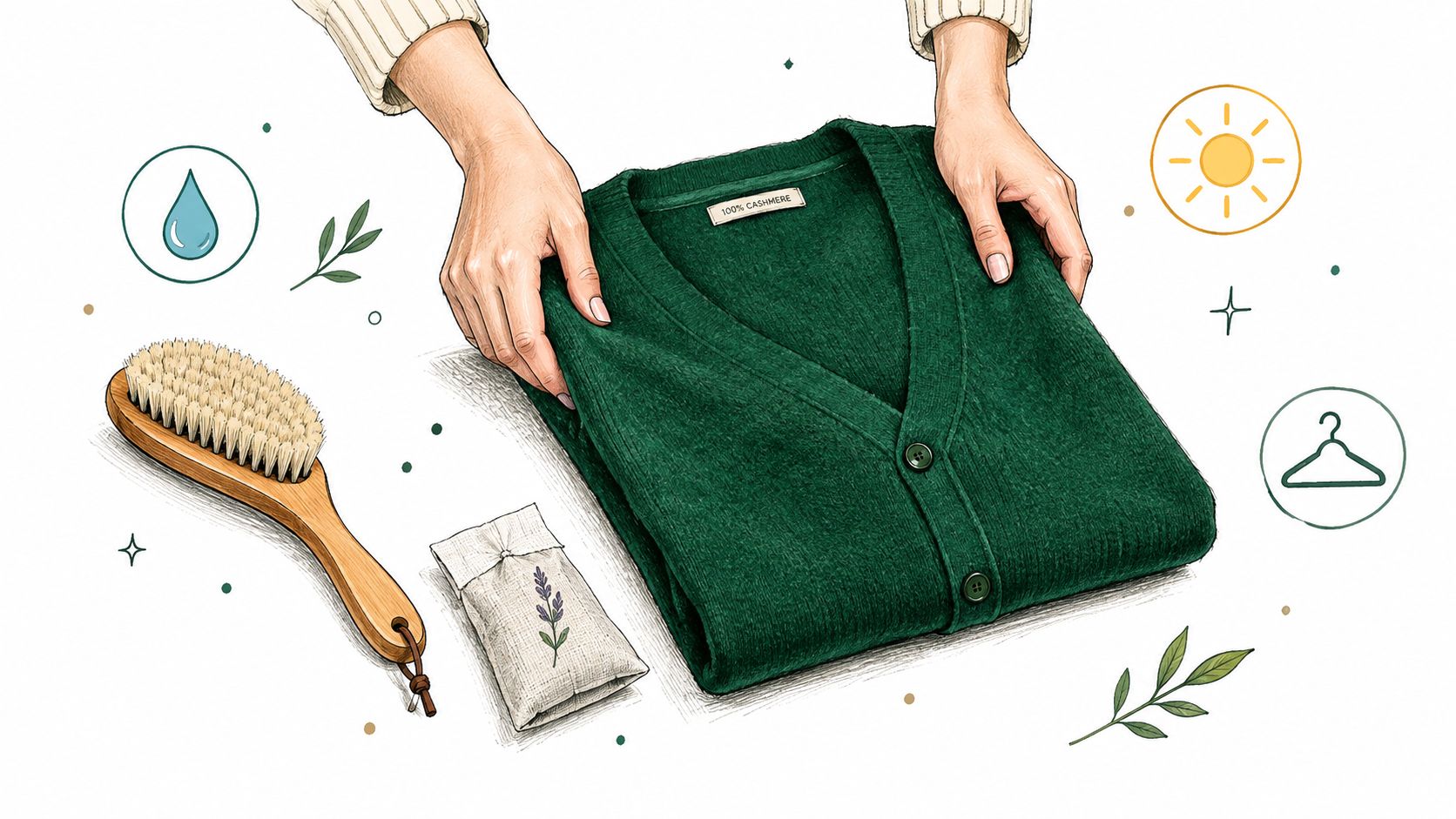
Air the cardigan between wears rather than washing it automatically. If it needs cleaning, follow its care label. For hand-washing, use a gentle method suitable for cashmere, avoid wringing, and dry it flat; if the label directs you to dry-clean, use a cleaner familiar with delicate knitwear. A care guide such as these cashmere care instructions can help you follow the garment's requirements.
Emerald adds a color check to the usual fiber routine. Before the first wash, test a discreet area with a clean, damp white cloth to check for dye transfer. Keep the cardigan away from harsh, direct sunlight when drying or storing it, since appearance can change with exposure and cleaning. Don't assume that a saturated shade will stay identical if you ignore the label or use an unsuitable cleaning method.
Store the sweater clean and fully dry, folded rather than hung, and protected from moths. If a seam comes loose or a small hole appears, consider repair before replacing the garment. Those habits support longevity, but they don't erase the impacts of raising goats or processing and dyeing the fiber. Look for traceability or independent certification when making an environmental decision, and treat broad sustainability wording as a claim that needs evidence.
Your Emerald Cardigan Buying Checklist
Run these checks in the fitting room or with the product page open. Every one of them has saved a client from a bad buy.
- Does the hem and fit work with my usual outfits? Check it over the layers you'll wear, not a bare tee.
- Can the seller substantiate the cashmere specification? A stated fiber diameter near 14–15.5 microns is a useful softness benchmark when backed by supplier testing (see the fiber research in the quality section above). Vague "cashmere feel" copy without numbers is a red flag.
- Is the knit even and sufficiently dense? Inspect the finished fabric, not just the fiber claim.
- Does the shade look good beside my face in natural light? Emerald flatters some complexions and fights others, so don't buy the green on reputation alone.
- Can I pair it with my real wardrobe? Try it against your usual denim and neutrals.
- Will I follow its care instructions? Plan for washing, flat drying, and moth-safe storage.
The cardigan's name traces back to James Thomas Brudenell, the seventh Earl of Cardigan, and its history reaches the Crimean War of 1853–1856. Early versions differed from today's sweater, with sleeved forms emerging later in the nineteenth century (GQ's history of the cardigan).
Before you commit, answer three questions. Does this color suit me? Does this shape fit my life? Can I care for this knit? A no on any of them means wait for a better cardigan.
Cashmere Boutique offers cashmere cardigans and other apparel, accessories, and home textiles, with product information to help shoppers compare materials, fit, and care. Explore the options at Cashmere Boutique and choose a piece that suits your wardrobe, not just the mirror.