
Olive Green Cashmere Sweater Guide: Shade, Fit, and Care
You're standing in front of the mirror wearing an olive sweater that looked perfect on the hanger. Against your face, though, you can't decide whether it makes you look rested or ready for bed. Don't dismiss olive yet. You may have picked the wrong member of the color family, not the wrong color altogether.
Table of Contents
- The Olive Green Cashmere Sweater Moment
- Reading the Olive Family
- What Makes Cashmere Soft, Warm, and Lasting
- Picking a Weight That Matches Your Day
- Fit, Sizing, and Silhouette Choices
- Outfit Formulas That Actually Work
- Care That Prevents Pilling and Fading
- A Short Decision Checklist Before You Buy
The Olive Green Cashmere Sweater Moment
An olive green cashmere sweater is an appealing alternative when black feels severe, beige feels predictable, and another gray crewneck won't add much to your wardrobe. My recommendation is to buy it as a working neutral, not a seasonal statement. That means choosing the shade against your face and the shape against the clothes you wear.
The mirror test matters more than the hanger test.
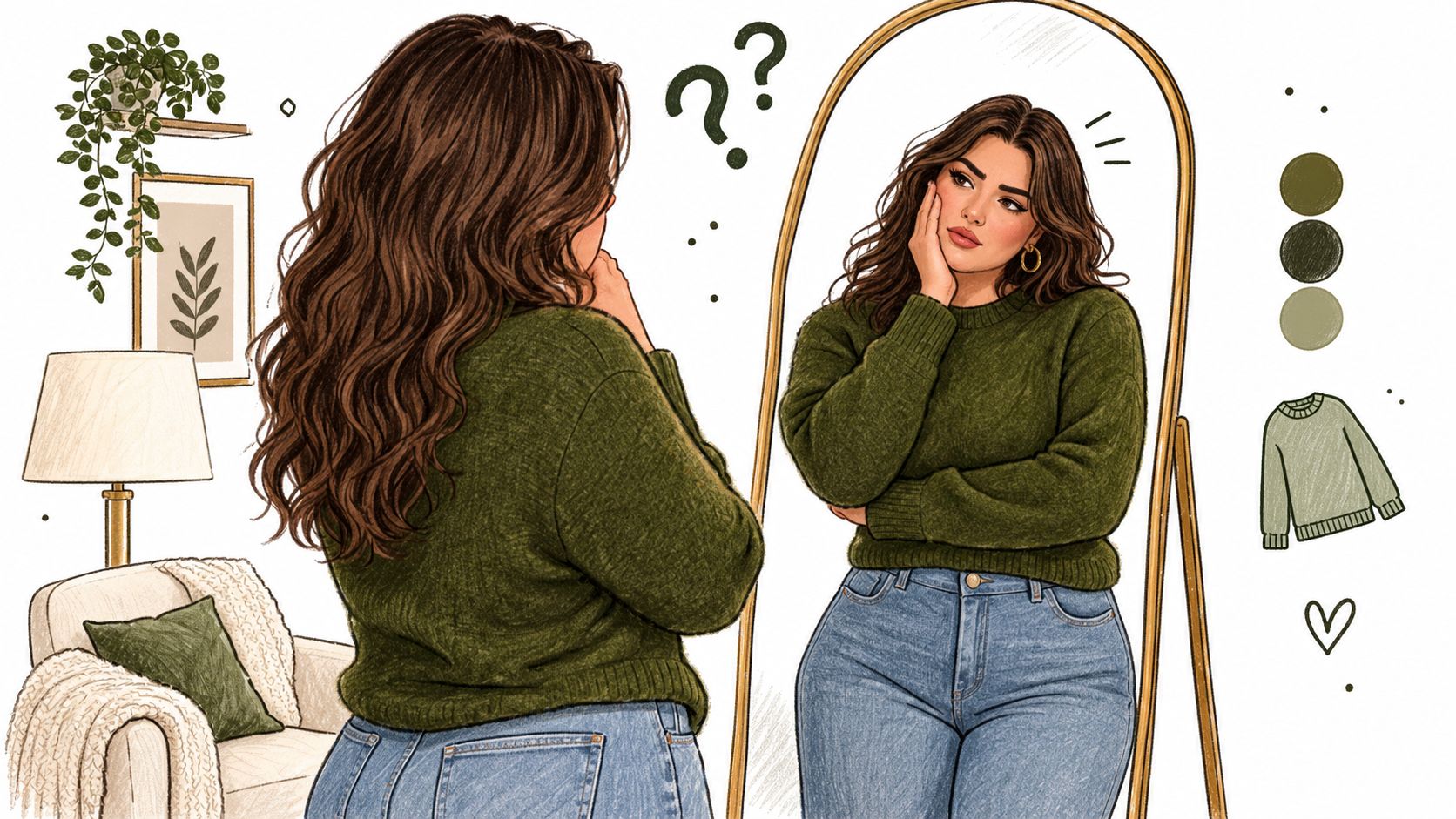
Olive's revival isn't just a stylist's impression. Reporting on renewed interest in olive and khaki recorded a 120% year-over-year increase in searches for “Olive” in October 2025. That's a reason to expect more choice, not a reason to buy whatever shade happens to be trending.
Its appeal also predates the current comeback. Olive's history in military clothing) gives the shade a recognizable practical association. In cashmere, I like that contrast: an understated, utilitarian-looking color in a soft knit that doesn't need elaborate styling.
Buy for ordinary days
The useful question isn't whether olive is fashionable. It's whether you can picture yourself reaching for this particular sweater on a normal morning.
- Look at your face: You shouldn't need extra makeup to make the shade feel convincing.
- Look at your outerwear: Try it with your everyday coat, not just the fitting-room jeans.
- Look at your routine: A sweater that needs care you won't give it is a poor purchase, however lovely it feels.
Shopping-floor rule: Don't buy the sweater because olive suits the model. Buy it because this olive suits you.
Aim for a piece you'll still want to wear after the novelty wears off. Shade, fit, and maintenance deserve more attention than a flattering product name.
Reading the Olive Family
Olive is a shade family, and shopping as though it's a single color creates unnecessary mistakes. Yellow-khaki, muted moss, military olive, gray-green, and deep jungle can produce quite different effects near your face.
Use this visual to separate the shades before comparing product photographs.
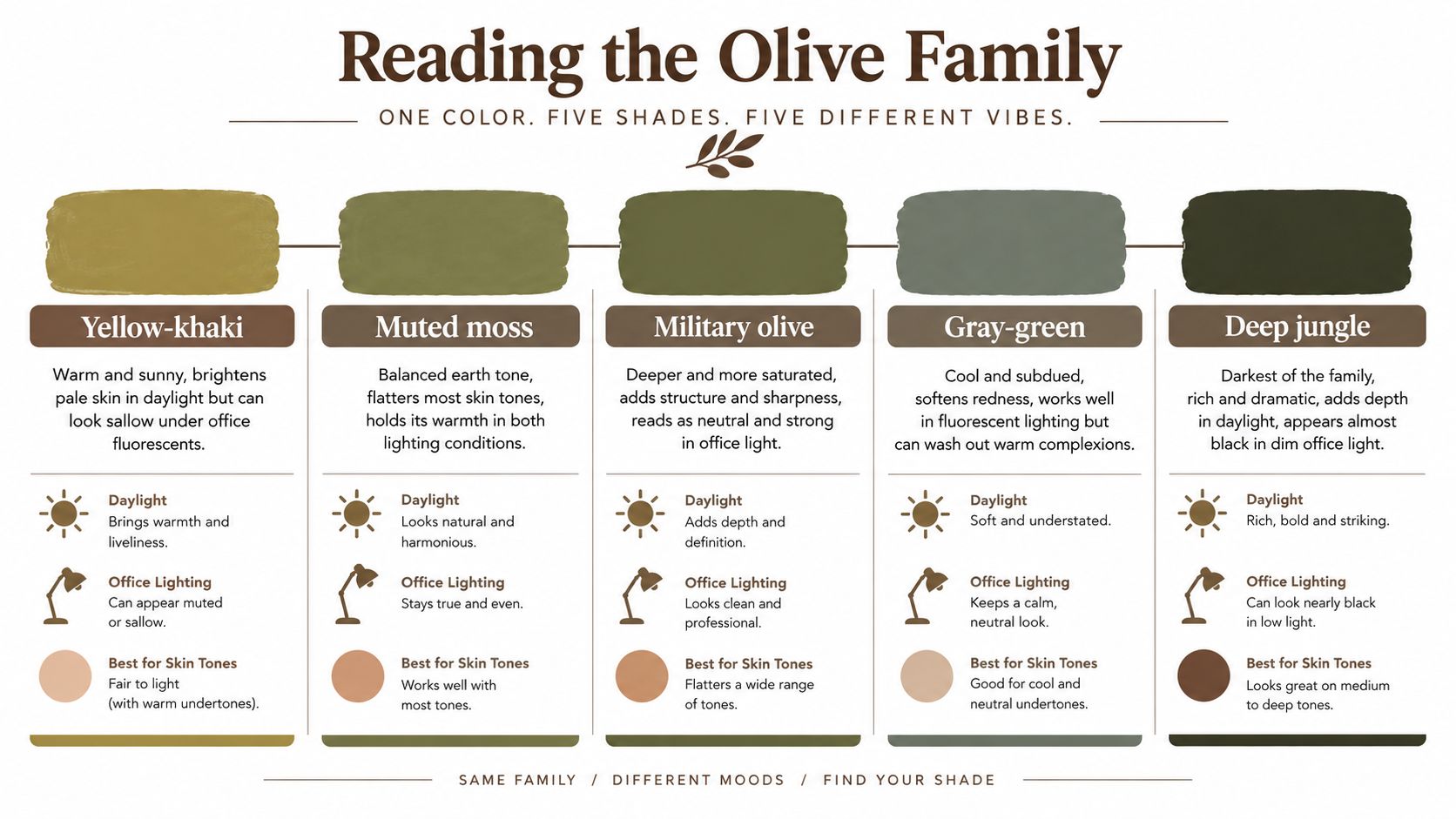
Choose contrast, not an undertone rulebook
Treat these as styling starting points, not guarantees about which complexion can wear which color.
| Shade | What to check in different lighting | Pairings I'd try first |
|---|---|---|
| Yellow-khaki | Does its warmth look lively in daylight but muddy at your desk? | Cream, navy, gold-toned accessories |
| Muted moss | Does the earthy softness complement your face or blur it? | Chocolate brown, pale blue, copper |
| Military olive | Does the stronger shade add definition without looking harsh? | Indigo denim, beige, burgundy |
| Gray-green | Does the cool cast balance warmth or leave you looking flat? | Ivory, navy, silver-toned accessories |
| Deep jungle | Can you still see the green in dim indoor light? | Cream, burgundy, polished metallics |
A warm-toned shopper trying moss beside a copper-framed mirror may like the harmony but want more contrast in daylight. A cool-toned shopper in the same knit might prefer a pale-blue shirt collar between the sweater and their face. Judge the whole combination, including nearby colors.
My fast test is to try cooler olives against warm skin and slightly yellower olives against cool skin. Then try the opposite. Keep whichever makes your face look clearer without effort.
For darker shades, Sprello's forest green color pairings for brands is a useful palette reference to translate into clothing combinations, rather than a prescription for skin tone.
Before buying online, ask for a daylight photograph or color swatch and compare it with something you already own. A fluffy surface and a smooth knit may make the same shade appear different, so don't rely on a tightly cropped color thumbnail.
Use the video as another visual comparison, but make your final decision in your own lighting.
What Makes Cashmere Soft, Warm, and Lasting
Micron diameter means the thickness of an individual fiber, not the thickness of the sweater. It's a useful specification because finer fibers help explain the smooth, less prickly feel shoppers associate with cashmere.
The important distinction is between fiber quality and finished-garment quality.
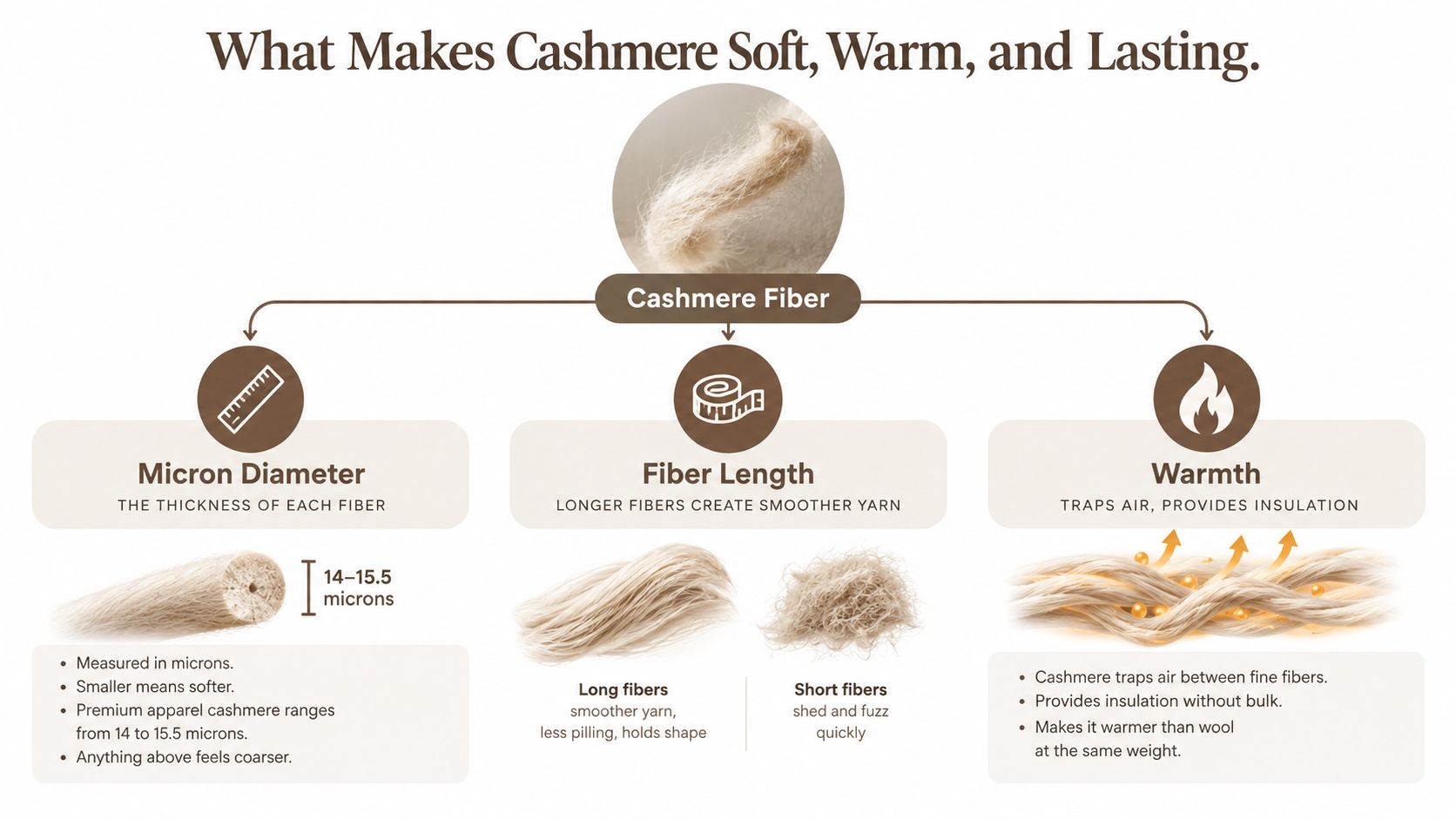
A peer-reviewed comparison of cashmere, fine wool, and yak fibers found average diameters of 14.64 microns for white cashmere, 20.39 microns for fine white wool, and 22.06 microns for white yak fiber. A stated 14–15.5-micron specification is consistent with premium apparel cashmere, but that comparison doesn't establish a universal ranking of every finished sweater. Nor should the fine-wool result be relabeled as a merino-specific measurement.
Ask beyond the softness claim
I'd ask a seller for measurable information before trusting “Grade A” on its own.
- Mean fiber diameter: Ask for the actual specification rather than a softness adjective.
- Fiber length: Request a measurement if available. Longer fibers can support smoother yarn and better resistance to excessive pilling.
- Composition: Check whether the garment is pure cashmere or a blend.
- Construction: Ask about ply and examine how evenly and densely the sweater is knitted.
The FAO's cashmere overview links quality to fiber fineness and provides context on origin and supply. Grade labels aren't globally standardized, so a prestigious-sounding label isn't a substitute for specifications.
Also ask whether the olive is dyed over naturally white or darker cashmere. The base fiber color can influence the finished shade's uniformity and depth. That's particularly relevant if you're trying to match a muted, specific olive rather than simply buying something green.
A sweater can feel wonderfully soft in the shop and still be the wrong purchase for hard, frequent wear.
Softness is necessary, but it isn't enough. Fiber length, dehairing, yarn construction, knit density, and finishing affect how the garment behaves. I'd take a balanced, well-constructed knit over an extravagantly fuzzy one with no useful material information.
Picking a Weight That Matches Your Day
Buy for the temperature you spend your day in, not the coldest moment between your front door and the car. If your office is warm, a bulky sweater can become an expensive item you repeatedly take off.
Ply describes the strands combined into a yarn; gauge describes the knit's stitch scale. Don't treat either label as a complete warmth rating. My practical comparison is to feel the fabric, inspect the knit, and try it beneath the outerwear you intend to use.
Olive Green Cashmere Sweater Weights Compared
| Weight | Ply and Gauge | Best For | Layering Notes |
|---|---|---|---|
| Lightweight | Often labeled 2-ply, with a fine knit | Climate-controlled offices and travel | Try beneath a blazer without bunching |
| Midweight | May be labeled 4-ply, depending on construction | Fall weekends and everyday layering | Leave space for a tee or shirt |
| Chunky winter knit | Substantial yarn and a visibly larger stitch | Cabin stays and cold commutes | Check that your coat closes comfortably |
| Airy shoulder-season knit | Prioritize the fabric's openness over its ply label | Cool spring days worn without a coat | Choose enough substance to drape neatly |
Match the sweater to the outfit
For an office day, I'd choose a fine crewneck under a blazer. For a weekend outside followed by lunch indoors, I'd choose a midweight crew over a washable tee, with a removable jacket rather than relying on a heavy sweater alone.
A chunky knit makes more sense when you'll wear it as the main indoor layer somewhere cold. For exposed walks, judge it as part of an outfit with suitable outerwear, not as a replacement for a protective coat.
Under a winter coat, check the upper arms and armpits for compressed fabric. On its own in spring, check the neckline and hem: they need to look intentional without a jacket framing them.
If you prefer neck coverage without a full turtleneck, compare the proportions in this funnel-neck cashmere sweater guide.
My first-buy recommendation is a moderate-weight crewneck. It's the option I'd choose for a wardrobe that needs both layering and standalone wear.
Fit, Sizing, and Silhouette Choices
A size label won't tell you whether a sweater works with your trousers. Start with proportions, then choose the size that delivers them.
For a classic set-in sleeve, I'd look for the shoulder seam near the shoulder's edge, sleeves landing at the wrist bone, and a hem that covers the belt without swallowing the back pockets. A deliberately dropped shoulder or tunic is a different design, not automatically a fit mistake.
Use these fit zones as reference points rather than rigid rules for every silhouette.
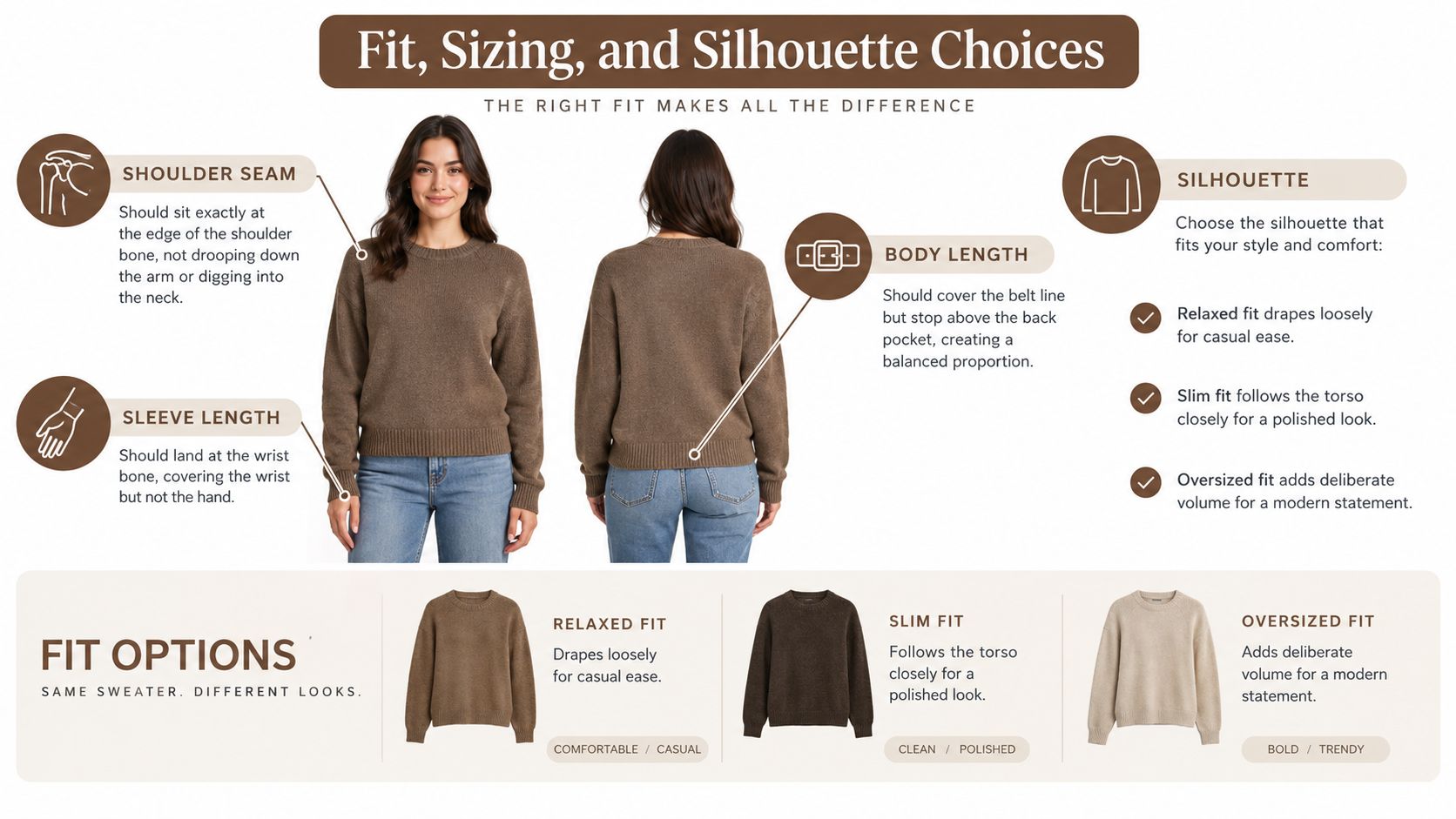
Choose the silhouette's job
- Classic crew: My pick with straight-cut trousers, straight jeans, and layered shirts. Look for room through the chest without pulling.
- Relaxed boyfriend: Good for a casual outfit with a narrower bottom or a controlled front tuck. Deliberate volume looks better than accidental bagginess.
- Longer tunic: Useful with slim trousers when you want coverage. Check the side view so the hem doesn't cling where you want it to skim.
Run the fitting-room test
- Wear your intended underlayer. A sweater that fits over a camisole may not fit over an Oxford shirt.
- Reach forward and lift your arms. Watch for pulling across the back and a hem that won't settle afterward.
- Sit down. Check whether the neckline shifts, the stomach feels constrained, or the hem catches awkwardly.
- Put your coat on. Walk around instead of judging only a static mirror pose.
- Inspect the cuffs and hem. They should sit neatly without needing constant adjustment.
Don't buy a tight sweater expecting it to stretch into the right size. Equally, don't choose excess fabric solely because you're afraid cashmere will feel restrictive.
I prefer comfortable ease with clean underarms. Fabric that bunches or rubs deserves attention, but a closer fit isn't a guaranteed anti-pilling strategy. Movement and the layers touching the sweater matter too.
For online shopping, compare garment measurements with a sweater whose fit you already like. That's more useful than guessing from a model's height.
Outfit Formulas That Actually Work
The easiest way to wear olive is to give it a clear role. Let it replace a familiar neutral, then add contrast through the shirt, shoes, or outer layer instead of buying an entirely new outfit around it.
These are the combinations I'd start with.
Everyday outfits with useful swaps
- Olive crew, indigo denim, white sneakers: Choose military olive for a grounded alternative to a navy sweatshirt. Add a cream jacket and a chocolate-brown belt; swap the sneakers for loafers when you want a tidier finish.
- Olive turtleneck, tailored trousers, camel coat: Gray-green is my preference when the coat is strongly warm-toned. Finish with dark boots and a simple metallic earring. For spring, replace the heavy coat with a light trench.
- Olive cardigan, striped Breton, straight-leg jeans: Muted moss works well as the quiet layer over a busier shirt. Add navy flats and a smooth bag you can carry by hand. Switch to cream jeans when you want the outfit to feel lighter.
Don't force the camel combination if you dislike warm browns near your face. The camel-colored sweater styling guide offers another way to assess that palette, but a navy coat is an equally useful choice.
Polished and evening options
An olive V-neck over a pale-blue Oxford, with chinos and loafers, is my pick for a less formal office. Yellow-khaki can look purposeful here because the visible blue collar separates the sweater from your face. Add a brown belt, then switch to darker trousers for dinner.
For evening, try a deep-jungle sweater with a leather skirt and knee-high boots. Keep the sweater's silhouette uncomplicated and let the contrast between soft knit and smooth leather do the work. A burgundy bag adds interest without requiring a bright accent.
Wardrobe shortcut: Start with the outfit you already wear most, then replace its usual sweater with olive.
The crewneck-and-denim formula is my first choice for repeat wear. You can assess the shade, comfort, and practicality with familiar pieces before deciding whether you want a more specialized neckline or silhouette.
Olive doesn't have to stay in an autumn wardrobe. Pale blue, cream, and lighter footwear are the swaps I'd use to keep it in rotation when the season changes.
Care That Prevents Pilling and Fading
A premium label won't compensate for rough laundering. I'd rather see a good sweater cared for consistently than an exceptional one twisted wet, hung up, and attacked with a shaver.
Expert cashmere guidance on washing and pilling explains that all cashmere can pill, with friction as the immediate cause and excessive pilling more associated with shorter fibers and poorer construction. Underarms, cuffs, shoulders, and bag-contact areas deserve particular attention.
A routine you can maintain
- After wearing: Check for spots, allow the sweater to air, and rotate it with other clothes instead of wearing it continuously.
- Before washing: Follow the garment label. Test your chosen wool-and-cashmere detergent and water temperature on an inconspicuous inside area, watching for color transfer or a changed surface.
- During washing: Use cool water, mild detergent, and minimal agitation. Don't scrub a stain aggressively.
- After rinsing: Press out water without twisting. Lay the sweater flat on a towel and gently arrange it to its original outline.
- For storage: Put it away fully dry and folded in a breathable drawer, not suspended from a hanger.
Heat and agitation can felt the fibers, while twisting can distort the knit. Wet cashmere is also heavier, so hanging it to dry invites stretching under its own weight. Consult the cashmere care instructions before treating a new piece.
Remove pills without chasing perfection
Use a cashmere comb gently, with the sweater supported on a flat surface. Don't repeatedly scrape a clean area to remove every trace of fuzz, and avoid an aggressive electric shaver that can catch the knit.
A little loose-fiber pilling isn't the same as thinning fabric, a snag, or an opening seam. Inspect the surface before deciding it needs more grooming.
Research on treated cashmere fabric shows that construction and fiber-surface treatment influence pilling performance. It doesn't justify trying experimental treatments at home.
For olive specifically, gentle cleaning helps preserve the dye appearance and avoid uneven surface wear. Wash when needed, not automatically after every outing, and reduce contact with rough bag straps or abrasive outerwear.
A Short Decision Checklist Before You Buy
Choose the sweater for your real calendar. A beautiful olive knit that only works with an imaginary wardrobe isn't versatile.
Before checking out, write down the trousers, shoes, and coat you'll wear with it first. If those items aren't already in your closet, decide whether you truly want the extra purchases. Don't turn a sweater purchase into a full wardrobe replacement project.
Save this buying checklist
- Shade approved: You've assessed the color against your face in daylight and indoor light, not just admired the product photograph.
- Materials explained: The seller provides a useful micron specification, clear composition, and whatever construction information is available.
- Weight chosen: You've matched the knit to your usual indoor conditions and outerwear.
- Proportions checked: The shoulders, wrists, chest, and hem work with your intended underlayer and bottom.
- Movement tested: You can sit, reach, and put on your coat without repeatedly rearranging the sweater.
- Care prepared: You have suitable detergent, space for flat drying, folded storage, and a cashmere comb.
- First outfit ready: You can wear it without ordering something else to make it work.
Know when to leave it
Walk away if the color only looks good beneath flattering shop lighting. Leave it if you're already planning to tug the hem down, roll the cuffs constantly, or tolerate a scratchy bag strap against it.
For a gift, prioritize the recipient's existing neckline and color preferences over what you'd choose for yourself. If you can't confidently judge the shade, check the return arrangements before buying.
There's no need to collect every version of olive. My preference is a single well-chosen sweater with a clear place in your wardrobe and a care routine you'll follow. That gives you a better chance of wanting to wear it two winters from now, without pretending any garment comes with a guarantee of looking untouched.
Cashmere Boutique offers cashmere sweaters, accessories, and home textiles, with apparel fibers specified at approximately 14–15.5 microns. Visit Cashmere Boutique to compare styles and available colors, then choose the olive shade and silhouette that work with your everyday outfits.