
Camel Colored Sweater Styling and Buying Guide
You're standing in front of the closet again, trying to pull together something that looks polished without feeling fussy. A camel colored sweater solves that problem better than most knits because it sits between casual and refined, softens denim, and still looks intentional with structured pieces. The trick is choosing the right shade, the right shape, and the right cashmere quality so it feels like a smart staple, not just another neutral.
Table of Contents
- Why a Camel Sweater Earns a Place in Every Closet
- What Makes Camel Color Feel So Luxurious
- How to Find Your Most Flattering Camel Shade
- Best Camel Sweater Silhouettes for Women and Men
- Easy Camel Sweater Outfits That Always Look Polished
- Cashmere Quality Weight and Texture Explained Simply
- Keep Your Camel Sweater Looking New Year After Year
Why a Camel Sweater Earns a Place in Every Closet
A camel sweater earns its place because it works with more than you expect and never looks as if it is trying too hard. It can sit beside jeans on a Saturday, then pair with trousers or a skirt on Monday and still feel polished. That flexibility is what makes the color so useful before you even start building an outfit.
Its appeal also comes from its history. Camel hair was used traditionally for tents, carpets, and cloaks in regions where camels were raised, and documented use in Western garments dates from the 17th century (camel hair history). By the 19th century, manufacturers blended camel hair with wool more often, which widened its use beyond traditional textiles. In the 1920s and 1930s, camel-hair coats appeared in polo culture between matches, linking the shade with relaxed luxury and sporting ease.
Practical rule: treat camel as a warm neutral bridge, not as a “special occasion” color.
That matters for cashmere buyers. Camel, beige, and tan sit in the same broad family of understated luxury neutrals, so the sweater feels versatile instead of trend-driven. It helps womenswear, menswear, layering, and gifting because the shade feels grounded, not loud. A good camel knit has the easy confidence of something borrowed from someone with excellent taste, even when it is the most practical piece in the outfit.
What Makes Camel Color Feel So Luxurious
Camel feels expensive because it comes from a natural fiber story, not just a color label. Its soft golden tan reads as warm and grounded, more like toasted honey or sunlit sand than a flat beige.
From fiber to fashion
That sense of richness comes from how the shade behaves in clothing. Camel carries enough warmth to feel inviting, but it still sits close to the neutral family, so it never looks loud. A camel sweater can feel dressed up without looking fussy, which is part of its appeal.
The color also has a built-in sense of texture. On cashmere, camel often looks deeper and more dimensional because the fibers catch light in a gentle way. On a smoother knit, the same shade can seem cleaner and more restrained. That difference matters when you are choosing a sweater, since the fiber and the color work together.
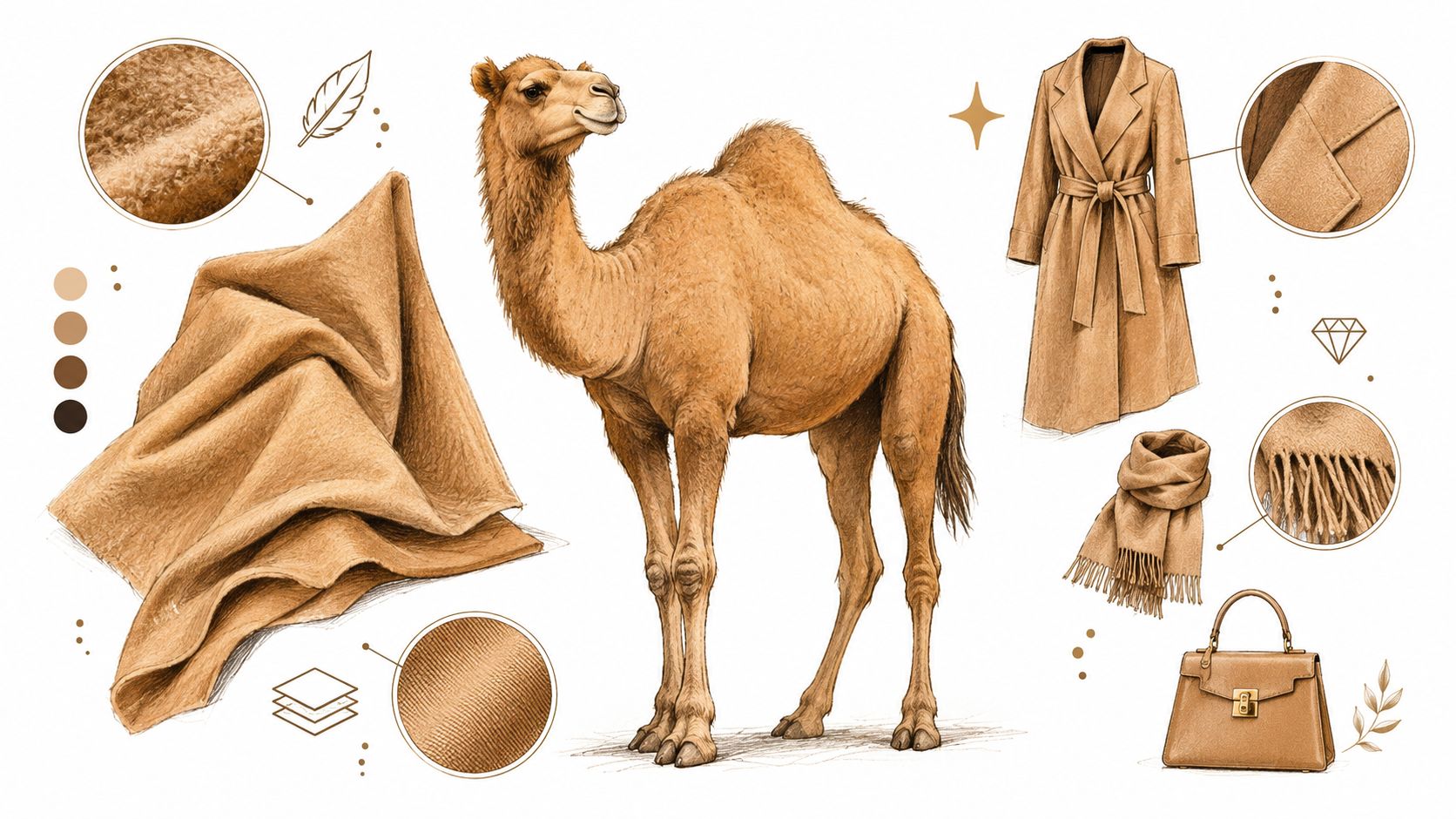
Camel also pairs well with materials people already read as refined. It sits naturally beside leather, wool, suede, and cashmere, so the outfit feels considered without needing much effort. A camel sweater over ivory trousers, with a camel belt or a dark coat, usually looks intentional because the shade links everything together.
Why the color reads as a neutral
Camel works as a neutral because it supports other colors instead of fighting them. It goes easily with denim, navy, ivory, chocolate, and charcoal, which makes it useful for wardrobes built around repeat wear. That is why it feels future-proof. You can style it now and still reach for it later without it looking tied to one short-lived trend.
It also reads as a quiet signal of taste. The shade feels calm, warm, and polished at once, so it gives an outfit presence without turning into the main event. If a camel knit sits well near your face and looks balanced with the rest of your wardrobe, it will usually feel more luxurious than a brighter or cooler brown. The goal is simple. Camel should look like a natural extension of your clothes, not a color you had to force into place.
How to Find Your Most Flattering Camel Shade
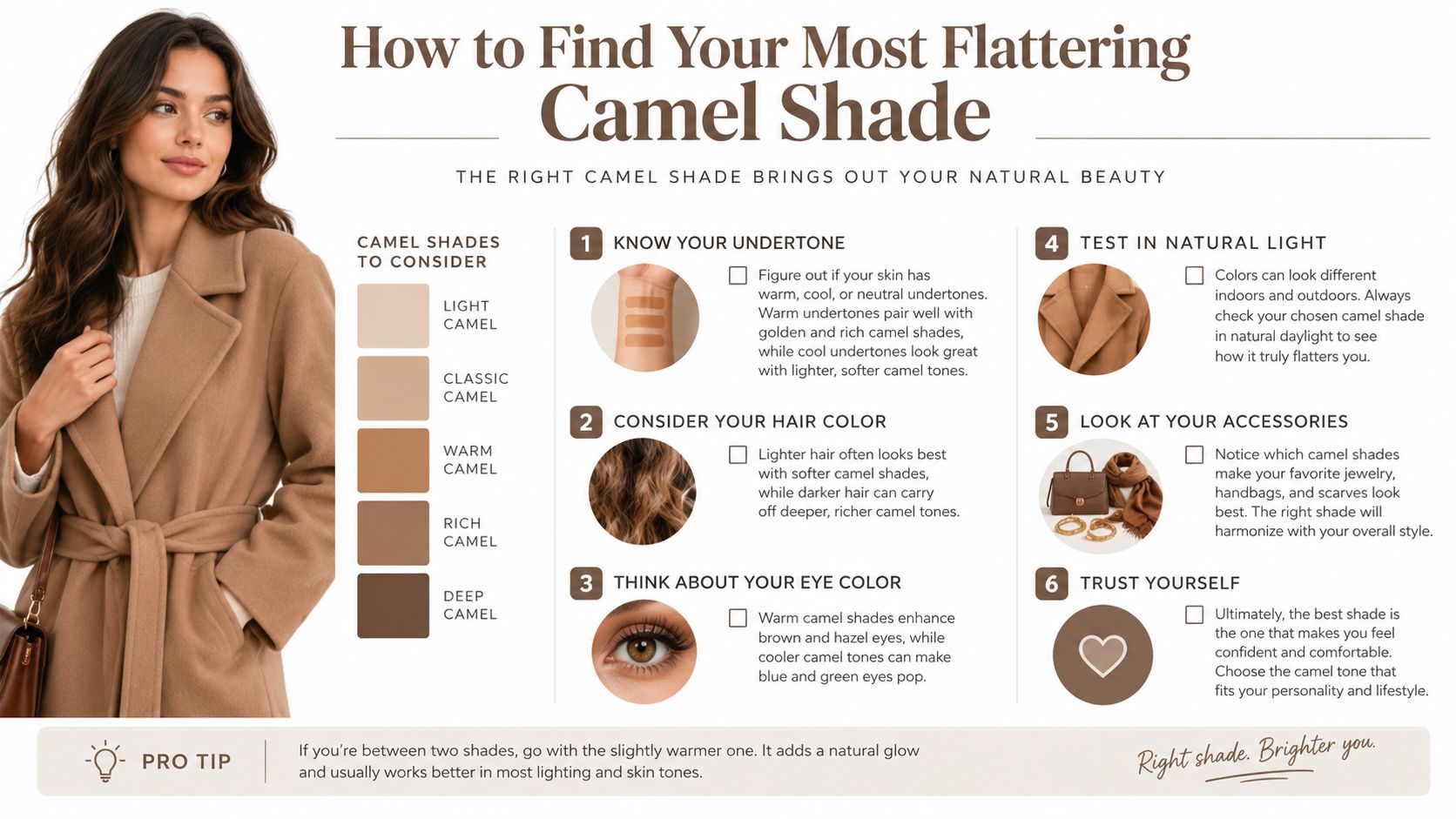
Not every camel sweater is the same shade, and that's where shoppers get tripped up. One version may look like honey, another like taupe, and another like a deeper cognac tone. A sweater that looks perfect in a product photo can suddenly feel too yellow, too gray, or too brown once it's near your face.
Match the undertone to your coloring
Warm undertones usually handle the most golden camel easily, especially when the color has a honeyed or toasted cast. Neutral undertones often have more room to move, so both softer taupe-camel and richer cognac camel can work. Cool undertones may find deeper or less-yellow camel easier to wear, especially if the sweater isn't sitting directly beside the face.
Good test: if the sweater makes your skin look calm and even in daylight, the shade is probably doing its job.
A useful habit is to compare the sweater near a window in daylight, then again under indoor light. Warm camel can look brighter, lighter, or more golden depending on the room, and a fuzzy knit can appear lighter than a smooth one even when the dye is the same. Screen calibration also changes what you think you're ordering, so a glossy online image can overpromise warmth or brightness.
Use placement to your advantage
If a stronger camel tone feels too warm up top, don't rule it out immediately. Move the shade away from the face with a shirt collar, scarf, or jacket opening, and it often becomes much easier to wear. A rose camel or taupe-camel can also soften the effect when you want the color story without the extra warmth.
For a quick shopping checklist, keep these ideas in mind:
- Honey camel: Best when you want warmth and glow close to the face.
- Taupe-camel: Helpful when you want a quieter, less-yellow read.
- Cognac camel: Stronger and richer, useful when you want depth.
- Rose camel: A gentler choice if golden camel feels too hot.
Best Camel Sweater Silhouettes for Women and Men
Shape changes how camel reads just as much as shade does. A crewneck can look relaxed and classic, while a turtleneck turns the same color into something more architectural. Think of the neckline like a frame around your face, it decides where the eye lands first.
Choose the neckline that fits your routine
A crewneck is the easiest entry point because it works with jeans, trousers, and layered shirting. A V-neck opens the upper body and gives you room to show a collar, necklace, or crisp tee underneath. A turtleneck is stronger and more polished, especially when you want the sweater itself to be the main statement.
Cardigans are useful when you want flexibility. They can stay open over a shirt for office polish or button up as a top on milder days. Twin sets lean more refined and can feel elegant for gifting, while a relaxed tunic works better when you want ease and coverage.
The men's side often benefits from the same logic, just with different styling habits. A camel crew works well under a coat, a zip style feels sporty, and a vest gives layering without bulk. For people who want a slightly higher neckline and a clean line under outerwear, this internal guide on a funnel neck cashmere sweater is a useful comparison point.
Match silhouette to the occasion
Office rule: cleaner necklines usually read more polished, especially when paired with tailored trousers or a neat skirt.
For weekend wear, a slightly relaxed body gives camel a softer, lived-in feel. For dinner or gifting, a more fitted shape or a fine-gauge knit usually looks considered without being stiff. The right silhouette is the one that supports how you dress, not the one that looks most dramatic on a hanger.
A short way to narrow it down is to ask where you need the sweater to do the most work. If it needs to layer, pick a sleeker shape. If it needs to stand on its own, choose one with a neckline or texture that carries the outfit.
Easy Camel Sweater Outfits That Always Look Polished
Camel gets easy once you stop treating it like a standalone piece and start pairing it with a clear color strategy. Cool contrast gives it definition, warm tonal dressing makes it feel luxe, and one updated accent keeps it from drifting into a tired neutral zone. The result is a sweater that looks styled even on simple days.
Simple outfit formulas
A camel sweater with navy trousers or jeans is one of the cleanest combinations because the cooler tone sharpens the warmth. Camel with charcoal works the same way and feels especially sharp in an office setting. Camel with denim reads casual but still pulled together, which makes it an easy travel choice.
Tonal dressing works differently. Camel with ivory feels soft and expensive, especially when the fabrics have some texture. Camel with chocolate creates a richer, grounded look that works well in colder months. If you want the outfit to feel current, add a cream accessory or a burgundy accent so the palette doesn't become too expected.
A camel sweater can show lint, makeup, and food marks more clearly than dark knits, so keep the rest of the outfit clean and simple when you want the color to look sharp.
Pairing matrix
| Pairing goal | Colors to try | Best occasion |
|---|---|---|
| Crisp contrast | Navy, charcoal, denim | Office, travel, everyday wear |
| Soft tonal look | Ivory, chocolate | Dinner, weekends, refined casual |
| Updated neutral capsule | Cream, burgundy | Modern wardrobe building |
One easy rule keeps the whole thing balanced. Use cooler colors when you want camel to feel fresh, and use warmer colors when you want it to feel enveloping. That way the sweater keeps doing different jobs without needing a full closet reset.
Cashmere Quality Weight and Texture Explained Simply
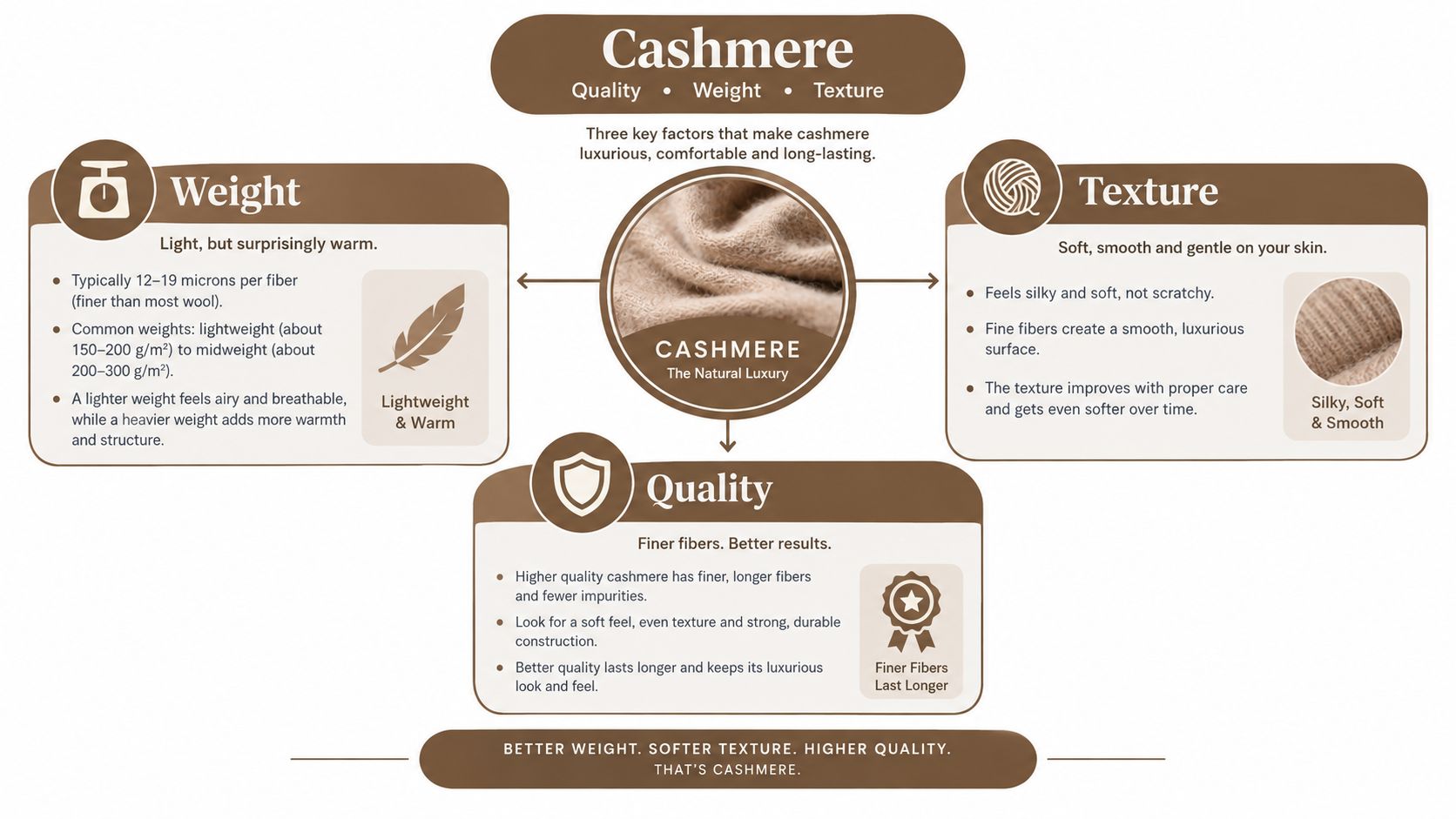
A camel sweater looks its best when the cashmere itself supports the color. Fiber diameter, knit structure, and surface texture all shape how soft it feels, how warm it wears, and how the camel shade reads in real life. A sweater can look rich online and still disappoint if the fiber or knit is off.
What to check on the label
In the United States, cashmere is defined as fine, dehaired goat undercoat fiber with an average diameter no greater than 19 micrometers, no more than 3% of fibers above 30 micrometers, and a diameter coefficient of variation no greater than 24% (cashmere quality specification). Finer fibers usually feel less prickly, but uniformity matters too, because a few coarse fibers can change comfort even when the average looks good. That is why micron claims and composition details matter more than the color name alone.
Thermal behavior comes from the yarn network, porosity, and trapped air, not the color. Cashmere adds warmth because the structure holds air close to the body, which is why a lightweight sweater can still feel efficient. A blend may trade some softness for structure or durability.
Why texture changes the camel tone
Surface texture also changes how camel looks. Research on cashmere fabrics found that lightness shifts with fiber alignment, viewing angle, hairiness, and hair direction, so a brushed sweater can look lighter and less saturated than a smooth one even when the dye is the same (cashmere surface characterization). Two sweaters labeled camel can look like different colors once you put them on.
For online shopping, compare front panels, cuffs, and collars, because abrasion and directional nap can create local reflectance differences. Daylight-balanced photos help too, since store lighting can make camel drift warmer or grayer than it will look outside. Cashmere Boutique, for example, lists Grade-A cashmere with stated fiber diameters around 14 to 15.5 microns, which is the kind of detail shoppers should look for when they want to compare options carefully.
If you want a practical buying checklist, how to choose high-quality cashmere sweater is a useful companion. It is easier to choose well when you know what softness, loft, and knit weight should feel like before the sweater reaches your closet.
Keep Your Camel Sweater Looking New Year After Year
A camel sweater stays elegant when you protect the loft, the drape, and the surface finish. Compression and friction flatten the yarn network, and once that happens the color can look duller because the light no longer catches the knit in the same way. Good care is partly about fabric health and partly about preserving the depth that makes camel look special in the first place.
Build a small, future-proof capsule
One camel knit can do more when it sits inside a simple neutral system. Pair it with one cooler neutral, like navy or charcoal, and one accent, like burgundy or a refined cream. That combination gives you enough range to wear camel often without making every outfit look the same.
Keep camel away from clutter in the outfit, then let texture do the talking.
For maintenance, fold the sweater instead of hanging it for long stretches, since hanging can stretch the shoulders. Use a gentle fabric comb or depiller when pills start to appear, and spot-check areas that brush against coats, handbags, or desk surfaces. If the sweater needs deeper attention, follow the care guidance on the garment label and the retailer's instructions at cashmere care instructions.
Borrow one lesson from home textiles
Wool care at home follows the same basic logic, keep fibers clean, dry, and protected from unnecessary friction. The wool rug care advice from Lewis and Sheron Textiles on wool rug maintenance tips is a helpful parallel because it reinforces the same idea, gentle upkeep preserves texture and appearance longer than harsh treatment.
If you store the sweater clean, fold it loosely, and keep it out of direct pressure, it'll hold its shape better between seasons. That's what keeps camel looking luminous instead of tired. A well-cared-for sweater doesn't just last longer, it keeps the shade looking intentional every time you wear it.
Cashmere Boutique carries camel cashmere sweaters, cardigans, and related layers that make this color easy to wear in real life. If you want to compare silhouettes, fiber details, and giftable neutral styles in one place, visit Cashmere Boutique and look for the camel pieces that fit your undertone and your wardrobe.