
Black Long Sleeve Sweater Buying Guide for 2026
Everyone says a black sweater is the easy buy. It isn't. A black long sleeve sweater only earns its place when the fit measurements, cashmere quality, knit weight, and laundering discipline are right. Get those wrong, and you end up with cuffs that fade, elbows that bag out, and a piece that looks tired before the season is over.
Table of Contents
- Why Your Black Sweater Never Seems to Wear Well
- Understanding Cashmere Quality Beyond the Label
- Choosing the Right Silhouette for Your Wardrobe
- Building Outfits Around Layering Rules
- Caring for Black Cashmere So It Actually Lasts
- When Black Is Not the Smartest Choice
- A Pre-Purchase Checklist for a Black Long Sleeve Sweater
Why Your Black Sweater Never Seems to Wear Well
A shopper pulls a black sweater out of the closet, and the problems are obvious. The elbows shine, the cuffs look dusty, and the body hangs differently than it did in the store. That isn't bad luck, it's usually a predictable mix of friction, weak construction, and careless washing.
Black also shows every small mistake. A little dye loss or surface abrasion stands out far more on a dark knit than on a pale one, so the sweater looks older faster even when the damage is minor.
Practical rule: if the sweater looks great only on the hanger, it's already a weak buy.
The question isn't whether black is versatile. It is. The question is whether the sweater was built to stay sharp after regular wear, or whether it was bought on color alone.
Understanding Cashmere Quality Beyond the Label
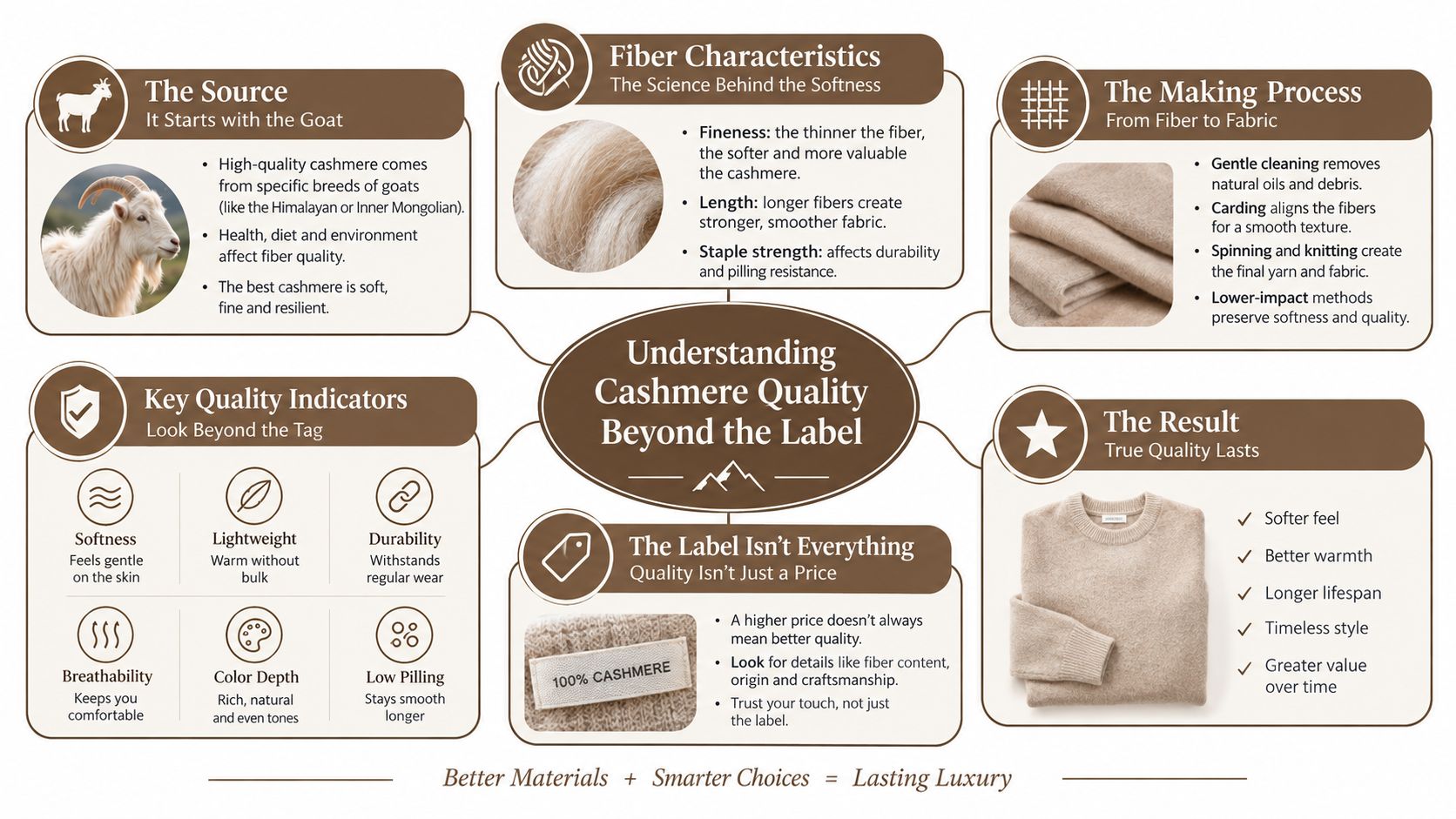
Cashmere quality starts with the fiber, not the marketing copy. Cashmere down fibers are exceptionally fine, and that fineness helps create an insulating network that traps still air. A peer-reviewed study reports a mean cashmere down diameter of approximately 13.8 micrometers in one goat population, and Cashmere Boutique says its Grade-A cashmere is specified at roughly 14 to 15.5 microns, which is in the zone you want for a soft, efficient sweater. How to choose high-quality cashmere sweater
Read the product page like a buyer, not a browser
Micron count is useful, but it's only one piece of the picture. Ply, knit gauge, and yarn weight change how the sweater hangs, how much structure it keeps, and whether it feels airy or substantial. Think of micron count like thread count in sheets. Helpful, but not the whole story.
A sweater can be soft and still hold its shape, or it can feel luxurious in hand and then collapse after a few wears. That's why I care more about the combination of fiber diameter, knit density, and finishing than the word cashmere by itself.
For everyday wear, a fine-gauge black sweater works best as a close-to-body layer under a jacket. If it's meant to do all the work on its own, it needs more body in the knit and a fit that doesn't cling.
Choosing the Right Silhouette for Your Wardrobe
Most black sweater problems start with the wrong shape. A crew neck stays closest to the body and sits cleanly under tailoring, which is why it works when jacket collars need room. A V-neck pushes the eye down the torso and gives a shirt more visibility, so it earns its place in sharper office outfits.
Pick the shape for the job
A mock neck is the modern choice. It looks polished without the bulk of a folded collar, and it sits neatly under coats. For a close cousin that reads even cleaner in outerwear, see the funnel neck cashmere sweater guide at funnel neck cashmere sweater.
A turtleneck gives the most warmth and the strongest line, but it also asks more of your proportions and posture. If the fit is off, black will not hide it.
If you want a fitter silhouette, do not guess. Read up on sewing ease at find the right sewing ease, then compare that idea with the sweater's actual chest and shoulder measurements. That is how you tell the difference between a knit that skims the body and one that pulls, rides up, or shows every layer underneath.
Buy for your closet, not your mood. If you wear blazers often, start with a crew neck or a mock neck. If you want a more assertive standalone knit, choose a turtleneck.
Building Outfits Around Layering Rules
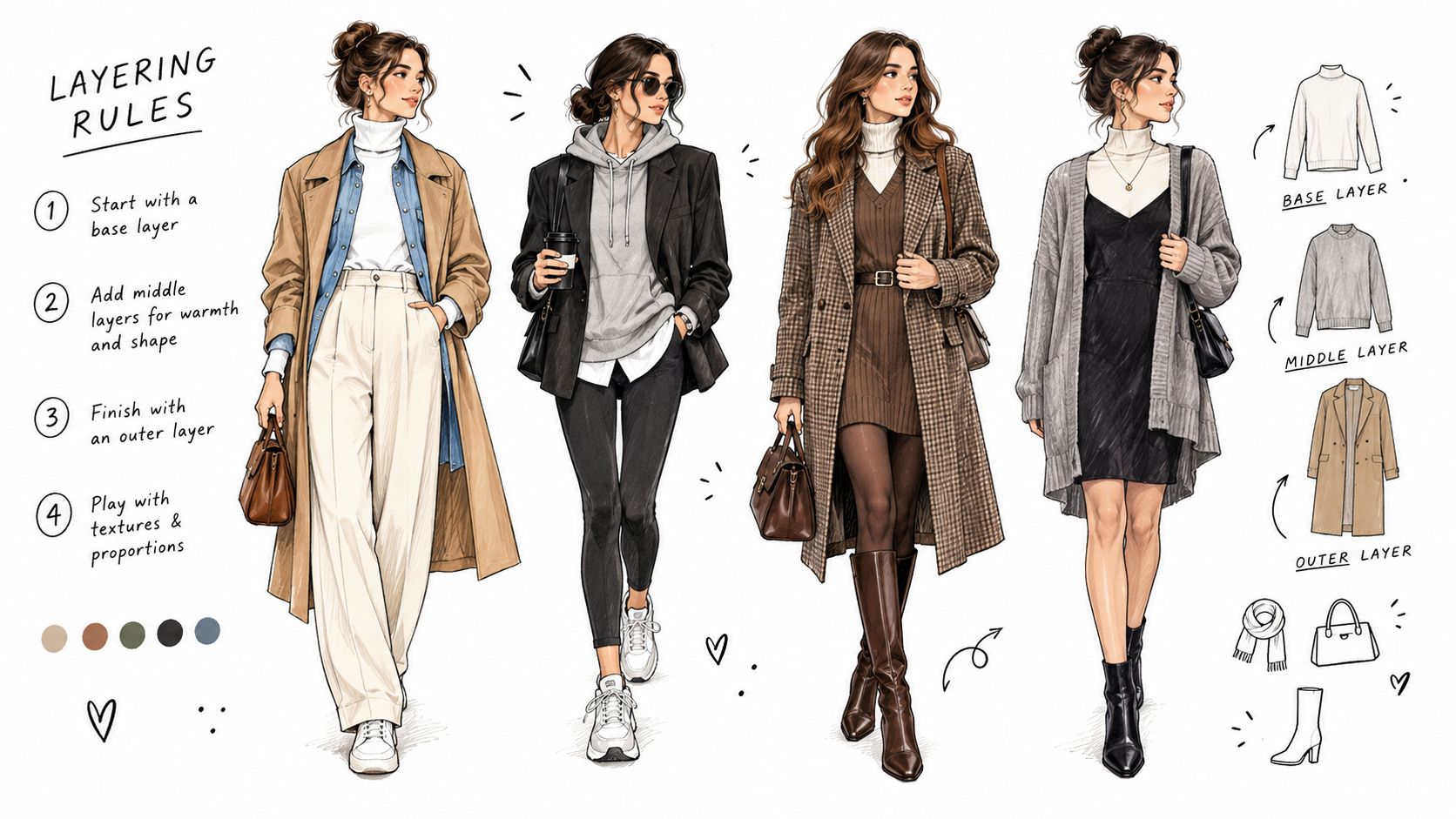
A black long sleeve sweater should either disappear neatly into the outfit or take center stage. It should not bulk up the chest, tug at the shoulders, or bunch under the sleeves of a coat. That's why the layering rule matters more than the styling rule.
Use three outfit formulas
For office wear, use a fine-gauge black sweater under a blazer. Keep the fit close enough to avoid sleeve drag, and let the sweater act as the quiet base layer.
For weekends, wear a mid-gauge knit over a collared shirt only if the neckline leaves enough room to show the collar cleanly. That works best when the sweater body isn't too tight at the bust.
For commutes or travel, choose the sweater as a warm middle layer under a topcoat. If the knit is too bulky, the coat will pull across the shoulders and the whole outfit starts to look forced.
Black should support the outfit, not fight it.
Cashmere Boutique sells black sweater options that fit this kind of layered wardrobe, including a women's crew neck cashmere sweater and a black cardigan twin set. I'd treat those as practical examples of the kind of pieces that can anchor a rotation, not as interchangeable with every black knit on the market.
Caring for Black Cashmere So It Actually Lasts
Black cashmere demands better care than people admit. The color makes tiny changes obvious, and the fiber itself doesn't love rough handling. Repeated hot washing and hard agitation can push dye loss, fading, felting, and distortion at the same time, so the care routine has to be deliberate. Cashmere care instructions
Black Cashmere Care Quick Reference
| Action | Frequency | Why It Matters |
|---|---|---|
| Cool wash or gentle hand wash | When needed, not after every wear | Cuts agitation that can fade black dye and stress fine fibers |
| Flat dry | Every wash | Helps prevent stretching and shape loss |
| Low-friction storage | Always | Reduces pilling, shine, and abrasion |
| Mild detergent for delicate protein fibers | Every wash | Protects cashmere better than harsh cleaners |
| Light de-pilling | As needed | Keeps black from looking worn too soon |
Colorfastness testing often uses ISO 105-C06, where a specimen is washed under controlled conditions and rated on a 1 to 5 scale for color change and staining, with higher numbers showing better resistance. That matters because “fade resistant” means little without a method behind it. Prevent pilling on quilts is a useful reminder that friction control matters across textiles, not just sweaters.
For maintenance, keep a small kit ready, a mesh bag, a cashmere comb, cedar, and breathable storage. If the sweater pills, remove the fuzz gently. If it snags, don't pull. If it shrinks, stop trying to rescue it with heat and accept that prevention was the fix.
When Black Is Not the Smartest Choice
Black is not automatically the most flattering color. It is the most controlled color, and that's different. It works when you want sharp tailoring, formal polish, or a neutral anchor for a narrow wardrobe. It's less convincing when your life includes lots of texture, frequent abrasion, and casual layering.
Charcoal and chocolate brown deserve more respect than they usually get. Charcoal softens the contrast while staying neutral, and brown can look less severe while still coordinating well. Recent fashion coverage has even pushed shoppers to consider chocolate brown as an alternative because it can feel distinctive without becoming difficult to wear.
Black also makes lint, shine, and surface wear more visible. If you move through your day with bags on your shoulder, a seat belt across the chest, and a coat over the top, brown or charcoal may age more gracefully.
The blunt answer is this. Buy black when you want formality and definition. Buy brown or charcoal when you want the sweater to look good after real life has touched it.
A Pre-Purchase Checklist for a Black Long Sleeve Sweater
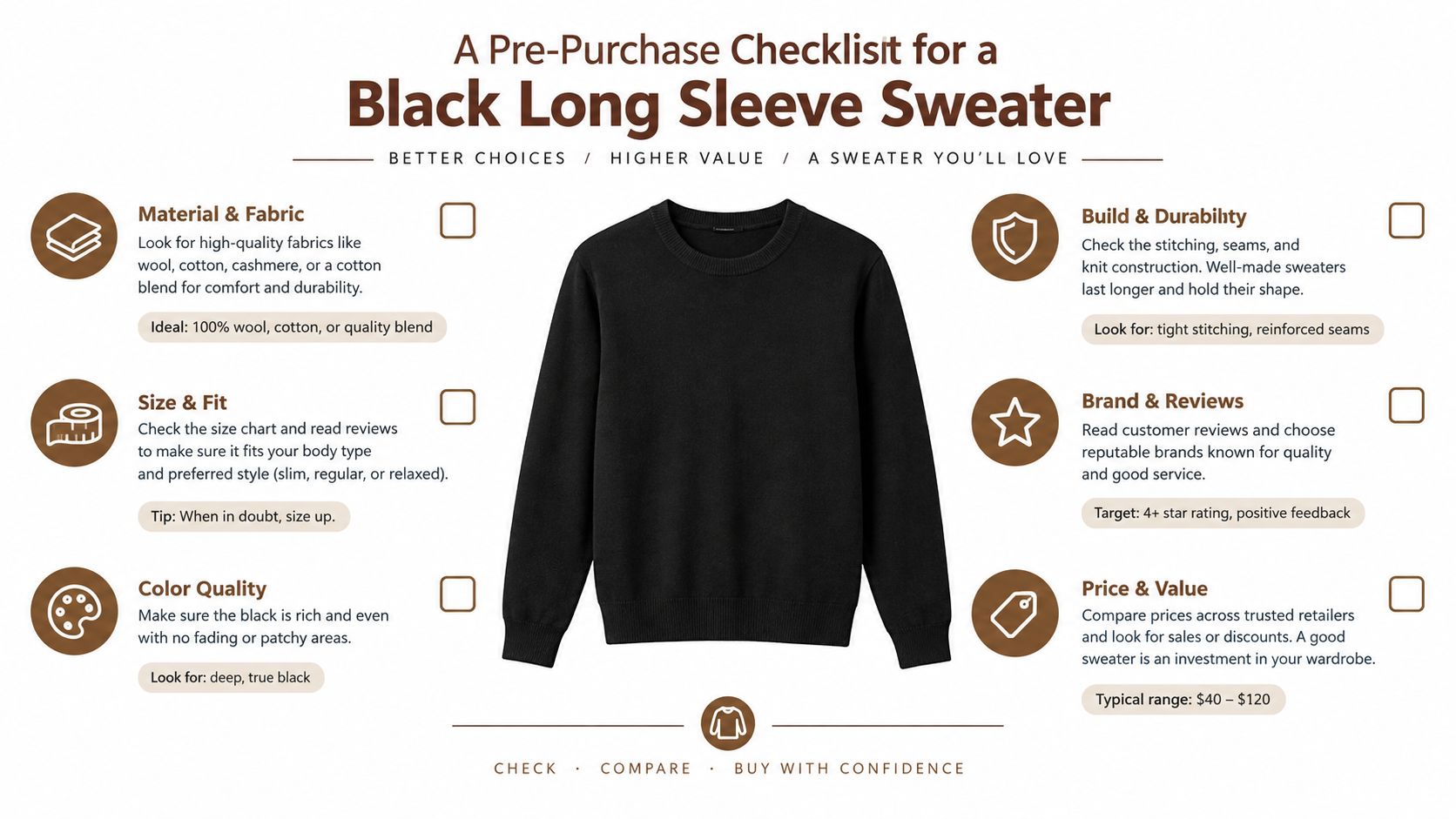
A serious buyer checks the label, the measurements, and the care burden before checkout. A black sweater that only looks good on the product page is a liability, not a staple. If you want the piece to earn repeat wear, you need to know exactly what you're buying and how much upkeep you'll tolerate.
Buy only if these answers are clear
- Fiber specification: Is the cashmere grade stated clearly, and does the micron range look consistent with fine, soft knitwear?
- Fit measurements: Are sleeve length, shoulder width, chest circumference, and hem length listed?
- Knit weight: Does the sweater need to layer cleanly, or does it need enough body to stand alone?
- Neckline and silhouette: Does crew, V-neck, mock neck, or turtleneck match your closet?
- Care reality: Are you willing to wash gently, dry flat, and store it properly?
Fit matters because online apparel returns are estimated at 19.3% of online sales, and apparel and footwear are especially hard to buy digitally because proportions are hard to judge. Independent return analyses also report that roughly 53 to 70% of apparel returns are linked to fit or sizing, which is exactly why a size label alone is not enough. Black everyday carry essentials can give you a clean visual reference for how black reads across practical items, but a sweater still has to earn its place on your body, not on a flat page.
If you want black cashmere that pulls its weight, shop the fiber first and the color second. Visit Cashmere Boutique for cashmere sweaters, cardigans, and accessories designed for real layering, then choose the silhouette and care routine that fit how you live.