
Duster Cardigan Cashmere: The Ultimate Style Guide
You're standing in front of a wardrobe full of clothes, yet nothing solves the in-between problem. A T-shirt feels too bare, a pullover feels too casual, and a coat is too formal for a quick coffee, a chilly office, or an evening at home. You want warmth without bulk and polish without stiffness.
That's where a cashmere duster cardigan earns its place. The long, open-front silhouette gives you the coverage of light outerwear with the softness and movement of knitwear. But a duster isn't just a longer sweater. Its extra length creates different demands on the fiber, the knit, the seams, the fit, and your care routine. Buy it as a luxury garment with mechanical needs, not as an oversized basic.
Table of Contents
- The Appeal of the Cashmere Duster Cardigan
- Understanding Cashmere Fiber and Duster Proportions
- Choosing the Right Weight and Knit for Every Season
- Mastering Proportions and Fit for Your Body Type
- Styling Your Cashmere Duster for Any Occasion
- Caring for and Maintaining Your Long Cashmere Layers
- Building a Timeless Wardrobe Staple
The Appeal of the Cashmere Duster Cardigan
A woman I advised recently had a familiar wardrobe gap. Her closet contained fine crewnecks, structured blazers, and a handsome wool coat, but none worked for the hours between leaving the house and settling into an evening. She wanted something refined enough for trousers and loafers, relaxed enough for denim, and comfortable enough to wear while working from home.
The answer was a long, open-front cardigan in cashmere. Worn loose, it softened a simple outfit. With a narrow belt, it became a graceful indoor coat. Over a silk dress, it added warmth without the visual heaviness of a traditional jacket.
A duster cardigan generally falls below the hips and may extend toward the calf. That length changes the garment's role. A short cardigan frames the waist and behaves like a top layer. A duster creates a vertical line, moves around the legs, and functions more like a flexible coat. It also uses more fabric, which makes the quality of the yarn and construction impossible to ignore.
Why the silhouette feels luxurious
Cashmere's appeal is tactile, but the best duster offers more than softness. It gives the body room to move while maintaining a fluid fall. The front panels should hang without twisting, the shoulders should recover after wear, and the hem should remain controlled rather than flaring unpredictably.
That's why I'm wary of choosing a long cardigan based only on an attractive photograph. A loose silhouette can conceal weak recovery, uneven tension, or a knit that will grow with wear. The longer the garment, the more visible those flaws become.
Buyer's rule: A duster should feel easy, but it shouldn't feel flimsy.
The garment also has psychological value. Wrapping yourself in a soft, substantial layer makes ordinary dressing feel intentional. It can turn a plain base of trousers and a fitted top into a complete look without demanding elaborate styling. That quiet versatility is what makes the piece suitable for a timeless wardrobe.
The strongest version is neither dramatically oversized nor tightly fitted. It has enough ease for layering, enough structure to hold its line, and a length that works with the way you sit, walk, travel, and carry a bag. If those details are right, a cashmere duster cardigan becomes a daily luxury rather than an occasional statement.
Understanding Cashmere Fiber and Duster Proportions
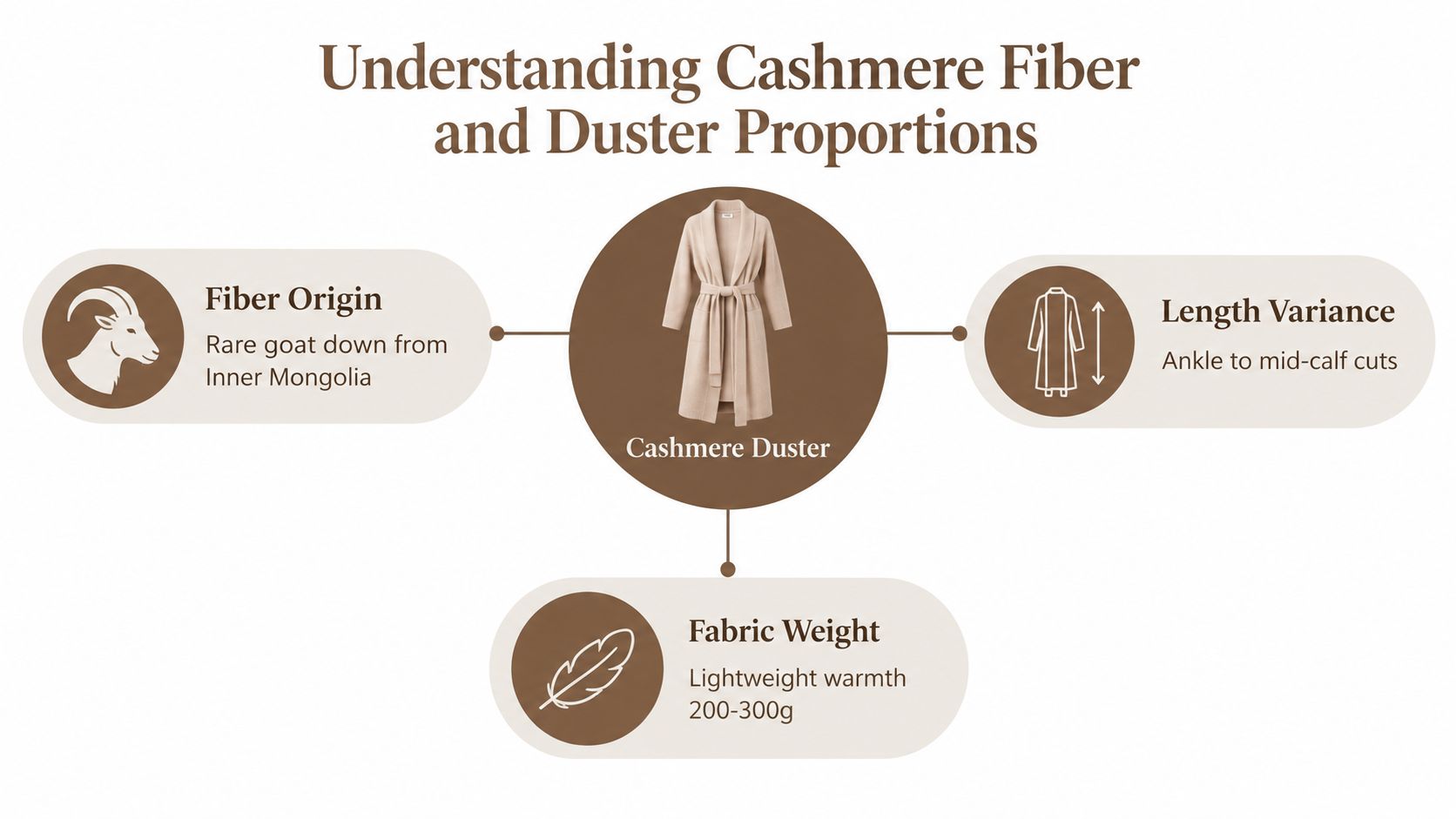
A cashmere duster cardigans starts with fiber quality, but the long silhouette changes what quality has to do. Extra length puts stress on the front edges, shoulders, sleeves, and hem, so a garment that looks soft online can still fail in wear if the yarn and knit are weak. Cashmere's origin in the Kashmir region, its link to the shawl trade, and the fact that it comes from the goats' soft winter undercoat are part of the fiber's luxury story, as described in the history and composition of cashmere. The infographic on duster proportions makes the point clearly, a long cardigan needs different balance than a shorter layer.
Scarcity matters more in a long garment
A waist-length cardigan can use fiber efficiently. A duster cannot. Its longer front panels, extended back, sleeves, and hem demand more material, so the cost and quality of the yarn matter more than they do in a compact knit.
That is why long cashmere garments deserve scrutiny at the points that wear first. The front band can stretch, the shoulder can lose shape, and the hem can start to pull or flare if the knit lacks control. A duster that is built well stays calm in motion and keeps its line.
Fineness controls the hand, but it isn't the whole story
Under the cited quality definition, the average fiber diameter must not exceed 19 microns, and no more than 3% by weight may consist of fibers exceeding 30 microns. Fine fiber matters because a long garment sits close to the body across a larger surface area, so coarse contamination becomes obvious fast.
Peer-reviewed cashmere fiber research shows that diameter is only part of the picture. Fiber length, elasticity, strength, crimp, whiteness, and the share of guard hairs also affect how the fabric feels and performs.
My recommendation is straightforward. Treat “Grade A” as a starting point, not a full buying standard. Use a guide to selecting quality cashmere to check the details that matter in practice, then ask for mean diameter, diameter distribution, fiber length, and coarse-fiber contamination. On a duster, I would also inspect the front band, shoulder seams, and hem finish with more care than the product copy suggests.
Construction has to support the length
A long cardigan spends its life in motion, in a car, at a desk, under a coat, over a chair back. That creates abrasion zones that shorter knits do not face as hard. The front edges rub, the sleeves compress, and the hem drags against daily contact points. A good duster handles that pressure without collapsing.
That is where knitting density and finishing matter. Stable construction keeps the panels aligned, helps the garment recover after wear, and reduces the chance that the shape will drift with time. In a duster, proportion is not only about style. It is about whether the piece can hold its line when the length starts working against it.
Choosing the Right Weight and Knit for Every Season
A long cashmere duster has to earn its place in a wardrobe. If the knit is too open, it looks fragile and sags once it starts moving through a normal day. If it is too dense, it feels heavy and loses the easy drape that makes a duster worth buying in the first place.
Start with the job the cardigan has to do. A piece meant to replace a light jacket needs enough body to keep the front edges from collapsing and to hold shape at the shoulders. A piece meant for layering under outerwear needs a smoother surface, less bulk through the sleeves, and enough flexibility to sit cleanly under a coat.
Read the construction, not just the marketing copy
Ply, gauge, stitch type, and finishing all matter, but only if you read them in context.
- Ply: More plies can create a rounder, more stable yarn, but ply alone does not guarantee better quality. Look at whether the stitches sit evenly and whether the fabric feels balanced in the hand.
- Gauge: A tighter gauge usually gives the cardigan more control and better resistance to snagging. A loose gauge can move beautifully, but a long silhouette needs enough structure to avoid drooping.
- Ribbing: A firm ribbed front band helps the cardigan keep its opening and reduces curling. It should spring back after gentle stretching.
- Stitch density: Check that the back, sleeves, and front panels all read with the same density. Uneven knitting shows up fast on a long duster.
- Finishing: Brushing, washing, and surface treatments change how the fabric feels and wears. A soft first touch means little if the garment loses shape under friction.
Cashmere research points to meaningful links between fiber diameter, elasticity, and strength, which explains why very soft yarns need careful engineering to stay stable in a longer garment. That matters on a duster, where excess softness can become distortion if the knit is not controlled properly (research on cashmere fiber properties).
Match the knit to your wardrobe
For spring and transitional weather, I favor a lighter knit with enough density to avoid looking limp. It should slide over a shirt or dress without catching, and it should stay comfortable when worn open. In a mild climate, an airy construction can look polished if the shoulders and side seams are secure.
For winter layering, choose a denser knit with enough recovery to handle repeated wear. The cardigan should sit over a base layer without pulling across the upper back. It should also fit under a coat without turning the sleeves into thick ridges.
The same buying discipline applies to buying bulk wool sweaters for branding. Different product, same questions: how stable is the knit, how consistent is the sizing, and how well will the garment hold up after regular wear?
Practical rule: Choose the lightest knit that still does the job. Extra weight is not a substitute for good fiber, balanced construction, or the right fit.
Do not trust a stated fabric weight unless the seller explains how it was measured. Judge the hand, recovery, stitch regularity, and the layer the garment is meant to sit under. A well-made duster feels warm because the fiber and knit work efficiently, not because the fabric is needlessly thick.
Mastering Proportions and Fit for Your Body Type
A standard bust measurement can't solve a duster fitting problem. Long cashmere garments introduce variables that short sweaters barely present: center-back length, shoulder drop, sleeve stacking, hem swing, side-slit placement, and the way the cardigan behaves when worn open or belted.
Online shopping makes this harder. Industry summaries place clothing return rates at roughly 15% to 40% by channel, with size and fit among the leading causes, and a cited Coresight survey found 53% of respondents identified size or fit as the top reason for online apparel returns (apparel return-rate benchmarks). Those figures aren't an argument against buying online. They're an argument for measuring the garment you already own before ordering another one.
Compare garments, not abstract size labels
Take a cardigan, coat, or lightweight robe that already fits the way you like. Lay it flat, button or close it if possible, and record the measurements that define its shape. Then compare those dimensions with the product's finished measurements, not just the brand's body-size chart.
| Measurement | Why It Matters | How to Check |
|---|---|---|
| Center-back length | Determines whether the hem works with your height, seating habits, and footwear | Measure from the high shoulder point to the intended hem on a similar garment |
| Shoulder width or drop | Controls whether the cardigan looks relaxed or collapsed | Compare the shoulder seam position with a layer you wear comfortably |
| Sleeve length | Prevents excessive stacking at the wrist and under a coat | Measure with the sleeve relaxed, then consider your preferred cuff position |
| Front width | Determines how much overlap or movement you get when the cardigan is closed | Compare the front panels with a coat or cardigan worn over your usual base layer |
| Hem swing | Shows how much the garment may catch, flare, or drag as you walk | Measure the lower width and observe whether the reference garment moves cleanly |
| Side-slit position | Affects stride, sitting comfort, and visual balance | Check where the slit begins relative to your hip and the layers beneath |
Account for body shape and movement
Petite clients often need to control both length and volume. A duster that is too wide can obscure the frame, while excessive length can catch on chairs, stairs, or the edge of a car seat. Choose a cleaner shoulder line, a narrower front panel, or a shorter longline cut rather than assuming that sizing down will solve every proportion problem.
Tall clients can usually carry more length, but sleeve placement still matters. A sleeve that ends too high can make the garment look undersized even when the body length works. Fuller-bust clients should pay close attention to the front opening and upper-back ease. If the panels pull outward, adding more overall length won't correct the problem.
“Oversized” is not a universal fit solution. Extra width increases drag, and drag becomes more noticeable as the knit extends down the body. A cardigan should move around you, not trail behind you.
For a useful color and silhouette comparison, look at the styling logic behind a cashmere brown cardigan, then return to the actual measurements before choosing a size. Color can change the visual impression of scale, but it can't repair a shoulder or hem that doesn't fit.
Styling Your Cashmere Duster for Any Occasion
A long cardigan needs a deliberate counterweight. If the duster is fluid and generous, the rest of the outfit should provide at least one point of definition. That might be a fitted base layer, a high waist, a visible ankle, a clean shoe, or a belt that draws the eye to the torso.
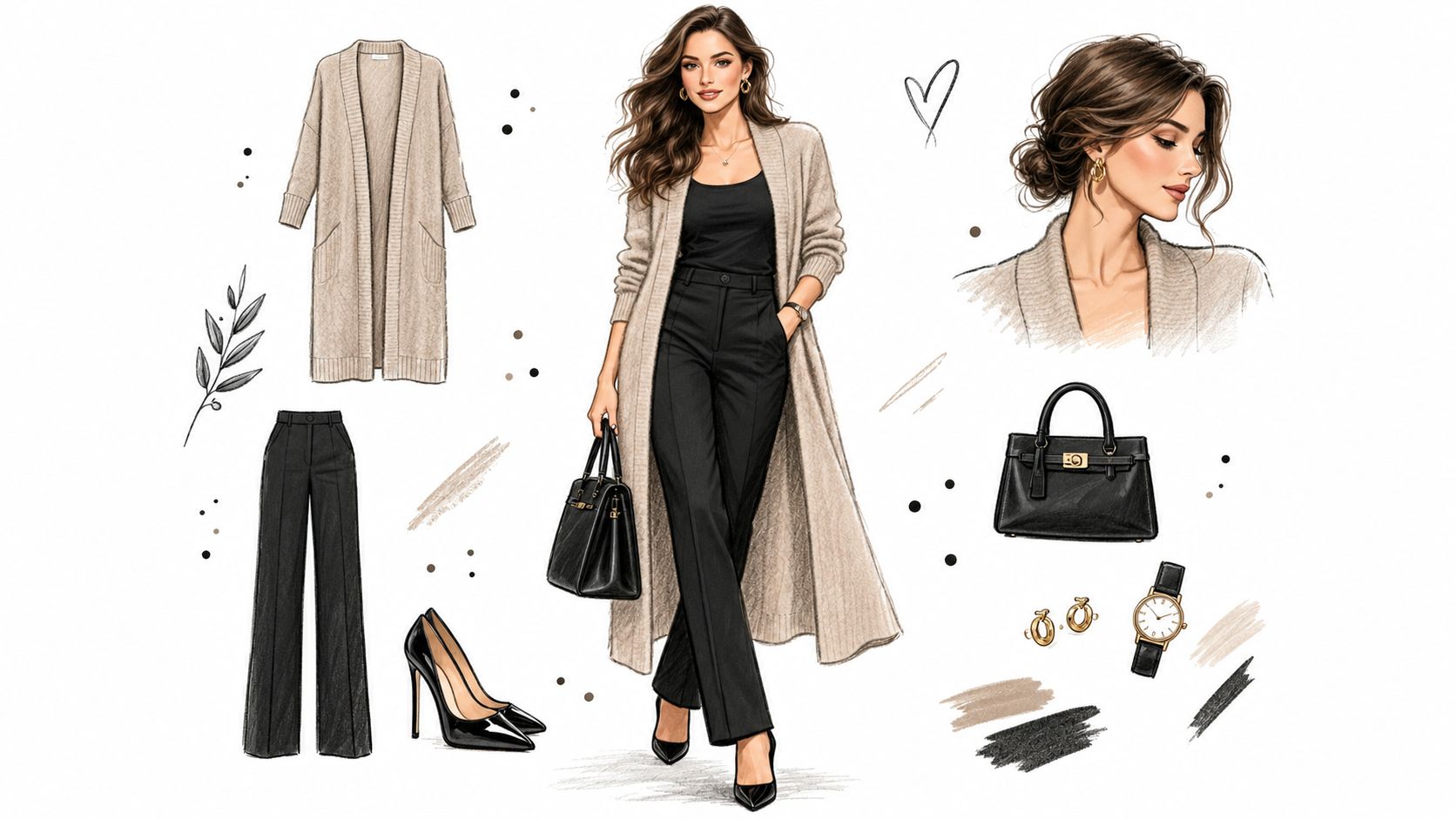
The easiest daytime formula is a slim top, straight or gently wide trousers, and a low-profile shoe. The cardigan supplies volume and movement, while the base keeps the outfit from becoming shapeless. High-waisted trousers are particularly effective because they give the eye a clear starting point beneath the long vertical line.
Build the outfit around one proportion
For casual wear, try a fitted ribbed tee, straight-leg denim, and ankle boots. Leave the cardigan open and push the sleeves slightly up the forearm if the knit recovers well. The small amount of wrist exposure adds structure without making the garment feel formal.
For office dressing, use a fine blouse or compact knit beneath the duster, then pair it with pressed trousers and a pointed or almond-toe shoe. A narrow belt can work over the cardigan, but don't cinch a soft knit aggressively. The goal is to suggest the waist, not compress the fabric and create permanent stress at the side seams.
For evening, place the duster over a column dress or a silk camisole with fluid trousers. Keep the accessories restrained. A long cardigan already creates a strong line, so a sculptural earring, polished clutch, or refined shoe is usually more successful than several competing statement pieces.
Stylist's rule: Use the cardigan for movement, then give the outfit one firm edge.
Texture can make the look feel intentional. Combine smooth cashmere with washed denim, polished leather, silk, or a crisp cotton shirt. Avoid pairing a very loose duster with several other bulky textures unless you want a deliberately cocooned effect.
The hem deserves attention too. A long cardigan looks cleaner when the footwear can visually support it. Sleek boots, loafers, pointed flats, and minimal sneakers tend to work better than shoes with excessive visual weight. If the hem reaches close to the ankle, check that it doesn't catch on the shoe or bunch around the instep.
For days that demand more weather protection, compare the role of a cashmere layer with a warm winter coat for busy days. A duster is a refined indoor and transitional layer, not a replacement for a protective outer coat in wet or severe conditions.
Here's a visual reference for balancing a long knit with polished tailoring:
A belt is optional, not mandatory. Wear the cardigan open when you want a long uninterrupted line, tie it loosely when you want more definition, and leave it unbelted over a dress when movement is the main advantage. The most convincing styling usually looks effortless because the proportions were solved before accessories entered the picture.
Caring for and Maintaining Your Long Cashmere Layers
The promise of “pill-free” cashmere is not a standard I'd use when assessing a duster. Pilling is a mechanical result of friction, loose fibers, yarn construction, finishing, wear patterns, and care. It doesn't automatically prove that a garment contains counterfeit fiber or that the cashmere is poor.
A long cardigan has more opportunities to rub. The underarms meet the body, the lower back meets chairs, the hips meet desks and bags, and the thigh-level panels brush against seats, handbags, seat belts, and other garments. A loose, low-density knit can be especially vulnerable because its loops have more room to move and catch.
Follow the duster wear map
Inspect the garment after each period of concentrated use. Don't wait until pills cover the entire surface. Early maintenance is gentler and lets you identify whether the problem is isolated to a friction zone or connected to a broader construction issue.
- Underarms: Reduce repeated friction with rough outer layers and check whether sleeves are twisting.
- Side seams: Watch for stress caused by a tight base layer or a bag strap crossing the torso.
- Hip and handbag zones: Rotate bags and avoid abrasive hardware rubbing against the front panels.
- Lower back and seat area: Remove the cardigan before sitting against rough upholstery for long periods.
- Cuffs: Keep them away from desk edges and watchbands that can catch fine loops.
- Hem: Check for floor contact, stair snags, and contact with car doors or chair legs.
Textile guidance cites a cashmere-knit study associating fibers shorter than 7.5 millimeters with pilling, while also emphasizing that fiber length, diameter variation, damaged fibers, finishing, wear, and care all contribute (technical guidance on cashmere pilling). That's why I'd rather see a brand report finished-garment testing than make a “never pills” promise.
Wash, dry, and store without stretching
Follow the manufacturer's instructions first. Where hand washing is permitted, use cool water and a gentle cleanser, avoid wet agitation, and press out water rather than twisting the knit. Lay the cardigan flat on a clean towel, reshape the shoulders and hem, and let it dry with full support.
Never leave a long wet knit hanging. Moisture makes the garment heavier, and gravity can encourage lengthwise growth. Store it folded, with the front panels aligned and the sleeves placed naturally. A hanger can create shoulder bumps and place stress on the upper seams even when the cardigan is dry.
Before buying, ask whether the finished garment has been assessed for abrasion, pilling, dimensional change after the stated care method, and recovery after hanging. Research shows that surface treatments can modify pilling behavior while preserving fabric hand, which confirms that construction and finishing deserve as much attention as fiber identity (research on cashmere fabric pilling and finishing).
Remove pills without damaging the loops
Use a cashmere comb sparingly on a dry, flat garment. Work lightly in one direction and stop if the tool catches. A fabric shaver can remove surface fuzz quickly, but it demands restraint because an aggressive blade can cut intact loops and weaken the fabric.
Never pull pills by hand. You may draw out neighboring fibers and create a larger damaged area. If the surface develops heavy fuzz in the same place after limited wear, have the garment assessed rather than repeatedly shaving it.
For detailed washing and storage instructions, use the brand's cashmere care instructions as a reference point, then follow the specific label sewn into your garment. Good care won't make cashmere indestructible. It will reduce avoidable stress and help the duster retain the proportion you paid for.
Building a Timeless Wardrobe Staple
A cashmere duster cardigan earns a place in a lasting wardrobe when three decisions are right: the fiber is properly specified, the proportions suit your body and routine, and the construction can tolerate the friction created by a long silhouette.
Buy the cleanest design you'll wear repeatedly. Neutral colors are useful, but the best color is one that works with your existing trousers, dresses, denim, and outerwear. Choose a knit with enough stability for its length, then check the front band, shoulder recovery, hem behavior, and finished measurements before you commit.
This isn't a garment to buy for a single photograph. It should solve real wardrobe problems on ordinary days, from cool commutes to informal dinners. With careful storage, gentle depilling, and sensible rotation, a well-made duster can provide the softness of a sweater while functioning with the presence of light outerwear.
Final buying test: If the cardigan looks beautiful but you can't explain where it will rub, how it will fit over your layers, and how you'll store it, keep shopping.
Cashmere Boutique offers cashmere cardigans, coats, sweaters, scarves, robes, and coordinating accessories selected for everyday wear, gifting, and layered wardrobes. Visit Cashmere Boutique to compare cashmere options, review sizing and care guidance, and find a long layer that fits your wardrobe rather than merely filling a product page.