
Article: Cashmere and Silk Cardigan: Fiber, Care and How to Buy
Cashmere and Silk Cardigan: Fiber, Care and How to Buy
When you see "cashmere and silk" on a label, what do you expect to feel? Most shoppers assume they're getting two luxuries at once, a garment that's warm like cashmere and sleek like silk. The label rarely tells you which fiber dominates, how the knit was built, or whether the blend will pill by March. That gap between the printed percentage and the garment in your hands is where most buying mistakes happen.
A cardigan is a layering garment, which makes the blend question more urgent than it is for a sweater. It goes over things, under things, gets pushed up at the elbows and rubbed by bag straps. The fiber ratio, the yarn, the knit density and your climate all decide whether it earns a place in your wardrobe or sits folded in a drawer. Walk through each trade-off in order, and you can judge a cardigan from a listing before you ever touch it.
Table of Contents
- Why Cashmere and Silk Belong in One Cardigan
- Blend Ratios and the Cardigan Each One Suits
- How to Style a Cashmere and Silk Cardigan Across Seasons
- How Fineness and Knit Decide Softness and Pilling
- How to Wash and Dry a Cashmere and Silk Cardigan
- What to Check Before You Buy a Blended Cardigan
- Choose Your Blend and Test It This Week
Why Cashmere and Silk Belong in One Cardigan
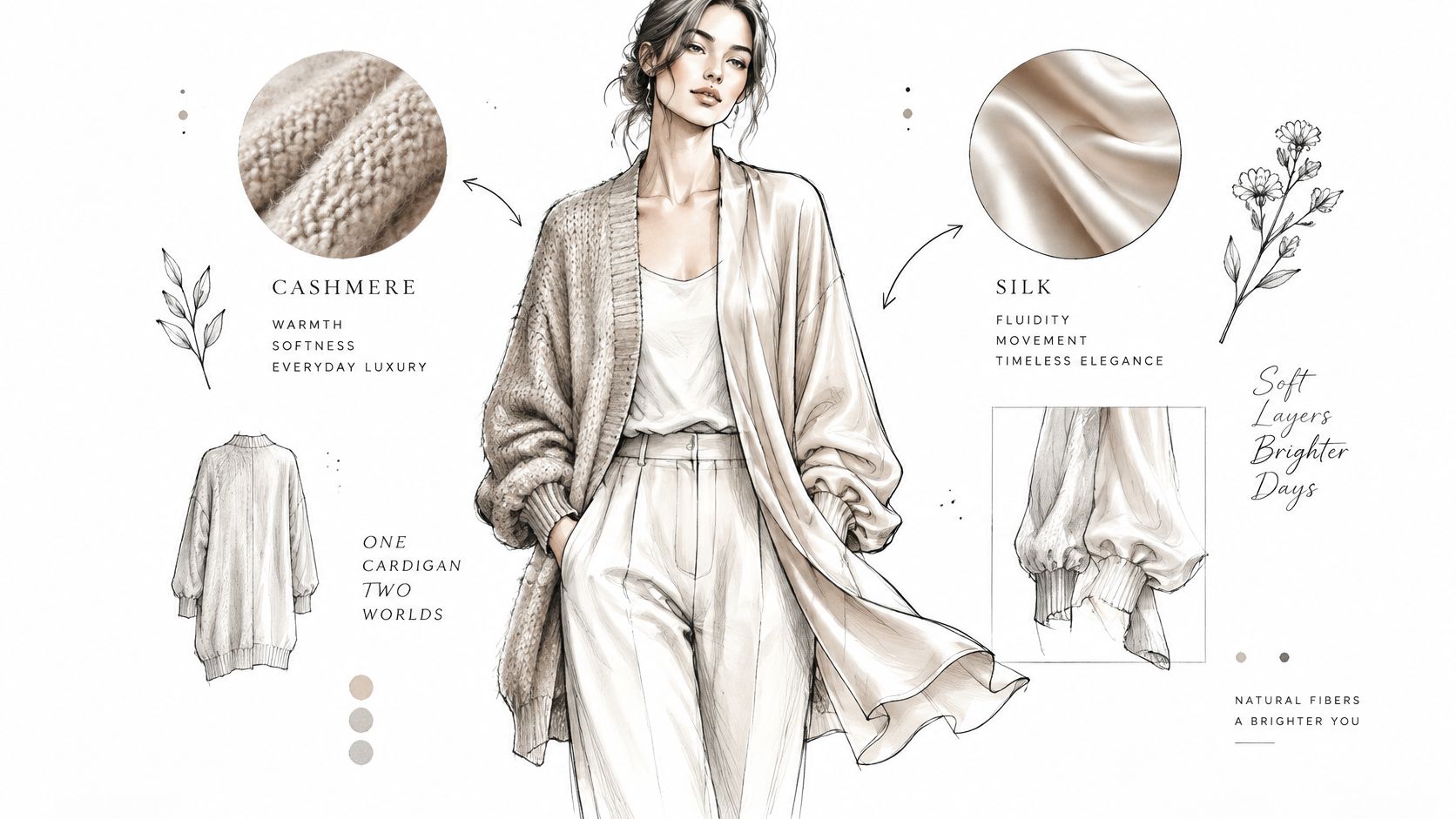
Why put cashmere and silk in the same cardigan? Hold a good blend in one hand and a pure wool knit in the other. The blend feels warmer than its weight suggests, yet it slides through your fingers instead of catching.
Cashmere supplies the warmth. Fine, crimped fibers trap small pockets of air, so the cardigan insulates without bulk and feels soft in the hand. That fineness also explains the price. Cashmere is a scarce fiber with a limited global supply, and it cannot be scaled like cotton.
Silk supplies the movement. It is a deliberately chosen ingredient rather than an obvious one: silk accounts for less than 0.2% of the global textile market, production is spread across about 60 countries, and woven examples from China date to approximately 2700 BCE, as Orbisica's history of silk sets out. In a knit it brings smoothness, drape, luster and lighter weight.
Cashmere works like a cushion of still air against the skin. Silk works like the thread that keeps the surface smooth and the cloth fluid. In cold weather, those air pockets are what you wear the cardigan for, and silk only has to keep that warmth from feeling stiff. On a mild day or in a heated room, the lighter drape is the useful half, and unused loft is heat you did not need. You give up some of pure cashmere's warmth and some of silk's slip.
Supply is the trade-off the fiber names skip. Silk lets a cardigan use less of a scarce fiber on days that do not need dense insulation. If your climate stays mild, buying the blend for the luxury wording can mean paying for cashmere that never does its job.
Before you read a single claim on a product page, try to predict from the composition line alone how that cardigan will feel and how it will hang. You'll be right more often than you expect, and you'll spot vague listings faster.
Blend Ratios and the Cardigan Each One Suits
Treat "cashmere and silk" as one standardized fabric and you'll buy the wrong garment for your climate. The ratio changes the hand, the warmth, the sheen and the way the cardigan falls. Here's how the families compare.
| Blend | Hand and drape | Best use | Trade-off |
|---|---|---|---|
| Silk-dominant, about 85% silk and 15% cashmere | Lustrous, fluid, light | Indoor layering, shoulder-season travel | Less dense insulation |
| Balanced, about 50% silk and 50% cashmere | Soft, warm, moderate drape | Everyday layering across seasons | Middling in both warmth and sheen |
| Cashmere-dominant, mostly cashmere | Dense, soft, insulating | Cold-weather layering | Less drape and luster |
| Pure cashmere (reference) | Warmest, softest surface | Coldest climates and outerwear layering | Less slip and sheen |
Technical summaries describe a higher-silk blend such as 85% silk and 15% cashmere as more lustrous and fluid, while a 50/50 blend offers a more balanced combination of softness, warmth and durability, per Selvane's notes on blending silk with natural fibers. That matches what you feel in the hand: the silk-heavy version behaves like a fine shirt, the balanced version like a light sweater, and the cashmere-heavy version like outerwear you happen to wear indoors.
One claim worth flagging carefully: the same summary states that silk-cashmere blending can increase tensile strength by up to 25% compared with pure silk. Don't read that as a guarantee stamped on every cardigan. Yarn construction, knit gauge, finishing and garment weight all sit between the fiber and the finished piece.
What the percentage cannot tell you
The composition line says nothing about pilling, opacity, stretch recovery or abrasion resistance. Two cardigans can carry the same 50/50 split and behave completely differently, because a loose knit lets yarn move and shed while a dense knit holds the surface steady.
More silk isn't automatically better, either. It improves drape and resilience, but it also reduces the dense, insulating hand that many cashmere buyers are paying for. A shopper who wants a cardigan for a cold office in January and buys an 85% silk version has bought the wrong garment, however good the garment is.
The buying test: name your dominant use first, indoor layering, shoulder-season travel or genuine cold, then match the dominant fiber to it, then read the construction details. Ratio first, construction second, price last.
Pure cashmere deserves a place in the comparison because it sets the ceiling on warmth and surface softness. It gives up slip and sheen to get there. If your cardigan needs to sit under a coat without catching, that trade is usually worth making.
How to Style a Cashmere and Silk Cardigan Across Seasons
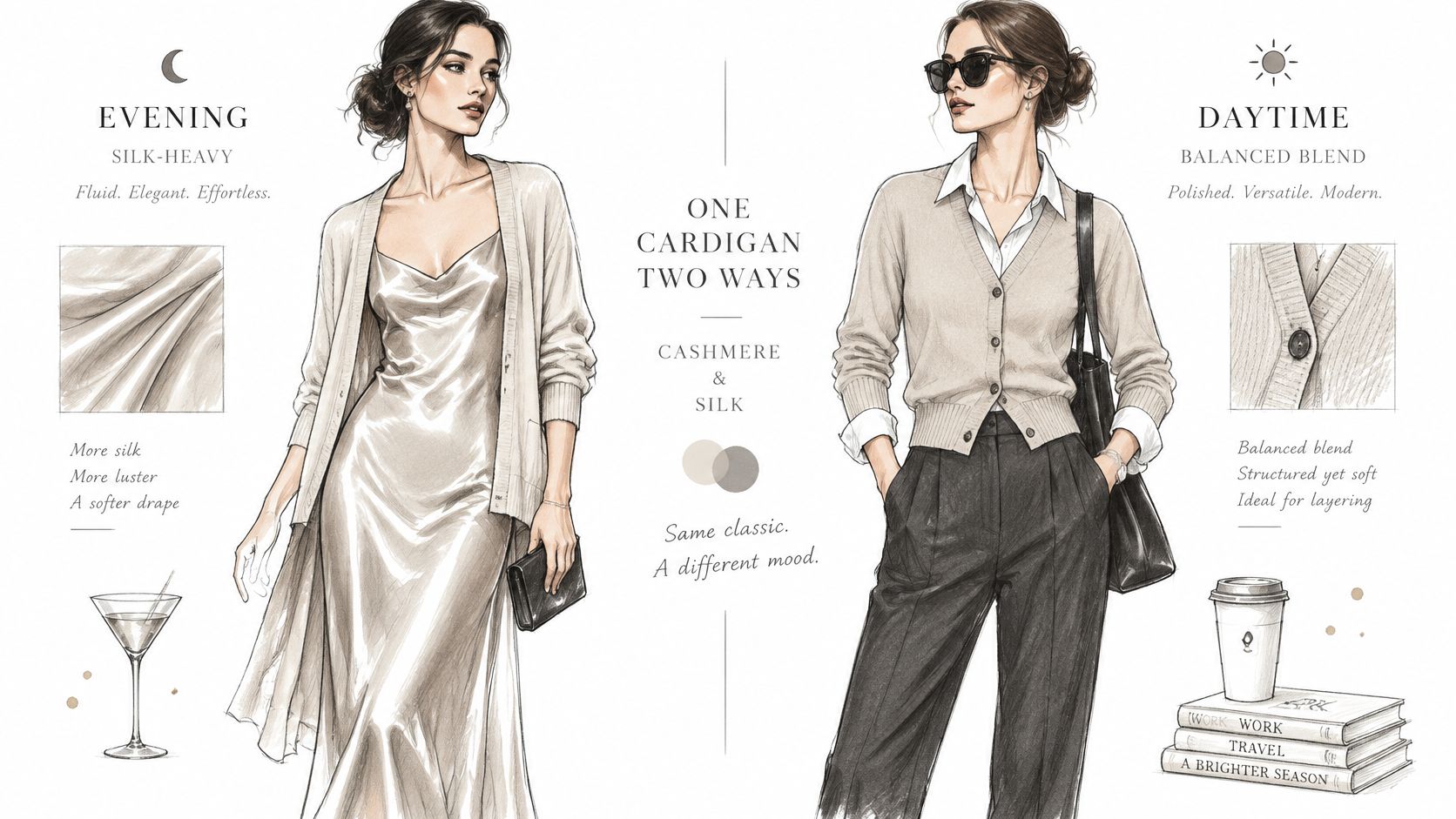
Start with the outfit that shows off a silk-heavy cardigan best. Worn open over a slip dress in the evening, the luster and drape do the work, and the cardigan reads as a light layer rather than a cover-up. Button it and the same piece looks fussy, so leave it open and let the front panels fall.
For daytime, a balanced blend buttoned over a crisp shirt with well-fitted trousers handles a relaxed office without looking like loungewear. The moderate drape keeps it from fighting the shirt collar, and the warmth is enough for a desk away from the window. Swap the shirt for a fine knit tee and it works on a weekend.
Cold weather reverses the logic. A cashmere-dominant cardigan layers under a dress coat or topcoat, adding softness at the neck and wrist where coat fabric meets skin. Because it has less slip, it stays put under a coat instead of bunching at the shoulders.
- Neutrals first: camel, navy and oatmeal cover the most outfits per purchase, especially in a balanced blend you'll wear weekly.
- Jewel tones for evening: a silk-dominant cardigan in emerald or deep berry carries a dinner outfit without jewelry.
- Belt the drape: a slim belt at the waist turns a loose silk-heavy cardigan into a defined shape when you want one.
Pairing matters as much as color. Silk-heavy knits look balanced against structured fabrics such as denim or wool crepe, because the softness needs something with body to sit against. Dense cashmere works better with fluid skirts and dresses, which stops bulk from building at the hips.
Travel is where the blend earns its keep. A silk-heavy cardigan over a tee with jeans or a midi skirt rolls flat in a suitcase and comes out wearable, and it covers a cool plane cabin without the weight of a sweater. If you prefer a collared shape for that role, a cashmere shawl collar cardigan gives you a warmer option with the same layering logic, though it takes more room in a bag.
https://www.youtube.com/embed/t8esKc3z0BE
The quick test in the fitting room: put the cardigan on over the outfit you'd actually wear it with. If it bunches at the elbows or underarms, or the front panels won't hang straight when open, the cut is wrong for you no matter how good the fiber is.
How Fineness and Knit Decide Softness and Pilling
Softness begins with fiber diameter. Cashmere is commonly reported below 16.5 microns, and business specifications of approximately 14 to 15.5 microns sit at the fine end of that range, according to a textile study on cashmere and silk knit performance. Fine fibers bend against the skin rather than pricking it, which is why good cashmere feels calm where coarser wool feels scratchy.
Fineness alone doesn't keep a cardigan intact, though. The same study reports cashmere staple lengths of roughly 45 mm with short-fiber content near 25%. Short fibers stand up out of the yarn, create hairiness, and migrate to the surface under rubbing, where they tangle into pills. Silk helps here because its filaments are much longer and smoother, reinforcing the yarn matrix and steadying the surface while adding luster and drape.
Why the same ratio can pill differently
Two cardigans, both labeled 50% cashmere and 50% silk, can behave nothing alike.
Say one is knitted loosely on a larger gauge, so the yarn has room to shift every time you move your arm. Surface fibers work free, fuzz appears at the underarm seam within weeks, and pills follow. The other is a dense, even fine-gauge knit. Yarn movement is limited, abrasion has less to grab, and the same fiber blend stays smooth through a season of wear.
That's the mechanism in plain terms: friction lifts short fibers, loose construction gives friction more chances, and a tight, even knit removes those chances. A dense fine-gauge knit is generally the better choice for repeated layering than a very loose one.
Three places do the damage before you notice it:
- Bag straps worn on the shoulder, where the cardigan takes constant back-and-forth rubbing.
- Seat belts across the chest and hip, especially on a commute.
- Underarm seams, where arm movement and body heat combine.
On a spec sheet, look for two things: the fiber percentages and the knit construction. The words "cashmere blend" on their own tell you nothing about either.
If a listing gives you percentages but no construction detail, ask before you buy, or compare the product photos for a tight, even stitch against a see-through, open one. The photo often answers the question the copy avoids.
How to Wash and Dry a Cashmere and Silk Cardigan
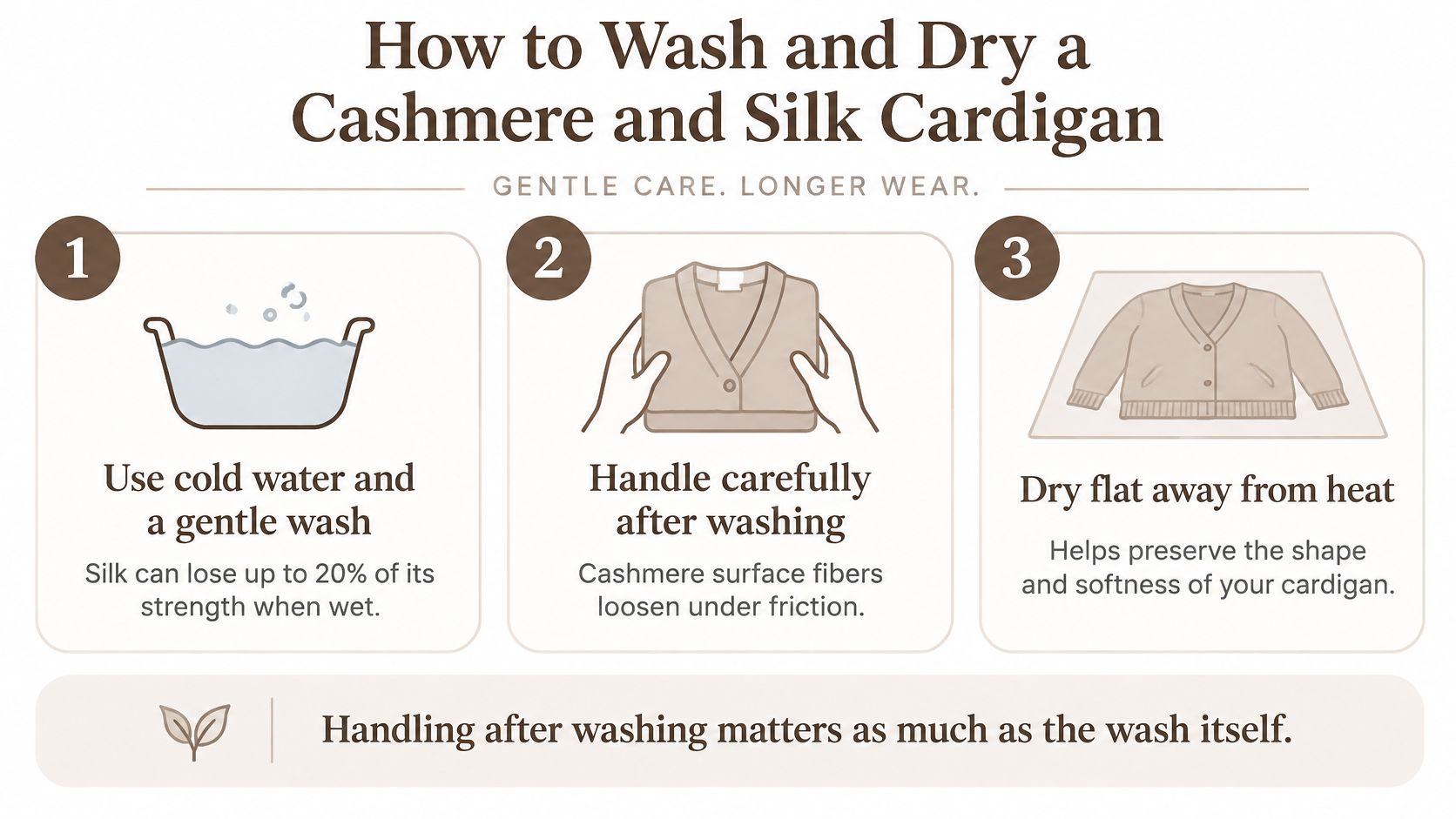
Handling after the wash matters as much as the wash itself. Silk can lose up to 20% of its strength when wet, according to a technical review of silk fiber properties, and cashmere surface fibers loosen under friction. A wet cardigan is at its most fragile exactly when it's heaviest and easiest to stretch.
The same review reports breaking tenacity around 4.3 g/denier, breaking elongation of approximately 10.9% and moisture regain of about 12.1% for the silk type tested. That moisture regain is why silk keeps a cardigan comfortable across changing temperatures: the filament absorbs and redistributes some water vapor instead of behaving like a synthetic. It's also why the fiber needs gentle handling while damp.
- Read the care label first. If it specifies dry cleaning, follow it. Silk blends with structured trims often do.
- Fill a basin with cool water and add a mild detergent formulated for protein fibers. Hot water and harsh detergent dull silk and shrink cashmere.
- Submerge and press gently. Push the cardigan down through the water with flat hands. Never rub, scrub or twist, because friction is what pulls short cashmere fibers to the surface.
- Rinse in cool water while supporting the full weight. Slide both hands under the body of the garment so wet silk and cashmere aren't hanging from the shoulders.
- Lay it on a towel, roll, and press the water out. No wringing. A twisted wet cardigan stretches out of shape and stays there.
- Reshape it flat to its original measurements on a dry towel. Measure against a folded garment you already own if you want a reference.
- Dry flat, away from direct heat and sunlight. Radiators and strong sun degrade silk and can leave cashmere stiff.
For silk specifically: if you're ever unsure whether a piece can take water at all, this guide to cleaning silk without damaging it walks through the judgment calls on dry cleaning versus hand washing.
Three slips undo all of that. Hanging a wet cardigan stretches the shoulders into peaks. A tumble dryer felts cashmere and dulls silk in one cycle. Brushing the knit while damp pulls fibers loose instead of smoothing them.
Storage is quieter but matters. Fold rather than hang, because a knitted cardigan hung on a hanger gradually lengthens at the shoulders. Keep it away from rough bags and car seats, and give it a day to recover between wearings. When drying goes wrong, this guide on how to dry sweaters covers the reshaping steps in more detail.
Fuzz is not a crisis. Once the garment is fully dry, lift pills with a fine knit comb or a fabric shaver held flat, working in one direction. A stiff brush makes it worse.
What to Check Before You Buy a Blended Cardigan
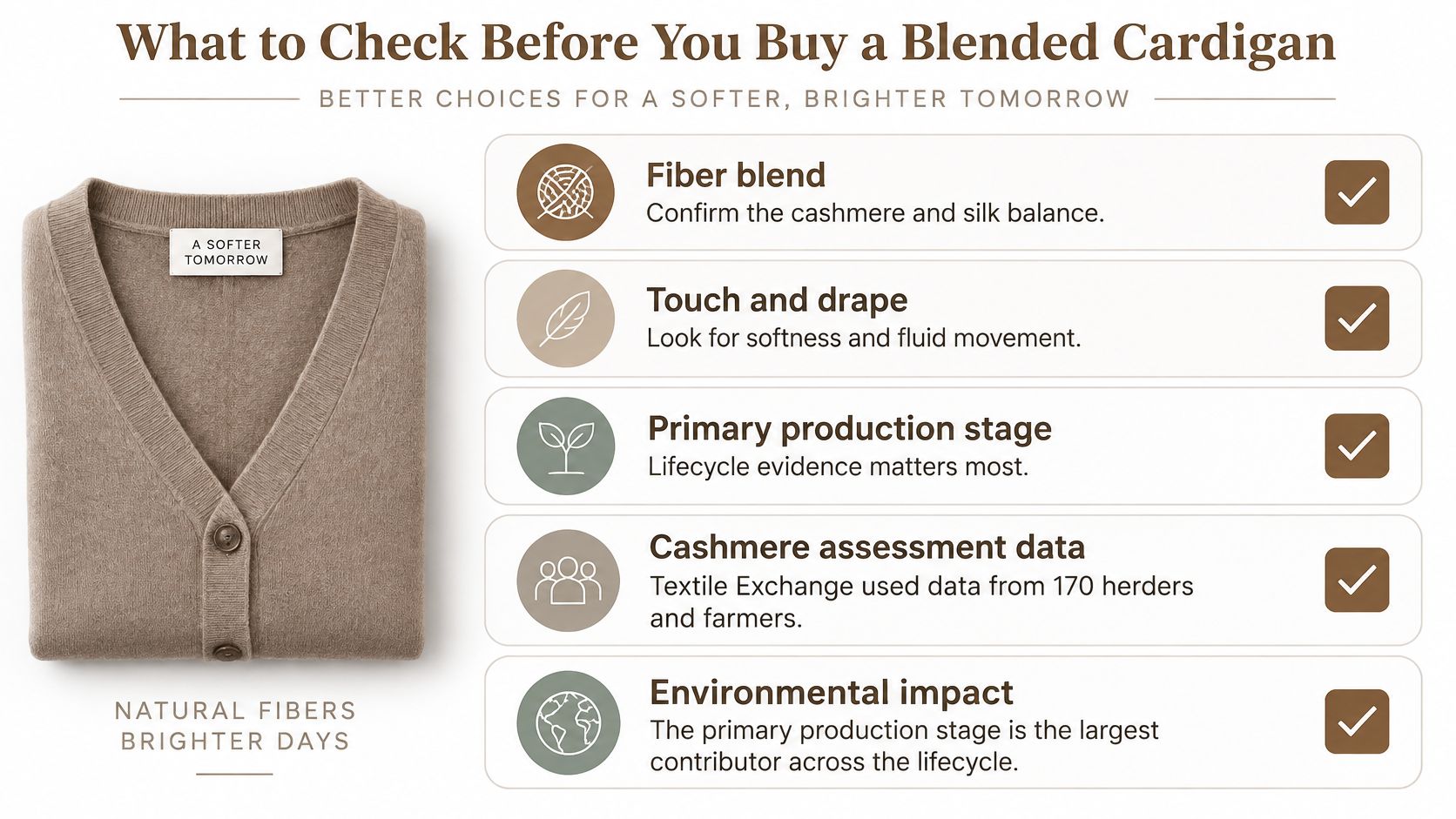
Fiber labels can't carry the environmental question on their own. Textile Exchange's cashmere lifecycle assessment drew on data from 170 herders and farmers across major production systems and assessed climate change, water use, ecotoxicity, land use, biodiversity, animal welfare and livelihoods. Its summary found the primary production stage is the largest contributor across several impact categories, and found no significant climate-impact difference per kilogram of clean dehaired cashmere between nomadic and farmed systems, as reported in the Textile Exchange lifecycle assessment summary.
That changes the checklist. Where the fiber came from matters more than which two fibers are named, and how long you wear the cardigan matters more than either.
- Fiber percentages in writing. "Cashmere blend" is not a composition. You want the numbers, and you want the composition line to match the blend family you chose.
- Yarn and knit construction. Dense and even beats loose and open for anything worn repeatedly. If the listing won't say, that's information too.
- Fabric weight against your climate. A featherweight cardigan for a heated office and a dense one for a cold commute are different purchases even at the same ratio.
- Traceability the brand can prove. Ask where the cashmere was sourced and whether animal-welfare claims come with documentation, not just a paragraph.
- Expected wear count. A well-made cardigan worn often for years usually beats a cheap one replaced each season, and the lifecycle evidence points at production, not disposal, as the heavy stage.
- Repair and end-of-life realism. Mixed-fiber construction complicates separation and recycling, so check whether the brand offers repairs before you need one.
Point six is the honest trade-off in this blend. Combining two valuable natural fibers can improve comfort and service life, and that's a real gain. The same combination makes the garment harder to recycle at the end. Comfort and durability rise; circularity falls. Neither fact cancels the other.
Natural and luxury are not the same as low impact. A cardigan can be beautiful, well made and still carry a production footprint that the label never mentions.
Sizing deserves a moment too, because a blend with silk slips and drapes differently from a pure wool knit, and the same number on the tag won't fit the same. If you're comparing charts across brands, this explanation of what clothing size labels actually mean helps you read measurements rather than letters. For a closer look at how fiber grade and ply show up in finished knitwear, see this guide on how to choose a high quality cashmere sweater.
Choose Your Blend and Test It This Week
Name the one use you're buying for. A cardigan for a cool office, a cardigan for a winter commute, and a cardigan for travel are three different purchases, and each points to a different row in the comparison above. Decide that first and the shortlist gets short fast.
Then work in a fixed order. Pull two or three listings in your chosen blend family and compare them on stated fiber percentages, knit construction, care label, and price, in that sequence. Composition tells you what the garment is, construction tells you how it will age, the care label tells you what ownership costs in effort, and price comes last because it can't correct a wrong answer to the first three.
If a listing gives only "cashmere blend" with no numbers, set it aside. There's no way to judge the trade-offs without them.
Set aside a day this week to wear your candidate through the situations you planned for. Note whether it moves freely when you reach and sit, whether the shape holds by evening, whether it bunches at the elbows or underarms, and whether fuzz appears where a bag strap or seat belt crosses it. Any failure sends you back to the knit and care questions before you commit.
If you want a pure cashmere reference point to compare against a blend, our Women's Cashmere Cardigan Twin Sweater Set is on sale for $199.00 USD, down from a regular price of $399.00 USD, in 12 colors. It gives you the dense, insulating end of the spectrum to hold next to a silk-heavy piece and feel the difference for yourself.
At Cashmere Boutique, we've been selling cashmere online since 1999, and we've learned that buyers do best when they can compare fiber, construction and care before deciding. Our cardigans, twin sets and pure cashmere layers give you a reference point for the dense, insulating end of the blend question, while our cashmere and silk scarves show how silk changes drape and luster in a smaller piece. Visit Cashmere Boutique to browse the cardigan collection in every available color and find the weight that matches your climate.