
How to Dry Sweaters Without Shrinking or Stretching
Your sweater came out of the wash looking fine. It's clean, it's soft, and it's heavy with water, and now you have to decide what happens next. Hang it over a shower rod, toss it in the dryer on low, or lay it out and wait. That choice, not the wash itself, is where most sweaters shrink or stretch. Learning how to dry sweaters properly starts with one small tag inside the seam.
Table of Contents
- Check the Care Label Before You Dry
- How to Dry a Sweater Flat, Faster
- When a Tumble Dryer Is Safe and When It Is Not
- Fixing Shape, Felting and Fuzz After Drying
- Choose Your Drying Routine Before the Next Wash
Check the Care Label Before You Dry
A sweater can survive a careful wash and still lose its shape in the next twenty minutes. You're holding it over the sink, it's dripping, and the dryer is right there. Before you use it, read the care label. That label isn't a suggestion. It tells you whether your specific garment was tested for machine drying or not.
Modern labels distinguish between hand-washable, machine-washable, and tumble-dryable garments, and those claims don't transfer from one sweater to another. A blend that tolerates a gentle cycle tells you nothing about an untreated cashmere knit. If you're comparing fibers, our guide to an extra fine merino wool sweater shows how construction and fiber choice change what care a garment can handle.
What Each Symbol Means for Drying
Care label claims and the drying method each one allows
| Label claim | What it allows | Drying method to use |
|---|---|---|
| Crossed-out tumble dryer symbol | No dryer at any setting | Flat dry on a towel |
| Tumble dry on low or a wool/delicates setting | Machine drying on that setting only | Flat dry first; use the dryer only if you accept the risk |
| Dry clean only symbol | Professional cleaning only | Take to a dry cleaner; do not dry at home |
| No symbol or unclear label | Unknown | Treat as hand wash and flat dry |
The crossed-out symbol is the easiest to misread. It doesn't mean avoid high heat. It means keep the garment out of the dryer entirely, even on low. A dryer symbol with a dot or a wool setting is narrower than it looks, too. It permits machine drying on that setting only, not on whatever cycle is convenient.
The Woolmark guide to drying a wool sweater treats flat drying as the baseline for wool knitwear, placing the washed sweater on a pale, lint-free towel, reshaping it to its original dimensions, and letting it air-dry naturally unless the label explicitly permits tumble drying. The same guidance warns against hangers, direct sunlight, sunlight concentrated through a window, radiators, and other direct heat, because hanging stretches a sweater lengthwise and leaves shoulder humps.
Practical rule: Follow the label, but choose flat air-drying whenever the label doesn't authorize machine drying.
For cashmere, that baseline matters even when the label allows more. A tumble-dry claim makes the dryer permissible, not risk-free, and flat drying stays the lower-risk default. We recommend dry cleaning for cashmere and pashmina products. Selected garments may be hand-washed in lukewarm water, gently squeezed without twisting, and dried flat away from direct heat or sunlight, but that's the exception, not the routine for every piece.
Run three questions before you start. What does the label say? Is the garment cashmere, wool, or a blend? Do you have time to dry it flat? Your answers set the method, and if any answer is unclear, flat drying is the safe call.
How to Dry a Sweater Flat, Faster
Flat drying has a slow reputation because of how it usually gets done: a soaking sweater parked on a towel and left. Take out most of the water first, support the knit properly, and keep air moving across both faces, and you keep the same protection while cutting hours out of the wait.
The Full Flat-Drying Method
- Press out water first. Lay the sweater on a clean towel, roll the towel up with the sweater inside, and press along the roll with your hands or knees. No wringing, no twisting. Twisting torques the knit, distorts stitches, and can leave one side longer than the other. Wringing feels efficient, which is exactly why it is the most common mistake, and the damage only appears once the garment dries.
- Lay it flat on a dry surface. Unroll onto a fresh, pale, lint-free towel or a mesh drying screen, with the whole garment supported horizontally so nothing hangs off an edge. A solid towel works at first but traps moisture under the knit once it saturates.
- Reshape while damp. Smooth the body, straighten the sleeves, align the side seams, and ease the neckline back to its original curve. Folds and creases left in a wet knit dry in place, so a sweater that looks flat enough is how you end up with a wavy hem.
- Measure against your pre-wash numbers. Shoulder width, body length and sleeve length are all checkable while the sweater is damp and corrections are still easy. If a sleeve runs long, push the knit gently back toward the cuff. If the body runs short, ease it lengthwise with flat palms.
- Keep heat away. Radiators, space heaters, hairdryers, heated towel rails and sun through a window all dry one area faster than the rest and lock in the distortion.
- Swap the towel and turn the sweater. When the towel feels damp through, move the sweater to a dry one. Turning it every few hours exposes the underside to air and prevents a musty smell.
- Leave it alone. Don't pick it up, try it on or fold it early. Handling a damp knit stretches it.
A Textile Research Journal study on mechanical action and felting explains why this low-stress sequence holds up. Wool fibers felt when moisture, heat and repeated rubbing let their surface scales interlock, and mechanical action is a major contributor to that shrinkage. Flat drying removes the rubbing, the heat, and the lengthwise pull you get from hanging a water-loaded garment by its shoulders.
Cashmere Boutique applies the same sequence to its robes: hand wash in lukewarm water with gentle shampoo, no bleaching, twisting or wringing, squeeze out excess water gently, reshape while damp, and dry flat away from direct heat. A robe carries more water than a sweater, so the towel roll and horizontal support matter even more.
Speed It Up Without Heat
Airflow beats temperature. A mesh drying screen lets air reach the underside of the knit instead of forcing all evaporation through the top face, and it still supports the sweater horizontally. A small fan moving room air helps too. Aim it across the room rather than at the knit.
The numbers behind this are striking. A 2025 Textile Research Journal study of fabric drying reported that obstructing evaporation behind a fabric sample prolonged drying time by 52 to 304 minutes, with an average increase of 170 minutes across all tested samples. Nearly three hours, added by blocking one face of the fabric. A saturated towel under a sweater does something similar, which is why swapping the towel and switching to mesh changes your drying time more than any amount of heat will.
If the underside can't breathe, the water has nowhere to go, and that is the whole reason the sweater is still damp.
Plan your timing around the knit, not your schedule. A fine single-ply layer dries far faster than a heavy multi-ply sweater, and thick seams, cuffs and a folded turtleneck hold water longest. Wash heavy knits early in the day so you can swap the towel and turn the garment before bed. A late wash means a sweater that is still damp at breakfast, and reaching for heat to finish the job is how flat drying turns into shrinkage.
The Travel Version
Hotel rooms rarely give you a drying screen, but they always give you towels. Roll the sweater in a dry bath towel and press out as much water as you can. Then lay it flat on a second dry towel on the bed or luggage rack, reshape it, and open a window or run the bathroom fan. Turn it once before you sleep. Never use the hotel hairdryer and never drape the sweater over a chair back, which creates the same shoulder and mid-body stretch as a hanger.
You'll know the sweater is ready when there are no cool or damp patches anywhere in the body and the seams feel dry to the touch. Press the inside of the cuff and the underarm seam between your fingers, since those layered spots dry last. If either feels cool, give it more time. Folding or wearing a sweater that is damp at the seams stretches it under its own remaining water weight.
When a Tumble Dryer Is Safe and When It Is Not
"I'll just use low heat" is the assumption behind most ruined sweaters. Heat is only one of three forces working on a wet knit inside a dryer, and a low-heat cycle still tumbles. Moisture and mechanical movement do damage that temperature alone doesn't explain.
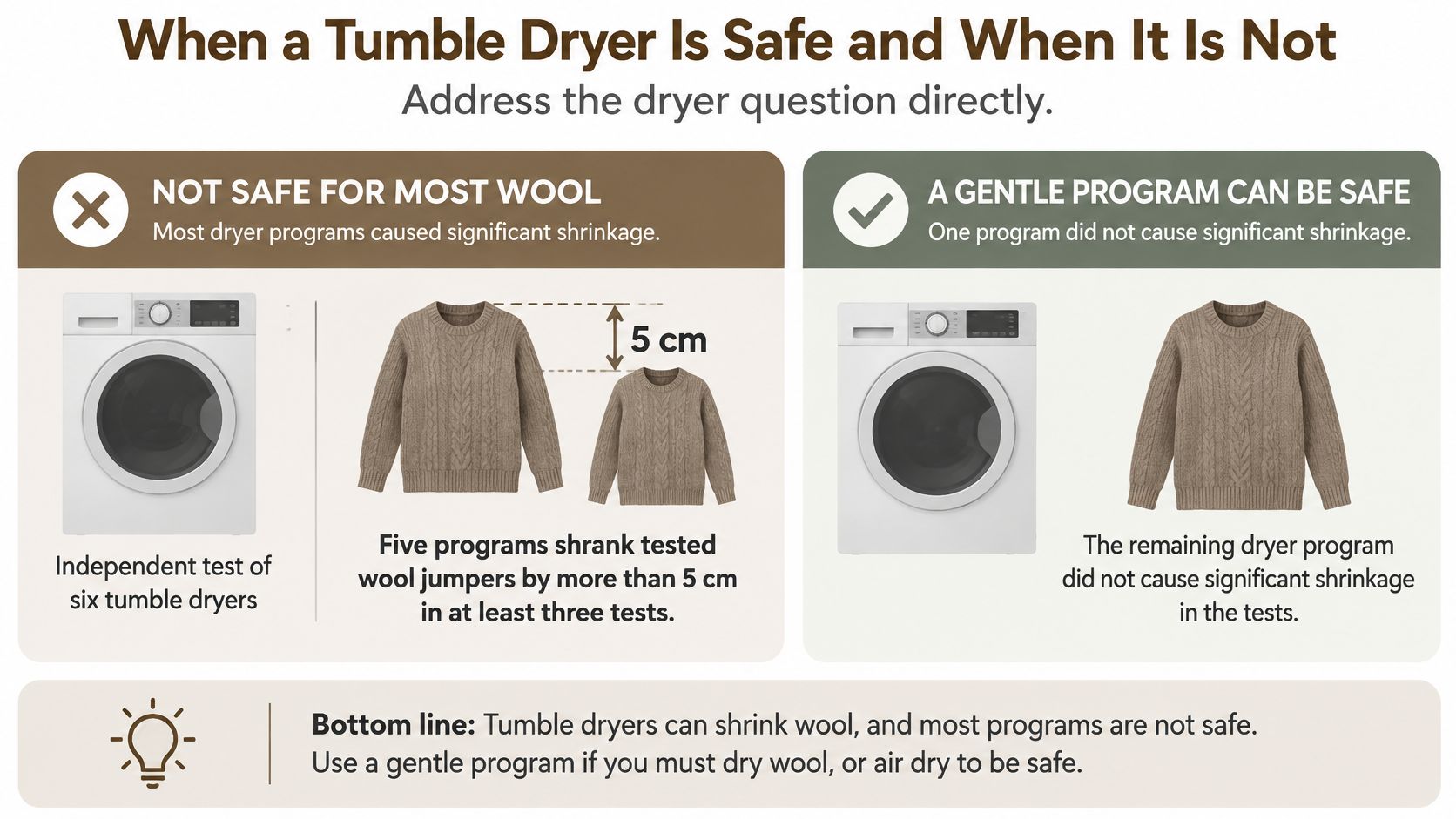
The test results are blunt. In the Which? snapshot test of six tumble dryers, five programs shrank tested wool jumpers by more than 5 cm in at least three areas, the worst result approached 20% shrinkage, and drum temperatures reached as high as 85°C. A jumper that loses 5 cm in three places and approaches a fifth of its size is a sweater in a different size.
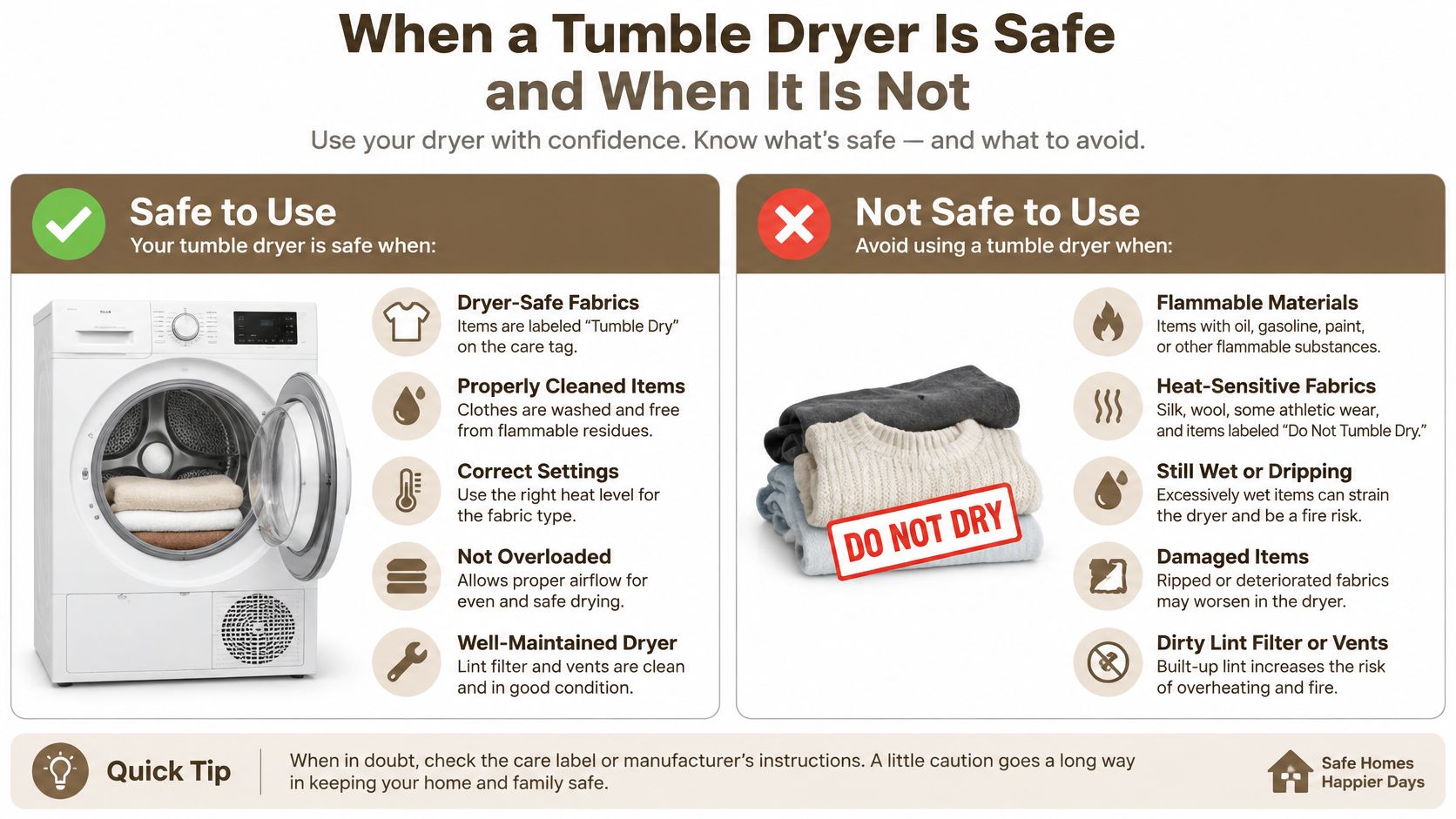
The mechanism explains the numbers. Shrinkage increases with the combined effects of fiber moisture, temperature, and mechanical movement, and untreated wool is particularly vulnerable to felting during repeated tumbling. A program's actual internal temperature and drum action can matter as much as the setting printed on the dial. Two dryers set to low can treat the same sweater very differently.
Drying methods compared on shrinkage risk, speed and best use
| Method | Shrinkage risk | Drying speed | Best use |
|---|---|---|---|
| Flat on towel | Lowest | Slowest, no heat | Everyday cashmere and wool |
| Flat on mesh screen with fan | Lowest | Faster than towel | Thick knits and quick-dry needs |
| Wool or cold-air dryer program | Conditional, not a guarantee | Faster than flat drying, slower than hot cycle | Labels that explicitly allow tumble drying |
| Standard hot dryer program | High; five of six tested programs shrank jumpers by more than 5 cm | Fastest | Not recommended for wool or cashmere |
There is a conditional case for the dryer, and it's narrow. Your label explicitly allows tumble drying. You use the manufacturer's wool setting or a cold-air, air-only mode. You keep the load small so the sweater isn't beaten against other garments. You pull it out while it's still slightly damp, reshape it immediately, and finish it flat. Miss any one of those conditions and you're gambling with the size you started with.
Shrink-resist treatment is the detail that decides this argument, and most cashmere labels never mention it. Wool sold as machine-washable has usually been finished to tolerate mechanical action. Untreated cashmere has not been, so a label that stays silent on the treatment tells you nothing reassuring about the drum. For cashmere and pashmina, dry cleaning is the standard recommendation, with hand washing in lukewarm water the route for selected garments. Neither of those involves a dryer.
If you do use a dryer regularly, keep its venting clear as part of reducing laundry fire risks at home, since lint buildup raises both temperatures and risk. A dryer running hotter than its setting suggests is exactly the machine you don't want near knitwear.
My call is simple. If you're unsure, dry flat. The cost is time, not damage, and time is recoverable.
Fixing Shape, Felting and Fuzz After Drying
The most common drying injury isn't shrinkage. It's the shoulder hump, two small peaks where a hanger held up a wet sweater and the water weight pulled everything else down. It looks permanent. If the sweater is still damp, it usually isn't.
Timing decides what you can fix. Research published in Fibers and Polymers on tumble drying and felting shrinkage shows that moisture content, fabric temperature, and mechanical action jointly drive felting shrinkage, and that untreated wool's moisture content changes its fiber mechanical properties during drying. In practical terms, a damp sweater can still be coaxed back to size. A dry, felted one can't, because the fibers have locked together.
Post-drying symptoms, likely causes and fixes
| Symptom | Likely cause | Fix |
|---|---|---|
| Shoulders peaked, sleeves hang long | Sweater hung while wet | Reshape flat while damp, then finish drying flat |
| Body or sleeves shorter than before | Heat, tumbling or felting | Stretch gently while damp; partial shrinkage may recover, full felting does not |
| Neckline or shoulders stretched | Wet weight pulling from the shoulders | Lay flat on a towel and support the neckline while it dries |
| Fuzz or pills on the surface | Friction from rough clothing or accessories | Remove with a cashmere comb or fabric shaver |
| Still damp after two days | Saturated towel or no airflow | Replace the towel and lift the sweater onto a mesh screen |
| Stiff, rough hand | Detergent residue or harsh rubbing | Rinse thoroughly and use a conditioner in the next wash |
Shoulder and neckline problems are one-session fixes while the knit is damp. Lay the sweater flat, flatten the peaks with your palms, ease the sleeves back to length, and let it finish drying in that corrected shape. This is exactly the moment when knowing how to dry sweaters flat pays off, because the same reshaping step that prevents distortion also reverses early distortion. Our piece on the pullover cashmere sweater covers how a classic pullover should sit at the shoulder when it fits properly, which gives you a reference for what you're reshaping toward.
Partial shrinkage sits in the middle. A sweater that tightened slightly can sometimes be stretched gently while damp, working the body and sleeves back toward their original measurements a little at a time. A fully felted sweater, where the surface looks matted and the stitch definition has blurred, won't recover. Don't keep pulling at it. You'll distort the shape without restoring the size.
Check your measurements before the sweater is fully dry. That's your last cheap chance to fix the shape.
Pilling is a separate cleanup, not a drying failure. Some pilling occurs through normal friction and may be gently removed with a cashmere comb or fabric shaver on a flat surface, working in one direction with light pressure. Don't pull pills off by hand, since that drags more fiber loose. To slow pilling down, don't wear cashmere next to rough clothing, metal necklaces, bracelets, belts, or rough leather items.
Two symptoms need a fresh start rather than more time. A sweater still damp after two days needs a dry towel and a mesh screen, not a third day on a wet towel. A stiff, rough hand points to detergent residue or harsh handling, and it's fixed in the next wash with a thorough rinse, not by drying the garment longer.
Choose Your Drying Routine Before the Next Wash
Decide how you'll dry a sweater before it gets wet, not while you're holding it over the sink. Five minutes of setup in advance removes every rushed decision that leads to a hanger or a dryer.
Your Pre-Wash Checklist
- Read and classify: Check the care label and note whether the garment is cashmere, wool, a blend, or a coat. The label decides whether a dryer is an option at all. Our care instructions page gives the exact guidance for our garments, and care claims vary by item, so check the product page for the specific piece you own.
- Stage your setup: Keep two pale towels and a mesh drying screen where you wash. That's the everyday station. For travel, your setup is a towel roll and a flat surface. In a humid room, add a fan or an open window.
- Block the time: Give thick knits a long, uninterrupted drying window. Don't start a heavy sweater the night before you need to wear it, and don't shorten the wait with heat.
- Check the machine too: If you machine wash any of your laundry, a clean washer protects the next load, and this guide to removing mold and odors from washers covers the disinfecting routine. Residue and odor in the drum transfer to garments you'd rather keep pristine.
- Store it dry and clean: Once the sweater is fully dry, fold it or pack it neatly in tissue paper and store it in a closet away from light, dust, and dampness. Clean any stains first, because fresh stains oxidize in storage and can attract moths.
One category never enters your home routine. We recommend dry cleaning all cashmere and pashmina products, and we specifically advise against washing cashmere coats and jackets at home. Structured pieces have linings, padding, and shaping that flat drying can't restore, so send coats to a cleaner rather than improvising.
Match the routine to the garment in front of you. A fine crew neck on a mesh screen in a ventilated room is an easy afternoon. A heavy knit in a humid apartment needs the towel swap, the turn, and patience. A coat needs a professional. None of those decisions require special equipment, just the right call made early.
When in doubt, lay it flat.
Cashmere Boutique offers cashmere sweaters, robes, scarves, coats, throws, and blankets made for the kind of careful, flat-dry routine described above, with care guidance published for every piece. If you're adding a sweater worth looking after properly, browse the collections at Cashmere Boutique and check the care details on the product page before your first wash.