
Pullover Cashmere Sweater Guide: Grades, Fit and Care
You're in the shop, or you're on your phone at the kitchen table, and two pullovers are both labelled cashmere. One feels smooth on the inside of your wrist. The other turns faintly scratchy before you've even checked the price. The hangtag doesn't tell you which one will still look decent after a winter of bags, seat belts, and washing.
A pullover cashmere sweater is a simple shape with several separate decisions hiding in it. Fiber diameter, yarn ply, stitch density, weight, and fit each change what you feel today and what the knit looks like next year. Softness is the easy part to notice. Construction is what you live with day to day.
Read the numbers in the order a careful buyer uses them. Start with the micron claim, then check whether the knit is built to last, then match weight and fit to the coldest hours you'll spend in it.
Table of Contents
- Micron Grades on a Pullover Cashmere Label
- Pullover Weights and Knit Styles Compared
- Judging Durability Beyond Softness and Micron Count
- Fit and Sizing for Your Pullover Cashmere Sweater
- Styling a Pullover Cashmere Sweater Through the Seasons
- How to Care for a Pullover Cashmere Sweater
- Price Drivers and a Pre-Purchase Checklist
Micron Grades on a Pullover Cashmere Label
Micron is the diameter of one fiber, measured in millionths of a metre. Cashmere is far thinner than a human hair, which is why a fine grade can sit next to skin when the yarn and the knit are also sound. A coarser lot in the same silhouette can feel pleasant in the hand and still prickle once the sweater warms up against your neck.
A Food and Agriculture Organization technical review reported that Chinese cashmere fibers generally measure 12.5–16.0 microns, with 15.5 microns regarded as a standard cashmere benchmark. Mongolian fibers in that review ran somewhat coarser, at 16.0–17.5 microns, but they were generally longer. Length matters later, because a longer fiber is easier to anchor in the yarn.
A shop reference for feel
Use this as a label decoder, not as a scorecard for the whole garment.
| Reference point | Micron range | What it means for feel |
|---|---|---|
| Standard cashmere benchmark | 15.5 | Soft, reference point for fine-grade pullovers |
| Chinese cashmere fiber | 12.5-16.0 | Generally the finest commercial supply, common in next-to-skin knits |
| Mongolian cashmere fiber | 16.0-17.5 | Slightly coarser but longer, can feel less fine against skin |
| Textile cashmere ceiling (mean diameter) | up to 19 | Above this the fiber does not meet the cashmere definition |
| Prickle threshold | about 25-30 and above | Fibers bend less and stimulate skin nerve endings |
Fibers near the fine end flex away from the skin. Fibers around the prickle threshold bend less readily, so they poke tactile nerve endings instead of giving way. That's the mechanical reason one cashmere pullover feels cloudy and another feels hairy by midday, even when both labels are honest.
The same FAO review estimated world cashmere production at about 5,000 tonnes in 1988, set against about 1.8 million tonnes of wool. Cashmere was only roughly 0.28% of that wool volume. China produced about 60% of the world's raw cashmere then, and Inner Mongolia supplied up to 70% of China's share. The raw-material base is small, and the fine fraction used for next-to-skin knits is smaller still.
Buyer's rule: Treat the micron number as a fiber-quality indicator, not a promise that the sweater will wear well.
Yarn ply, knitting density, finishing, and garment weight still decide warmth, pilling, and how the shape holds. A 15.5-micron claim on a loose, short-staple yarn can disappoint. A slightly less fine fiber in a dense, well-twisted knit can feel calmer after a month of wear. If a product page prints a grade and nothing else, use a guide on how to choose a high-quality cashmere sweater and then ask what the yarn is made of. Weight and stitch come next, because they change the result of the same fiber.
Pullover Weights and Knit Styles Compared
Warmth in a fine knit works a bit like a down jacket. The fiber doesn't have to be heavy if the structure holds still air. Fineness helps that warmth-to-weight balance only when the stitches are close enough to trap the air. The same nominal grade in an open, floppy knit looks thinner, drapes faster, and shows every snag.
The Cashmere and Camel Hair Manufacturers Institute describes cashmere as a non-medullated animal fiber with a mean diameter no greater than 19 microns, with limits on diameter variation and on fibers over 30 microns. A stated 14–15.5-micron specification sits at the fine end of commercial cashmere and should prickle less than coarser fiber. U.S. cashmere-goat research cited there reported an average fiber diameter of 15.34 microns, so a claim in that band is plausible. It still belongs with a supplier test, not on faith.
Weight classes
| Weight class | Gauge and yarn thickness | Warmth and feel | Best use |
|---|---|---|---|
| Lightweight fine-gauge | Fine needles, thin yarn | Airy, drapes easily, low bulk | Layering under blazers and spring evenings |
| Standard mid-weight | Mid gauge, medium yarn | Balanced warmth and body | Year-round everyday wear |
| Heavy or chunky | Coarser gauge, thick yarn | Dense, very warm, more bulk | Cold winters and outdoor layering |
| Cable or textured knit | Heavier stitch pattern | Structured, warm, slower to drape | Statement knitwear on cold days |
Crew necks and V-necks cover the most outfits. A crew closes the throat without bulk. A V-neck leaves room for a collar and vents a little heat. A turtleneck traps warmth at the neck, which is useful in a windy commute and too much in a heated office. A polo collar adds a woven-looking edge to a knit body, so the sweater reads more like a light layer than a lounge piece.
Cable and other textured stitches use more yarn and sit farther from the body. They look richer and they weigh more. They also take longer to dry and show wear where a bag strap crosses a raised stitch. A brushed surface is a different choice again. Brushing lifts fiber for a halo, and our note on a brushed cashmere sweater is worth reading before you treat that halo as everyday armor.
Say you dress in a cold city. A fine-gauge crew under a wool coat stays light on the train and still blocks a chill between buildings. A heavier V-neck, worn on its own for a walk, carries the warmth without the coat. Neither is "better." They answer different hours.
Hold the sweater to a window or a phone flashlight. You want an even, closed stitch, with no bright gaps and no thin patch at the elbow or underarm. A fine-gauge pullover that is also dense should look smoother and hold its shape better than a loose knit in the same fiber grade. If light pours through, the air pockets are holes, not insulation.
Judging Durability Beyond Softness and Micron Count
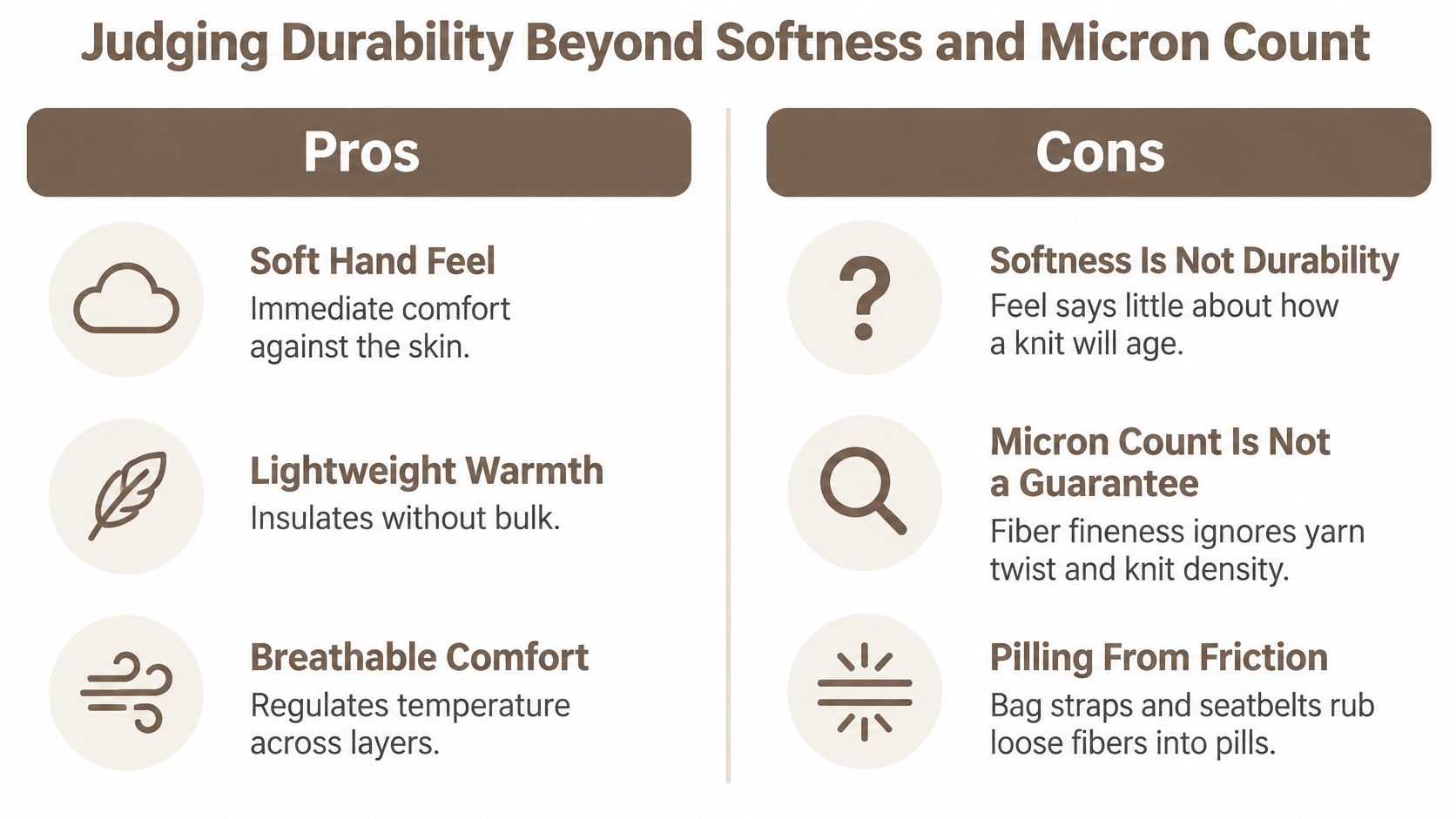
The softest, lightest pullover is not automatically the one you'll still want in five years. Soft hand feel tells you about the first minute against your skin. It says very little about elbows, underarms, and the tenth wash.
Finer fibers can feel kinder and still be easier to abrade. Fast Company, covering recycled cashmere development, makes the construction point concrete. Recycling can shorten cashmere fibers and raise the risk of weakness and pilling, so makers have had to adjust yarn twisting, washing, and finishing to get comparable durability. Independent, product-level wear tests are scarce. A seller who only says "buttery soft" hasn't answered the question you're asking.
What to check on the garment
Pilling is mostly friction plus fiber migration. Short or poorly anchored fibers work out of the yarn, then tangle. Construction decides how fast that happens.
- Ply. Two or more strands twisted together usually hold better than one loose end. If the page doesn't say single-ply or multi-ply, ask.
- Density. Tight, even stitches snag less. Open gaps catch rings, bag hardware, and rough coat linings.
- Fiber length. Long staple stays in the yarn. Short fiber migrates. Recycled lots need the maker to show how twist and finishing compensate.
- Finishing. Run a hand from shoulder to cuff. An even surface is a good sign. Thin spots at elbows and cuffs are not.
- Recycled content. Shorter fiber isn't a reason to walk away if the supplier explains adjusted twist and wash tests. Silence is the weaker sign.
| Factor | Stronger sign | Weaker sign |
|---|---|---|
| Ply count | Two or more plies twisted together | Single loose yarn with no twist detail |
| Knit density | Tight, even stitch with no light showing through | Open gaps or see-through patches |
| Fiber length | Long staple stated or evident in fine yarn | Short fibers with no length information |
| Finishing | Even surface, consistent handle across the garment | Thin patches or uneven texture at elbows and cuffs |
| Recycled content | Supplier explains adjusted twist and washing tests | Shorter fibers with no explanation |
Fuzz versus real damage
First-wear fuzz at the underarms and cuffs is often loose surface fiber. A cashmere comb lifts it. A small hole, or a patch you can see through at the elbow, is structural. Those are different problems, and only the first one is routine.
The same idea shows up in other plush textiles. The guide on how to keep plush quilt fabric soft is a useful cross-check on friction, because pills form where surfaces rub, not because a fiber is "fake." Before you pay, ask for ply, density, fiber length, and any wash-test note. Generic lifespan claims are marketing. Those four details are checkable.
Fit and Sizing for Your Pullover Cashmere Sweater
A 40-inch chest in a fitted pullover can feel tight the moment a blazer goes on. The same chest in a relaxed cut layers over a shirt and still moves. Letter sizes won't settle that. Brands draft differently, so the only honest comparison is your body against the garment's flat measurements.
Measure before you trust the size label
- Measure your chest at the fullest point, tape level, over a light shirt.
- Lay the pullover flat, smooth, and measure straight across from armpit to armpit.
- Double that flat width and compare it with your chest. The difference is your ease.
- Check sleeve length to the wrist bone, and body length to where you want the hem, usually the hip for a regular pullover.
A fitted cut sits close, with little spare fabric. A regular cut leaves a few centimetres of ease and straight sleeves, enough for one shirt. Relaxed or boyfriend cuts drop the shoulder and loosen the body. Oversized cuts go past the hip and widen the sleeve.
Cashmere relaxes a little with wear. A slightly snug new sweater is not proof it will shrink, and it is also not a reason to buy a size that already strains at the chest. If it feels tight in the shop, a blazer will make it worse.
Match the cut to the job
| Fit type | How it sits | Layering room | Best for |
|---|---|---|---|
| Fitted | Close to the body, minimal ease | Little room for layers | Under blazers and tailored outfits |
| Regular | A few centimetres of ease, straight sleeves | Room for one shirt underneath | Everyday office and casual wear |
| Relaxed or boyfriend | Dropped shoulder, looser body | Room for a collared shirt and scarf | Weekend wear and easy layering |
| Oversized | Extends past the hip, wide sleeves | Room for a jacket over it | Statement looks and cosy days |
If the seller's size chart isn't on the page, treat the letter size as unknown until they send chest, length, and sleeve numbers.
Shoulders tell the truth faster than hems. If the shoulder seam sits halfway down your arm on a style that isn't meant to be dropped, the body will look sloppy even when the chest measurement is right. On a dropped-shoulder style, that low seam is the design. Read the fit name before you "fix" it by sizing down.
Styling a Pullover Cashmere Sweater Through the Seasons
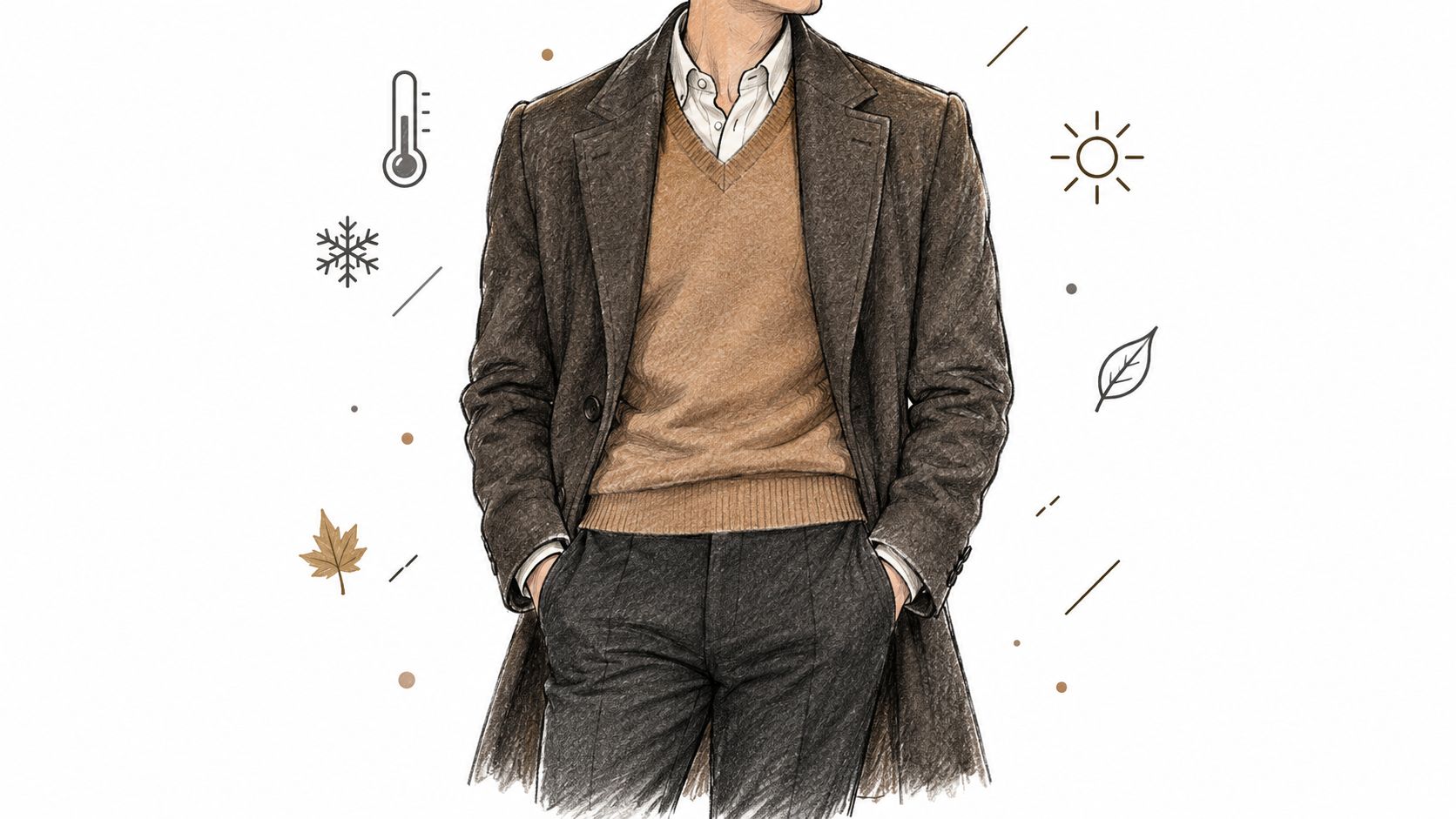
Treat the pullover as the middle layer between a shirt and a coat. Pick the weight for the coldest hour you'll spend in it, not the average temperature of the day. A mild morning and a freezing platform are not the same outfit.
Spring. A lightweight fine-gauge crew over a cotton tee handles a warm afternoon and a cool walk home. Leave the heavier knits packed. The fine gauge drapes under a light jacket without adding a lump at the waist.
Summer. A fine-gauge V-neck earns its place in air-conditioned offices and on cool evenings. It isn't a beach cover-up. It's the layer you grab when the meeting room is colder than the street.
Autumn. A standard mid-weight crew over a collared shirt covers the commute. Tuck the shirt so the hem doesn't bunch, and keep the coat's inner lining smooth. Rough canvas against cashmere is how a new sweater fuzzes in a week.
Winter. A heavy V-neck or a turtleneck under a wool coat is the cold-day stack. The sweater does the close-to-body warmth. The coat blocks wind. You don't need both to be bulky.
Dressy evenings. A fine-gauge crew or V-neck under a blazer reads clean if the knit is dense and the fit is regular or fitted. Chunkier cables fight the jacket line.
Roll the sleeves once if you want a looser look, and stop there so the cuff doesn't stretch. Add a scarf when the air bites, and take it off indoors so the neckline doesn't felt from constant friction. Bags, seat belts, and rough outer layers cause most of the wear you'll notice. Shift a crossbody to the coat, not the cashmere, on long days.
A short look at proportion helps when you're choosing between a neat crew and a longer, easier body.
Watch how the hem and shoulder sit with the coat and trousers. That's the styling test, more than the color story.
How to Care for a Pullover Cashmere Sweater
Most damage is friction or distortion. Fibers get dragged out by rubbing, or the wet garment is pulled out of shape by gravity. Gentle handling beats any miracle product.
NBC Select frames cashmere pilling as fiber migration under abrasion, not automatic proof of a fake. Fine fibers bend easily. Short or weakly held ones leave the yarn at the underarms, cuffs, sides, seat belt line, and handbag strap zone, then tangle into pills. Softer fiber needs better yarn and fewer rough partners.
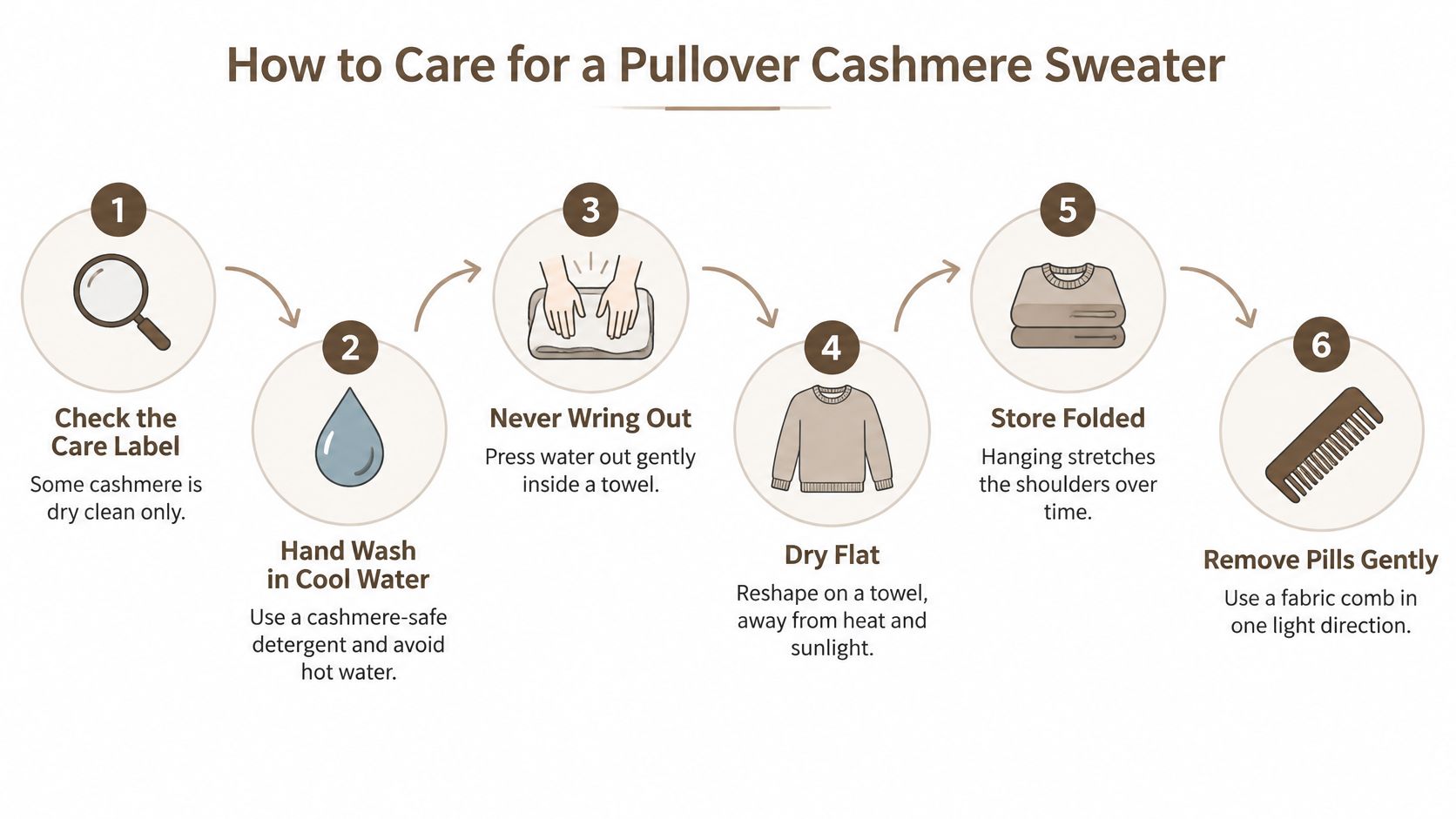
A home routine
- Read the care label first. Some cashmere is marked dry-clean only. Follow that symbol. General advice below is for pieces labelled hand wash, and it never overrides the maker's instruction. Our care instructions sit alongside the garment label, not instead of it.
- Wash cold, briefly. Use a basin, cool water, and a mild or cashmere-specific detergent. Hot water and long soaks felt the surface and shrink the ease you measured so carefully.
- Press, don't scrub. Soak for a few minutes and ease the water through with your palms. Rubbing is abrasion, the same problem as a bag strap.
- Skip the wring. Lift the sweater as a bundle. Roll it in a towel and press. Twisting pulls shoulders and ribs out of line.
- Dry flat, away from heat. Lay it on a dry towel, reshape sleeves and body, and keep it off radiators and sunny sills. Hanging a wet pullover lets the shoulders grow.
- Store folded. A shelf or a drawer keeps the shoulder seam where it was knitted. Hangers stretch that seam over a season. Clean knits before long storage so moths have less to feed on.
- Depill on a flat table. Use a cashmere comb or a low-tension fabric shaver, light strokes, one direction. Never pull pills off by hand. You'll yank anchored fiber with them.
Rotate pieces. Don't wear the same pullover on back-to-back days. Resting it flat lets the fibers recover their loft. Aggressive shaving thins the knit, so only work the spots that have actually pilled, and stop when the surface is even. Pilling often eases after the loose first fibers are gone. If you're cutting into the stitch itself, you've gone too far.
Price Drivers and a Pre-Purchase Checklist
Quality cashmere sweaters were reported to retail for about $400 to $2,500 in 2025, according to Dataintelo. That spread is wide enough to make a cheaper pullover look like a bargain and an expensive one look like a guarantee. Neither reading is safe.
Raw cashmere is geographically tight. An IUCN report described China as holding about 65–75% of global production, with roughly 78 million cashmere goats and about 12,000 tonnes of raw cashmere a year in the period it covered. Mongolia ranked second, with about 3,200 tonnes of raw greasy cashmere in 2004 from around 11.4 million goats. Herds, pasture, and processing in those regions move the price of the fiber that ends up in a pullover. Ordinary wool and cotton are produced far more widely, which is one reason a cashmere pullover never behaves like a basic commodity knit.
What the tag is charging you for
- Fiber grade: Finer lots cost more to sort, and a printed micron range should come with a test, not just an adjective.
- Ply and twist: Multi-ply yarn uses more processing. A single loose yarn is cheaper and usually weaker.
- Stitch complexity: Cables and intarsia take longer to knit than a plain jersey body.
- Finishing and dye: Even color and a consistent hand are mill time. Thin elbows are a miss, not a rustic detail.
- Weight: More grams of cashmere cost more, but only if the fiber and the knit are sound.
- Brand: Some of the price is the name. Construction still has to show up in your hands.
A very cheap pullover can resemble a thin cotton tee that happens to say cashmere. It looks right on the hanger and lacks the density that lets a knit last. A high price can also be mostly brand. The test is the same at both ends.
Our Women's Crew Neck Cashmere Sweater is $119, down from $239, in 4 colors, and our Women's Pure Cashmere V-Neck Boyfriend Sweater is $129, down from $259, in 5 colors. Those sale figures are not a quality score. They are a reason to run the checklist before you add either one, or anyone else's, to the basket.
Go or no-go before you order
- Name the coldest hour you'll wear it, and pick lightweight, mid-weight, or heavy from that hour.
- Ask for micron documentation. Confirm ply and whether the knit is dense. We specify Grade-A fiber at about 14–15.5 microns and, on styles such as the women's crew, a three-ply yarn. If a listing won't say, don't guess.
- Measure your chest and compare it with the garment's flat width, doubled. Ignore the letter until the numbers agree.
- Read fiber content, whether it is 100% cashmere or a blend, and the care symbols. Plan a cold wash only if the label allows it.
- Check the return window before you pay. A sweater you can't send back is a sweater you must be sure of in the photos.
Judge value by construction and documented fiber, not by the size of the discount or the softness in a product video. Use any listing, including ours, as a test case. If the micron, the ply, and the size chart aren't there, it isn't ready to buy.
Cashmere Boutique has specialized in cashmere apparel since 1999, with pullover styles for women and men plus size charts and care notes so you can check grade, fit, and washing before you order. If you're ready to compare a crew, a V-neck, or a heavier knit against the checklist above, visit Cashmere Boutique and read the fiber and measurement details on the style you plan to wear.