
How to Wear a Men's Overcoat: Fit, Layers and Occasions
You pull on your overcoat before leaving for work. It looked sharp over a shirt in the fitting room, but now the suit underneath makes the buttons tight. Reach for your bag and the whole coat lifts.
Learning how to wear a men's overcoat starts with that moment, not with choosing a colour. The right coat needs to work over your real clothes, through your normal movements, in the weather you face.
Table of Contents
- Fit the Coat Over What You Will Actually Wear
- How to Put On and Close the Coat
- Test Movement and Confirm the Fit Before You Buy
- Wearing, Carrying and Taking Off the Coat Indoors
- Matching Coat Weight and Length to Your Climate
- Layering Sweaters, Robes and Scarves Under the Coat
- Outfit Examples for Work, Travel and Formal Events
Fit the Coat Over What You Will Actually Wear
Fit an overcoat over the heaviest outfit it will realistically cover. A neat outline over a dress shirt tells you very little about how it will sit over tailoring or winter knitwear.
Chest allowance and sleeve check by underlayer
The Masculine overcoat fit guide recommends approximately 1–2 inches of additional chest room over a dress shirt, 2–3 inches over a suit jacket, and 3–4 inches over a heavy sweater or cardigan, with coat sleeves extending about 0.5–1 inch beyond the jacket cuff.
| Underlayer | Extra chest room | Sleeve check |
|---|---|---|
| Dress shirt only | 1–2 inches | Covers the shirt cuff |
| Suit jacket | 2–3 inches | Extends about 0.5–1 inch past the jacket cuff |
| Heavy sweater or cardigan | 3–4 inches | Same check, tested with the sweater on |
Treat these allowances as fitting guidance, not instructions to add inches blindly to your usual size. Retailers distinguish between body measurements and finished garment measurements. Check which kind the chart shows before comparing numbers.
A jacket adds structure through the chest and shoulder. A heavy cardigan adds softer but substantial bulk through the body and sleeves. Without enough space, the coat stops buttoning cleanly, pulls across the back and loses its drape.
Get the difficult alterations right first
On a conventional set-in sleeve, the shoulder seam should meet the natural shoulder edge rather than droop down the arm. The collar should touch your neck without pushing the jacket collar outward. Sleeves should finish before your knuckles.
For online orders, use a flexible tape around the fullest part of your chest, held level without tightening it. Compare that measurement with the men's size guide, then review the product's shoulder, sleeve, chest and length measurements.
A tailor can usually shorten sleeves and adjust side seams where the seam allowance permits. Shoulder width and armhole shape are much harder to change. Hem alterations also need care because pockets and buttons can end up looking too low.
Buying rule: Choose the shoulder and back fit first. Don't buy a poor foundation because the sleeves look right.
At Cashmere Boutique, we advise allowing room for comfortable movement over layers rather than relying on your usual dress size. Sizing up can add bulk without fixing restrictive armholes. Finish the fitting with the sweater you'll wear on your coldest ordinary day.
How to Put On and Close the Coat
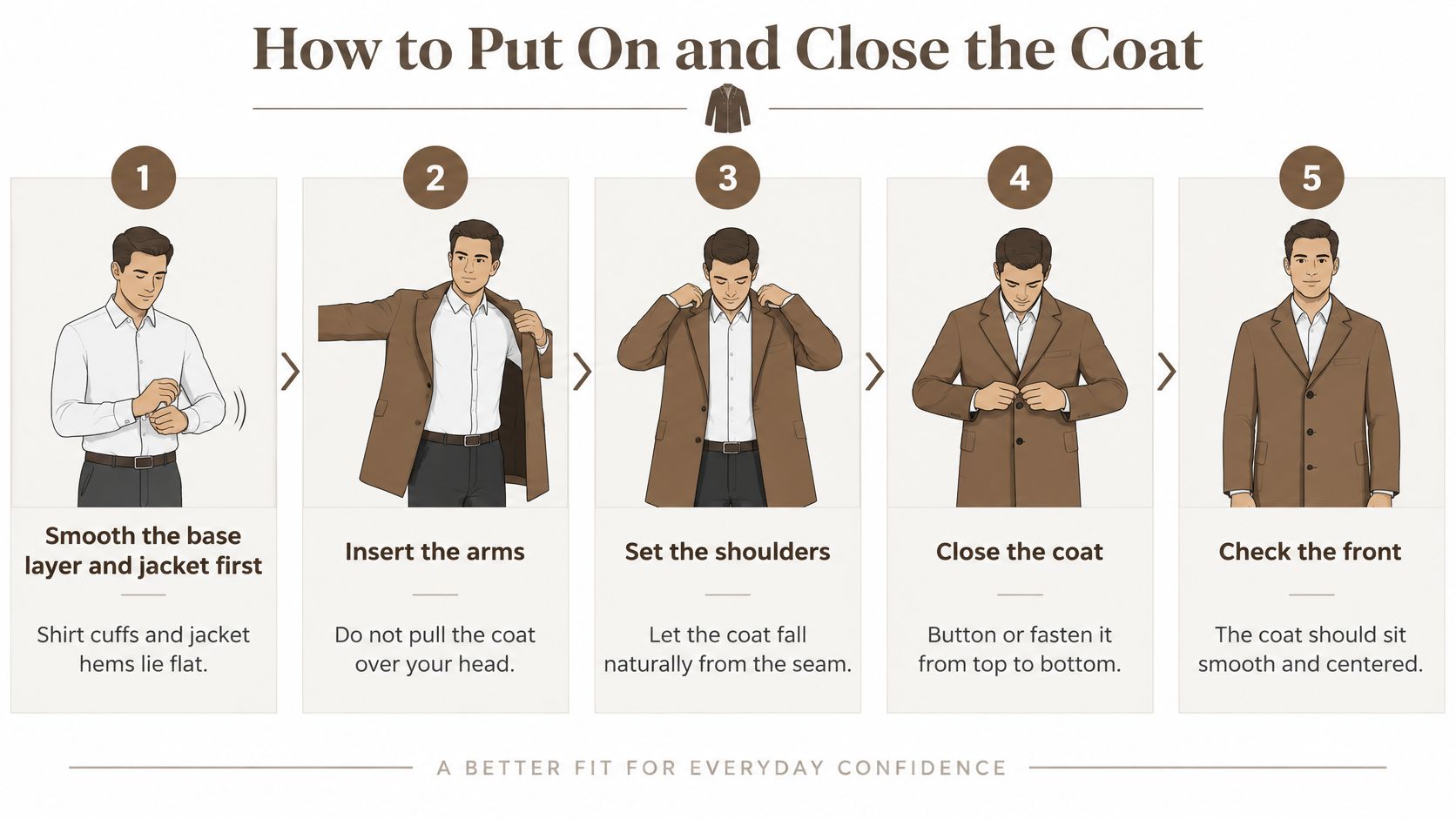
Dress the layers underneath before adjusting the outside. A twisted jacket sleeve or folded shirt cuff can make a correctly sized coat feel wrong.
The Real Men Real Style overcoat guide recommends settling the underlying clothes, checking coverage and testing everyday movement rather than treating buttoning as the final check.
- Smooth the base layer and jacket. Flatten shirt cuffs and release any jacket hem caught at the back. Don't trap bunched fabric inside the coat and mistake it for a sizing problem.
- Insert your arms and settle the shoulders. Put the coat on through its sleeves rather than pulling it over your head. Let its weight fall naturally before arranging the collar against your neck.
- Close the working buttons while standing naturally. Work upward through the central fastening positions without sucking in your stomach. Secure the highest button only when the design or wind protection calls for it, and leave any deliberately nonworking button alone.
- Check the lower outline. The hem must conceal the jacket completely; around the knee to slightly below is a useful formal starting point. Excessive length can overwhelm a shorter frame, while a cropped coat can leave the jacket exposed.
- Let your arms hang. Confirm that neither jacket nor shirt cuffs escape below the coat sleeves. The sleeves should cover the layers without swallowing your hands.
- Inspect the back collar. Use a second mirror to check for a clean contact line. A persistent gap deserves attention before you assume a scarf will hide it.
Use this dressing illustration as a quick visual reminder.
Catch the obvious failures
- Exposed tailoring: Release a trapped jacket hem before deciding the coat is too short.
- A gaping fastening: Don't force a button through visible tension lines.
- A crowded neckline: Remove excess scarf bulk rather than pushing the collar outward.
- Packed sleeve openings: Gloves should sit comfortably, not force the cuffs into ridges.
A smooth front is necessary, but it isn't enough. You still need to establish whether you can wear the coat comfortably through an ordinary day.
Test Movement and Confirm the Fit Before You Buy
A mirror rewards standing still. Commuting doesn't.
A coat can look excellent with your arms at your sides and become awkward the moment you reach for a steering wheel. The Masculine movement-focused fit guide recommends assessing the shoulders and chest over the intended layers while walking, sitting and reaching.
Run a realistic fitting
Keep the coat fastened for the initial checks so an open front doesn't hide restriction.
- Raise both arms: Look for the whole body lifting excessively or the armholes digging in. Some movement is normal; discomfort isn't.
- Rotate your torso: Turn as though reaching for something beside you. Watch for a tight band across the shoulder blades.
- Sit down: Check whether the front presses into your stomach or the lapels buckle sharply.
- Reach forward: Mimic holding a steering wheel. You shouldn't need to hunch your shoulders to gain reach.
- Carry your usual bag: Check the handle clearance and how a strap affects the shoulder.
- Walk and climb stairs: Take a normal stride rather than shortening your steps to accommodate the hem.
Keep these actions handy during a fitting.
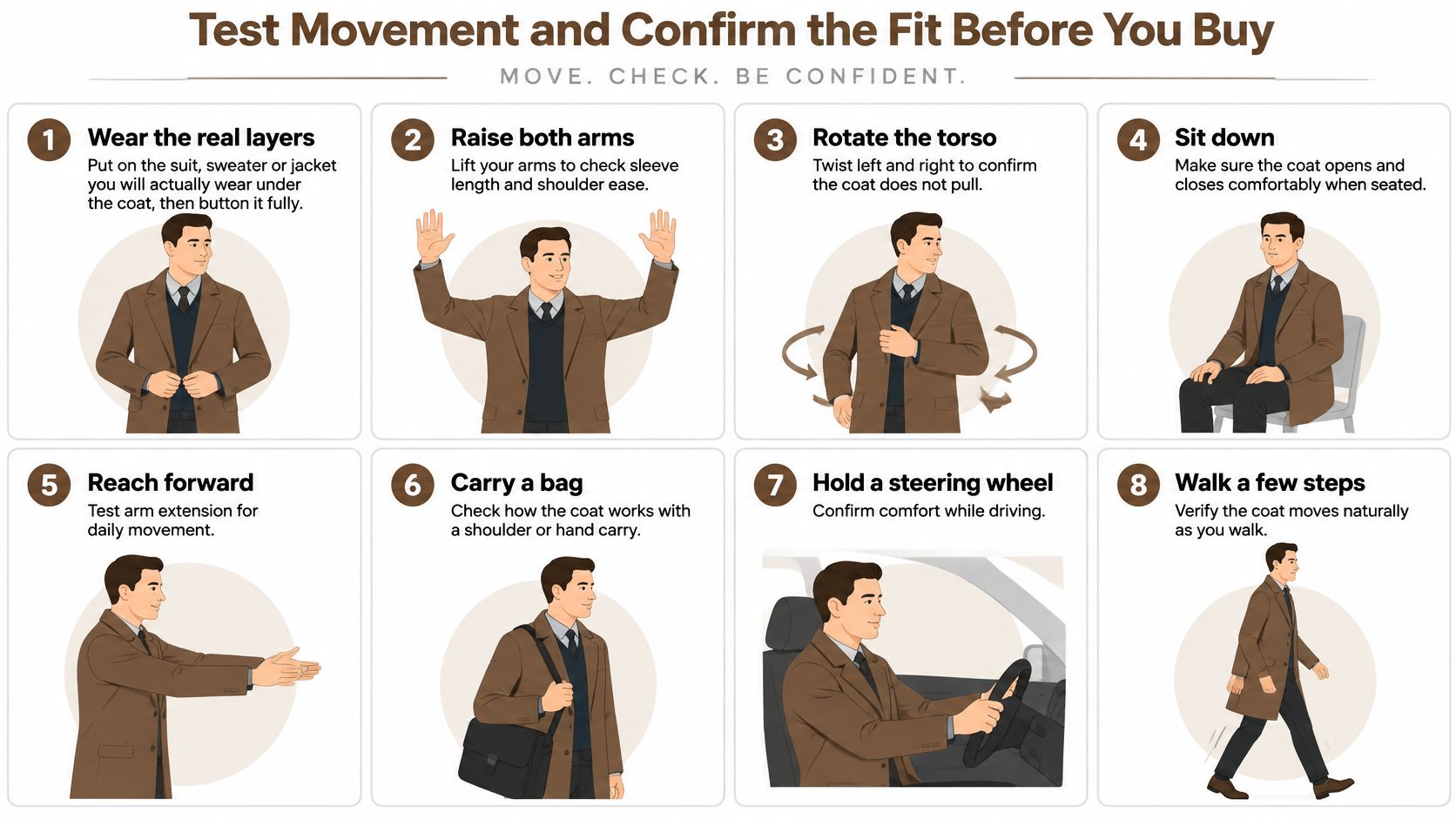
Change the cut before chasing a size
| What happens | What to try |
|---|---|
| Back pulls when reaching | A cut with more upper-back ease, including a raglan option |
| Set-in shoulder seam drops down the arm | A smaller size or a narrower shoulder block |
| Buttons strain across the chest | More chest room |
| Sleeves bind over knitwear | A fuller sleeve or a less bulky underlayer |
| Hem obstructs your stride | A shorter length or a more useful vent |
Compare a slim-fitting topcoat and a roomier raglan over the same outfit. The fitted shoulder may look cleaner over a suit, while the raglan may accommodate a substantial knit more easily. A deliberately dropped shoulder isn't automatically a sizing fault, but it should be a design choice, not an accidental compromise.
Fix each failure separately. Increasing the size to solve back tension can create oversized shoulders and an unnecessarily wide body.
Before buying, compare garment measurements with a coat you already find comfortable. Don't convert a sweater's letter size directly into a numbered coat size. At home, keep tags attached and test indoors within the return conditions, including a sustained seated stretch.
If a coat prevents an ordinary movement you need every day, it isn't the right daily coat, however good the photograph looks.
Wearing, Carrying and Taking Off the Coat Indoors
Unbutton your coat when you arrive indoors unless the room is cold. Leaving it open also makes sitting and reaching easier while you decide whether to take it off.
To remove it, ease it off your shoulders and withdraw your arms. Don't drag the coat downward by its sleeve ends or yank at the cuffs.
Carry it without crushing it
Fold the coat neatly over your forearm, with the lining tucked out of view and the hem clear of the floor. Avoid bunching it beneath you on a chair, where your weight presses creases into the body.
- Move heavy bags: Carry a loaded bag by hand when practical rather than leaving it suspended from the same shoulder.
- Arrange the coat before driving: Open the front and free the hem before sitting. Don't pull trapped fabric out from underneath yourself while reaching for the wheel.
- Use a proper hanger: At home, choose a broad, padded or shaped hanger that supports the shoulders.
Brush lint and surface dust away with a soft clothes brush, working gently along the fabric. Empty the pockets so their contents don't distort the coat while it hangs.
Let damp wool dry at room temperature with air around it. Keep it away from direct heat, and don't put it into enclosed storage while it's still damp. These habits preserve the shape you selected rather than asking pressing or alterations to repair avoidable distortion.
Matching Coat Weight and Length to Your Climate
Coat weight and length by climate
| Climate | Coat weight | Coat length | Underlayer |
|---|---|---|---|
| Mild and wet | Lightweight or midweight | Knee-length | Fine-gauge cashmere crew with a thin scarf |
| Cool and dry | Midweight | Knee-length to full length | Cashmere crew or cardigan |
| Windy or wet with real cold | Midweight to heavy, tightly woven | Full length for wind coverage | Heavier cashmere knit, scarf tucked inside the collar |
| Sub-freezing | Heavy cloth | Full length | Chunky knit with room to button over it |
These are starting combinations, not temperature guarantees. A loosely woven heavy coat can admit more wind than a denser, lighter cloth. Lining, closures and your exposure time matter too.
Lightweight cloth suits transitional weather and frequent moves between heated spaces. Midweight cloth is the practical middle ground for general use. Heavy cloth makes more sense when you spend sustained time outside in genuine cold.
Choose coverage for the journey
A shorter coat is easier for driving and active errands. A longer coat protects more of your legs from wind and splash, but requires more attention on stairs and seats.
In a mild, wet city, a fitted midweight knee-length coat over a fine knit often works better than an oversized winter coat. An extra-fine merino wool sweater is another low-bulk layering option. Carry an umbrella or choose dedicated rainwear for persistent rain; a longer wool coat isn't automatically waterproof.
The Closet's autumn/winter menswear coverage identified oversized wool overcoats as a Fall 2025 trend. Extra volume, however, doesn't establish warmth or guarantee flattering proportions.
Match length to wind and time outdoors, not just the season on the calendar.
For prolonged freezing exposure, don't insist on a dress coat if insulated weatherproof outerwear better suits the conditions. Formal appearance and maximum weather protection aren't always the same purchase.
Layering Sweaters, Robes and Scarves Under the Coat
A thick knit under a structured coat stacks volume quickly. The problem usually appears first where several layers meet: the upper sleeve, shoulder and neckline.
A fine-gauge cashmere crew or V-neck works well beneath a classic overcoat. It adds insulation without forcing the sleeve into a rounded tube. Choose a crew for a simple neckline and a V-neck when you want the shirt collar or tie to remain visible.
Give substantial knitwear a suitable shell
A chunky cardigan belongs under a coat with a fuller body and sleeves. Don't assume a soft fabric means a generous cut. A supple coat can still have narrow armholes.
- Fine knits: Pair with structured tailoring and a thin scarf.
- Textured cardigans: Use a relaxed silhouette with enough sleeve space.
- Wrap-front knits: Choose a robe-cut cardigan for an outdoor robe-style look.
- Lounge robes: Keep them for lounging rather than treating them as ordinary street layers.
Ply alone won't tell you how bulky a garment will be. Yarn thickness, stitch structure and density also affect how it sits beneath a coat. Judge the actual combination rather than assuming a higher-ply garment must be warmer or thicker.
Keep the scarf proportional
Use a thin wrap inside a close-fitting collar. Save a substantial scarf for a more accommodating neckline, and avoid stacking a large knot over a thick roll-neck. These cashmere scarf styling methods offer ways to arrange the fabric without building an unnecessary mound.
For a relaxed weekend outfit, leave the coat open when conditions allow so the knit remains visible. Close it when you need protection. If a new sweater disrupts a coat that otherwise fits, try a thinner sweater before replacing the coat with a larger one.
Outfit Examples for Work, Travel and Formal Events
You're heading to the office, then straight to dinner. A dark knee-length coat over a suit can handle both, but the accessories should stay restrained. A bulky weekend scarf is often the part that makes the outfit feel less polished.
Use these combinations as a visual starting point.
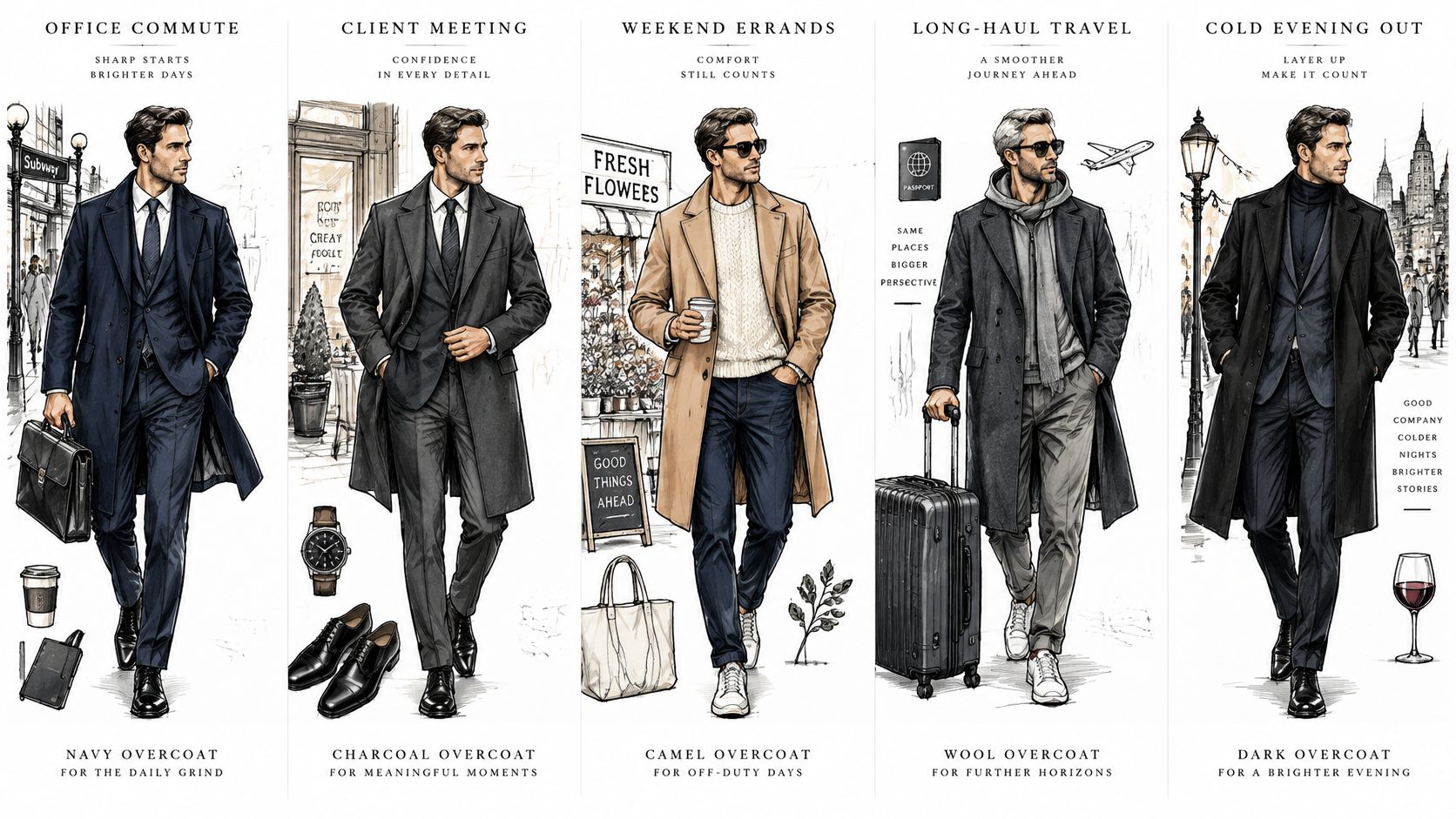
Overcoat outfits by occasion
| Occasion | Coat choice | Underneath | Finish |
|---|---|---|---|
| Office commute | Midweight knee-length topcoat | Suit or fine-gauge cashmere crew | Plain scarf, leather gloves |
| Client meeting or formal dinner | Tailored, darker overcoat | Suit jacket with no bulky knit | Clean leather gloves, no chunky scarf |
| Weekend errands | Relaxed raglan or car coat | Cashmere crew or cardigan over an open-collar shirt | Knit beanie or light muffler |
| Long-haul travel | Lightweight full-length coat | Layered cashmere knit | Coat folds over the arm indoors |
| Cold evening out | Heavy full-length coat | Suit with a thin cashmere sweater | Scarf tucked inside the collar |
For an office that doesn't require a suit, wear smart trousers, a shirt and a black V-neck men's sweater. Keep the coat's colour compatible with both trousers and shoes rather than trying to match every piece exactly.
Travel requires a different compromise. A lightweight long coat offers coverage at your destination without the carrying weight of heavy winter cloth, but it won't replace serious insulation on arrival in severe cold. Choose for the journey you have.
For another visual reference, watch the styling demonstration.
A relaxed car coat is useful for errands, but it's a weak substitute for a well-fitted overcoat at a formal dinner. Swap the outer layer rather than trying to correct its informality with dressier gloves. For less formal plans, changing a chunky scarf to a plain, fine wrap may be enough.
Cashmere Boutique offers men's cashmere sweaters, cardigans, scarves and knee-length and full-length outerwear for building these combinations. Visit Cashmere Boutique to compare styles and size guidance, then choose the coat around your real layers and daily routine.