
Cashmere Cardigan Petite: How to Choose a Fit That Works
You ordered the cardigan that looked perfect on the model. The shoulders sat clean, the hem stopped at the hip, and the cuffs kissed the wrist. On you, the shoulder seam slides halfway down the upper arm, the sleeves cover your knuckles, and the hem lands at mid-thigh. The bust isn't even tight. The garment was built for a longer torso and a wider shoulder, then labeled smaller. A petite cashmere cardigan only works when shoulders, armholes, cuffs, buttons, pockets, and hem scale together. A shorter copy of a regular cardigan often fits worse, not better.
Table of Contents
- Measure Your Frame Before You Shop
- Choose the Cut Length That Fits Your Proportions
- How to Check Fit on Your Body in Five Steps
- Fabric Checks for Fineness, Staple Length and Pilling
- Fixing Pilling, Stretch and Fit Problems
- Styling a Petite Cashmere Cardigan for Balance
- Confirm the Fit Before You Buy
Measure Your Frame Before You Shop
Start with five numbers, taken over a fitted base layer, tape level, each one twice. You need shoulder width across the back from one shoulder point to the other, bust at the fullest point, sleeve length from the shoulder point to the wrist with the arm slightly bent, back-waist length from the nape to the natural waist, and armhole depth from the shoulder point down to the underarm.
A layering cardigan usually needs about 5 to 10 cm of ease over the bust. Compare that with the garment's finished chest measurement, never the body size printed on the label. A size small from one maker can be a medium from another once the knit is finished.
Why the label misleads
A dedicated anthropometric study scanned 200 petite women aged 20 to 54, with an average height of approximately 157 cm, and used data from 180 of them to build experimental size charts and prototype garments, according to the University of South Africa thesis. Treat 157 cm as a research benchmark, not a universal petite cutoff. The study is South African, so it doesn't define every shopper.
What it does confirm is the fitting order that matters. Align the shoulder seams first. Close or overlap the front without horizontal strain. Check that the armholes don't restrict movement. Assess sleeve length with the arms relaxed and then bent. Then verify the hem against your torso. A shoulder seam past the shoulder point, or a hem well below the hip, makes the cardigan look oversized even when the bust is correct.
Say the cardigan looks hip-length on the model. Your back-waist length is short, and the garment's shoulder-to-hem measurement was never compared with it. On you it drops to mid-thigh and chops the leg line. Bust ease was fine the whole time. The miss was body length.
| Measurement | How to take it | Compare with the garment | Petite note |
|---|---|---|---|
| Shoulder width | Across the back, from one shoulder point to the other | Finished shoulder seam width | Seams past the shoulder point make the whole cardigan look oversized |
| Bust | Fullest point, tape level, over a fitted base layer | Finished chest measurement | Allow about 5 to 10 cm of ease for layering |
| Sleeve length | Shoulder point to wrist, arm slightly bent | Shoulder-to-cuff length | Cuffs should stop at the wrist bone, not below it |
| Back-waist length | Nape of the neck down to the natural waist | Garment body length from shoulder to hem | Shorter torsos need shorter hems; longer torsos need more length |
| Armhole depth | Shoulder point down to the underarm | Finished armhole depth, shoulder seam to underarm seam | Gaping at the underarm means the armhole is too large |
| Height | Stand against a wall, shoes off | Not a garment measurement; cross-check the size chart only | Use as a cross-check only; 157 cm was the study average, not a cutoff |
Lay your five numbers beside the retailer's published chart. We keep a sizing chart so you can match finished garment figures, not a guessed body size. Ask for those finished measurements if a product page only lists S, M, and L, and account for knit stretch plus the layer you plan to wear underneath.
Write the five numbers in your phone notes before you shop.
Choose the Cut Length That Fits Your Proportions
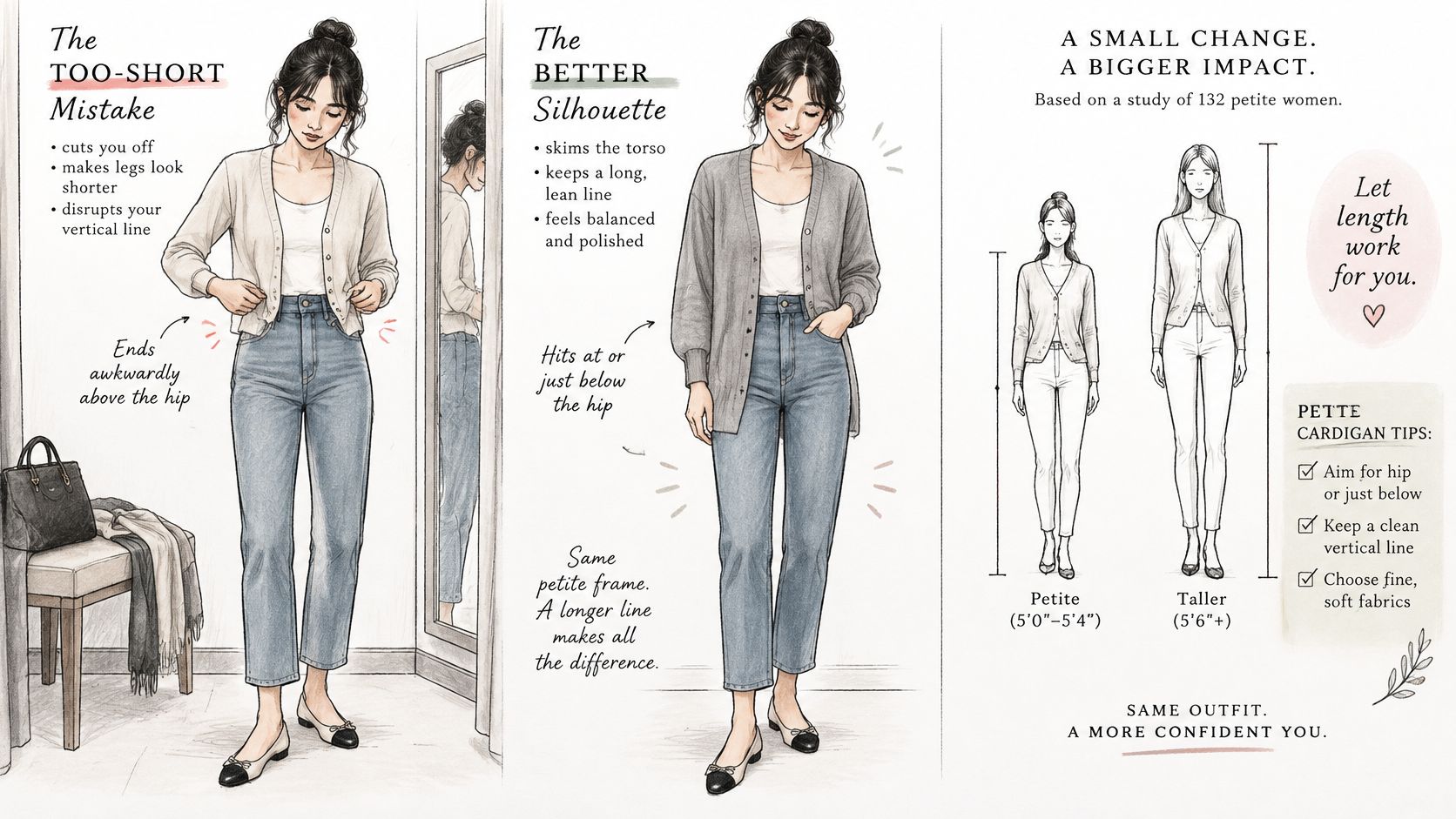
The usual mistake is grabbing the shortest cardigan on the rack and calling it petite. Length is the most common fit problem, but shortest isn't the same as proportioned.
A study of 132 petite women found that the most common fit problems were related to length. Among women 5'2" and under, more than half reported issues with garment lengths and pocket placement, and dart and pocket proportions were also off for some of them, according to research archived at Virginia Tech. Shoulder width, armhole, cuff, button placement, pocket height, and body length have to be scaled together. A regular cardigan with only the sleeves shortened still fails that test.
Match the cut to the torso
A short torso usually wants a cropped or waist-length cardigan with the hem above the hip bone. An average petite torso is better in a hip-length cut that ends at the widest part of the hip. A long torso needs hip length or a little more, worn open, so the line doesn't look chopped. Cropped on a long torso often reads unfinished. Hip-length on a short torso often reads like a coat.
| Torso length | Cut that usually works | Hem placement | Proportions to check |
|---|---|---|---|
| Short torso | Cropped or waist-length cardigan | Above the hip bone | Buttons and pockets sit above the hip, not at the hem |
| Average petite torso | Hip-length cardigan | At the widest part of the hip | Pockets sit at a comfortable hand height |
| Long torso | Hip-length or slightly longer, open front | Just below the hip, not mid-thigh | Sleeve seam at the shoulder point; avoid a cropped cut |
Beyond the hem, check four details that labels skip.
Sleeve seam: it should land on the shoulder point, not outside it.
Armhole: a large hole gaps when you drop your arm and binds when you reach.
Button scale: smaller buttons suit a smaller frame. Oversized buttons pull the eye down the front.
Pocket height: the pocket should sit where your hand falls, not at the hem where it adds bulk at the hip.
Petite is a proportion category, not a height category. A woman who is 5'2" with a long torso and a woman who is 5'4" with a short torso need different hems. If you want a second pass at body measurements before you commit to a cut, a guide to better-fitting petite clothes from ClothME is a useful cross-check on how petite charts are built.
A petite-labeled cardigan is worth buying only when the finished shoulder, sleeve, and body are shorter and narrower than the regular size, not when only the sleeve was trimmed.
How to Check Fit on Your Body in Five Steps
Numbers get you close. The try-on decides it. Work through these in order, over the fine knit you'll wear underneath, and stop at the first miss.
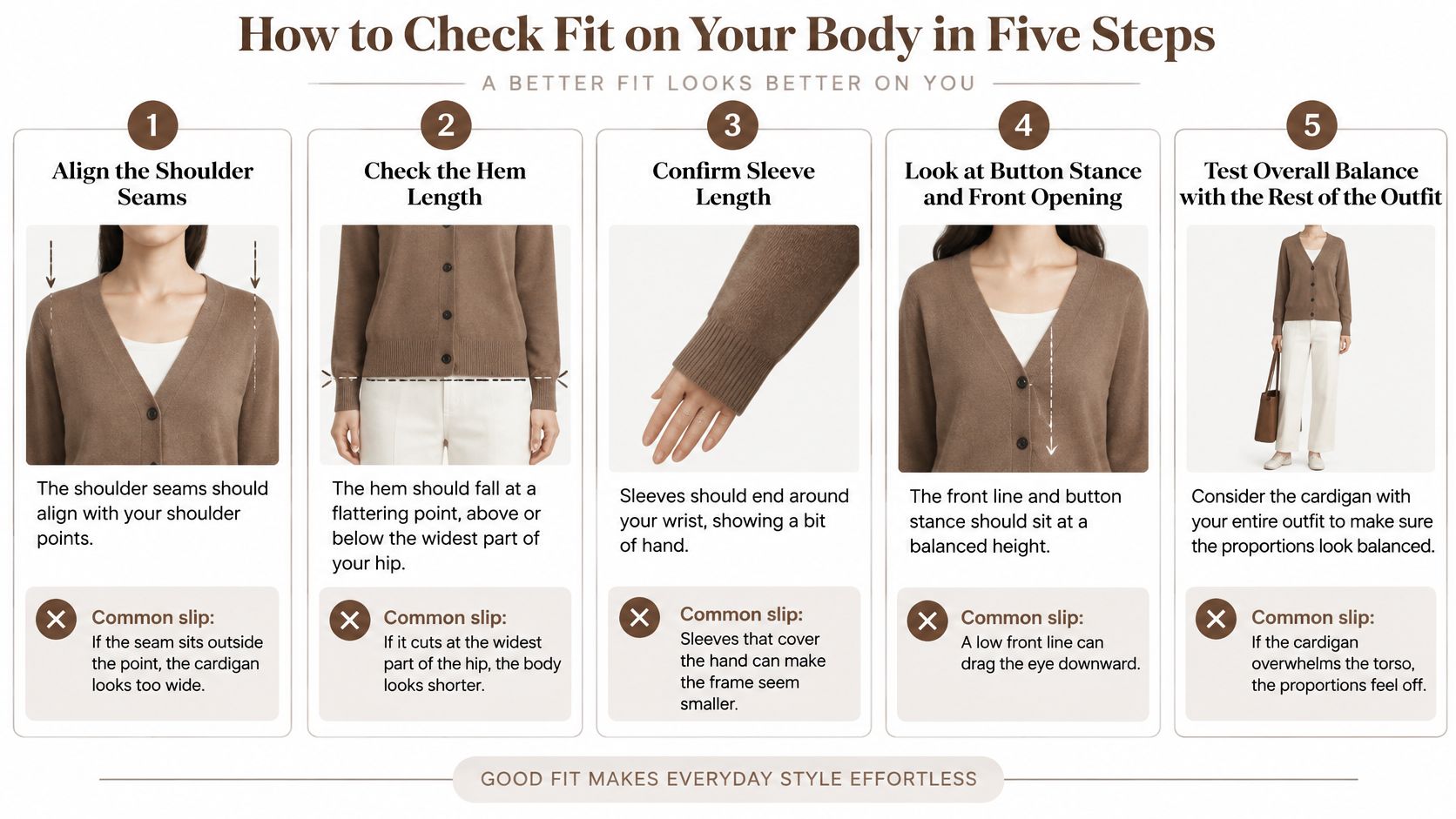
- Set the shoulder seams on your shoulder points. If the seam sits outside the point, the whole cardigan looks wide, no matter how neat the bust is. Don't tug it up and pretend it stays. It won't.
- Close or overlap the front without horizontal pull lines. Strain across the bust means too little ease for layering. An open-front style can hide a tight button line, but it can't add fabric that isn't there. If the knit pulls while you're still in a thin base layer, it will pull harder over a shirt.
- Move in the armholes. Lift an arm, reach forward, then cross your arms. A pretty armhole that binds at the desk is the wrong armhole. Gaping when your arms hang is the other failure, and it usually means the hole was cut for a larger frame.
- Check the sleeve twice. Arms relaxed, then bent at the elbow. The cuff should stop at the wrist bone when the arm is bent. A sleeve that looks fine when it's straight often runs long on a petite arm the moment you type or hold a bag.
- Set the hem in a mirror, then turn sideways. It should land at the hip point you chose for your torso, not cut across the widest part. A cardigan that looks correct from the front can still sit too low, or too long, at the back.
If the front looks right and the side looks long, trust the side.
Do this over a base layer, not a bare camisole, so you see how the knit behaves when it's layered. Cashmere has give. A cardigan that is perfect with nothing under it can feel snug, and look shorter through the body, once a shirt is underneath.
Fabric Checks for Fineness, Staple Length and Pilling
A Grade A label doesn't settle quality. It doesn't tell you how many short fibers sit in the yarn, and those short fibers are what show up as pills on a close-fitting cardigan.
Peer-reviewed testing places cashmere from China and Mongolia at roughly 14.5 to 16.5 microns, with tested white cashmere averaging 14.64 microns. The same work notes that fibers shorter than 7.5 mm are particularly associated with pilling, as reported in the Journal of Natural Fibers. A technical fabric benchmark found samples near 15.2 to 15.4 microns with mean fiber lengths around 31.5 to 37.4 mm, yet still about 21.7 to 32.4% of fibers shorter than 12.5 mm. Fine and weak surface performance can live in the same yarn.
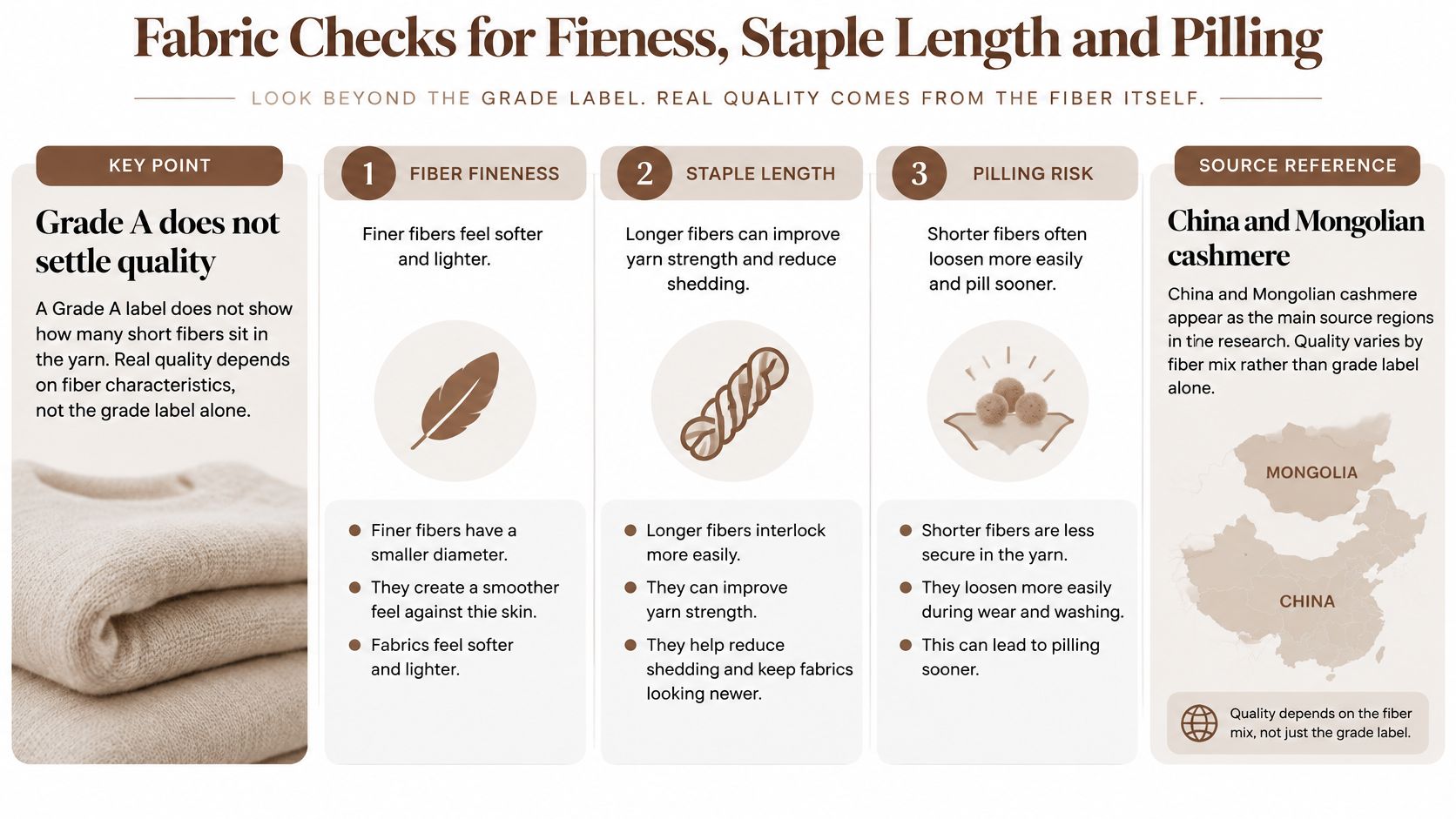
Leading processors set an upper mean fiber-diameter limit of 19 microns, and they prefer 16.5 microns or less for knitted goods, according to a World Bank cashmere study. Our own cardigans use Grade-A fibers specified at approximately 14 to 15.5 microns. That range sits inside the knitwear preference. It still doesn't replace a short-fiber check.
A four-step screen
Composition and fineness. Confirm it's the fiber claimed, and note the stated micron figure. Under 16.5 microns is the knitwear preference. Under 19 microns is the usual ceiling.
Staple length. Ask for staple-length or short-fiber data when the seller has it. A large share under 7.5 mm is the pilling flag, even when the average micron looks excellent.
Friction zones. In person, look at underarms, front edges, and the spot a bag strap will rub. Early fuzz there is a wear issue. Dense pills already on a new garment are a yarn issue.
A lab rating. Ask for an ISO 12945 or ASTM D3511 pilling result and the conditions behind the grade. A number without the test method isn't comparable.
Micron count alone predicts neither pilling nor how long the surface stays smooth. If you want the wider buying checks that sit next to fineness, our note on how to choose a high-quality cashmere sweater walks through what to read on a product page.
Fixing Pilling, Stretch and Fit Problems
Light fuzz under the arms, or where a bag strap rubs, is friction. Heavy, dense shedding is a different problem. A fine cardigan can still pill. Pilling tracks fiber friction, entanglement, washing intensity, and finishing, not the luxury label. One study found that reducing surface friction and entanglement lifted treated cashmere to a pilling grade above 4, and that grade held after repeated washing, as described in research on anti-pilling cashmere finishing. Yarn twist, knit density, backpack straps, seatbelts, and how you wash all sit beside fiber grade.
I would start with the cheapest fix that matches the symptom, and I wouldn't recut a shoulder that was wrong on day one.
| Symptom | Likely cause | Fix |
|---|---|---|
| Pilling under the arms or where a bag strap rubs | Friction and abrasion, not only fibre grade | Comb off pills, rotate with another knit, wash cold |
| Shoulder seams slide down the upper arm | Shoulder seam wider than your shoulder point | Return within the window; tailoring rarely fixes shoulders |
| Sleeves cover the wrist bone | Sleeve length not adjusted for a petite frame | Take up the cuff or hem the sleeve |
| Hem falls across the widest part of the hip | Hip-length cut chosen for a longer torso | Shorten the hem or choose a cropped or waist-length cut next time |
| Front pulls across the bust | Too little ease for layering | Choose an open front or size up after checking ease |
| Elbows bag after a few wears | Hung on hangers or washed hot | Fold, dry flat and lay out to reshape |
Care that actually holds the shape
Use a fabric comb, not scissors. Scissors nick the knit and leave a thin spot that pills again. Rotate the cardigan with another knit so the same underarm and strap line aren't rubbed every day. Wash cold, by hand or on a gentle cycle, and dry it flat. Heat and hanging are what stretch elbows and hems.
Sleeves and hems can usually be shortened. A tailor can take up a cuff or lift a hem without wrecking the hand of the yarn. Shoulder seams that are too wide are rarely worth altering, because the armhole, the sleeve cap, and the front width were all cut to that wider shoulder. Return it.
A fit problem found on the first wear is cheaper to solve than one found after months of wear.
Styling a Petite Cashmere Cardigan for Balance
A shopper at 5'2" puts on a hip-length cardigan, wide-leg trousers, and flat shoes. Each piece is fine alone. Together they stack horizontal breaks and drop the eye to the floor, so she looks shorter than she is. The cardigan isn't too small. The outfit has no unbroken line.
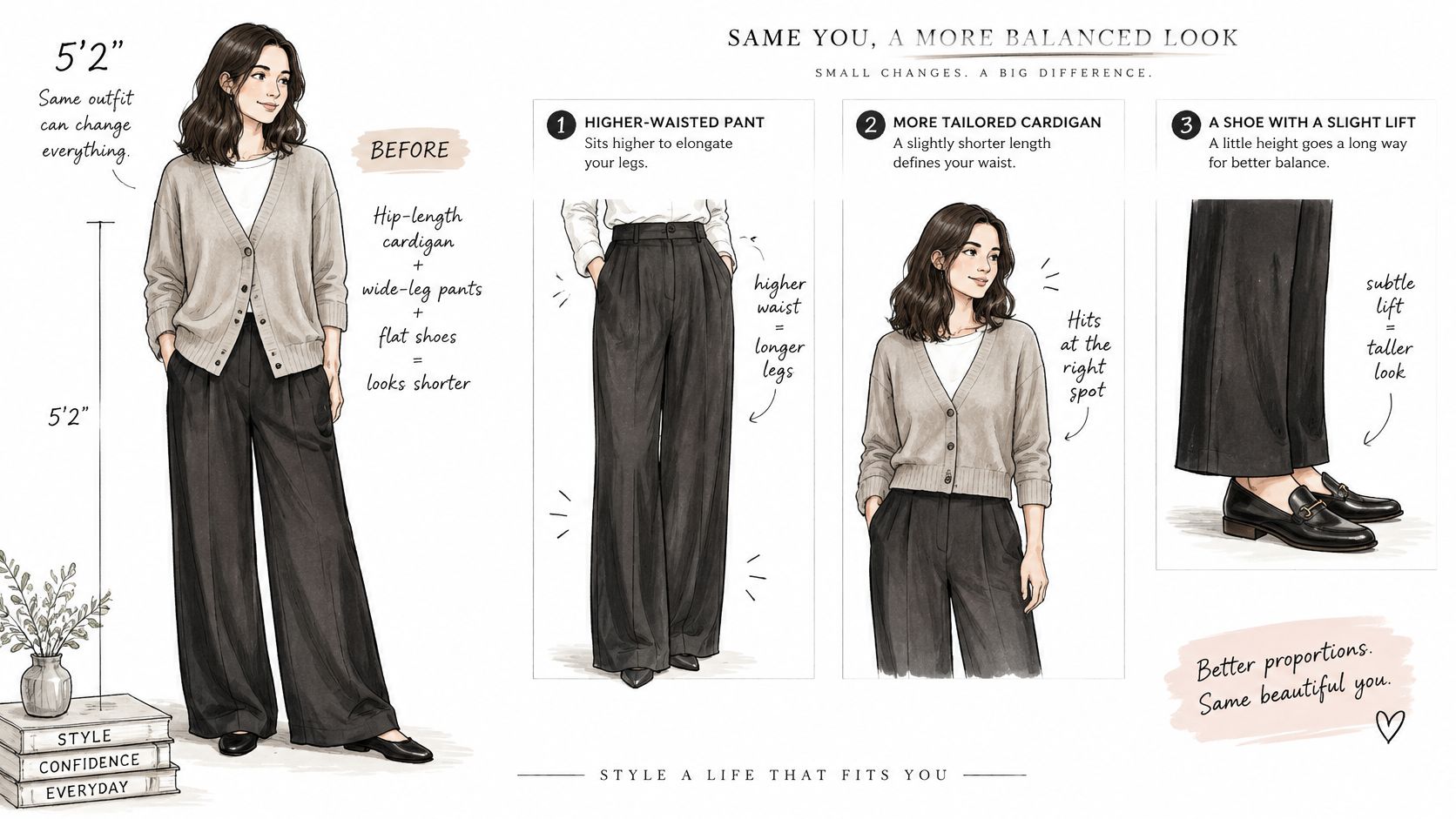
Office day. Pair a hip-length cardigan with high-waisted straight trousers, a tonal shell, and a low block heel. The waist sits high, and the color runs from shoulder to shoe without a hard break at the hip. Skip a contrasting belt if the cardigan already ends at the widest part of the hip.
Weekend coffee. Wear it open and push the sleeves to the forearm so the wrist shows and the arm line shortens. Don't stack a bulky hoodie or a padded vest underneath. Extra bulk at the shoulder makes a correct shoulder seam look wide again. A fine knit base layer is enough.
Evening. Belt an open cardigan at the natural waist over a midi skirt. The belt marks the waist you measured, and tonal colors lengthen the silhouette instead of cutting it into blocks. A shawl collar adds softness at the neck without extra fabric at the hip. Our cashmere shawl collar cardigan notes are a useful read if you want that neckline without adding shoulder bulk.
Three rules cover most outfits:
- Keep color close from top to hem. A sharp contrast at the cardigan edge shortens the torso.
- Keep bulk at the shoulders minimal. Pads, scarves, and thick layers fight a correct shoulder seam.
- Let the hem meet the trousers or skirt. A gap, or a hem that cuts the widest part of the hip, breaks the line you just built.
Confirm the Fit Before You Buy
Buy only when all five try-on checks pass. Shoulder seams sit on your shoulder points. The cuff stops at the wrist bone with the arm bent. The front closes without pull lines over your base layer. The armholes allow a reach and a cross. The hem lands at the point you chose for your torso.
If one check misses, pick a different cut rather than talking yourself into the fit. If two or more miss, walk away. A petite label doesn't override a shoulder that's too wide or a hem that hits mid-thigh.
Lay your five measurements beside the retailer's published sizing chart and compare finished garment figures, not body sizes. Read the return terms before you order. A home try-on is the only real test of drape and layering, and we offer easy returns so that try-on isn't a guess you have to live with.
Wear it for one day in the conditions you expect, a commute or a meeting, before you decide to keep it. Strap rub, seatbelt contact, and a bent arm at a desk reveal problems a mirror does not.
Cashmere Boutique has sold cashmere cardigans, sweaters, and wraps since 1999, with sizing guidance and easy returns so you can check shoulder, sleeve, and hem at home. If you're ready to match a petite proportion to a real garment, not a shorter copy of a regular one, visit Cashmere Boutique.