


Cashmere Coat Rain: Can You Wear It and How to Save It
No, a cashmere coat is not rainwear; it can handle light drizzle with immediate blotting and drying, but sustained rain or a cloudburst needs a waterproof shell or umbrella.
The familiar advice to never let cashmere get wet is too absolute. A few surface droplets don't mean you've ruined your coat, and a soaking doesn't automatically mean it's beyond saving. What matters is how thoroughly it gets wet, how long it stays wet, and what you do while its shape is vulnerable.
Table of Contents
- Rain Levels a Cashmere Coat Can Take
- What to Do the Moment Your Coat Gets Wet
- How to Dry a Soaked Cashmere Coat Safely
- Protecting Cashmere Before the Forecast Turns
- Storing and Caring for a Coat After Rain
Rain Levels a Cashmere Coat Can Take
Treat cashmere as luxury insulation, not weather protection. Decide whether to wear it by looking at the whole journey, including the uncovered walk home, rather than the conditions outside your door.
Cashmere is hygroscopic, meaning it absorbs and releases moisture according to its surroundings. Premium fibers commonly measure roughly 14–15.5 microns in diameter, as described in the cashmere wool reference. The softness that makes the fabric appealing doesn't give a finished coat waterproof seams, a protective membrane, or reliable resistance to sustained rain.
Cashmere coat verdict by rain exposure
Use this lookup as a practical decision aid, not a tested exposure rating. There isn't a universal safe number of minutes: rain intensity, cloth density, coat weight, and the amount of shelter along your route all affect the outcome.
| Exposure | Typical situation | Cashmere coat verdict | What to do |
|---|---|---|---|
| Light drizzle or mist | A few minutes of walking to the car or station | Fine to wear with prompt aftercare | Blot at the destination and air-dry at room temperature |
| Brief shower | A short outdoor crossing with no sustained downpour | Wear with care | Blot, reshape shoulders, and hang to dry if the coat retains its shape |
| Prolonged rain | An extended walk in steady rain | Needs a rain shell | Wear a shell over the coat; if soaked, support it for drying |
| Cloudburst or heavy downpour | Sudden intense rain | Don't wear it exposed | Keep it protected beneath an umbrella or shell, or leave it at home |
The distinction between a shower and a cloudburst matters more than a stopwatch. A review of precipitation extremes in Nature Reviews Earth & Environment examines exceptional short-duration rainfall intensity. For your coat, the practical lesson is simple: a short journey can still involve heavy exposure.
Watch the garment itself. Darkening cloth, a noticeably heavier hem, or moisture reaching the lining means you shouldn't keep treating the situation as light drizzle. Seek shelter rather than finishing an optional walk.
Practical rule: If you can't keep the coat reasonably dry for the whole journey, change the outer layer before you leave.
The hallway checklist
Before putting on the coat, check the conditions you'll encounter:
- Rain type: Is the forecast mist, intermittent showers, or steady precipitation?
- Uncovered distance: Include station entrances, queues, and the return trip, not just the walk to your car.
- Shelter: Pack an umbrella or a shell rather than assuming you can find cover.
- Warmth backup: If this is your only warm layer, don't risk soaking it before a long journey.
- Coat construction: Read the composition and care labels rather than relying on the word cashmere in the product name.
Our collection includes a full-length blend coat made from 30% cashmere and 70% fine wool, alongside knee-length, full-length, pea, belted, funnel-neck, and hooded styles made from 100% pure cashmere. Those descriptions identify composition and silhouette, not equivalent rain performance. A blend shouldn't be assumed to shed water or dry like pure cashmere, and a hood alone doesn't make a coat rainwear.
For everyday cashmere coat rain decisions, choose the garment for the least sheltered part of your day.
What to Do the Moment Your Coat Gets Wet
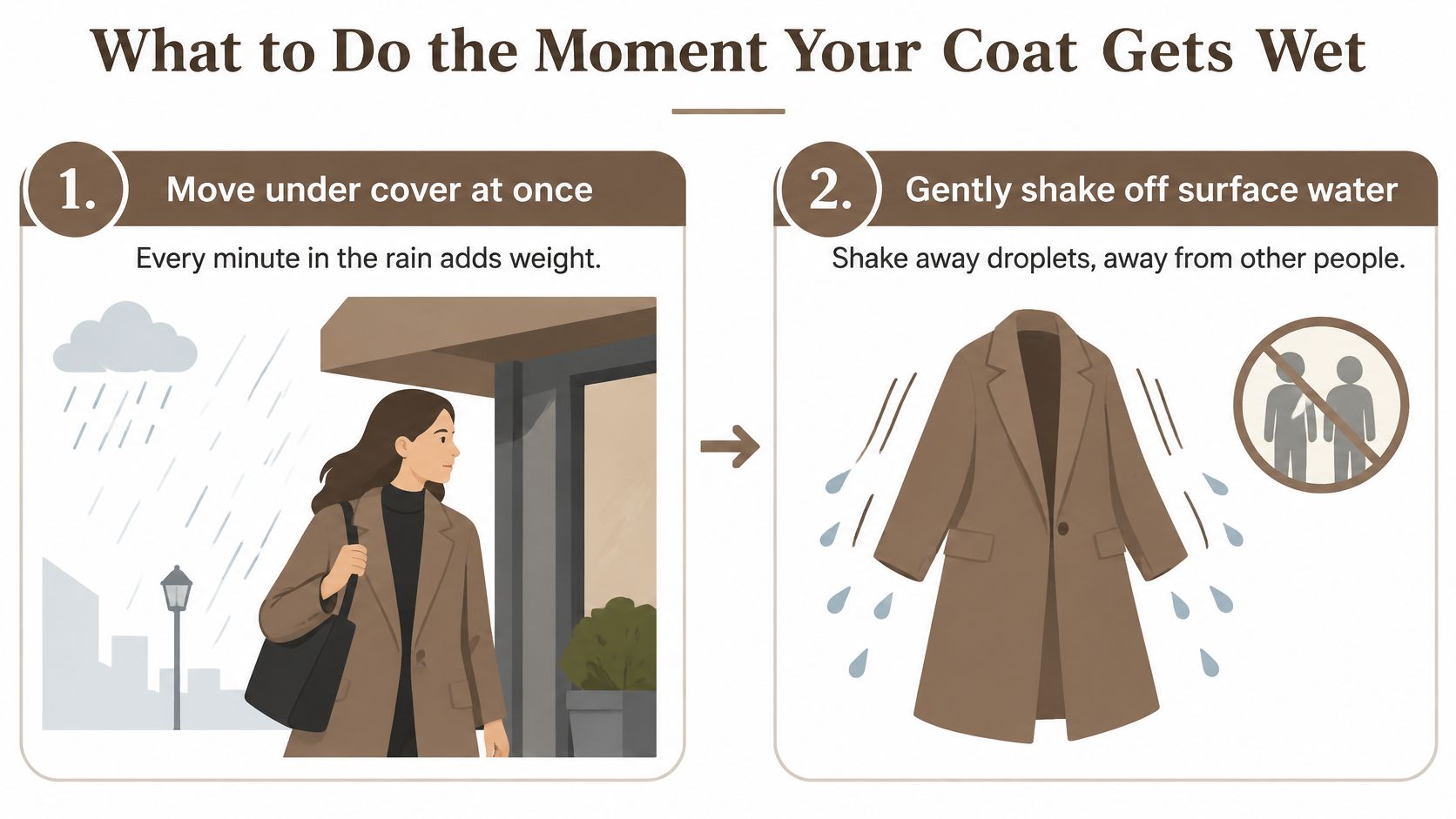
Start by stopping further exposure, not by trying to clean the coat. Your first job is to remove loose water and keep the garment aligned without adding friction.
The immediate rescue sequence
- Move under cover at once. Don't stay outside inspecting the damage. Continued exposure adds water and makes the coat harder to handle safely.
- Gently shake off surface water. Use a restrained movement, away from other people and nearby fabrics. Don't snap the coat sharply or swing it by its collar.
- Blot with a clean, dry towel. Press the towel against wet areas, lift it, and move to a dry part of the towel. Scrubbing drags across the nap and can turn a small mark into a larger disturbed patch.
- Release the belt and align the fronts. Remove a detachable belt and dry it separately, then loosely close the coat if that helps the panels sit straight. Avoid cinching damp fabric at the waist.
- Reshape with light hand pressure. Set the shoulders, lapels, cuffs, and hem back into their natural positions. Smooth rather than pull, and stop if you're stretching the cloth to make it look even.
- Choose support according to wetness. A lightly damp coat that holds its shape can go on a broad, padded hanger in a ventilated room. If it's dripping or sagging, support the body with both arms and prepare a flat drying surface instead.
Why beading isn't proof of protection
Cashmere's overlapping surface structure can repel initial droplets, but its protein interior absorbs moisture vapor and can take up roughly one-third of its dry weight under suitable conditions, according to the cashmere fabric study published by Taylor & Francis. That moisture uptake isn't a rain-resistance rating.
Don't mistake beads on the shoulders for permission to stay outside. Likewise, don't scrub a visible water mark or reach for a hair dryer to make the surface look normal quickly.
Before hanging, the coat should be damp at the surface rather than dripping, and it should hold its shape after gentle adjustment.
Keep it away from radiators, heated towel rails, and direct sunlight. If the weight is pulling the shoulders downward, a hanger isn't the right support yet.
How to Dry a Soaked Cashmere Coat Safely
Blot, support, reshape, then leave it to air-dry completely. A saturated coat needs a stable surface and patient handling, not a stronger drying treatment.
Spread clean, absorbent towels over a drying surface large enough to support the coat without leaving the sleeves or hem dangling. Check the care label and construction before laying it flat, especially if the coat has structured shoulders or a fitted chest.
Press out excess moisture with another towel without compressing the garment into a tight bundle. Replace the towels underneath when they become damp, lifting and supporting the coat rather than dragging it across the surface.
Safe and unsafe ways to dry a soaked cashmere coat
The low-stress approach follows the handling principles outlined in Clothing Digest's wool fabric guide: avoid combining wet fibers with unnecessary heat, agitation, or unsupported weight.
| Method | Safe? | Why |
|---|---|---|
| Blot with a dry towel, then lay flat | Yes, if construction permits | Removes excess water while supporting the garment |
| Broad, padded hanger in a ventilated room | Yes, once no longer saturated or sagging | Distributes support across the shoulders |
| Narrow hanger from one shoulder | No | Concentrates the wet garment's weight and risks distortion |
| Radiator, hair dryer, or direct sun | No | Direct heat can shrink or distort wet fibers |
| Tumble dryer | No | Heat and tumbling risk felting and loss of shape |
| Wringing or twisting | No | Applies force to vulnerable wet fabric and seams |
| Steaming while still damp | No | Adds heat before the garment has dried and its shape can be assessed |
A broad hanger is useful, but it isn't a solution for every wet coat. If the shoulder points look stretched or the back hangs under obvious tension, keep the garment supported horizontally where its construction allows.
Check the hidden layers
Gently arrange seams and edges into position without tugging them straight. Open the coat enough to let air reach the lining, while keeping the fronts and sleeves supported.
Thickness, weave, lining, and interlining all affect drying, so don't promise yourself it'll be ready for the next outing. The towel-handling principles in our guide to how to dry sweaters are useful, but a structured coat needs more attention to its internal layers than a simple knit.
Rain exposure isn't automatically permanent damage. Rubbing, twisting, overheating, and letting wet fabric stretch are the avoidable hazards.
Before brushing, steaming, storing, or wearing the coat, check the underarm seams, inside collar, pocket areas, and lining. It's ready only when those areas feel evenly dry and the shoulders have retained their shape.
Protecting Cashmere Before the Forecast Turns
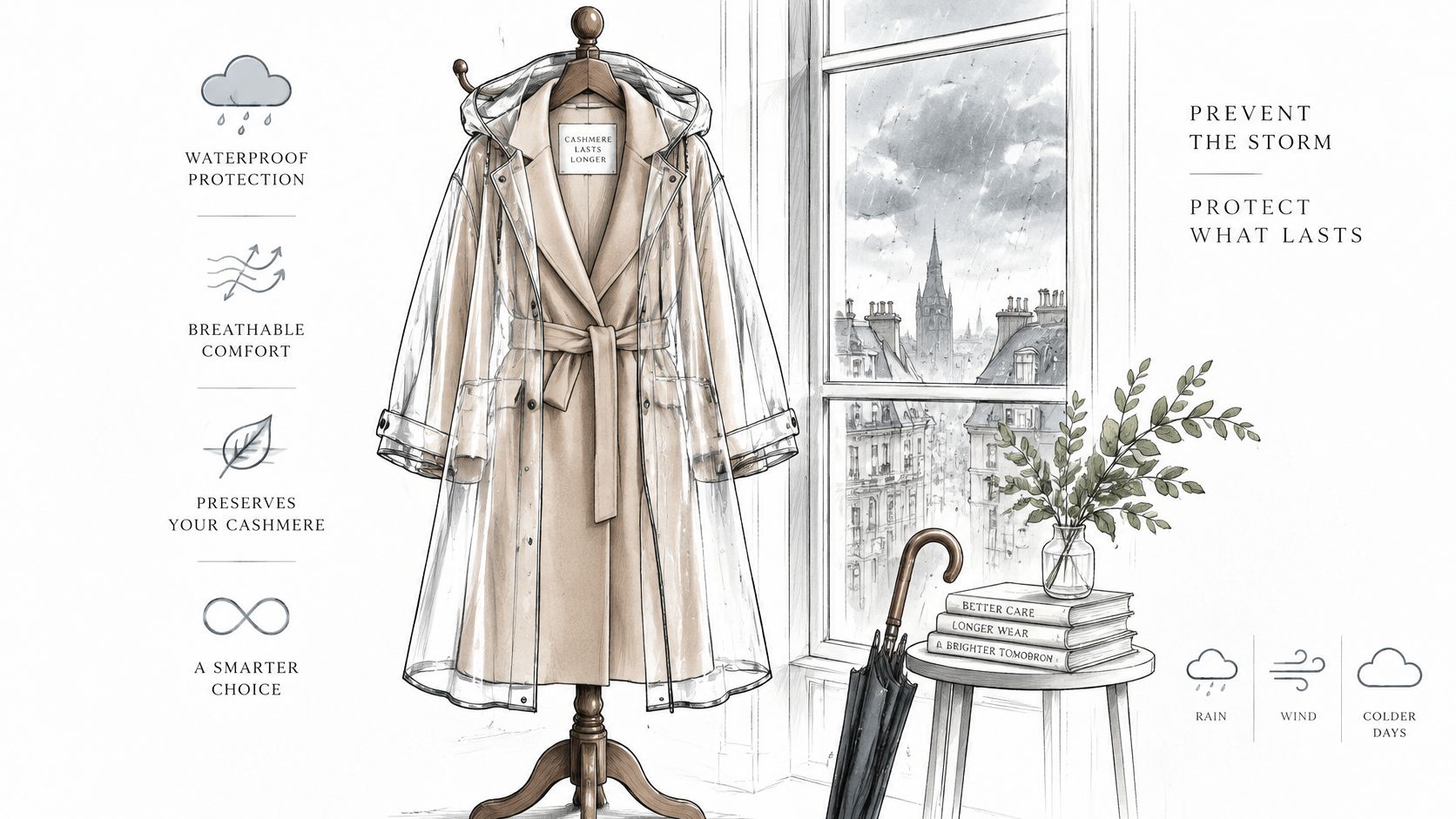
A loose waterproof shell is a better starting point than treating the cashmere itself. Choose one that fits over the coat without flattening the shoulders, squeezing the sleeves, or forcing the hem into folds.
An umbrella is convenient for short walks, but wind-driven rain can still reach the lower sleeves and hem. For an exposed commute, a shell offers more consistent coverage, provided it's long and roomy enough for the coat underneath.
Don't make spray your first fix
A generic water-repellent spray isn't automatically suitable for cashmere. Products intended for leather, synthetic outerwear, or other wool fabrics may have different compatibility requirements.
The Taobao cashmere humidity and storage guide discusses moisture absorption and breathable care. The useful distinction is between managing exposure and trying to turn an absorbent luxury fabric into waterproof apparel.
If you're considering a treatment, use this sequence:
- Confirm compatibility: Check both the coat manufacturer's instructions and the treatment label for the actual fabric and finish.
- Test discreetly: Apply only to a concealed area that won't show through to the outside, then let it dry fully.
- Compare carefully: Look for changes in color, softness, surface texture, and residue before considering wider application.
- Reject improvised coatings: Don't substitute household mixtures or a spray intended for shoes.
A successful patch test doesn't establish waterproof performance. Fabric density, seams, lining, and finishing still matter.
Pack for the predictable trouble spots
Inspect shoulder points, the collar, cuffs, pocket openings, and hem before the next wet outing. Those are useful places to spot roughened nap, lingering marks, or an uneven outline before further wear.
Protect the coat from the weather rather than asking a treatment to change what the coat is.
Carry a wide umbrella and a clean absorbent cloth for emergency blotting. If you remove the coat, keep it away from wet seats and the damp base of a tote. Once it's dry, our guide to protecting cashmere from moths addresses the separate risks that remain between wears.
Storing and Caring for a Coat After Rain
Once the coat has dried, inspect it in good light before returning it to the closet. Look for a changed shoulder line, puckered seams, an uneven hem, or water marks that remain visible without touching the surface.
Brush lightly with a soft clothes brush, following the direction of the nap. Don't use vigorous brushing to force a flattened or stiff patch back into place, especially where a bag strap rubbed against wet fabric.
Put it away without trapping moisture
Choose storage that protects the shape and keeps the coat away from dampness:
- For regular wear: Use a wide, shaped hanger with room around the garment, so the shoulders aren't crowded against neighboring clothes.
- For folded storage: Support the folds with tissue and avoid packing the coat under heavy items.
- For a recently wet coat: Avoid an airtight plastic bag, which can trap residual moisture before you notice it.
- For seasonal storage: Keep the clean, carefully folded or packed coat away from moisture, direct light, dust, and moths.
We recommend dry cleaning for all cashmere coats and fur items. Our guide to how to wash a coat provides further care context, but don't interpret rain exposure as a reason to improvise a full wash at home.
When to involve a cleaner
Arrange a professional assessment after repeated soaking, persistent water marks, or unexpected changes in the shell or lining. A cleaner should also inspect visible distortion rather than having you repeatedly spot-treat the same area.
Tell the cleaner whether the coat encountered clean rain or road splash, whether the lining became soaked, and whether you applied heat, detergent, or a spray. Bring the care label information and identify each affected area so they can assess the construction as well as the surface.
Return a dry, sound coat to rotation instead of leaving it bundled in a bag. If its shape or texture has changed, keep it out of use until it's assessed.
Cashmere Boutique offers pure-cashmere and cashmere-blend coats, along with scarves and other cold-weather layers. Visit Cashmere Boutique to compare coat compositions and silhouettes, and choose your outerwear with both your everyday route and your rain-protection plan in mind.