
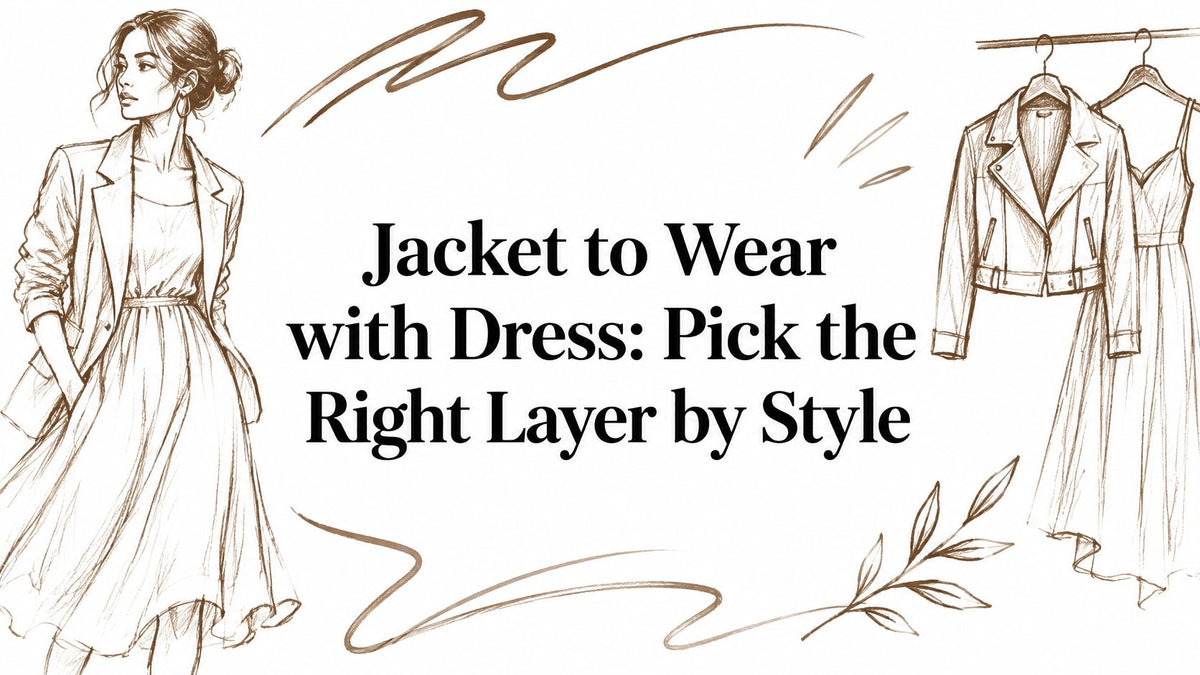
Jacket to Wear with Dress: Pick the Right Layer by Style
The dress is chosen. The shoes are settled. What stalls the outfit is the layer over it: the jacket already in your closet either buries the waist you bought the dress for or leaves your arms bare at exactly the wrong moment. Most advice on this subject repeats two lines, cropped jacket with a maxi dress and blazer with a fitted one, and neither line tells you what to do when your dress is a jersey column, your shoulders are narrow, or the ceremony is outdoors in October.
I judge a jacket against the dress it will sit on, not against a category label. That means checking where the hem lands on the dress, how much ease the layer has over the dress fabric, and whether its surface fights or complements the dress sheen. Get those three right and the outfit reads as intentional even when nothing in it is expensive.
The table below settles the most common pairings in under a minute. Everything after it covers the conditions, the fit checks and the colour decisions that decide whether the pairing survives a real day.
Table of Contents
- Jacket Pairings by Dress Style at a Glance
- Choosing a Jacket for Occasion, Season and Climate
- Length and Pairings That Work in Practice
- Color, Fabric and Sheen That Work Together
- Adjusting the Jacket to Your Body Shape
- Checking Construction and Confirming the Pairing
Jacket Pairings by Dress Style at a Glance
The dress is the fixed point. Choose the jacket by asking where its hem will land on that dress, never by shopping a jacket category on its own. These six dress shapes cause the most pairing trouble, and each has a length rule that resolves it.
| Dress style | Jacket type | Length | Why it works |
|---|---|---|---|
| Fit-and-flare or fitted sheath | Cropped cardigan or short tailored jacket | Cropped to natural waist | Defines the waist and keeps the skirt visible |
| Column or straight dress | Blazer or straight-cut cardigan | Hip length | Continues the dress line without adding bulk |
| Maxi or slip dress | Duster, draped wrap or long open cardigan | Knee length or longer | Extends the vertical line and balances the fabric |
| Pleated, gathered or full skirt | Soft unstructured cardigan | Hip to mid-thigh | Avoids fighting the skirt volume |
| Knit or jersey dress | Relaxed cashmere cardigan or zip jacket | Hip length | Moves with the stretch fabric |
| Satin or evening dress | Structured dark jacket or fine wrap | Waist to hip length | Adds contrast and polish to a sheen fabric |
A fit-and-flare or fitted sheath wants a cropped cardigan or a short structured jacket that stops at the natural waist. Anything longer covers the flare that made you buy the dress. Column and straight dresses take a blazer or a straight-cut cardigan at hip length, because the jacket side seam continues the dress line instead of cutting across it.
A maxi or slip dress needs length in the layer. A duster, a draped wrap or a long open cardigan reaching the knee or below keeps the vertical line intact. A cropped jacket over a floor-length column divides the body at the waist and leaves the dress reading as a skirt. Pleated, gathered and full-skirted dresses need something soft to hip or mid-thigh, since a stiff jacket with a defined waist competes with the volume below. Knit and jersey dresses stretch and shift, so a relaxed cashmere cardigan or a zip jacket moves with them rather than staying rigid while the dress slides underneath. Satin and evening dresses take a structured dark jacket or a fine wrap for contrast against the sheen.
The hem is the decision. Everything after that is adjustment.
Denim sits outside this table because it behaves unlike every knit and structured layer above: it holds a hard shape and adds texture rather than drape, so it works on casual cotton and linen dresses and fights fluid ones. If you want to bring a denim jacket into the rotation, Cedar & Lily Clothier's denim pairing tips cover how it should sit over a dress before you commit it to silk or jersey.
Find your dress in the first column, take the length from the third, and treat the fourth as the test the outfit has to pass.
Choosing a Jacket for Occasion, Season and Climate
The dress tells you what looks right. The conditions tell you what you can wear for four hours. Work out the hardest thing the day will ask of the layer before you shop, because standing in wind for a forty-minute outdoor ceremony is a different problem from walking between a heated car and a heated room.
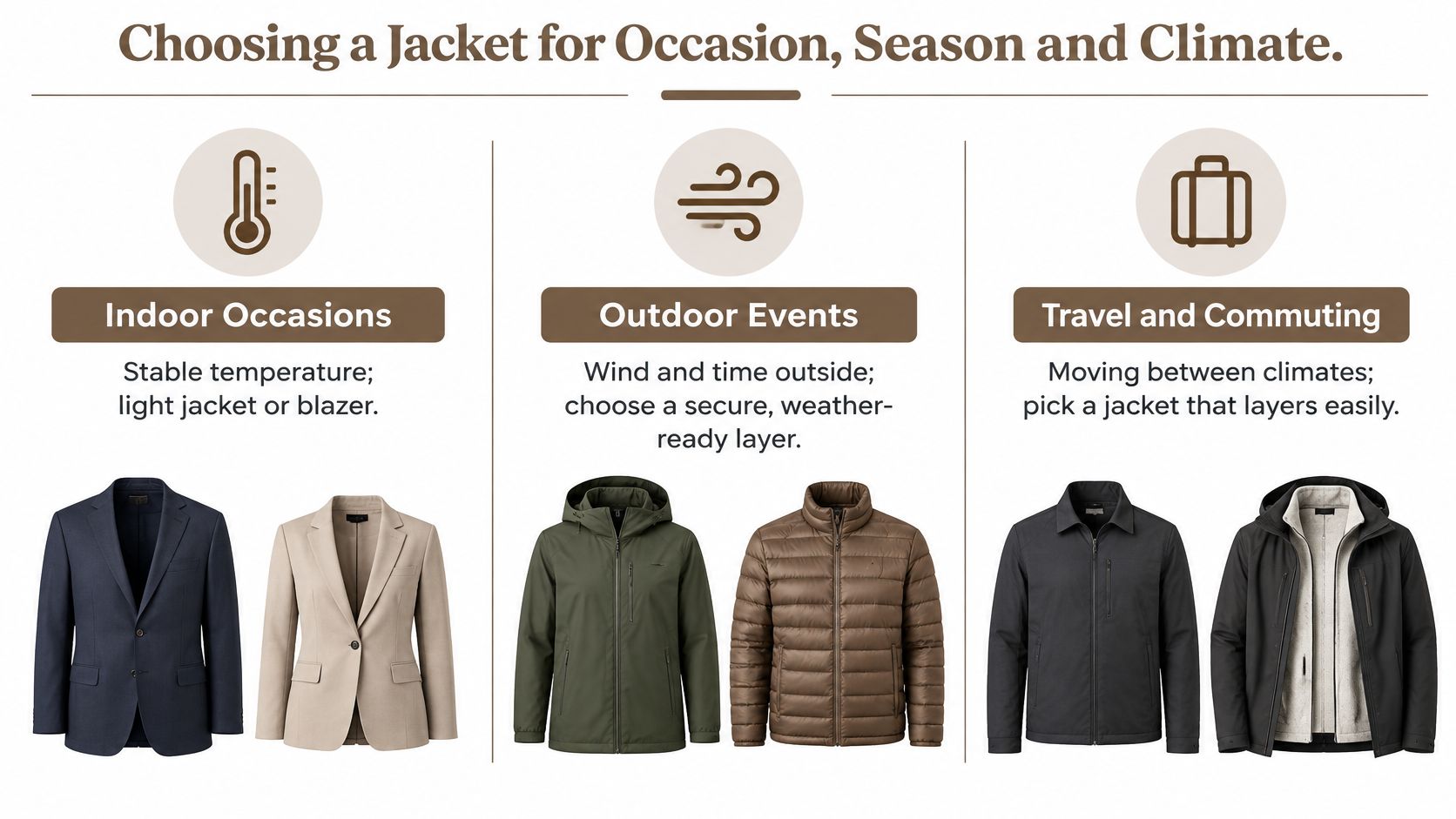
Three Conditions That Change the Answer
Indoor occasions with stable temperature. A dinner, an office day, a reception in a hotel ballroom. A fine cashmere cardigan or a lightweight blazer does the work and comes off without disturbing the dress. The test here is removal, not warmth.
Outdoor events where wind and time outside matter. Full arm coverage and a secure front matter more than thickness. A structured jacket or a knee-length coat holds its shape in wind, and a pashmina or wrap laid over the shoulders adds warmth without changing the dress silhouette.
Travel and commuting between heated and cold spaces. You need a layer that folds into a bag and can go back on in a cold train carriage. A compact cardigan or a pashmina beats a heavy coat you end up carrying.
The layer that keeps you warmest is often the one that spoils the outfit. Excessive bulk hides the waist, bunches over dress sleeves and gets in the way when you sit down, carry a bag or eat. Styling guidance makes the same distinction between insulation and coverage: jackets give full arm coverage for cool and windy conditions, and a scarf adds warmth without disrupting a smooth drape, as Böhme's outerwear styling notes set out. A wrap or shawl preserves a dress silhouette better than a bulky cropped jacket because it never touches the waist.
Underdressing is a common regret. In a 2024 personal-style survey, 85% of respondents said they preferred to be slightly overdressed rather than underdressed, according to Your Everyday Style. That argues for one layer more than you think you need, provided the extra layer is thin.
Pick for the hardest condition: choose the layer for the worst ten minutes of the day, then confirm you can take it off and hold it in one hand.
| Situation | Best layer | Length | Watch for |
|---|---|---|---|
| Indoor dinner or office | Fine cashmere cardigan or light blazer | Hip length | Overheating; choose one that comes off easily |
| Outdoor ceremony on a cool day | Structured jacket or wrap | Waist to hip length | Bulk over the waist; a wrap keeps the silhouette |
| Windy evening outdoors | Structured jacket or knee-length coat | Knee length | Coat can hide the dress; check sleeve fit over dress sleeves |
| Rain or long time outside | Knee-length or full-length coat | Knee length or longer | Needs a closed weave; light fabrics fail in wind and rain |
| Travel between heated spaces | Lightweight cardigan or pashmina | Hip length or scarf | Easy to remove and carry in a bag |
| Warm season, air-conditioned venue | Thin cardigan or cropped jacket | Cropped to hip | Thin fabric covers the arms without heat |
A pashmina earns its place in this list precisely because it covers arms and shoulders without touching the waist, and the case for keeping a pashmina shawl in the wardrobe is mostly about how many different conditions one piece handles.
Four questions settle it. How long will you be outside? How cold and how windy? What is the dress fabric (a fluid satin sheds a wrap, a wool crepe holds a coat)? How formal is the event? Answer those and the layer chooses itself.
Length and Pairings That Work in Practice
One rule decides most pairings. The jacket hem should land on a deliberate point of the dress, at the waist, at the hip, or below the knee, never at a spot that looks accidental. A hem that stops two inches below the waist on a fit-and-flare dress makes the torso look long and the skirt look like an afterthought.
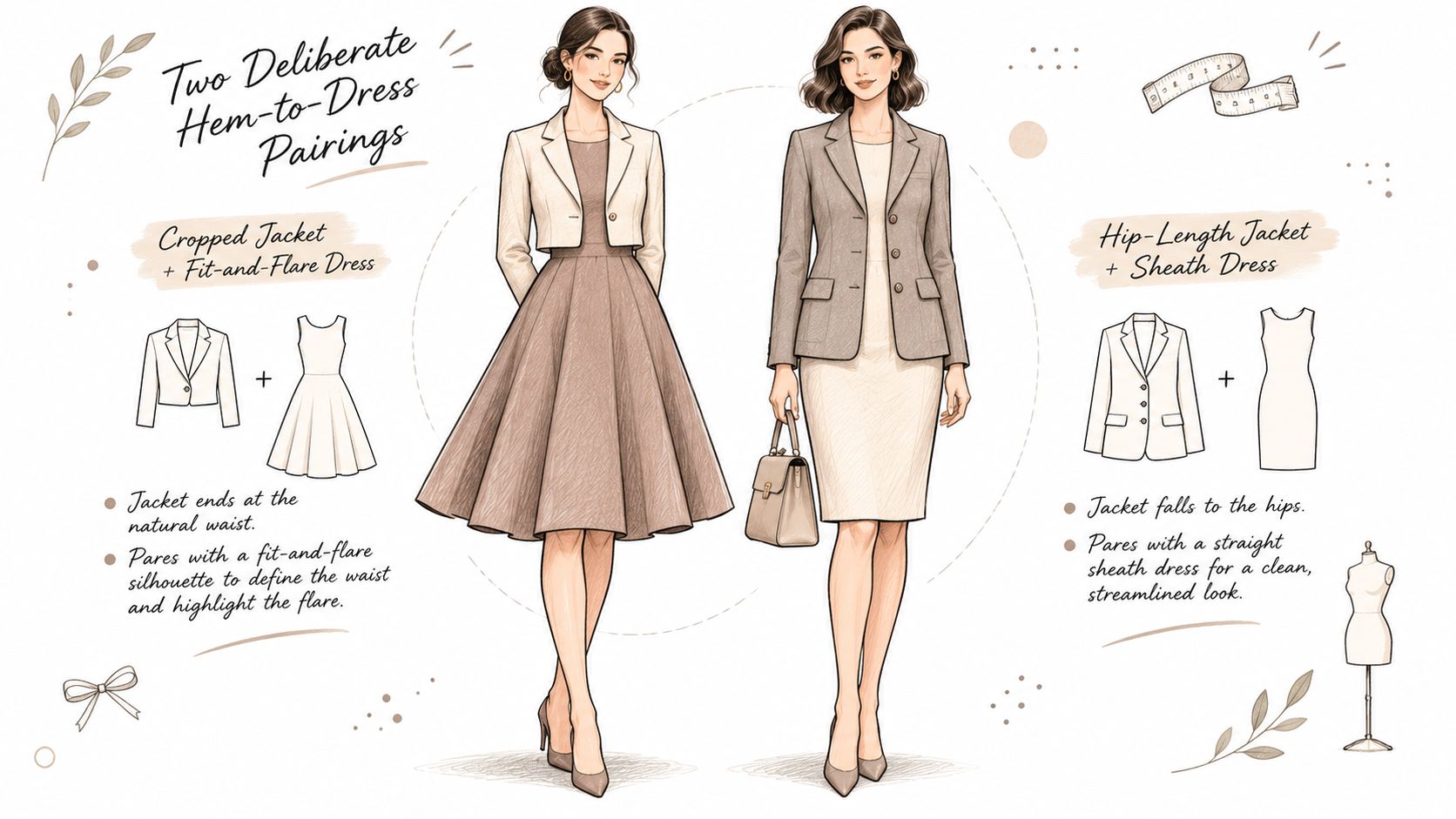
The Three-Step Hem Test
- Put the dress on first and stand in front of a full-length mirror. Never judge a jacket hem against trousers.
- Hold the jacket open and mark where its hem falls relative to the dress waist, hip or widest point. If it lands in a soft zone with no relationship to the dress, try another length.
- Close the jacket and watch the front of the dress. If the dress front rides upward or the fabric gathers above the hem, the jacket is too snug through the bust or too long for the dress proportions.
That principle is older than any of us. The Victoria and Albert Museum records a blue velvet spencer jacket dated about 1815 to 1820, cut high-waisted to follow the raised waistline of the gowns it was worn over. It had long sleeves and a high collar for coverage, and it demonstrates the point that still governs the decision: the jacket should relate to the dress proportions rather than merely sit on top of them.
Four Pairings That Work
Cropped fitted jacket over a satin slip dress, evening. Waist length, structured shoulder, dark colour. The jacket gives shape to a fluid dress that has none of its own, and the satin keeps the outfit from looking like office tailoring.
Fine cashmere cardigan over a jersey midi dress, office day. Hip length. The knit moves with the stretch fabric instead of trapping it, and it comes off in a warm meeting room without creasing.
Long open coat over a maxi dress, winter event. Knee length or longer, worn open. The vertical line continues the dress, while the coat adds warmth without crushing the skirt.
A wrap over a sleeveless sheath, cool ceremony. No waist interference at all, arms and shoulders covered, off in one movement when the room heats up.
The shared principle is contrast of structure and softness. The Metropolitan Museum of Art documents an Elsa Schiaparelli ensemble from summer 1940 pairing a jacket with a black mermaid dress, treating the jacket as part of a coordinated formal outfit rather than a cover-up. A structured layer shapes a fluid or fitted dress, and the dress stays visible underneath. The open version of this idea is the duster cardigan, which covers the arms and back while leaving the front of the dress in view.
Match jacket length to the dress proportions, not to the dress size on the label. Two dresses in the same size can need two different jacket lengths.
Color, Fabric and Sheen That Work Together
Colour coordination between a jacket and a dress works best at moderate, not maximal, relationship. A review of dress-perception research reports that moderately matching colours, rather than near-identical or strongly contrasting ones, tend to produce the most favourable first impressions, per the published review of dress perception studies. The practical version: the jacket should either clearly repeat a colour family in the dress or clearly act as a neutral. Nothing in between.
The neutrals that sit over most dresses are charcoal, navy, camel, ivory and black. Pair a high-saturation or patterned dress with one of those, or repeat a single muted undertone from the print. That gives the outfit cohesion while keeping the jacket and dress readable as two garments.
The Near-Miss Problem
The pairing that fails most often is two nearly identical versions of the same difficult colour. Two burgundies, two greens, two navy-blacks. Small differences in value, undertone and fabric reflectance make the combination look accidental rather than coordinated, as though one piece faded in the wash. If you can't match it exactly, move decisively to a neutral instead.
Contrast direction changes the read of the outfit. A dark jacket over a light dress adds apparent structure and formality. A lighter jacket over a dark dress softens the silhouette and reads more casual. Neither is better; choose by the occasion.
Benchmark to shop by: the jacket either repeats a colour family from the dress or functions as a clear neutral, with no ambiguity between the two.
Sheen is the second half of the decision. Cashmere has a matte, softly diffusing surface that harmonises with dresses of low to moderate sheen. Glossy satin needs sharper separation, in colour or in texture, or the whole outfit goes flat and the dress loses its depth. A dark matte knit over ivory satin is a cleaner pairing than a cream knit over cream satin.
Lighting lies to you in fitting rooms. Assess the full outfit in daylight near a window and again under indoor light before you buy or before the event. Colour perception varies between people and between light sources, and a match that looks perfect under shop spotlights can look slightly wrong at a reception.
Run three checks in this order. Does the jacket repeat the dress colour or act as a neutral? Is any shade a near-miss on a difficult colour? Does the sheen contrast enough? If the first answer is clear, the second and third are quick.
Adjusting the Jacket to Your Body Shape
Standard size advice gets you into a jacket that fits a standard figure. Those fit problems are not rare. 91% of consumers surveyed by Vogue Business said their clothing size changes between brands, and 43% identified poor fit as a purchase deterrent, according to Vogue Business on sizing. So fit the jacket to your body, then to the dress, and treat the label as a starting guess.
Start With Shoulders, Bust and Hips
Shoulders decide everything downstream, because the shoulder seam sets the armhole and the balance of the front and back panels. A narrow-shouldered wearer should check that the seam ends at her natural shoulder edge, and skip padded shoulders that push the seam down the arm. Rounded shoulders need curved shoulder shaping so the back neckline sits flat rather than pulling away.
A fuller bust needs enough ease through the bust and upper arm that a closed jacket lies flat over the dress bodice. If the closure strains or gapes, the jacket will never look right over a dress, whatever the size label says. Fuller hips need a hem and side seam that clear the widest point, or a hip-length jacket rides up at the front and creates a fold above the pocket.
| Body feature | What to check | Fit sign |
|---|---|---|
| Narrow shoulders | Shoulder seam at the natural edge; avoid padded shoulders | Seam slides down the arm |
| Rounded shoulders | Curved shoulder shaping so the back neckline sits flat | Back collar pulls |
| Fuller bust | Bust and upper-arm ease so the closure lies flat | Closure strains or gapes over the bodice |
| Fuller hips | Hem and side seam clear the widest point | Hem rides up at the front |
| Size varies by brand | Measure fullest bust and shoulder width, then check the brand size chart | Chart and body measurements disagree |
When the Label Lies
Measure the fullest part of your bust and your shoulder width with a soft tape, then compare both numbers with the brand's size chart rather than with the size you wear in a favourite sweater. Brand charts describe garment measurements, not your body, and the gap between the two is where returns come from. A jacket bought to fit your bust and shoulders will need less alteration than one bought to fit a number.
Checking Construction and Confirming the Pairing
A jacket can suit a dress in color and length yet fail once you move. Check the construction over the dress itself: the shoulder seam should sit at the natural shoulder edge, and the armhole should allow movement without pulling the front panel diagonally across the chest. The jacket also needs enough room to avoid compression lines, riding up, or bunching at the sleeves.
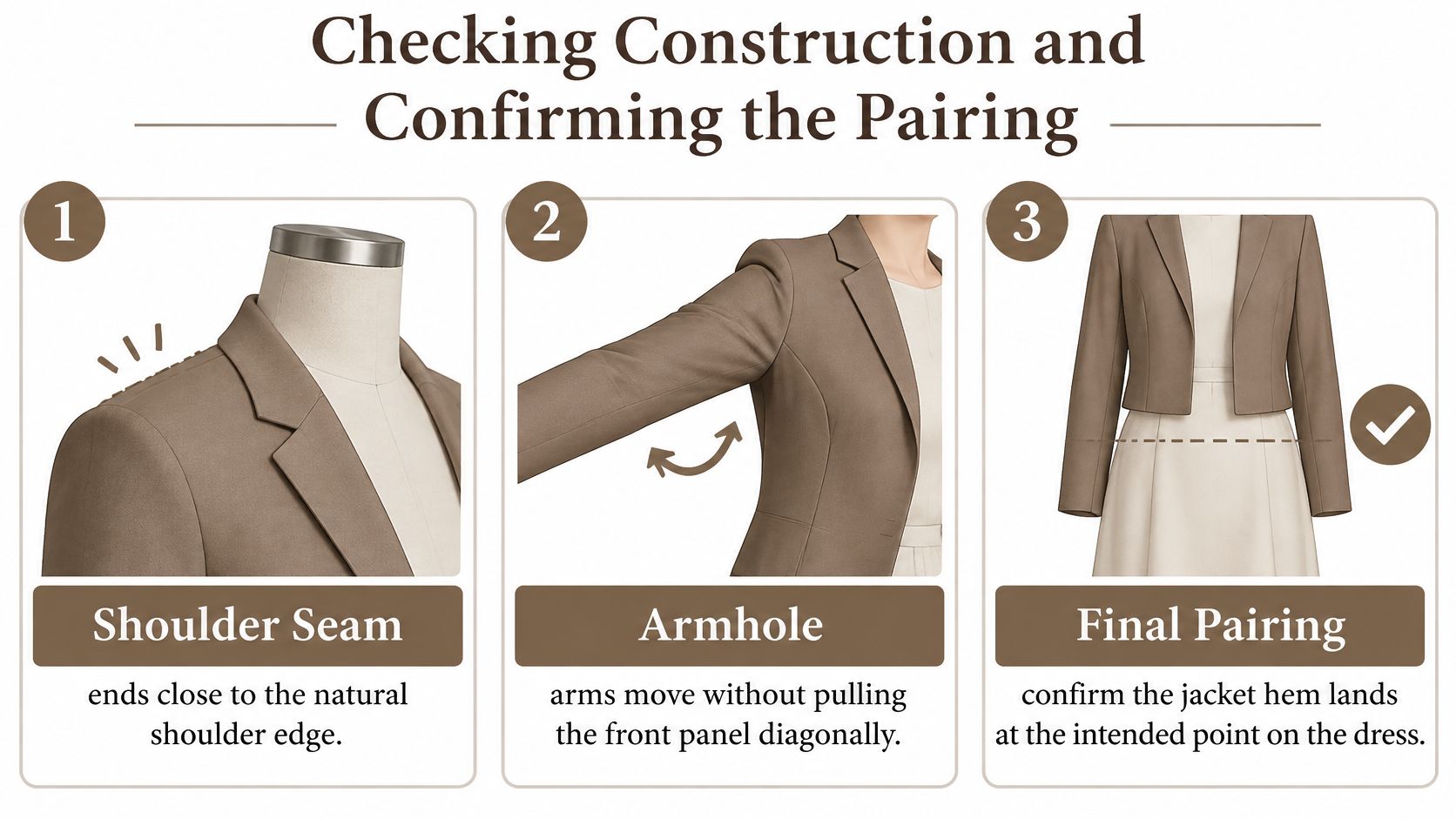
The Movement Test
Put on the dress, then the jacket. Sit down, reach forward, and lift both arms. Persistent wrinkles at the armhole or horizontal stress lines across the front usually mean the jacket lacks ease. Steaming will not correct a fit problem, and a jacket that only looks right while you stand still is likely to shift out of place as you move.
Bust and upper-arm ease matter most when you close the jacket. If fastening it pulls the dress fabric upward, choose a roomier size or wear the jacket open. The open front can preserve the dress's line, while a closed jacket offers more coverage but needs enough ease to lie flat.
Sleeve Volume and Fabric Bulk
A narrow jacket sleeve can catch on a voluminous dress sleeve, creating friction and bunching. Smooth dress sleeves generally sit more easily under structured jackets, while pleated or gathered dresses pair more comfortably with relaxed layers. Fine 14 to 15.5 micron cashmere can provide warmth with less bulk than coarse knitwear, but the jacket sleeve still needs to clear the fabric underneath.
For a coat worn over a dress or other layers, allow room for comfortable movement rather than relying on your usual dress size. Measure around the fullest part of the bust and compare it with the Women's Size Guide. Then review the coat's product-specific shoulder, sleeve, chest, and length measurements. A sizing chart helps you assess the fit before ordering; the dress and the layer should be considered together.
The Five Checks Before You Buy
- Identify the dress style and find its row in the first table.
- Choose the length and check the hem in front of a mirror.
- Choose the colour, repeating the dress's colour family or using a controlled neutral; avoid a shade that nearly matches but looks off.
- Check the conditions, including whether you will be indoors or outdoors, how long you will be outside, the temperature, and how easily the layer comes off.
- Test the fit by sitting, reaching, and lifting your arms, then compare your measurements with the size chart.
Finish by holding the dress and jacket together in daylight, then checking them under indoor light. Keep a pairing that works in both settings and still allows comfortable movement. A zip-front layer can be worn open while you assess the line; this cashmere bomber jacket guide can help illustrate the general open-front shape, without requiring a specific product match.
A good layer respects the dress rather than hiding it. A fine cardigan may stop at the waist, a wrap can sit clear of the dress, and a coat can be long enough to cover its hem. Cashmere Boutique has sold cashmere cardigans, wraps, coats, and pashminas online since 1999, and provides sizing charts and product measurements for checking ease and length before ordering. Use the bust measurement and the garment details to choose a layer that works with the dress in both daylight and indoor light.