
What to Wear to Interview: 8 Polished Outfit Ideas
You're in the lobby at 9:52, twelve minutes early, holding a folder you don't need and rehearsing an answer you'll never use. The receptionist buzzes someone. A door opens. Your interviewer looks up, takes you in, and forms an impression before either of you says a word. From that point on, every answer is being delivered to a person who has already decided something about you.
That's the moment this guide is built for. Not the abstract question of what counts as professional, but the specific one: what do you put on your body for this interview, in this industry, on this platform?
Eight outfit formulas follow. Each is built on fine knitwear, because cashmere does something a suit jacket can't. It holds a clean line, it moves with you, and it adjusts when the room runs warm, the interview runs long, or the dress code turns out to be vaguer than the job posting suggested. Each formula names the industry, the formality level, and the interview format it suits, so you can pick one and stop deliberating.
If you're still tightening your handshake and eye contact, start with these before-and-after professional pitch examples, then come back and get dressed.
Table of Contents
- 1. Cashmere Crew Neck with Tailored Trousers
- 2. Cashmere V-Neck Layered Over a Collared Shirt
- 3. Cashmere Cardigan with Shell Top and Tailored Bottoms
- 4. Cashmere Sport Coat Over a Knit
- 5. Cashmere Wrap or Pashmina as a Statement Layer
- 6. Cashmere Turtleneck with Tailored Blazer
- 7. Cashmere Knit Dress with Structured Layer
- 8. Camel Cashmere Coat with Tonal Knit Underneath
- 8 Interview Outfits at a Glance
- Dress the Part, Then Land the Role
1. Cashmere Crew Neck with Tailored Trousers
A fine-gauge cashmere crew neck with well-fitted trousers or a pencil skirt is the highest-return outfit on this list. It reads polished and approachable at once, which is the exact register most office, creative, and mid-level interviews call for. The knit signals competence without the stiffness of a suit, and the soft drape and muted tone read as considered rather than effortful.
Appearance is doing work before you speak. In a 2019 JDP Hiring survey of 1,997 people in the United States aged 18 to 70, 88% said an interviewee's appearance could influence an interviewer's perception of competence, as CBS News reported on the JDP survey. You can't control that judgment. You can control whether your clothes hand it something to trip over.
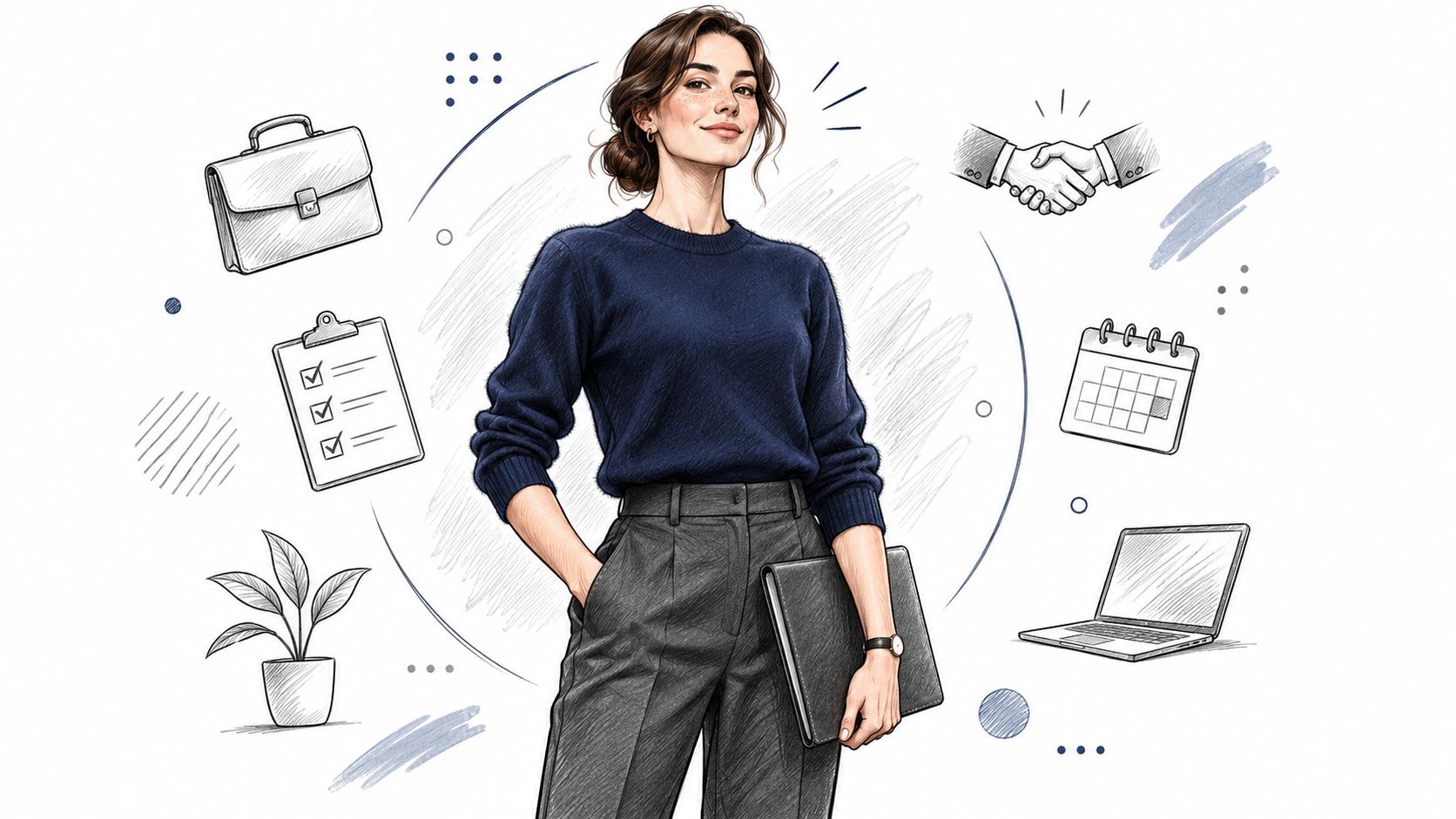
Two ways it plays out. A marketing candidate wears a navy crew neck with black fitted trousers and leather loafers to a mid-size agency. A product manager wears a heather grey crew with a dark pencil skirt to a Series B tech company. Same formula, different rooms.
Fit, care, and the details that show
- Fitted, not tight: the sweater should skim the body and return to shape when you tug the hem. A relaxed fit looks sloppy under interview lighting.
- Steam, don't iron: pressing flattens the loft of the yarn and leaves a sheen. Hang it in a steamy bathroom or run a hand steamer ten inches away.
- Comb the pills: a cashmere comb across the underarms and cuffs takes ninety seconds and makes an old sweater look new.
- Keep accessories quiet: a simple watch, small earrings, a slim belt. Anything that catches light distracts from your face.
It falls flat in exactly one setting: a conservative partnership or banking panel, where you put a structured blazer over the top. Elsewhere, this is your default.
2. Cashmere V-Neck Layered Over a Collared Shirt
The V-neck over a collared shirt is the most reliable business-casual move a man can make. The collar and cuffs stay visible, which is a quiet signal of attention to detail, and the knit adds warmth and texture that a shirt alone doesn't have. It suits interviews in offices that are professional but not formal, which describes a large share of them.
The research backs the layering instinct. A conjoint analysis of interview presentation with 108 participants, including students, educators, and hospitality professionals, found that grooming and professional attire were the strongest contributors to favorable professionalism judgments, and that business casual outperformed casual clothing, while formal business dress produced the strongest overall presentation effect, per the Journal of Retailing and Consumer Services study. Grooming came first. The sweater is the frame, not the picture.
The collar rule: The shirt collar sits outside the knit neckline, points down, and stays crisp. A crumpled collar under a good sweater reads worse than a plain shirt on its own.
Two worked examples. An analyst wears a charcoal V-neck over a white oxford with dark chinos to a consulting interview. A junior designer pairs navy with a light blue shirt and tan trousers for an agency. Keep the V shallow so the proportions hold.
A black V-neck men's sweater is the version that earns its place in a wardrobe, because it works over white, blue, and grey shirts without a single adjustment. Finish with leather derbies or oxfords. Sneakers undo the whole thing.

3. Cashmere Cardigan with Shell Top and Tailored Bottoms
Here's the situation this outfit solves. Say a school district posts a coordinator role with no dress guidance, and the interview is with a panel of four. You have no idea whether they expect a blazer or a knit. That ambiguity is now normal.
Monster's January 2025 survey of more than 1,300 U.S. workers found that 43% had worked in an office without a dress code during the previous year, and 61% of workers with a dress code said it had changed recently, according to Monster's 2025 dressing-for-work poll. You can't research your way to certainty. You can wear something that adapts mid-conversation.
A cashmere cardigan over a fitted shell or blouse does exactly that. Buttoned, it's structured enough for an introduction to a hiring committee. Open over a silk shell, it's warm and conversational by the second question. A teacher candidate wears a camel cardigan over a cream silk blouse with navy trousers for a school district panel. A nonprofit program coordinator pairs a plum cardigan with a black shell and well-fitted pants for a foundation interview.
Button it for the introduction, open it later
- Choose a slightly longer hem: it balances trousers and a pencil skirt and keeps the line clean when you sit.
- Reach for a fitted shell: a loose one bunches under the knit and destroys the silhouette.
- Mind the buttons: all closed for the handshake, the top two open once the room settles.
- Stick to fine-gauge knit: chunky textures read casual in education, healthcare, and nonprofit settings.
This one underperforms in a formal corporate or legal interview, where a cardigan looks like a compromise. Wear the structured option instead.
4. Cashmere Sport Coat Over a Knit
A soft cashmere or cashmere-blend sport coat over a fine knit is the suit alternative for men in creative, tech, finance-adjacent, and hospitality roles where full tailoring tips into overdressed. The fabric's drape and texture signal quality without a logo, and it photographs well in both natural and fluorescent light.
The caution is real. In a 2020 survey of 1,000 UK hiring managers, 51% said they had judged job applicants based on appearance and reported rejecting candidates for presentation-related reasons, and among those, 40% cited clothing, per the BBC's report on the survey. Those are self-reported attitudes from UK employers in 2020, not a controlled experiment, and they vary by industry. What they establish is simpler: presentation choices get remembered, and neatness is the baseline everyone is measuring against.

A UX designer wears a grey sport coat over a black fine-gauge crew to a design agency interview. A sales candidate pairs a navy blazer with an open-collar shirt and dark trousers for retail management. Both read as deliberately under-formal rather than underprepared.
- Fit the shoulders first: they're the hardest area to alter, and a dropped shoulder ruins the line everywhere else.
- Go tonal with the knit: close shades read cohesive. High contrast looks like two outfits.
- Brush and hang wide: a garment brush after each wear, then a broad wooden hanger to hold the shape.
Skip this in a formal law or investment banking interview, where a structured suit is the lower-risk answer.
5. Cashmere Wrap or Pashmina as a Statement Layer
A pure cashmere wrap adds color, texture, and warmth over a dress, blouse, or knit without taking over the outfit. It's the piece that works hardest for creative, fashion, hospitality, and client-facing interviews, where personal style is part of the job description. It's also the only item on this list you can adjust mid-interview without leaving the room.
The garment does two jobs at once. It covers the shoulders in a room with aggressive air conditioning, and it gives a plain sheath dress a finished look that reads intentional rather than improvised.
A communications candidate drapes a charcoal pashmina over a navy sheath dress for a corporate PR interview. A hospitality applicant wears an ivory cashmere wrap with a black knit dress to a boutique hotel interview. The first is playing it safe; the second is showing taste. Both work, in their own rooms.
A wrap should look like a decision, not a precaution. Drape it over one shoulder and let it fall; don't clutch it closed like a cardigan you forgot to button.
- Conservative rooms, neutral tones: charcoal, camel, black, navy. Save the deep jewel and brighter shades for creative roles where color is expected.
- Test the drape seated: a wrap that's perfect standing can slide off a seated shoulder. Pin it once with a slim brooch or tuck the end under your arm.
- Carry a small pouch: a clean case keeps the wrap free of lint and wrinkles in a bag.
Don't wear this to a government or engineering panel. In rooms where personal style is read as a risk, a wrap looks decorative where a cardigan looks composed.
6. Cashmere Turtleneck with Tailored Blazer
A fine cashmere turtleneck under a structured blazer is the sharpest minimalist look available, and it removes an entire decision: no tie, no collar to arrange, no gap at the neck. It has become the default in tech, design, and creative industries, and it suits anyone who prefers a clean, simple silhouette.
On video, it works even harder. In a 2025 FlexJobs survey of more than 2,200 U.S. respondents, 81% preferred casual or business-casual work outfits, according to the FlexJobs remote work style report, which confirms how much the standard has relaxed. Relaxed norms haven't removed the judgment though. The same source reports that 25% of employees felt their professionalism had been judged by attire. Dress for the camera, not for the office you no longer commute to.

A software engineering candidate wears a black turtleneck under a charcoal blazer with dark trousers. A creative director pairs a cream turtleneck with navy for an advertising agency interview. Keep blazer and trousers tonal for the clean effect.
Test the whole outfit through the camera
- Avoid fine stripes and small checks: they shimmer on webcams. Solid tones hold.
- Lose the reflective jewelry: pendants and metal watch faces catch ring lights and flare.
- Sit down and check the neckline: a turtleneck is safe; a lower neckline that looks fine standing may gap when you lean in.
- Choose breathable, non-itchy knit: a long call in a scratchy wool blend ends with you distracted and touching your collar.
The contrarian point: more formal isn't automatically better on video. A blazer you keep tugging at looks worse than a well-fitted sweater you forget you're wearing.
7. Cashmere Knit Dress with Structured Layer
A fitted cashmere knit dress with a structured jacket or longline cardigan is the one-piece answer for corporate, legal, and client-facing interviews. It cuts the number of decisions to two, presents a coherent silhouette, and never looks like separates that were assembled in a hurry.
The numbers point toward smart casual as the safer middle. In 2025, 55% of employers preferred smart-casual interview attire, while 26% preferred formal business attire and 19% had no specific dress code, according to Career Launch Kit's interview attire guide. A knit dress with a structured layer sits inside that majority and can be pushed formal for the minority with one jacket change.
A legal recruiter wears a navy cashmere midi dress with a black structured blazer to a law firm interview. A finance candidate pairs a charcoal knit dress with a camel longline cardigan for corporate banking.
- Pick a knit with body: enough weight to skim the hips rather than cling. Sit, cross your legs, and reach forward before you commit.
- Check opacity in daylight: hold the fabric up to a window. If you can see your hand, it's too sheer for an interview.
- Fold, don't hang: a knit dress stretched on a hanger grows at the shoulders within a season.
If you want a second layer that doesn't fight the dress, this guide to the right jacket to wear with a dress covers the proportions that keep the line clean.
8. Camel Cashmere Coat with Tonal Knit Underneath
The coat is the first thing anyone sees, and it does its work in the thirty seconds before the interview starts. A camel or charcoal cashmere coat over a tonal knit and pressed trousers says quality and preparedness before you've said hello. Then you remove it in the lobby and present a clean, finished outfit.
Status signals land fast. A Princeton-linked study summarized in Princeton's coverage of the dress code research found observers rated identical men as appearing substantially richer when shown in higher-status-looking clothing, with an average perceived-status difference of about two points on a 10-point scale. That's a warning as much as a tip: the same face got different judgments purely because the clothing changed. It doesn't prove expensive clothes win jobs, and it doesn't excuse anyone's bias. It does mean the coat matters.
Plan the reveal. Remove the coat in the lobby, fold it over your arm, and walk in with the knit underneath doing the talking. Standing in a coat during a warm interview reads as nervous.
A candidate arriving for a finance interview wears a camel overcoat over a navy suit and tie. A PR candidate wears a charcoal coat over a black knit dress and ankle boots.
- Leave the pockets empty: a stuffed coat pulls the front out of shape and adds bulk at the hip.
- Size for the layers underneath: allow room for a sweater rather than trusting your usual dress size, as our team at Cashmere Boutique advises for coat fitting.
- Hang it wide: a broad wooden hanger, never a wire one, and let the coat rest between wears.
For the longer silhouette, this guide on how to wear a men's overcoat covers length and proportion.
8 Interview Outfits at a Glance
| Outfit | Best For | Formality Level | Key Strength |
|---|---|---|---|
| Cashmere Crew Neck with Tailored Trousers | Office, creative, and mid-level interviews | Polished business casual | Comfortable, versatile, and approachable |
| Cashmere V-Neck Layered Over a Collared Shirt | Relaxed but professional office interviews | Business casual | Adds warmth and polish with visible shirt details |
| Cashmere Cardigan with Shell Top and Tailored Bottoms | Education, healthcare, nonprofit, and corporate interviews | Flexible, from smart casual to polished | Adjustable formality and comfortable layering |
| Cashmere Sport Coat Over a Knit | Creative, tech, finance-adjacent, and hospitality roles | Smart casual to business professional | Sophisticated alternative to a full suit |
| Cashmere Wrap or Pashmina as a Statement Layer | Creative, fashion, hospitality, and client-facing roles | Smart casual to polished | Adds adaptable warmth, color, and texture |
| Cashmere Turtleneck with Tailored Blazer | Tech, design, and creative interviews | Modern business casual | Sleek, streamlined appearance |
| Cashmere Knit Dress with Structured Layer | Corporate, legal, and client-facing interviews | Polished business professional | Cohesive outfit with adjustable structure |
| Camel Cashmere Coat with Tonal Knit Underneath | Interviews in cooler climates | Professional outerwear | Makes a strong arrival impression and adds warmth |
Dress the Part, Then Land the Role
Pick the formula that matches your industry's formality, then do two things before interview day. First, wear the full outfit sitting down for twenty minutes, because every garment behaves differently in a chair than in front of a mirror. Second, test it in the exact conditions you'll interview in: same camera, same lighting, same room temperature. Layering is what carries you through the day, so build in one adjustable piece you can button, open, drape, or remove without leaving the room.
For the outer layer, consider silhouettes like a semi-fitted belted wrap coat, which adjusts at the waist, a flowing cashmere-blend overcoat with a looser drape, or a shorter structured pea coat with a double-breasted front. Each works in dependable palette colors such as black, navy, charcoal, camel, and burgundy, and each reads as deliberate rather than generic. Cashmere Boutique publishes color charts and Grade-A cashmere specifications so you can see exactly what you're ordering before it becomes your interview-day armor, and a size guide that walks you through bust, waist, hips, chest, and sleeve measurements rather than leaving you to guess.
Care matters as much as choice here. Let a cashmere garment rest two or three days between wears, keep it away from rough fabrics, metal necklaces, bracelets, belts, and textured leather bags, and dry clean or hand wash according to the care guidance rather than improvising in a rush the night before. A sweater that pills under the arms on the morning of an interview can't be fixed in ten minutes.
Your answers still do the heavy lifting. Once you've sorted the outfit, sort your closing: these interview closing scripts from StoryCV take the awkwardness out of asking for the job without sounding scripted.
The formulas above only work if the knit underneath is good: fine-gauge, opaque enough to hold a clean line, and soft enough that you forget you're wearing it. That's the whole of what Cashmere Boutique sells, from crew necks and cardigans to coats and pashmina wraps in a full range of colors. Browse the collection and use the color and size charts before you order, so your interview outfit is settled well before the lobby moment arrives at Cashmere Boutique.