

Cashmere Sweater Pilling: Why It Happens and Fixes
Some pilling after repeated wear is normal even on premium cashmere, and pills alone don't prove a sweater is poor quality. Use the three-pattern table below to distinguish loose early fuzz, friction in a particular spot, and widespread pilling that deserves a closer inspection.
The familiar advice to buy better cashmere oversimplifies the problem. A soft, finely made sweater can develop pills beneath a shoulder strap, while a less delicate knit may tolerate that same contact differently. What matters is where the pills appear, how they develop, and whether the fabric underneath remains sound.
Table of Contents
- Three Patterns of Cashmere Sweater Pilling
- Why Soft Cashmere Forms Pills
- Friction Spots That Pill a Sweater First
- How to Remove Pills Without Cutting Yarn
- Habits That Keep New Pills From Forming
- When to Repair, Keep, or Replace It
Three Patterns of Cashmere Sweater Pilling
Before reaching for a comb, spread the sweater on a table and look at the whole garment. Early shedding, localized friction pilling, and persistent widespread pilling are different signals. Treating them all as the same problem can lead you to remove fiber unnecessarily or overlook an area that needs repair.
We consider some pilling after repeated usage normal for cashmere. That doesn't mean every amount or pattern should be dismissed as routine, nor does it mean an expensive sweater should remain perfectly smooth regardless of wear.
What Your Cashmere Pills Are Telling You
| Pattern | What you see | Usual cause | Next step |
|---|---|---|---|
| Early shedding | Soft halo or loose fuzz in the first wears | Short fibers working free of a new knit | Rest the sweater and lift only loose fiber |
| Localized friction pilling | Tight pills at underarms, seams, elbows, seatbelt, or bag strap | Repeated rubbing in one zone | Remove raised pills and change that contact |
| Persistent widespread pilling | Pills across most of the sweater after gentle wear | Short staple, low twist, or a loose knit plus wear | Check density and thinning before more shaving |
Early shedding isn't necessarily established pilling. A soft halo consists of projecting fibers, while a pill is a small tangle attached to the fabric. Don't try to turn every slightly fuzzy surface into a perfectly flat one, especially if the knit looks even and feels substantial.
Localized pills are easier to interpret when you compare neighboring panels. A rough patch beneath a bag strap, beside an otherwise smooth shoulder, points toward a particular contact. It doesn't establish that every part of the sweater has failed.
Persistent widespread pills call for more careful observation. If the garment becomes heavily covered despite gentle handling and little abrasion, inspect its construction and document its condition before another removal session. The pattern is a reason to investigate, not a home test that proves a particular fiber grade.
Why a Grade Label Isn't Enough
The textile paper published in Fibres & Textiles in Eastern Europe.pdf) explains pilling through interacting fiber, yarn, fabric, and wear characteristics rather than fiber grade alone. Cashmere's fine diameter, relatively short fibers, and smooth surface can contribute to its vulnerability even while those characteristics help create a desirable soft handle.
Staple length means the length of the individual fibers. Yarn twist describes how those fibers are held together, while knit density concerns how closely the knitted loops sit. A grade or micron description doesn't tell you everything about either construction feature.
Read the table from observation to action. Let loose fuzz settle rather than repeatedly grooming it; address the contact behind a concentrated patch; inspect widespread pilling for changes in fabric thickness.
A pill-free sweater is the wrong promise. A useful promise is clear guidance on what the surface is telling you and how to respond without weakening the knit.
Why Soft Cashmere Forms Pills
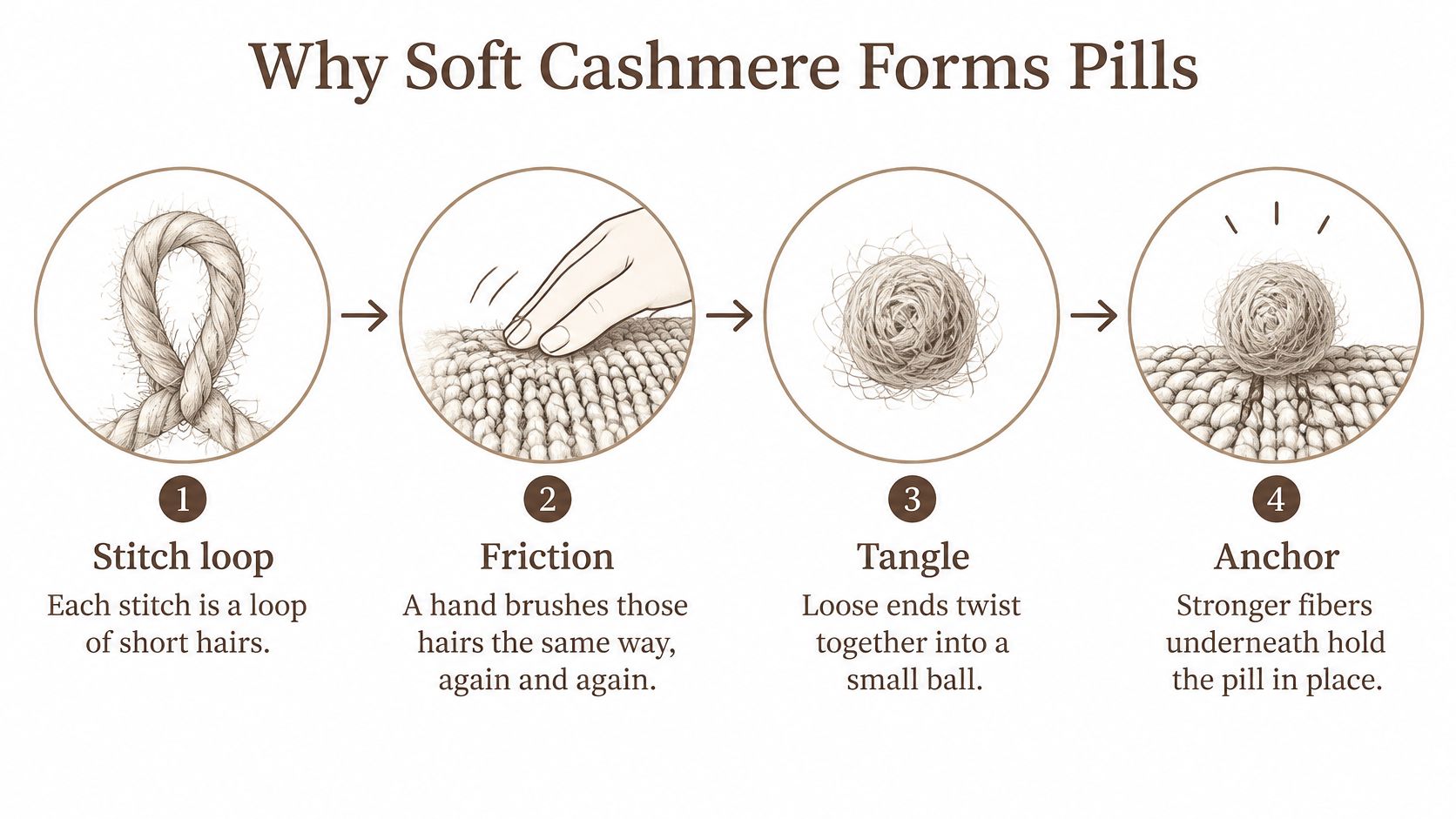
Think of each stitch as a loop of short hairs held together in yarn. Now think of a hand brushing those hairs repeatedly: some ends lift, meet neighboring ends, and tangle. Fibers still held within the yarn anchor that tangle to the sweater.
That's why a pill doesn't fall away when you brush the surface with your palm. The visible ball contains loose ends, but it remains connected to the fabric underneath. Pulling hard on the ball transfers force to those connections.
The illustration separates the process into its visible stages.
Softness and Strength Aren't the Same Property
A fine fiber bends readily against the skin, which helps explain cashmere's gentle feel. But a pleasant hand isn't a complete durability test. The way a spinner combines the fibers and a knitter builds the fabric matters to how securely those ends remain in place.
Consider an airy fashion pullover beside a compact sweater knit. The airy garment may drape beautifully and feel light, yet its open construction can leave more opportunity for movement at the surface. The compact garment offers a different balance of weight, flexibility, and support.
More plies don't automatically settle the comparison, either. Ply describes the strands combined in a yarn, not a universal measure of tightness or resistance to abrasion. A loosely knitted multi-ply sweater can still require thoughtful handling.
Our guide to pullover cashmere sweaters offers context for choosing a garment style. Alongside shape and neckline, consider whether you want a light layer for occasional outings or something you'll wear frequently beneath outerwear.
Match the Knit to the Day
An après-ski outfit illustrates the trade-off. A sweater worn indoors faces different contact from one pushed beneath a snug jacket, backpack, and textured cuffs throughout a busy day. For outfit ideas, you can browse men's après-ski sweaters in California Cowboy's guide, then consider how each layer will sit against your knitwear.
Keep these distinctions in mind:
- Fiber feel: Softness describes what you notice against your skin.
- Yarn construction: Twist influences how firmly the fibers are gathered.
- Fabric construction: Loop spacing affects the support surrounding the yarn.
- Actual use: Clothing, equipment, and laundering introduce different kinds of rubbing.
Wearing usually concentrates contact in recognizable places. Rough laundering can expose much more of the garment to agitation at once, so an all-over change after cleaning deserves attention to the care method as well as the sweater itself.
Friction Spots That Pill a Sweater First
Say you wear the same sweater on a quiet workday and on a day spent traveling across town. The fabric hasn't changed between outings, but the surfaces touching it have. Those contacts help explain why cashmere sweater pilling can look uneven.
Use the commuting example below to consider where your own sweater meets straps, sleeves, and furniture.
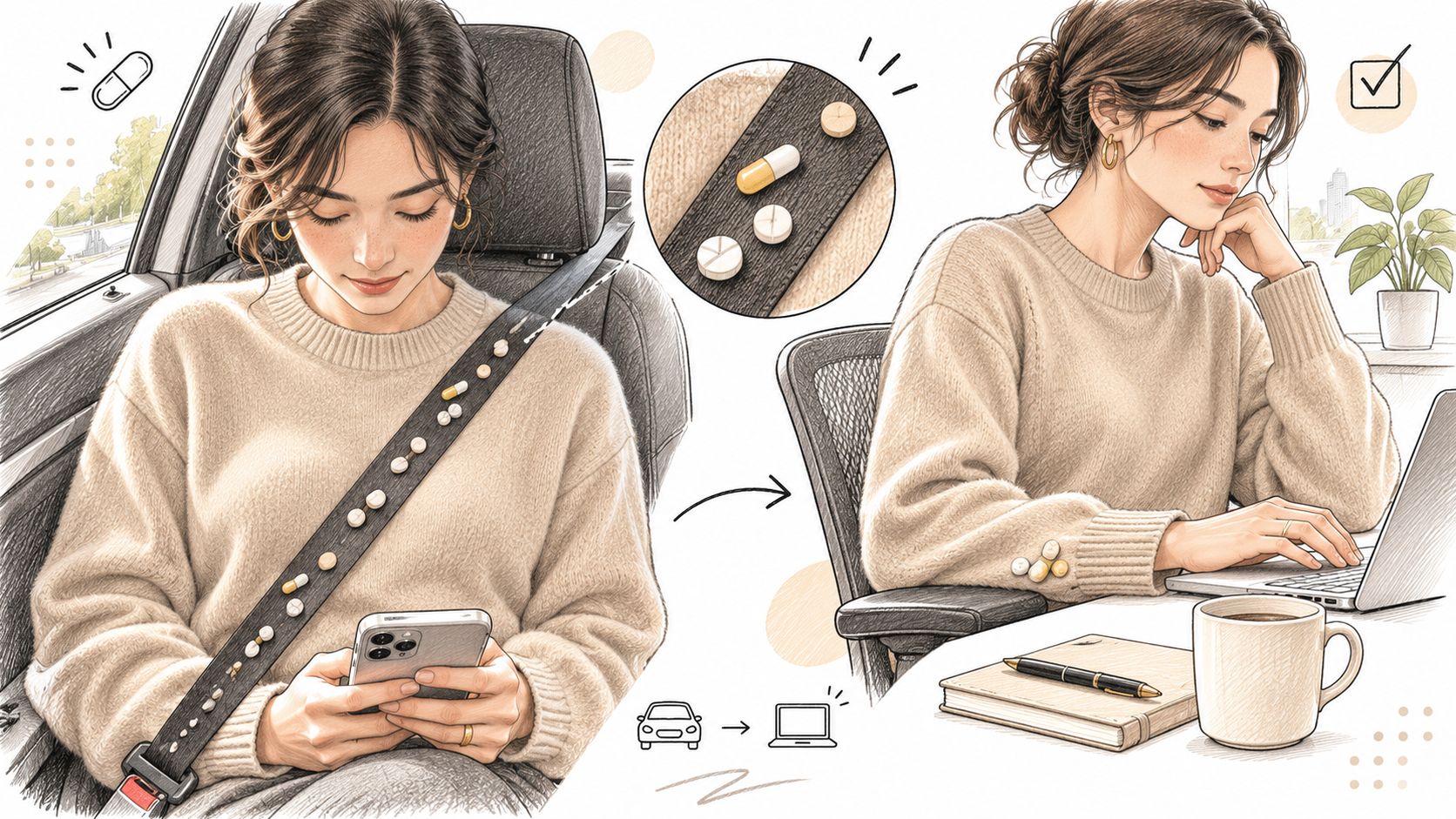
A Quiet Day and a Busy Commute
On the quiet day, you wear a smooth shirt underneath and leave your bag beside the desk. Your underarms and inner elbows still move, but the chest and shoulders have little repeated contact. If you lean your forearms against a rough desk edge, the sleeves may receive more abrasion than the body.
On the travel day, a seatbelt lies diagonally across your chest. Later, a crossbody strap moves against your shoulder while the bag rests at the opposite hip. A tote carried on the same shoulder can create another concentrated contact point.
None of this means you should compromise safety or stop carrying what you need. Keep your seatbelt correctly positioned, and use a smooth outer layer between the belt and delicate knitwear when practical.
Read the Location Before Blaming the Garment
Small accessories can be easy to miss because they don't cover much fabric. Their edges may repeatedly touch the same stitches as you walk, type, or reach.
- At the neckline: Check whether a necklace pendant or jacket zipper catches or rubs.
- At the cuffs: Look at bracelets, watch edges, and rough leather straps.
- At the hem: Notice contact with denim waistbands, belt buckles, and bag hardware.
- Along the sides: Check where your arms move against the body of the sweater.
A smooth back beside a pilled underarm is consistent with localized abrasion, not evidence by itself of uniformly poor construction. Likewise, a line across the chest is more informative when it matches the route of a strap.
For a visual companion to your inspection, watch the video with your own garment laid nearby.
Choose your worst contact points before buying a tool or replacing the sweater. If the trouble is concentrated beneath a bag and beside a bracelet, changing those contacts gives you a more useful starting point than repeatedly grooming the entire garment.
How to Remove Pills Without Cutting Yarn
Remove raised pills, not the sweater's natural surface. Some friction-related pilling can be gently managed with a cashmere comb or fabric shaver, but the tool and pressure must suit the condition of the knit.
Selvane's guide to natural-fiber pilling connects prevention with wear and washing, and discusses controlled combing alongside the risks of aggressive shaving. The important distinction is between lifting an unwanted tangle and cutting into structural yarn.
Prepare Before You Groom
Start with a dry garment, good light, and a clear work surface. Don't hold the sweater suspended while removing pills, because you need to see how the fabric behaves beneath the tool.
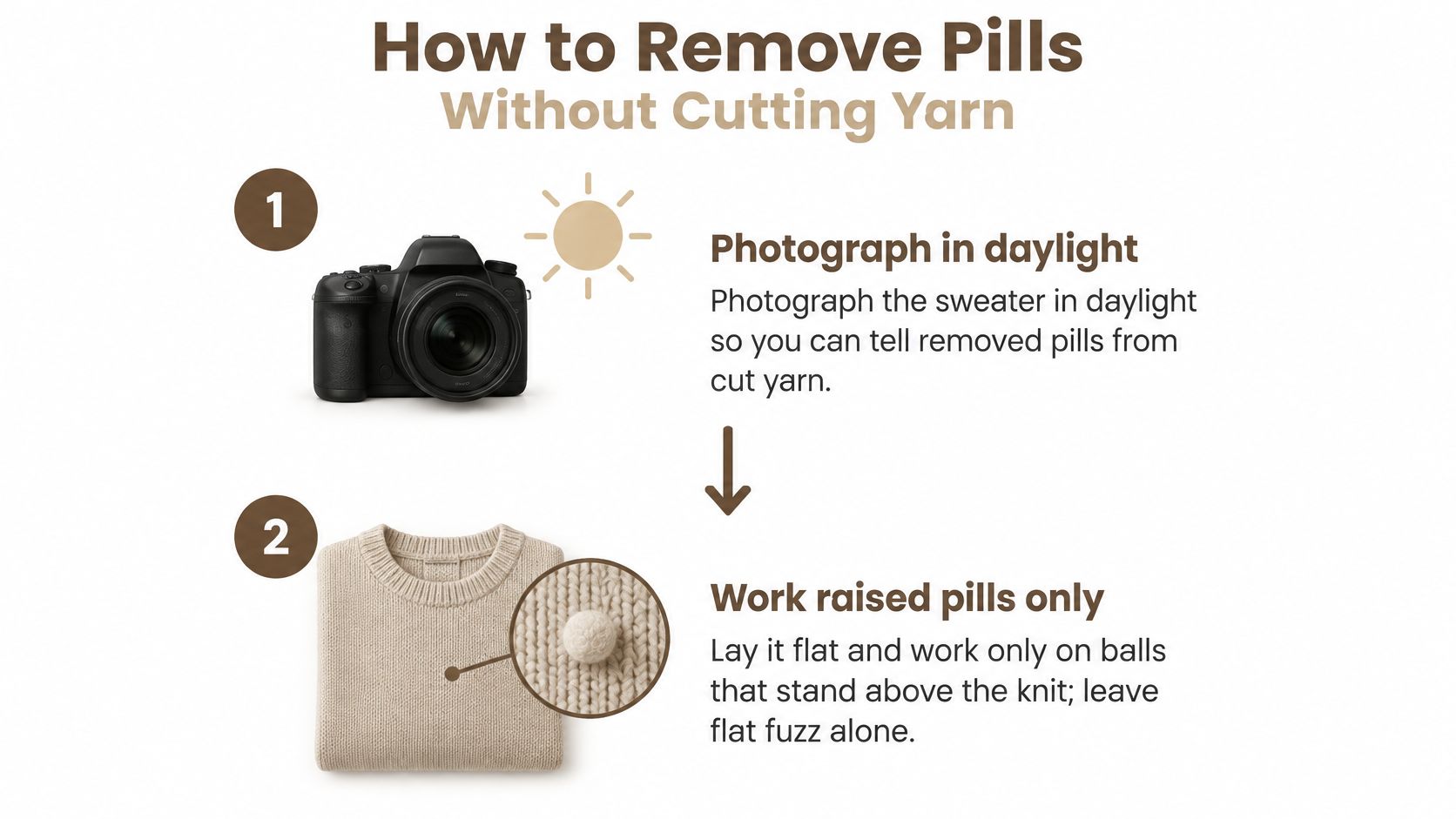
- Photograph the sweater in daylight. Capture the whole garment and the affected patches so you can compare their appearance afterward. Stop preparation if the inspection reveals a hole or an already translucent patch.
- Lay it flat and identify raised balls. Smooth the fabric without stretching it taut out of shape. Leave flat fuzz alone, and stop if what you thought was a pill looks like a continuous yarn loop.
- Test a plastic de-pilling comb on an inconspicuous area. Support the fabric with your free hand and use short strokes in one direction with minimal pressure. Stop if the teeth catch, pull loops upward, or distort the stitches.
- Consider a shaver only on sound fabric. For dense pills on a substantial knit, use a guarded battery fabric shaver at its gentlest suitable setting, following its instructions. Keep it moving and stop immediately if the surface becomes thinner, unusually flat, or shiny.
- Leave attached pills alone rather than tugging. Don't pull them off with your fingers. If removal requires force, stop instead of transmitting that force into the knitted loops.
- Separate pills from damage. A pill is a small ball of tangled fiber; a snag is a pulled loop, and broken yarn may leave a gap. Don't pass a blade over a snag or hole.
- Inspect the reverse. Turn the sweater inside out and examine treated areas for weakened stitches or thin spots. Stop grooming if the reverse reveals damage that wasn't obvious from the front.
Choose the Least Aggressive Suitable Tool
The typical tool costs below reflect our care guidance, not a guaranteed current retail price. Obtain a repair estimate for structural damage rather than treating a specialist mend as another de-pilling option.
| Tool | Typical cost | Use it when | Stop when |
|---|---|---|---|
| Plastic de-pilling comb | $3 to $5 | A few raised pills on an otherwise sound knit | Fibers start to pull into a run |
| Battery fabric shaver | $6 to $20 | Many tight pills and the fabric still feels thick | The surface looks thinner, shiny, or flat |
| Pulling with fingers | No cost | Never | Any tug risks pulling a stitch |
| Knitwear repair | Quote based on the mend | Holes, snags, or a thin elbow | Shaving would remove sound yarn |
Practical rule: Every pass removes some fiber. Aim for a tidy surface, not a shaved-bare one.
There's no need to repeat the treatment on a fixed schedule. Inspect first, work only where needed, and put the tool away when the raised pills are gone.
Habits That Keep New Pills From Forming
Prevention works best when it fits your routine rather than turning every wear into a maintenance project. Keep abrasive items away from the knit, allow time between outings, and clean the garment appropriately instead of grooming it constantly.
We advise keeping cashmere away from rough clothing, metal necklaces, bracelets, belts, and rough leather items. You don't have to abandon an outfit you enjoy, but a smooth layer or different accessory can prevent direct contact with the sweater.
Wear and Rest
We recommend allowing cashmere two or three days of rest after a day's wearing. Rotate another layer into your wardrobe rather than repeatedly wearing and brushing the same garment.
Rest is also a useful inspection opportunity. Air the sweater, check for marks or odor, and decide whether it needs cleaning rather than sending it automatically into the laundry.
- Before wearing: Check the inside of your jacket for exposed hook-and-loop fasteners, rough seams, and catching hardware.
- After wearing: Remove the sweater carefully without dragging jewelry across it.
- Between outings: Fold it once it's aired and dry, keeping it away from objects that might snag the surface.
Clean According to the Garment
Our recommendation is dry cleaning for cashmere and pashmina products, with selected garments suitable for hand-washing. We specifically advise against washing cashmere coats and jackets at home. A washable pullover and a fitted cashmere coat aren't interchangeable care cases.
For a garment approved for hand-washing, use this gentle approach:
- Turn it inside out. Use lukewarm water and a mild detergent intended for wool or cashmere, without scrubbing the surface.
- Handle it with support. Gently squeeze rather than twist, then rinse carefully without pulling the wet garment by its shoulders.
- Press out excess moisture. Support the sweater on a towel and press gently instead of wringing it.
- Dry it flat. Reshape it on a clean, dry surface away from direct heat and sunlight.
If a garment explicitly permits machine washing, use the approved cycle and a mesh bag. Access to a gentle cycle alone doesn't make a hand-wash-only or dry-clean-only garment machine washable.
Our guide to drying sweaters can help you arrange the drying stage without hanging a wet knit. Avoid unnecessary washing, but don't leave soiling untreated just to minimize handling.
Store It Clean and Dry
Fold cashmere rather than leaving it on a hanger, and keep it away from light, dust, and dampness. We recommend neatly folded storage, with tissue paper or suitable plastic storage where appropriate; for summer, our guidance includes a well-sealed, dry, see-through plastic box.
Only pack a garment once it's completely dry. A storage container doesn't correct damp fabric or a damp closet.
Make a simple weekly plan: choose the outing for this sweater, leave the following days for other layers, and identify the rough accessories that won't touch it. That's a more manageable habit than trying to remove every new speck of fuzz immediately.
When to Repair, Keep, or Replace It
The deciding question is whether sound fabric remains beneath the pills. A substantial, intact knit may need light surface care; a thin or damaged area needs a different response. Don't use a cleaner-looking surface as your only measure of success.
Check the garment in even light without stretching it. Openwork and deliberately airy knits naturally reveal spaces, so compare the suspect patch with an undamaged area of the same construction rather than assuming any visible light means failure.
Keep a Sweater That Still Has Its Structure
Keep wearing it when the body and sleeves remain resilient, the stitches look continuous, and the problem is limited to removable surface tangles. A patch of pills doesn't cancel out a comfortable fit or an otherwise useful garment.
A heavier multi-ply knit can still need ordinary upkeep, while a fine, lightweight sweater may remain serviceable with careful use. Judge the actual cloth rather than deciding from weight or ply alone.
Keep the sweater when its structure is sound. Change its job when the fabric can no longer tolerate the same wear.
You might reserve a delicate pullover for low-contact days and choose a different layer for carrying equipment or commuting with a heavy bag. That isn't failure; it's matching the garment to a suitable use.
Repair Before Removing More Fiber
A pulled stitch, opening seam, hole, or thinning elbow deserves assessment by a knitwear repair professional. Keep the surrounding fabric intact and take clear photographs to help explain what changed.
- Choose repair: There's a localized defect with enough sound fabric around it to support a mend.
- Reduce hard wear: A vulnerable area can remain useful if you stop exposing it to repeated abrasion.
- Consider replacement: Weakness extends through much of the garment, its shape no longer holds, or repair won't restore the function you need.
Replacement isn't automatically the most economical choice, and repair isn't automatically practical for every sweater. Ask for an assessment of the damaged area and decide based on the garment's remaining structure, your intended use, and the proposed mend.
Shop for Construction as Well as Softness
When shopping again, examine the evenness of the stitches, how the fabric recovers after gentle handling, and whether its weight suits your routine. Persistent widespread pilling alone can't tell you the precise staple length or twist, so don't diagnose either from a photograph.
Our Grade-A cashmere fibers measure approximately 14 to 15.5 microns in diameter. That specification describes fineness, not a no-pill guarantee, and it should be considered alongside construction and care.
Use our guide to choosing a high-quality cashmere sweater to prepare more useful buying questions. Our cashmere FAQs also address quality and care, helping you consider maintenance before choosing your next knit.
Cashmere Boutique offers cashmere sweaters, accessories, and home textiles, along with FAQs covering quality and care. Visit Cashmere Boutique to explore the collection and review the care guidance before choosing a knit that suits how you'll wear it.