
Article: Pashmina Shawl Test: How to Spot Real Pashmina
Pashmina Shawl Test: How to Spot Real Pashmina
The ring test sounds decisive, but it answers the wrong question. A tightly finished viscose scarf may pass through a wedding ring more easily than a handwoven wool shawl. The test reflects how smoothly yarn compresses, not the fiber's species.
A pashmina shawl test should separate four claims: fiber identity (whether the material is goat cashmere), fiber percentage (how much cashmere it contains), fineness (fiber diameter), and craftsmanship or origin (such as handloom weaving, hand-twisted fringe, or a named production region). These claims require different checks. Home methods can offer clues, but fiber identification and fineness assessment require laboratory analysis.
Table of Contents
- What Each One Proves
- Fiber Diameter Benchmarks to Check Against
- How to Run a Sample Check Step by Step
- Lab Report Items Worth Requiring
- Confirm the Label Before You Buy
What Each One Proves
A shawl can feel fine, pass a burn check and still leave its fiber content unproved. Each home check answers a narrower question: whether the surface feels fine, whether a sample behaves like protein fiber, or whether the label states a claim. None establishes fiber identity, percentage, fineness and craftsmanship or origin at once.
| Check | What It Shows | What It Cannot Show | How to Use It |
|---|---|---|---|
| Ring test | How readily the fabric compresses and passes through a ring | Species, blend percentage or origin | Treat as a weak screening clue, never proof |
| Burn test | Whether a sampled fiber behaves like protein fiber | Whether it is cashmere or silk, or the blend percentage | Avoid testing a finished shawl |
| Hand feel and softness | An impression of surface finish and fineness | Composition or blend percentage | Use only as a screening clue |
| Weight | Whether a full-size piece falls within the cited typical range of 150 to 200 grams | Fiber identity | Ask about outliers; weight cannot identify the fiber |
| Label wording | What the seller claims | Whether the claim is verified | Use it to decide what a lab check should assess |
The ring test measures compression, not composition. A thin viscose scarf may slide through a wedding ring more readily than a handwoven wool shawl. The result reflects yarn twist and finishing, not the animal that produced the fiber.
A burn test can indicate whether a sample is protein based. Cashmere, wool and silk are all protein fibers, so burning cannot distinguish them or measure a silk share. It also damages the sample. Avoid burning a finished shawl.
Hand feel is useful for judging the surface, but softness can reflect finishing and yarn construction as well as fineness. Your fingertips read the fabric's feel, not its fiber percentage. The same distinction matters in knitwear: choosing a high-quality cashmere sweater requires attention to grade and ply, not just a plush surface.
Two cheap checks worth doing first
Weigh the shawl and read its label. A guide to typical pashmina shawl weights gives approximately 150 to 200 grams for a full-size piece. Treat that as a screening range, not a fiber test: a weight outside it prompts questions but does not identify a substitution.
The label records the seller's claim. India's IS 17269 standard applies to finished products containing at least 90% pashmina fibers. A label can help you identify the claim to check, but it cannot verify the content.
The sheen trap and the weave trap
Sheen and weave describe fabric characteristics, not fiber identity. Silk-blended pashmina is denser and has a sheen from the silk, while pure pashmina is softer and fluffier. A blend can contain 65 to 70% pashmina and 30 to 35% silk, so sheen alone cannot tell you whether a shawl is a blend or what its exact proportions are.
A waffle weave has a knitted effect and a square weave pattern. That structure says nothing about the yarn's composition. Handloom construction, natural dye and heritage-motif claims concern how a piece was made, not what fiber it contains. Pashmina is the Indian and Persian name for cashmere, but the name alone does not establish fineness, percentage or origin.
Use home checks to decide what to ask, not to issue an authenticity verdict. The ring test, burn test and hand-feel check each have limits. A lab can assess fiber identity, percentage and fineness; craftsmanship and origin require evidence about how and where the shawl was made.
Separate the claims before you buy: a fiber test addresses identity and percentage, a diameter report addresses fineness, and documentation about production addresses craftsmanship or origin. A single home check cannot answer all four.
Fiber Diameter Benchmarks to Check Against
A micron count is only useful next to the limit it has to meet, and the limits differ by market. India's BIS specification IS 17269:2021 states that pashmina fiber should generally be non-medullated and have a mean diameter of no more than 16 microns, and the same standard allows a declared fiber content tolerance of minus 2 percentage points for 100% pashmina and minus 3 percentage points for blends. Read the tolerance before you accuse anyone of mislabeling, because a purity claim can sit slightly under 100 and still conform.
U.S. labeling uses a different yardstick. The FTC's cashmere labeling guidance sets an average fiber diameter no greater than 19 microns and no more than 3% by weight of fibers exceeding 30 microns. A shawl can satisfy the American cashmere definition and still miss the Indian pashmina limit, so the market a piece was sold in matters as much as the number printed on the report.
| Benchmark | Source | Limit |
|---|---|---|
| Pashmina mean fiber diameter | IS 17269:2021 | No more than 16 microns |
| Cashmere mean fiber diameter | US FTC cashmere labeling | No greater than 19 microns |
| Coarse fibers over 30 microns | US FTC cashmere labeling | No more than 3% by weight |
| Declared content tolerance, 100% pashmina | IS 17269:2021 | Minus 2 percentage points |
| Declared content tolerance, blends | IS 17269:2021 | Minus 3 percentage points |
| Optical fiber diameter, genuine pashmina | Optical fiber diameter test | 12 to 16 microns |
| Optical fiber diameter, shahtoosh | Optical fiber diameter test | 9 to 12 microns |
Optical fiber diameter results are worth knowing for one specific reason: they separate the legal from the illegal. A PashWrap article on the shahtoosh ring test reports that optical-fiber testing classifies fibers measuring 12 to 16 microns as genuine pashmina and 9 to 12 microns as shahtoosh, whose trade is prohibited. A result in that lower band is a legal problem, not a lucky find.
Outliers deserve suspicion. The same publisher's guide to what real pashmina is puts authentic pashmina at no more than 14 microns and merino wool at 17 microns or more, which conflicts with the 16 micron limit above and with the 12 to 16 micron optical range. Merino specs get quoted just as loosely, and how extra fine merino wool is specified shows the same mean-versus-minimum confusion. Treat a 14 micron ceiling as a dealer claim until a report shows a mean, not a minimum.
Diameter predicts handle and warmth. It doesn't prove origin, and one reading proves nothing about a whole shawl. The same trap appears in bedding, where what matters more than thread count is the material behind the headline figure. Match the label claim to the row that governs it, then check every reported result against that limit before you accept the report.
Match the row, not the marketing. A purity claim answers to the tolerance row, a fineness claim answers to the diameter row, and no single number satisfies both.
How to Run a Sample Check Step by Step
Run the two free checks before anything leaves your hands. They decide whether a shawl is worth the cost of laboratory work.
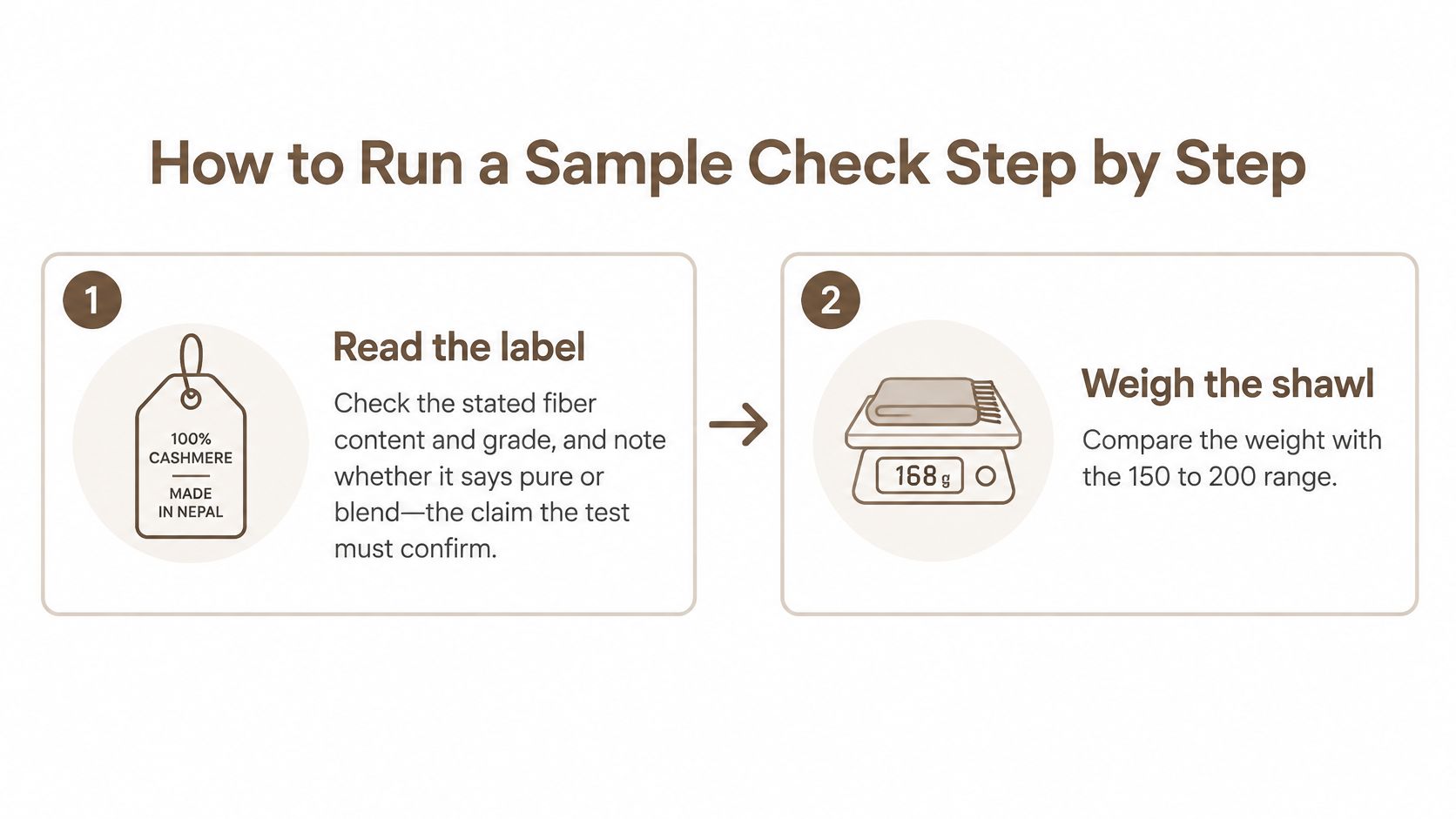
- Read the whole label. Note the stated fiber content, whether it says pure or blend, and any grade or origin claim. That sentence is the claim a test has to confirm, and a report answering a different question tells you nothing about your purchase.
- Weigh the piece. A full-size pure shawl occupies a narrow weight band, so one that feels heavy for its dimensions suggests dense yarn or a blend, and one that feels impossibly light raises the same question from the other side. Record the figure next to the label claim.
- Inspect tassels and weave as production clues only. Tassels on a pashmina are hand twisted and knotted at the ends, and fringing a single shawl takes the weaver a couple of hours, while traditional shawls are woven on handlooms because the yarn is too fragile for power looms. Those details tell you about labour and route. They don't identify fiber, so ask the seller to explain the production method and verify composition separately.
- Cut samples from several zones. Take cuttings from the center, the border, the tassel and any patch that looks different, and send them together. A localized wool or acrylic admixture hides from a single snip near the hem.
- Compare the report with the label and the benchmarks. Identity, percentage and mean diameter each have to clear their own limit. A mismatch at this stage is a reason to stop before payment, while you still have room to negotiate.
The sequence matters more than any single number: claim, weight, structure, laboratory, comparison. Skip the middle steps and you'll pay for testing on pieces a scale would have eliminated.
A short video walkthrough sits below if you'd rather watch the opening checks than read them.
Lab Report Items Worth Requiring
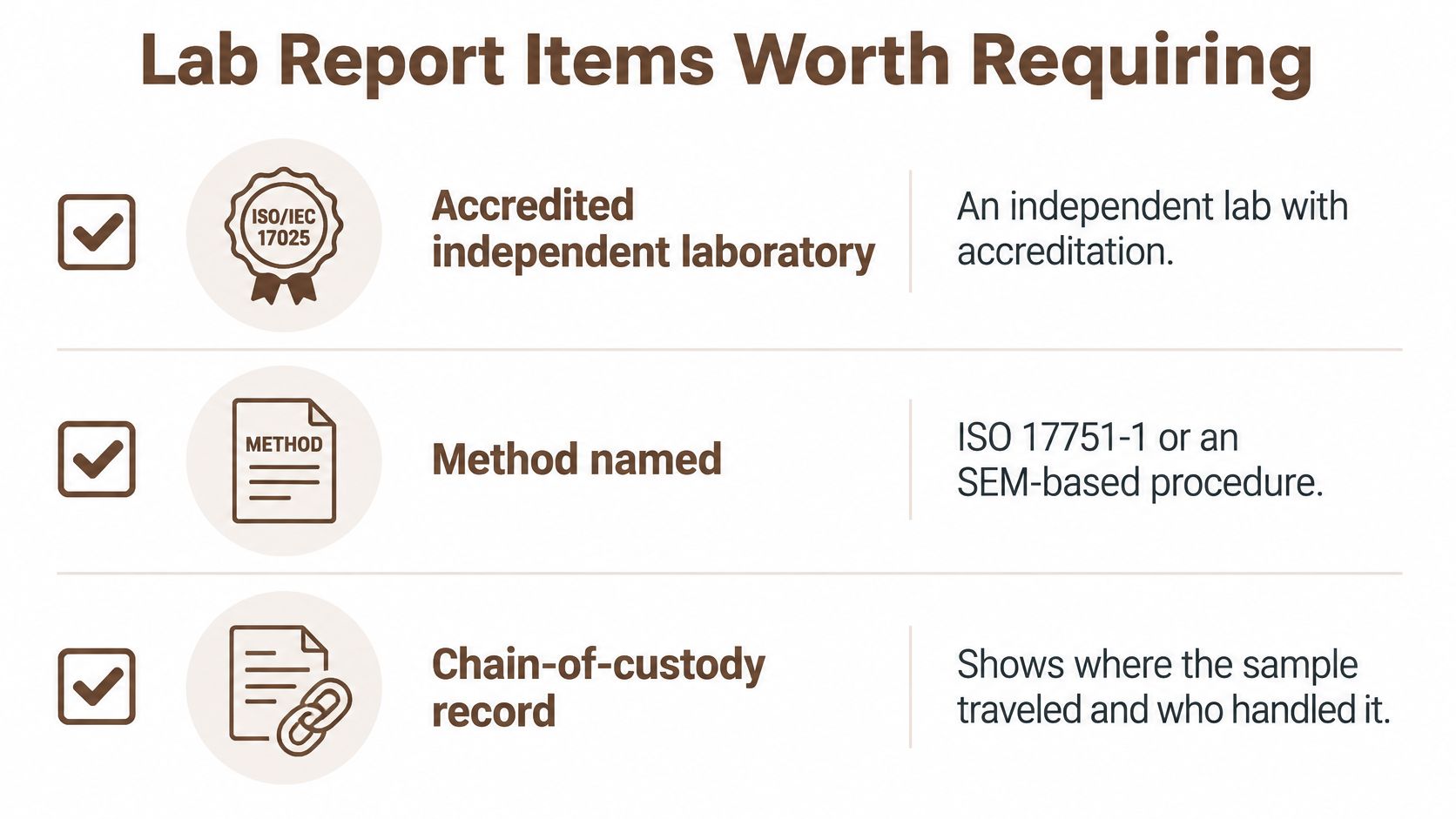
A credible report reads like a method statement. Each line below answers one of the four claims a shawl can make: what the fiber is, how much of it is present, how fine it runs, and how or where it was made. Ask for all seven and confirm each one appears.
- An accredited, independent laboratory. Look for accreditation to ISO/IEC 17025 for textile fiber testing, and ask for the scope that includes the method used. This underwrites the other six items rather than any single claim.
- A named method. ISO 17751-1 or a scanning electron microscopy procedure, written on the report. The ISO 17751-1 standard covers loose fibers, intermediate products, finished products and blends. Whatever the method, the report should state how many fibers were examined and how many diameter measurements were taken for each fiber source.
- Chain-of-custody details. Where on the garment each sample came from and who handled it. This is the item that ties every conclusion to your shawl instead of an anonymous swatch.
- Fiber identity by microscopy, with the fibers named and the evidence stated. This is the only line that answers the identity claim.
- Mean diameter, the full distribution and the coarse-fiber percentage, never a single minimum reading. These figures carry the fineness claim, and a lone minimum can hide a coarse tail in the distribution.
- Blend percentages wherever silk or wool is possible, plus the sampling location for each subsample. This answers the percentage claim.
- Fiber count, uncertainty, date and signature. The count supports fineness and percentage, the uncertainty tells you how much weight to give the numbers, and the date and signature make the document attributable.
Instrument-based work has scaled up fast. The government-reported Pashmina Certification Centre certified more than 15,000 shawls in its first year of operation and later added SEM-EDS equipment, which lets analysts read fiber morphology and elemental characteristics at a precision ordinary visual inspection cannot reach.
Red flags are easier to spot than good practice. An unqualified 100% pashmina conclusion, samples drawn only from the softest edge, a minimum where a mean should be, or a passed hand-feel demonstration offered as authentication all point to a document written for the seller rather than for you. The fourth claim, craftsmanship and origin, sits partly outside the report's reach: hand-twisted tassels and handloom weaving are production facts no fiber test confirms, so for high-value orders or a dispute, add DNA or species analysis when origin is the commercial point. Keep the report, the label and the purchase record together in one file. That trio is what turns a claim into a record, and DPPWare's textile passport solution shows how the same traceability logic is being applied to supply chains at scale.
Confirm the Label Before You Buy
Turn the checks into a decision with three outcomes.
- Buy when the label, the weight, the tassels and the report agree on fiber, percentage and fineness.
- Ask when the report is missing a mean diameter, a named method, sampling locations or a fiber count, and let the seller supply a corrected version.
- Walk away when there's no documentation at all, or when the only evidence on offer is a photograph.
Take our Pure Pashmina Wrap: 100% cashmere, 3 ply, 28 by 80 inches with 3 inch tassels at each end, made in Nepal. Every element there is checkable, which is the point. A listing that states fiber, ply, dimensions and origin gives a laboratory something to confirm or contradict. A listing that says "luxury pashmina" gives it nothing.
Apply the same rule to any product page. A listing claims 100% pashmina and the report shows a blend with 25% silk: ask for a corrected statement or walk away, because the label no longer matches the evidence. If the report shows a mean diameter above 16 microns, the fineness claim fails the benchmark, and a refund or price adjustment is the right request before money changes hands. Once the seller produces a document and a label that agree, the purchase can proceed.
For men's styles and scarf-weight pieces, the four claims stay the same, and choosing a pashmina scarf for men is a question of proportion and finish rather than a separate rulebook. Fiber identity, fiber percentage, fineness and production route remain the whole checklist.
The four claims worth separating are the ones we try to answer on every product page: fiber identity, fiber content, fineness and where the piece was made. At Cashmere Boutique, the pure pashmina wraps, pashmina-silk blends, cashmere scarves and throws are listed with their composition and construction stated, so you can test a listing against the benchmarks above instead of judging by sheen. Browse the pashmina collection before your next purchase, and use our pashmina FAQs on fiber, styles and care when a label leaves you guessing.