
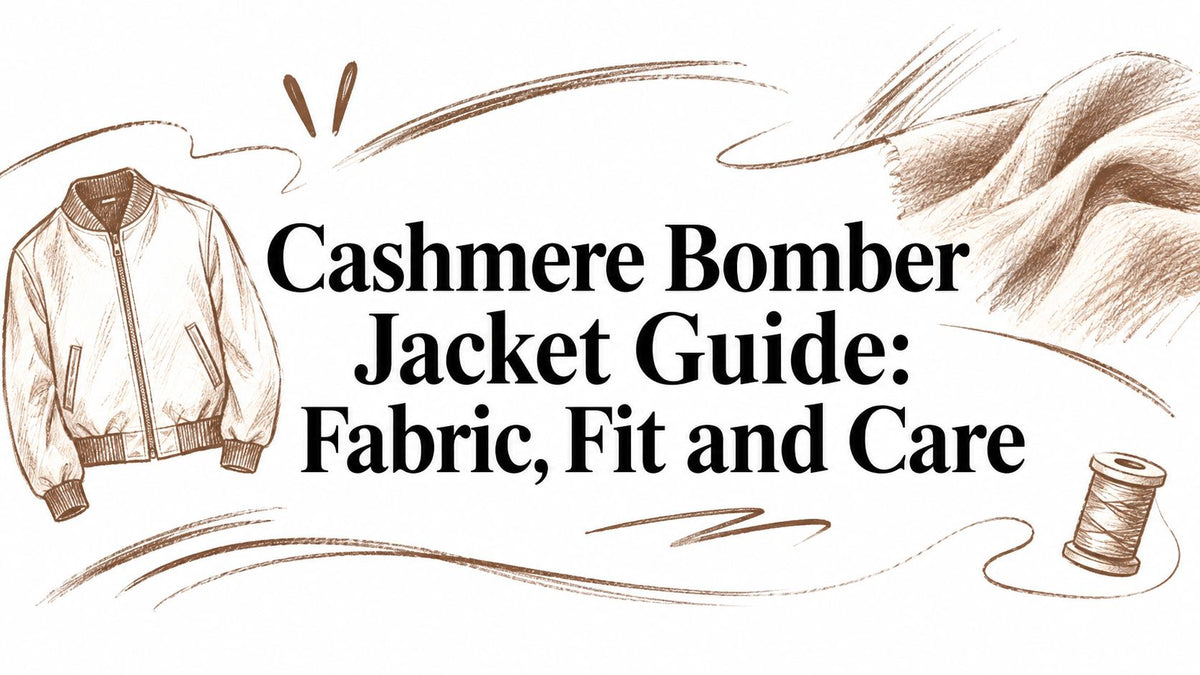
Cashmere Bomber Jacket Guide: Fabric, Fit and Care
You're standing in a store or staring at a product page, one hand on a cashmere bomber jacket that feels impossibly soft, the other hovering over a wool or nylon version that costs less and looks tougher. The label says cashmere, the price says think twice, and the question you need answered isn't how soft it is today. It's how it'll look after three months of commutes, bag straps, car seats and office chairs. Judge it by where you'll wear it and what will rub against it, and the choice gets much clearer.
Table of Contents
- Cashmere Bomber Jacket Versus Other Materials
- Fiber Grade and Origin to Check on the Label
- Fit, Silhouette and Layering Over Knitwear
- Styling Looks for a Cashmere Bomber
- Where a Cashmere Bomber Holds Up and Where It Doesn't
- How to Care for a Cashmere Bomber Without Pilling
- Confirm the Fit and Specs Before You Buy
Cashmere Bomber Jacket Versus Other Materials
Most shoppers compare bombers by look first and regret it later. Put five options on the same criteria and the differences stop being vague. You're really choosing between softness, abrasion resistance and care effort, because no material wins all three.
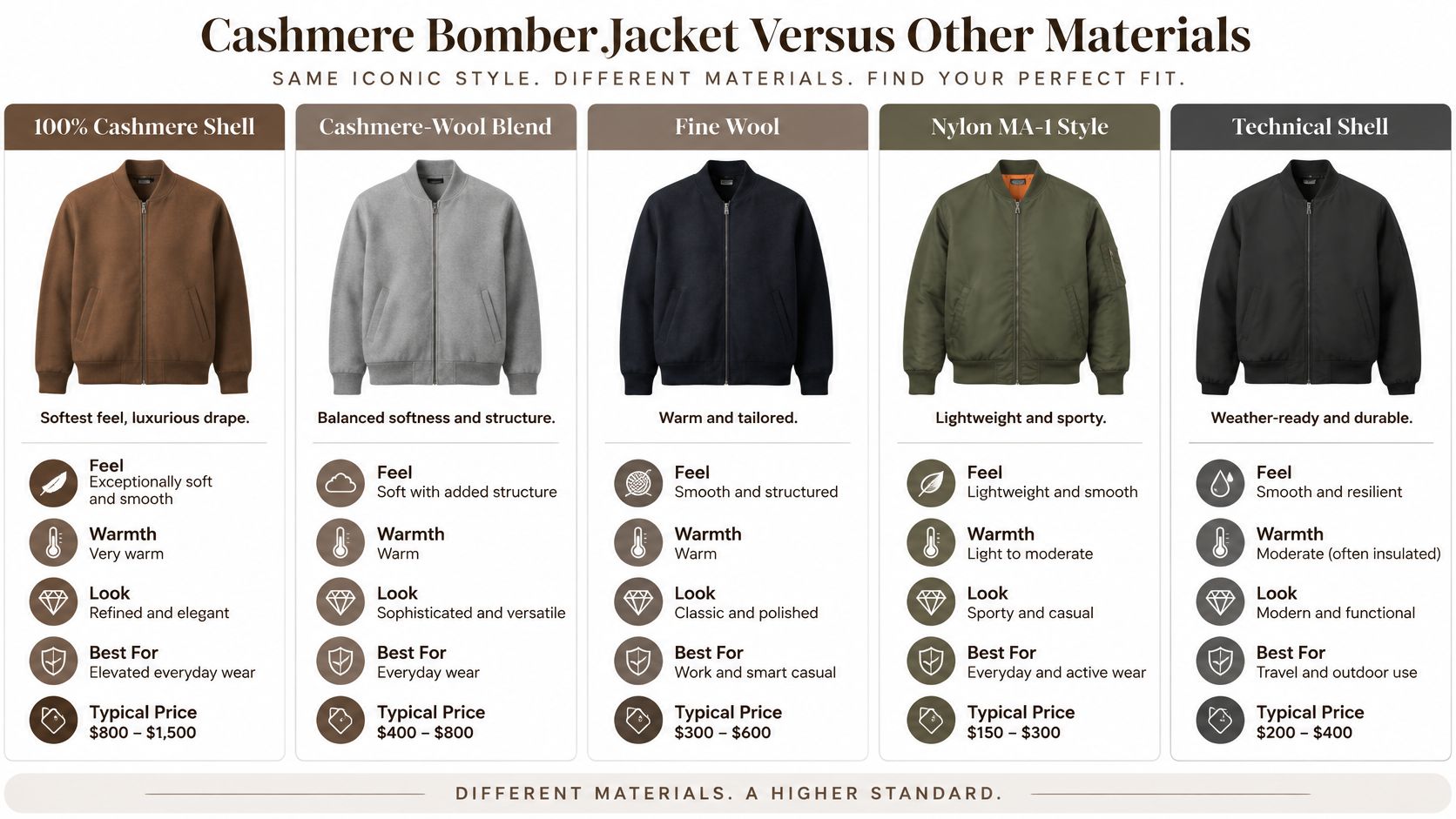
Bomber Jacket Materials Compared
| Material | Warmth for weight | Softness | Abrasion resistance | Care effort | Best use |
|---|---|---|---|---|---|
| 100% cashmere shell | High | Very high | Low to moderate | High, hand wash or dry clean | Office layering, travel, mild weather |
| Cashmere-wool blend | High | High | Moderate | Moderate | Everyday commuting and mixed weather |
| Fine wool | High | Moderate | Good | Moderate | Cold days with more movement |
| Nylon MA-1 style | Moderate | Low | High | Low, machine wash | Wet, rough or outdoor use |
| Technical shell with fleece lining | Moderate to high | Moderate | High | Low | Hiking, rain and active cold |
A pure cashmere shell feels lightest against a shirt and drapes without stiffness. A blend keeps much of that hand feel while wool adds structure, which is why it's often the better daily compromise. Fine wool looks more polished and tolerates friction better, nylon shrugs off rain and rough handling, and a technical shell is built for weather rather than polish.
The Trade-Off That Decides It
The CFDA fiber guide to cashmere describes cashmere as durable and shape-retaining, yet less resilient than fine wool, with pilling, shrinking and distortion possible from inappropriate care. That distinction matters more on a bomber than on a sweater. Ribbed cuffs, hems, seat contact, shoulder-bag straps and repeated zipper movement concentrate friction in small areas.
If you're weighing zip closures on casual layers more broadly, choosing a black hoodie zipper covers similar questions about hardware and daily wear. For a softer knit comparison under a jacket, the guide to an extra fine merino wool sweater helps you judge what to layer underneath without adding bulk.
Choose pure cashmere when the jacket will live in dry, low-friction settings. Choose a blend or technical shell when weather and abrasion dominate your week.
Can a cashmere bomber jacket replace a wool or technical jacket? For office layering, travel and mild weather, yes, comfortably. For wet, abrasive or heavily active use, no. Match the row in the table to your actual week, not to the outfit you imagine wearing twice a year.
Fiber Grade and Origin to Check on the Label
A bomber worn for occasional dinners has different fiber demands from one worn daily under a shoulder bag. Softness matters, but so do fiber length and how the jacket will be rubbed. Labels rarely list these details, so knowing what to ask can help separate useful specifications from vague claims.
Cashmere Fiber Origin and Diameter
| Origin | Typical fiber diameter | Fiber length | What it means for a bomber |
|---|---|---|---|
| China, including Inner Mongolia | About 14.5 to 16.5 microns | Not specified here | A finer range can feel soft against the neck and wrists |
| Mongolia | About 14.5 to 16.5 microns | Not specified here | The range overlaps with Chinese fiber; origin alone does not establish performance |
| Iran | About 17.5 to 19.5 microns | Not specified here | A coarser range may feel firmer against the skin |
| Afghanistan | Not specified here | Not specified here | The figures cited here do not establish a typical diameter |
The Food and Agriculture Organization cashmere overview estimates world cashmere production at approximately 5,000 tonnes in 1988, compared with about 1.8 million tonnes of wool, or roughly 0.28% of wool production by weight. Later estimates in the same source put global raw-cashmere production at approximately 4,500 tonnes. China accounted for roughly 60% of that raw-cashmere production, with Inner Mongolia contributing as much as 70% of China's share.
Those figures help explain why cashmere is scarce; the fiber-diameter ranges help explain how it may feel. The comparative study cited elsewhere in this article gives about 14.5 to 16.5 microns for Chinese and Mongolian fiber, and 17.5 to 19.5 microns for Iranian fiber. A finer fiber tends to bend more readily against skin, while a coarser one can feel firmer. Origin is a clue, not a guarantee of softness or wear performance.
Finer Is Softer, Not Automatically Better
A fine fiber can feel especially gentle at first touch, but softness alone does not tell you how a bomber will wear. The jacket's use matters: repeated rubbing from a bag strap or contact at the cuffs can stress the same areas, whatever the label says. Fiber length also affects how yarn behaves. Longer fibers stay anchored more securely, while shorter fibers can work loose and contribute to pilling.
If a seller cannot provide diameter or length, judge the jacket by its construction and intended use rather than assuming a soft hand means lasting performance. For secondhand garments, ScanFlip AI's tips for vintage resellers offers context for reading labels when details are incomplete.
A Label Checklist You Can Use
- Confirm the composition: Look for 100% pure cashmere or an exact blend percentage. Do not treat wording that suggests pure cashmere as proof if the listed composition includes other fibers.
- Look for a published diameter: Compare a stated figure with the ranges above, while recognizing that origin does not establish an exact measurement.
- Check origin claims carefully: Country of manufacture is not necessarily the same as fiber origin. Ask which refers to the cashmere itself.
Compare jackets using the same facts: composition, any stated diameter, and fiber origin. Then weigh those details against where the bomber will be worn and rubbed, rather than choosing by softness or label alone.
Fit, Silhouette and Layering Over Knitwear
A cashmere bomber jacket borrows its shape, not its fabric, from flight gear. The history in this guide to flight jackets and the MA-1 notes the MA-1 was developed in the 1950s for U.S. Air Force and Navy pilots and flight crews, made from high-quality nylon with polyester interlining rather than cashmere. Its compact waist length, knitted collar, cuffs and hem were functional aviation features that later became fashion codes.
That origin tells you what to inspect. The trim isn't decoration. The knit collar, cuffs and hem seal warmth, control the cropped silhouette and take constant stretching every time you put the jacket on or push up your sleeves.
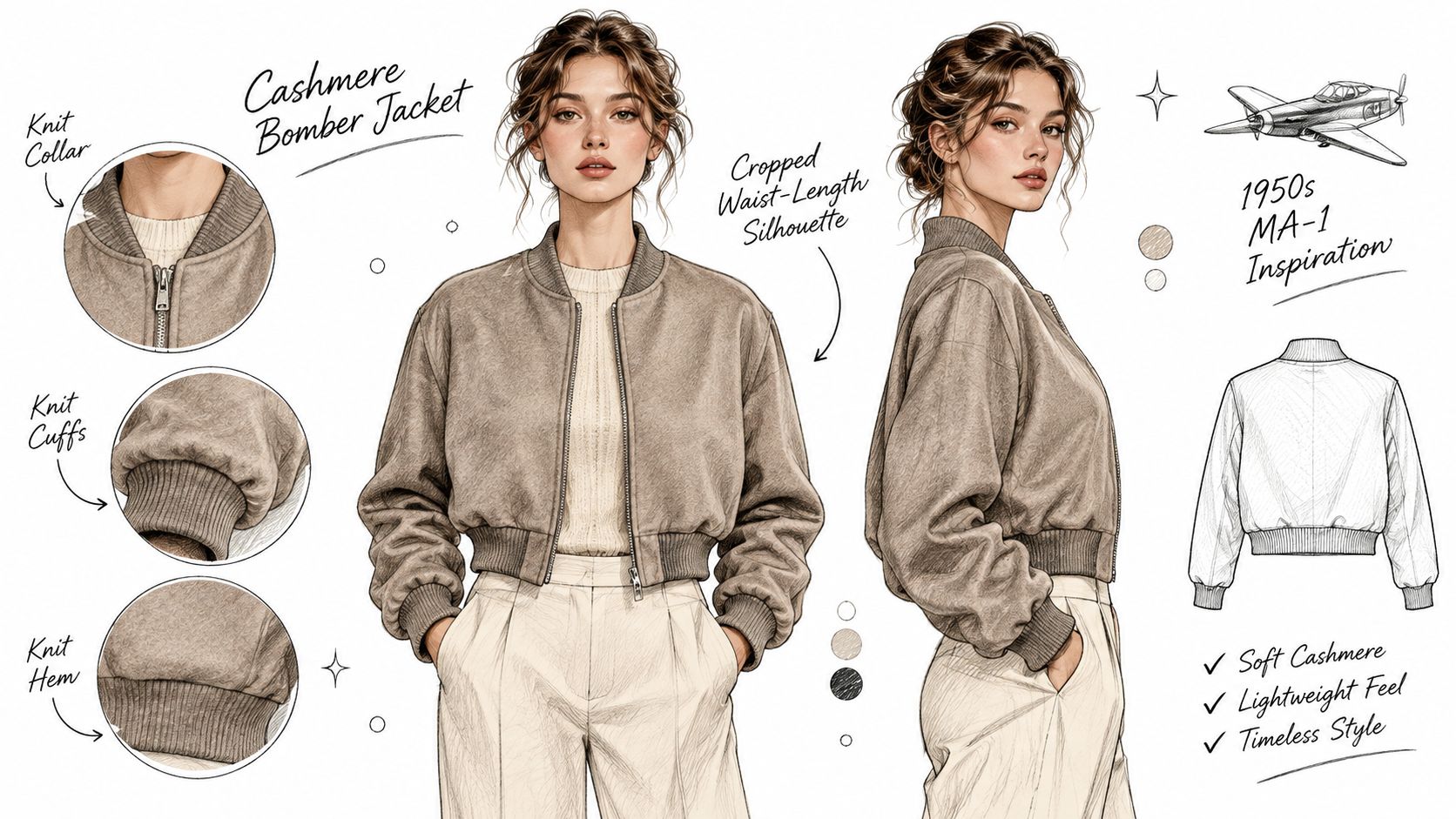
Run the Fitting Room Test in Order
Start at the top and work down, wearing the knit you plan to layer most often. Don't test a bomber over a thin tee if you'll wear it over a crew neck sweater four days a week.
- Check the shoulders: Seams should sit at your natural shoulder edge, not droop onto the upper arm or pull inward toward the neck.
- Check the sleeves: With arms relaxed, cuffs should reach the wrist bone. Bend your elbow. The cuff shouldn't ride halfway up your forearm.
- Check the body over knitwear: The shell should clear a fine-gauge sweater without pulling at the armholes or across the back.
- Check the hem: The cropped hem should sit at or just above your waistband line. Much longer and it stops reading as a bomber, much shorter and it rides up when you sit.
- Close the zip and move: Zip it without tension across the chest, then raise your arms, sit down and hug yourself. Pinching at the armhole now means distortion later.
Choose Lining by How You'll Wear It
An unlined pure cashmere bomber feels softest over knitwear and works well in dry weather, but the inside of the shell rubs directly against whatever you're wearing. A breathable partial lining suits commuting because it limits moisture buildup while reducing some internal friction. A full lining is warmest for standing outdoors, waiting on a platform or watching a game, but it traps more heat when you move indoors.
Practical rule: If you can't raise both arms comfortably while wearing your thickest planned layer, the size is wrong, no matter how neat it looks standing still.
A thin base layer helps more than expected. It cuts friction between shell and sweater, absorbs odor before the cashmere does, and lets the jacket glide instead of grabbing. Thick, chunky knits do the opposite. They stretch the armholes, push the shoulder line out of shape and make the cropped body look boxy.
Finish with the cuffs. They should feel snug enough to hold warmth at the wrist without cutting in or needing constant tugging. Loose cuffs on day one only get looser, and on a bomber they change the whole silhouette.
Styling Looks for a Cashmere Bomber
A cashmere shell reads softer than nylon, so it pairs best with pieces that share that relaxed polish. Technical trousers, chunky trail shoes and shiny sport layers fight the fabric. Relaxed-smart pieces let the jacket look intentional.
Four Looks Built From the Same Jacket
Office works with a fine-gauge crew neck in a matching or neutral tone, straight wool trousers and loafers. Close the zip to the collarbone so the knit collar frames the sweater cleanly. The effect is closer to a soft blazer alternative than to casual outerwear.
Weekend is simpler. Wear a plain cotton tee, straight dark jeans and white sneakers, and keep the cropped hem visible at the waist. Don't let a long tee hang far below the hem, because that breaks the bomber proportion that makes the outfit work.
For smart casual, put an open-collar shirt under the jacket with chinos and a suede boot. Leave the zip partly open so the shirt collar and knit collar sit together without competing. This is also where a navy bomber jacket earns its place, because navy handles both denim and grey or stone trousers without looking stark.
Travel calls for the jacket over a thin knit with a lightweight scarf and dark denim. It layers easily on a plane, doesn't look creased as quickly as a structured coat when you fold it over your arm, and works when cabin temperatures swing. Keep the scarf smooth rather than heavily textured to reduce rubbing at the neck.
Color and Proportion
Camel, navy, charcoal and oatmeal are the most versatile bases because they sit comfortably with black, grey, denim and brown footwear. Bright colors and bold patterns can work, but treat them as a single statement and keep everything else quiet. A patterned cashmere bomber jacket over a patterned shirt rarely looks relaxed.
Avoid stacking bulky knits underneath to chase warmth. You'll distort the shoulders and lose the clean, cropped line, and a finer layer plus a scarf usually feels warmer anyway because the cuffs and hem can still seal properly. Match trousers and shoes to the jacket's formality, and the softness looks deliberate rather than underdressed.
Where a Cashmere Bomber Holds Up and Where It Doesn't
A cashmere bomber can feel exceptionally soft and still wear poorly under a daily bag strap. Judge it by how it will be worn and abraded, not by softness or a label alone. It is a friction-sensitive outer layer: a good choice for light use, but a poor stand-in for technical outerwear.
A comparative study of cashmere and wool hand-knitted fabrics notes that finer Chinese and Mongolian fibers feel softer next to the skin, while coarser Iranian fibers feel firmer. The study also finds that finer fibers generally provide less structural strength than coarser wool fibers, and that cashmere has lower water-vapor permeability than wool in comparative hand-knitted-fabric testing.
That trade-off affects comfort as well as wear. A dense, heavily milled bomber can retain warmth, yet feel less breathable on a brisk walk or crowded train. You may arrive warm but slightly damp inside the shell, which can leave the jacket uncomfortable.
Cashmere Bomber Performance by Use Case
| Use case | Expected performance | Main wear risk | Practical fix |
|---|---|---|---|
| Office layering over a shirt | Good | Light pilling at sleeve cuffs | Rotate with another jacket and brush gently |
| Commuting with a bag strap | Fair | Shoulder and strap rubbing | Use a smooth strap and avoid rough layers underneath |
| Driving | Fair | Seat contact and hem wear | Choose a denser shell with a reinforced hem |
| Travel | Good | Creasing and crushing | Fold loosely and hang or steam lightly |
| Wet or windy outdoor use | Poor | Moisture retention and abrasion | Wear a waterproof shell over it or choose technical outerwear |
Start by checking the high-contact areas. Ribbed cuffs, waistband, pocket openings and sleeve seams face repeated rubbing as you grip, stretch and move through the day. Stable construction or reinforcement at those points can matter more than a broad grade claim on a swing tag.
Judge the Whole Construction, Not the Micron Count
For commuting or indoor-to-outdoor wear, a breathable partial lining and moderate-weight knit can limit moisture buildup while retaining warmth. For cold, stationary use, such as waiting at a station or sitting outdoors, a denser shell provides more insulation but less ventilation. The right trade-off depends on the wear pattern.
For example, a daily walk with a crossbody bag puts repeated pressure on the shoulder and strap area. A very fine, unlined, loosely knitted shell is more vulnerable there, even if it feels exceptionally soft. A slightly firmer blend, smooth strap and thin layer underneath better match that kind of use.
A cashmere bomber works as a luxury mid-layer and does not replace a technical jacket in wet or abrasive conditions.
How to Care for a Cashmere Bomber Without Pilling
Most pilling panic starts with a care mistake, not a defective jacket. Heat, agitation and aggressive pill removal do more damage than ordinary wear. Work gently and in order, and you'll keep the surface smoother for longer.
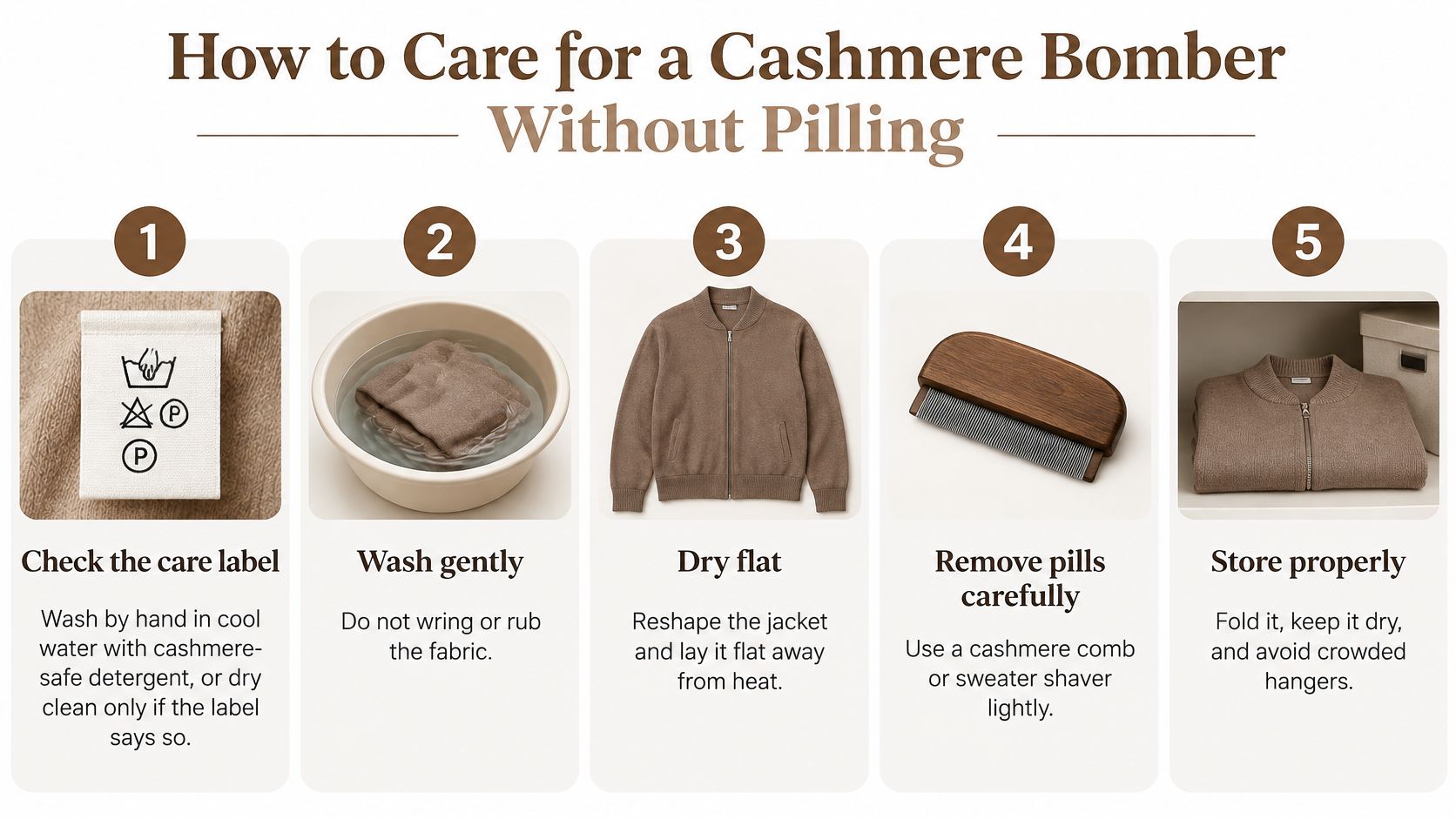
The Care Routine Step by Step
- Check the care label first: Wash by hand in cool water with a cashmere-safe detergent, or dry clean only if the label says so. Heat and agitation cause felting and shrinkage, and the common slip is using a regular wool cycle because it sounds gentle enough.
- Press water out, never wring: Lift the jacket supported in both hands and press gently against the basin. Twisting distorts the knit, stretches the zip line and pulls cuffs out of shape.
- Dry flat and reshape by hand: Lay it on a clean towel and smooth the collar, cuffs and hem back to their natural lines. Hanging a wet cashmere bomber jacket lets its own water weight drag the shoulders down.
- Keep it away from direct heat: Dry away from radiators and direct sun, because heat shrinks and stiffens fibers. If you use a professional service, delivery advice from Approved Lux Personal Assistant is worth reading before you hand over a delicate knit for collection.
- Brush early pilling, don't shave hard: Use a soft cashmere brush in one direction on cuffs, pockets and sleeves where pills start. Aggressive shaving can cut sound fibers and thin the surface you're trying to save.
- Store folded or properly supported: Fold it for longer storage or use a wide padded hanger for short periods. A thin wire hanger stretches shoulders and leaves points that are hard to steam out.
The same gentle approach applies to layering pieces such as a pullover cashmere sweater, which often pills first where a jacket rubs it. Caring for both garments together reduces friction damage on each.
Build a simple rhythm around wear. Rotate the jacket with another layer so it rests between outings, air it after each wear instead of washing it, and brush it after a heavy-use week before small pills mat together. Rest is care, even though it doesn't feel like doing anything.
Confirm the Fit and Specs Before You Buy
Don't order on softness and a size letter. Pick one target style and run it through a checklist that covers fiber, measurements, construction, lining, care and returns. If a listing can't answer most of these points, you're buying a guess.
A Six Point Buying Checklist
- Fiber: Confirm 100 percent pure cashmere or the stated blend percentage, and check whether a fiber diameter is published. Reject any listing that implies pure cashmere while listing a blend.
- Fit: Measure your chest, sleeve length and preferred body length over a fine knit, then check those numbers against the seller's size chart before choosing a size.
- Construction: Inspect photographs or descriptions of the ribbed cuffs, waistband, pocket openings and sleeve seams for reinforcement, and check hem length against your waistband.
- Lining: Note whether the jacket is unlined, partly lined or fully lined, and match that choice to commuting, travel or stationary outdoor use.
- Care: Read the care instructions and confirm whether hand washing is allowed or dry cleaning is required, then decide if you'll follow them.
- Returns: Confirm the return policy and exchange window before you order, especially when you're between sizes or unsure about sleeve length.
Price needs the same plain reading as fiber content. For example, our Men's Pure Cashmere Zip Cardigan Jacket is on sale for $159.00 USD, down from a regular price of $319.00 USD, with 4 colors available, while our Men's Cashmere Jacket is on sale for $399.00 USD, down from a regular price of $699.00 USD. Those figures only help if the construction and fit suit your use case, so run the checklist before you compare discounts.
Pay closest attention to what's missing. A listing that leaves diameter, blend percentage and construction unstated while leaning on words like luxury is asking you to fill gaps with hope. Choose the cashmere bomber jacket that answers your questions clearly, fits over the knitwear you own and matches the friction level of your real week.
Browse sweaters, zip jackets, coats, scarves and throws at Cashmere Boutique and use the fiber, fit and lining checks above on every style you shortlist. Pick one target piece, compare its published specs against your measurements and commute, and order only when the answers line up.