
Women's Cashmere Cardigan with Pockets: A Buying Guide
Most buying advice for a women's cashmere cardigan with pockets tells you to feel the fabric, look for a Grade-A label, and count the pockets. That advice gets you a soft cardigan. It doesn't get you one that still hangs straight after two winters of carrying a phone in the left pocket.
The pocket is where a cardigan's engineering shows itself. A pocket mouth takes repeated friction, a loaded pocket pulls on the front panel, and a shallow pocket sags at the hem. None of that appears in a softness rating or a grade stamp, and most product pages skip it, listing "pockets" as a feature without a single measurement.
What follows is the order a knitwear buyer works in. Screen the listing in two minutes, read the fiber number properly, match the pocket build to what you carry, then decide what a premium price is buying.
Table of Contents
- How to Judge a Pocketed Cashmere Cardigan at a Glance
- Fiber Fineness, Softness and the Micron Range
- Pocket Designs Compared for Real Carry Loads
- Pilling, Wear Zones and Care That Protects the Knit
- Fit, Layering and Styling With Pockets
- What Scarcity and Longevity Mean for Price
- Choose the Pocketed Cardigan That Fits Your Routine
How to Judge a Pocketed Cashmere Cardigan at a Glance
Two minutes on a product page tells you most of what matters, if you know which lines to read. Run this table before you read a single review.
Buying criteria at a glance
| Signal | Stronger version | Weaker version | Why it matters |
|---|---|---|---|
| Fiber diameter | Stated micron figure, around 14 to 16.5 microns | 'Grade-A' with no number | Sets the softness baseline against the skin |
| Knit construction | Fine-gauge knitted cardigan | Woven or unspecified construction | Knit flexibility drives drape and comfort |
| Staple length | Stated and 7.5 mm or longer | Not stated | Shorter fibers contribute to pilling |
| Care instructions | Specific wash and dry guidance on the label | Generic or missing care | Controls shrinkage and fuzzing over time |
| Measurements | Garment measurements such as chest and length | Size chart only | Shows how the cardigan fits when pockets are loaded |
Fiber diameter comes first because everything else is easier to judge once you know how fine the yarn is. A Grade-A stamp with no number beside it tells you nothing you can compare across two listings. A stated figure, even a middling one, at least gives you a reference point.
Knit construction is the row shoppers skip and later regret. A fine-gauge knitted cardigan moves with you, drapes over a dress and gives slightly where a pocket pulls. A woven or vaguely described garment behaves like a different product, and no amount of softness will fix a front panel that refuses to lie flat.
Staple length, when the seller states it, predicts how the surface will age more reliably than any softness claim. Care instructions and garment measurements complete the scan: the first tells you whether the knit survives your laundry routine, the second tells you where the hem will sit once a phone is in the pocket.
How to use the weaker columns: treat each one as a question for the seller, not a reason to walk away.
A cardigan can score well on all five rows and still have a shallow pocket that sags under a phone, which is why the pocket itself deserves a separate test. This table screens listings. It doesn't grade garments.
Fiber Fineness, Softness and the Micron Range
A micron is one thousandth of a millimetre, and it measures the width of a single fiber. Smaller numbers bend more easily against skin, which is why that number predicts softness better than the word luxury ever will. It's also the one figure a careful seller publishes, because it can be tested by anyone with the right instrument.
A peer-reviewed study of cashmere goat fiber reports that processed cashmere should generally stay below 19 microns, with a 14 to 19 micron average considered appropriate for textile use. The same study notes that fibers above 16.5 microns are commonly used in woven fabrics or blended with wool, while Chinese cashmere below 16.5 microns is associated with high-quality luxury knitwear. Its samples from Southwest China averaged between 15.76 and 16.27 microns. A further comparison in the same source describes top-quality cashmere for knitted garments at roughly 14 to 15 microns, against about 17 to 18 microns for lower-grade material used in weaving (the peer-reviewed study of cashmere goat fiber).
Why does diameter matter more for a knitted cardigan than for a coat? Knitwear depends on fine, flexible fibers to create soft hand, smooth drape and a layering weight that doesn't bulge under a jacket. A pocket adds load to that structure, so the yarn needs enough fineness to feel good against the body and enough body to hold its shape.
Micron range and what it means for a cardigan
| Micron range | Typical use | Feel against skin | Trade-off |
|---|---|---|---|
| Below 14 microns | Super-fine premium knitwear | Very soft and light | Least resistant to abrasion at pocket corners |
| 14 to 15 microns | Top-quality knitted cardigans | Soft hand and smooth drape | Wear is set by knit density and construction |
| 15 to 16.5 microns | High-quality luxury knitwear | Balanced softness and wear | Good middle ground for daily pocket use |
| 16.5 to 19 microns | Woven fabrics or wool blends | Firmer, less soft | Often more robust but less luxurious |
| Above 19 microns | Outside the range for processed cashmere | Can feel coarse | Not a typical choice for a fine cardigan |
Placing a stated figure in three steps
- Find the number. Look in the specifications tab rather than the marketing copy. If the page says Grade-A and no micron figure appears anywhere, ask the seller directly before ordering.
- Place it in the band. A stated 15.5 microns sits in the high-quality knitwear range. A stated 17 microns sits where weaving and blending usually live, which doesn't make it bad, only different.
- Check that construction matches the promise. Fine yarn knitted loose won't behave like the same yarn knitted dense. Ask about knit density or garment weight if the page stays quiet.
What the number cannot tell you: fiber diameter says nothing about durability, animal welfare, traceability or how well the cardigan was sewn. It's one input, and a useful one, but it isn't a verdict.
That's where a broader screening method earns its place. Our guide to choosing a high-quality cashmere sweater walks through the fiber, construction and finishing checks that sit alongside diameter, so the figure gets context instead of carrying the whole decision.
Pocket Designs Compared for Real Carry Loads
"Has pockets" is the least useful sentence on a product page. What you need to know is whether the pocket holds a phone without dragging the hem sideways, and whether the opening is reinforced where your hand goes in and out fifty times a day.
Demand for working pockets isn't a niche preference. A survey of female students found that 58.3% wanted more pockets in their clothing, while only 41.7% owned a dress with pockets (the study on pocket function in women's clothing). Read those two figures together and the gap is plain: women want pockets that do something, and often don't own garments that provide them.
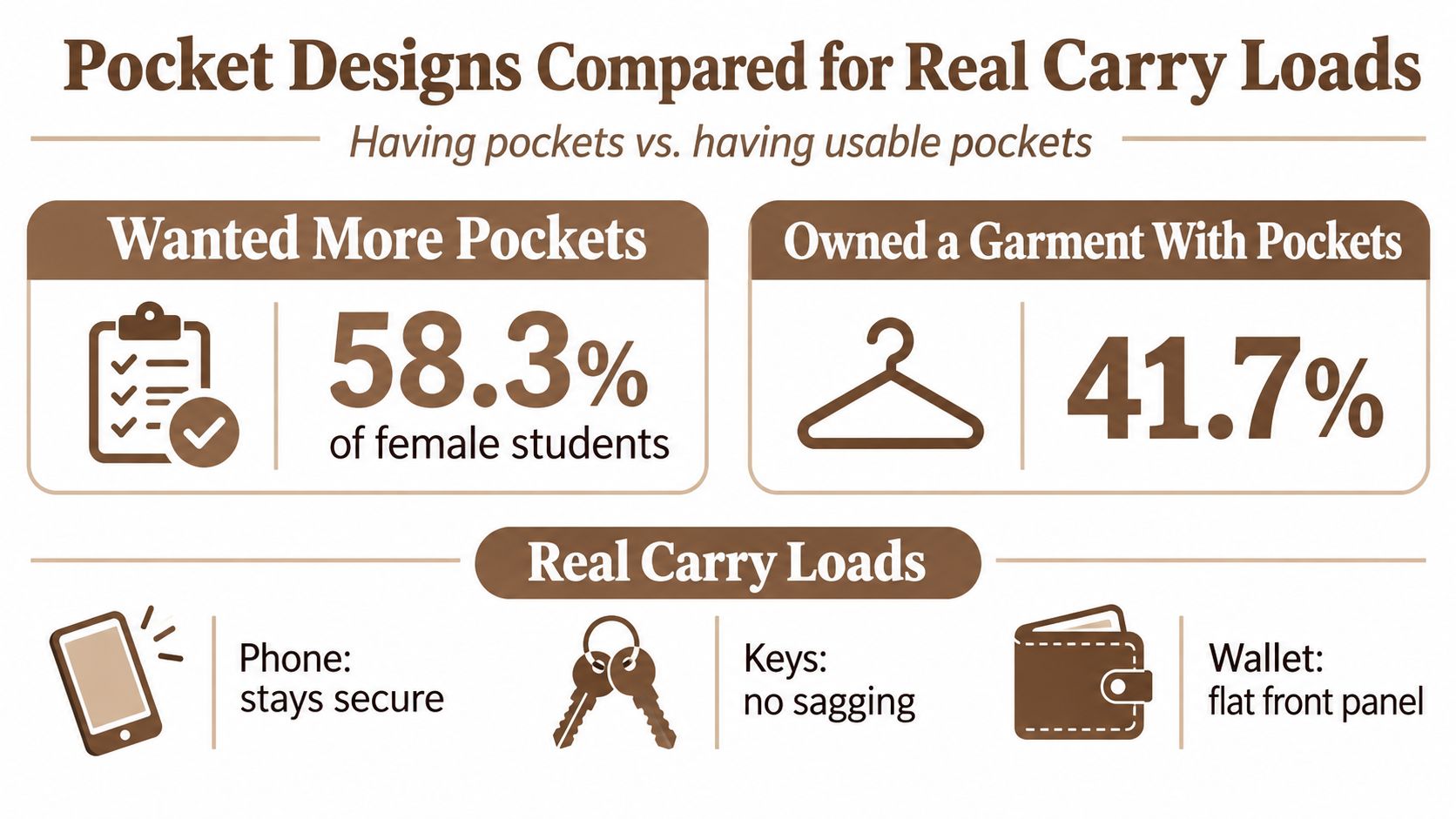
The questions that decide the purchase rarely appear on the page: how deep is the pocket, does it sag when loaded, is it sewn into a side seam or applied as a patch, and does the opening have any reinforcement at the corners?
Four pocket builds and the loads they carry
| Pocket design | Realistic load | Effect on drape | Best use |
|---|---|---|---|
| Side-seam slash pocket | Phone and hand warmth | Can pull the front down when loaded if unsupported | Commuting and errands |
| Patch pocket | Phone or card | Keeps a structured, visible shape | Office days and layering |
| Inside pocket | Small items such as a passport or card | Keeps the front clean and smooth | Travel and fitted silhouettes |
| Zip pocket | Keys, card or cash | Secure, but can add stiffness | Travel and crowded settings |
Bigger isn't automatically better. An oversized or poorly supported pocket adds bulk to fine knitwear, stretches the front panel and makes a fitted cardigan hang unevenly. A neat inside pocket usually beats a deep patch pocket on a slim silhouette, and a zip pocket earns its stiffness when you're standing in a crowd with your phone in it.
Matching the load to the design
- List what you carry. Phone, keys, a card, a passport. Be honest about the phone, since it's the heaviest single item to pocket.
- Match that load to a build. Keys want a zip. A passport wants an inside pocket. A phone wants a supported opening with a stated depth.
- Check measurements before you order. Compare the stated pocket opening and depth in centimetres with the items themselves. Take a phone measuring roughly 15 cm by 7 cm: a pocket shallower than that lets the top of the phone stand above the opening and pull the hem down.
The test that beats a photograph: put the phone or passport in the pocket while standing, then sit down. If the front pulls down or the shoulders drag, the pocket is carrying weight the garment wasn't built for.
Pocket capacity and silhouette retention always cost each other, so the useful decision is which one your day requires more.
Pilling, Wear Zones and Care That Protects the Knit
Pilling isn't a softness problem. It's a friction problem, plus loose fiber ends and the way the yarn was engineered. A 2023 study on cashmere knitted fabric found that a modified chitosan and siloxane treatment reduced directional friction and weakened the tendency of surface fuzz to tangle, with treated fabric reaching pilling grade 4 while keeping a soft hand and good launderability (the 2023 study on cashmere knitted fabric).
What that work shows is that friction can be engineered down. What it doesn't show is that your cardigan has been through that treatment. Assume it hasn't unless the seller says so, and treat the high-friction points as separate wear zones.
Where a pocketed cardigan wears first
- Pocket mouths and corners: repeated hand entry abrades the same few square centimetres, and a loaded pocket keeps tension on the opening all day.
- Side seams: the seam absorbs the load a slash pocket transfers to the body panel.
- Cuffs and underarms: sleeve ends rub on desk edges, and the underarm rubs against the body with every arm movement.
- Contact points: a shoulder bag strap or a seat belt works the same patch of knit for hours on end.
A care routine that protects the surface
- Turn the cardigan inside out. Abrasion during washing then lands on the inner face, not the surface you see.
- Wash it in a mesh bag. The bag stops the knit catching on zips, buttons or the drum.
- Choose a gentle, low-agitation cycle, only if the care label permits. Heat and agitation are what push loose fibers to the surface.
- Dry it flat, without twisting or hanging. A wet knit on a hanger dries out of shape, and our method for drying sweaters flat keeps the shoulders and hem where they started.
- Keep heat away. Cashmere fibers carry surface scales that can shrink and mat under heat, so skip the dryer and the hot radiator.
- Lighten the pocket load. Keys and a full wallet in a soft pocket stretch the knit and accelerate fuzzing around the opening.
A product page that pairs fiber data with care instructions and construction detail is doing the work. One that implies a micron count alone guarantees a pill-free surface is selling a number, not a garment.
Fit, Layering and Styling With Pockets
A pocket is a shelf. It only holds weight if the wall behind it is built to carry it, and on a cardigan the wall is the front panel, the shoulder seam and the knit density all at once. Get those right and a loaded pocket disappears into the design. Get them wrong and every phone becomes a visible tug at the hem.
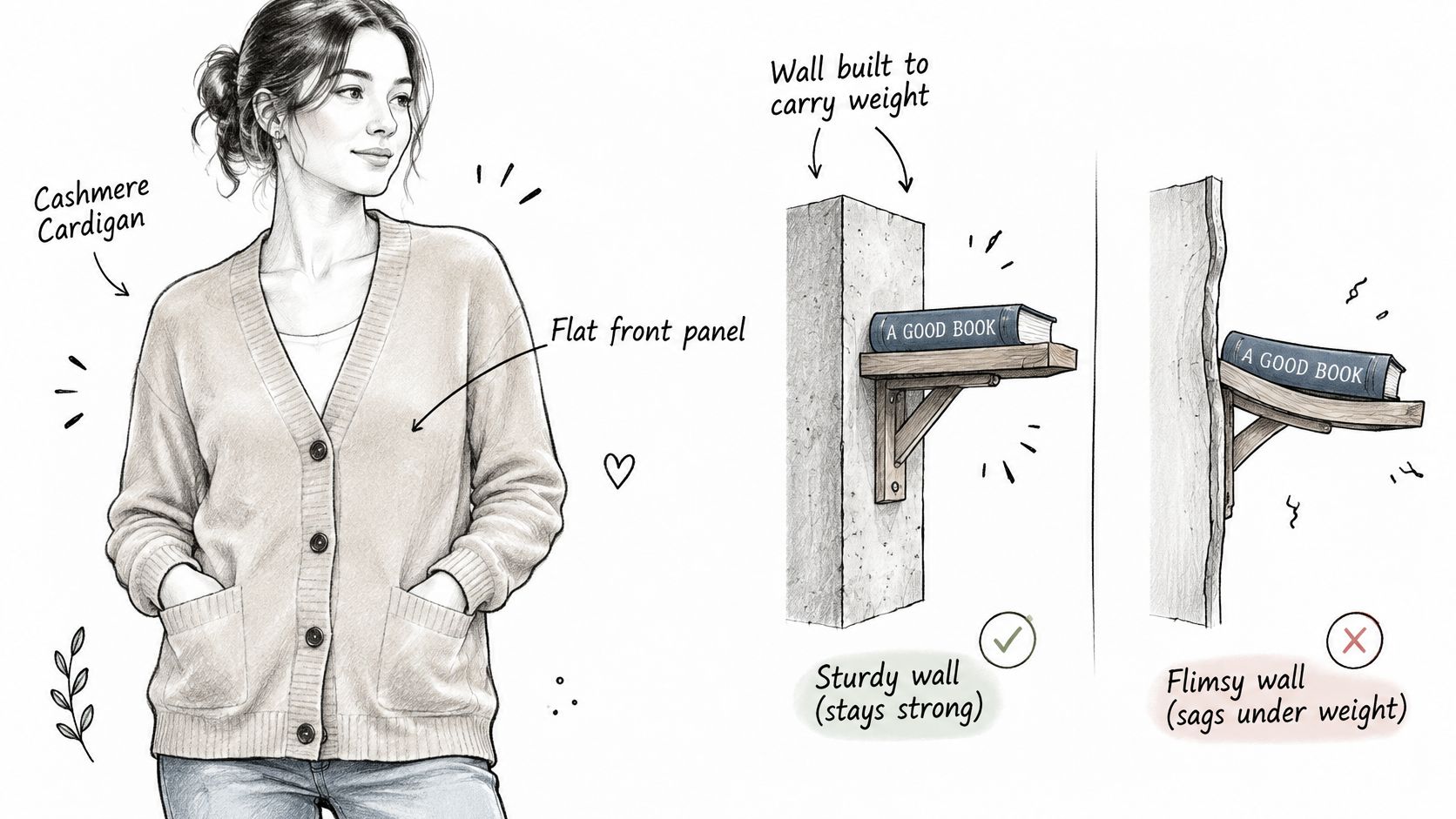
Three fit points that decide whether pockets work
Shoulder seam. It should sit at the edge of your shoulder, not below it. A dropped seam looks relaxed but sends pocket weight outward, which drags the front panel with it.
Sleeve length. Check it with your arms bent. A sleeve that only reaches the wrist when your arms hang straight will ride up every time you take a steering wheel or a phone.
Body length. A hem at or just below the hip keeps pockets reachable without you hunching to get a hand inside. Cropped cardigans with pockets look tidy but demand a shorter reach than many expect.
Open-front and button-front styles do different jobs. An open front shows the pocket, layers easily over a dress and lets the panel fall where it wants, which hides a light load well. A button front gives a neater line for the office and holds the panel steadier, but the buttons pull if the pocket is overloaded.
Three days, three loads
An office day with a laptop bag puts a strap across one shoulder all morning, so a patch pocket holding a phone keeps its shape visible and stops the phone pressing into your hip.
A weekend walk with keys in a side-seam pocket works fine for a short errand and less well for two hours, because a bunch of keys concentrates weight in a small area.
A travel day with a passport in an inside pocket keeps the front clean, nothing swings, and the passport sits against the body rather than pulling the hem sideways.
The thirty-second fit check
- Put both hands in the pockets and sit down. The front panel should stay roughly flat and the hem shouldn't lift.
- Raise your arms overhead. If the shoulders drag or the pocket mouths gape, the armhole or the body length is wrong for you.
- Load the pocket with what you'd really carry, then look at the silhouette from the side rather than the front. That's the view everyone else gets.
Layering is where a pocketed cardigan earns its place in a wardrobe. One layer over a dress in autumn, under a coat in winter, with the pockets doing the job a bag would otherwise do. If you're working with a shorter frame, our notes on choosing a cashmere cardigan for petite builds cover where the hem and the pocket opening should land.
What Scarcity and Longevity Mean for Price
Cashmere costs what it costs because there is very little of it. The Food and Agriculture Organization estimated world cashmere production at approximately 5,000 tonnes in 1988, against about 1.8 million tonnes of wool, which put cashmere output at around 0.28% of wool production by weight. China supplied roughly 60% of global raw cashmere, Inner Mongolia produced up to 70% of China's share, and Mongolia contributed an estimated 20 to 25% (the FAO assessment of cashmere and other animal fibers).
Those are historical estimates rather than today's market total, and production methods have changed since. Their value now is as a benchmark: the fiber in a women's cashmere cardigan with pockets has always come from a handful of regions in small quantities, which is why origin and traceability claims deserve checking rather than skimming.
Scarcity explains a price. It doesn't justify one on its own.
What longevity actually depends on
Fiber length matters as much as fiber diameter. Research on cashmere identifies fibers shorter than 7.5 mm as a significant contributor to pilling, with fiber friction and finishing treatments adding to the effect, which means a micron figure alone cannot predict how a cardigan will wear (research connecting fiber length, friction and pilling).
Ask the seller for fiber length where it's available, yarn construction, knit density, any abrasion or pilling test results, care requirements and repair options. Ask about recycled or traceable content too. Natural and biodegradable describe the fiber, not the grazing, the processing or the garment's working life.
The cost-per-wear sum worth doing before you buy: a cardigan worn sixty times a season for five seasons spreads its price across three hundred wears. That arithmetic only holds if the cardigan is still wearable in season five.
A premium cardigan beats a cheap replacement only when the durability answers come back well. If nobody can tell you the fiber length or the pocket depth, the higher price is buying a story. Sellers who want to prove the difference can skip the studio, because Picjam's AI fashion photography tool generates on-model images with a phone or a passport loaded in the pocket, which is the view shoppers are looking for.
Choose the Pocketed Cardigan That Fits Your Routine
Start with your day, not with the catalogue. A commuter who carries a phone from morning to evening needs a patch or side-seam pocket with a stated depth and a supported opening. A traveller who carries a passport needs an inside pocket that keeps the front flat. An office worker who layers needs a structured front, buttoned or open, that holds its line under a jacket.
Then test the listing against the criteria you now have. Two styles from our own collection show how that works in practice. The open-front 100% cashmere cardigan sweater is priced at $169, reduced from $329, and its open front is the easier shape for a patch pocket because the panel falls free. The women's cashmere round neck cardigan is on sale at $129, regular $259, in seven colors, a buttoned shape that holds the front steadier when a pocket carries weight.
Neither price is a verdict. Before you buy any cardigan, check the micron figure or the knit construction, the pocket depth and any reinforcement in centimetres, the care label, and garment measurements rather than a size chart alone. Then match the pocket design to the load you'll really put in it.
The listing earns the purchase when those answers come back right. Not before.
Cashmere Boutique has sold cashmere directly to customers since 1999, with Grade-A fibers specified at approximately 14 to 15.5 microns and the supporting detail a careful buyer wants, from size and color charts to care guidance, published alongside each product. If you're choosing a cardigan you'll wear with your hands in your pockets, compare our women's cardigan shapes against the loads you carry and read the measurements before you commit. Visit Cashmere Boutique to see the current collection and find the one that suits your day.