
What Is Two Ply Cashmere: Warmth, Softness and Durability
Two-ply cashmere is yarn made by twisting two separately spun cashmere strands together, and ply describes construction, not grade, warmth or fiber quality. If that's all the label tells you, how much do you really know about the sweater you're buying?
Not enough to judge how soft it will feel, whether it suits your climate, or how it will look after regular wear. Ply is useful information, but it's only one part of the specification. Learning to separate yarn construction from fiber quality and knitting makes cashmere much easier to compare.
Table of Contents
- Two-Ply Cashmere Explained in Plain Terms
- How Ply Count Changes Weight and Feel
- How Two Strands Shape Warmth, Softness and Durability
- Reading Two-Ply Labels Without Being Misled
- Caring for Two-Ply Cashmere to Limit Pilling and Shrinkage
- Confirm the Ply Before You Buy
Two-Ply Cashmere Explained in Plain Terms
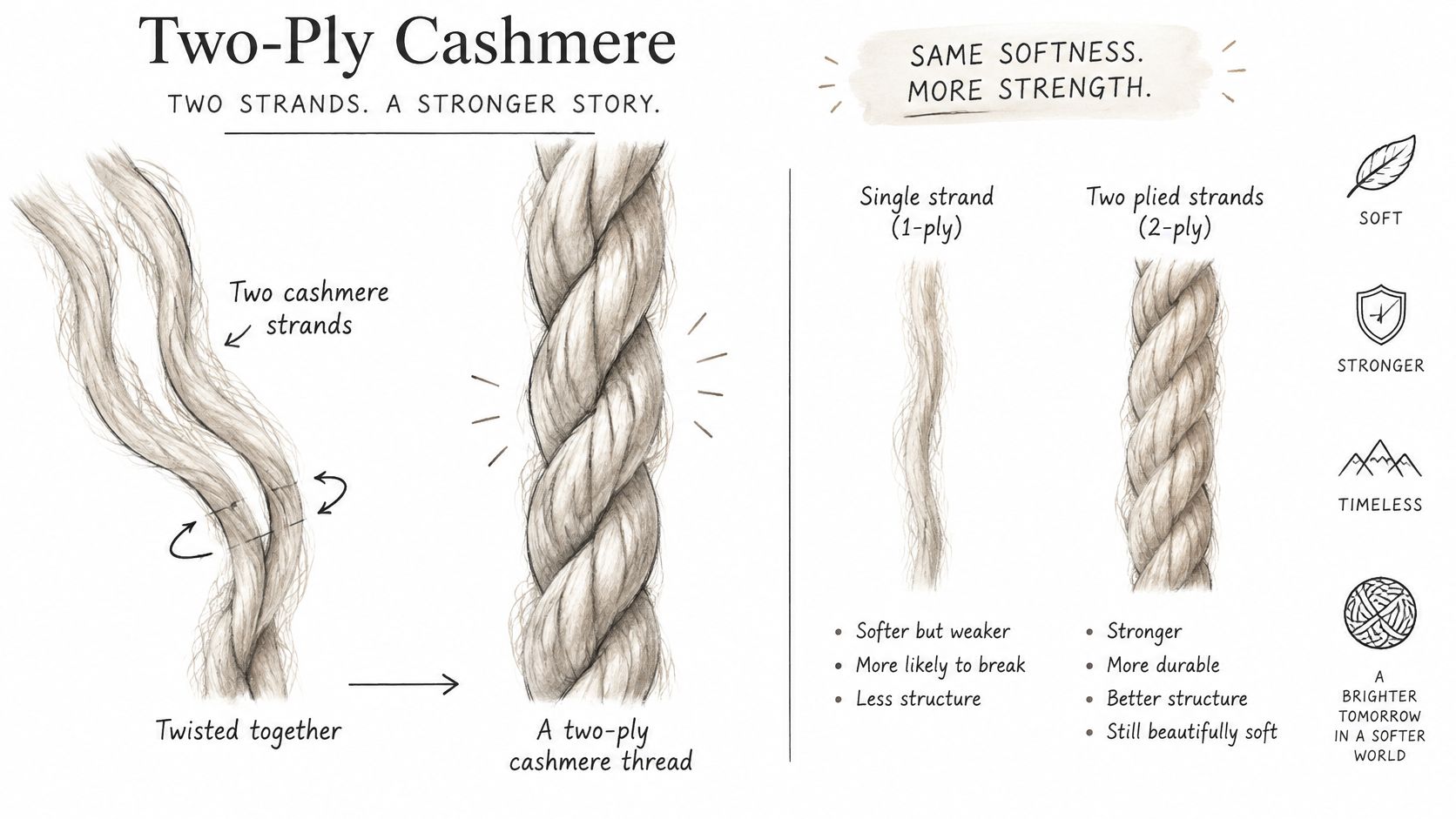
Two-ply cashmere combines separately spun strands into a single knitting yarn. Think of a sewing thread beside a small twisted cord: the cord has more structure because its component threads work together.
Each starting strand already contains many individual cashmere fibers. Those fibers are spun into a continuous length, then the spinner twists the strands together. The resulting yarn is what the knitter uses to form the garment's loops.
What the label actually describes
Say you're examining a cardigan labeled two-ply cashmere. That description concerns the yarn inside each knitted stitch. It doesn't mean the cardigan has an inner and outer layer, and it doesn't tell you whether the yarn contains another fiber.
Cashmere itself comes from the goat's fine, downy undercoat. DiscoverFashions' cashmere guide describes two-ply as two strands twisted together and reports cashmere fiber diameters of 14–19 microns. Fiber diameter is a separate measurement from the number of strands used to build the yarn.
Read the product description as separate pieces of information:
- Ply: How the knitting yarn is assembled.
- Composition: Whether the garment is pure cashmere or a blend.
- Fiber diameter: How fine the fibers are, if the seller publishes a measurement.
A blend can have a plied construction just as pure cashmere can. Likewise, a substantial-looking yarn can contain fibers that don't feel especially fine against your neck.
Practical rule: Treat ply as a construction detail, not a shortcut for judging the whole garment.
When someone asks, “What is two ply cashmere?”, the most useful answer separates the yarn's architecture from the material inside it. You need both pieces of information to make a sensible purchase.
How Ply Count Changes Weight and Feel
| Ply | How the yarn is built | Typical weight and feel | Common garments | Durability note |
|---|---|---|---|---|
| Single-ply | One spun strand | Lightest, most delicate feel in a comparable yarn range | Fine lightweight knits | Fiber length and spinning quality govern wear |
| Two-ply | Two spun strands twisted together | Balanced weight, stable knit | Sweaters, cardigans, scarves, hats | Stable structure; fiber length still affects pilling |
| Three-ply | Three spun strands twisted together | Fuller and warmer with comparable starting strands | Shawls, wraps, robes | Fiber length and spin matter; ply alone doesn't predict pilling |
| Four-ply | Four spun strands twisted together | Densest and heaviest with comparable starting strands | Overcoats, blankets | More material isn't a guarantee against surface wear |
Read this comparison within a similar yarn range, not as an absolute ranking of every cashmere garment. A spinner can start with very fine singles or much thicker ones, so the finished yarn's size matters alongside its construction.
Single-ply suits an airy, delicate effect when the maker wants little bulk. The balanced option offers more yarn structure without necessarily creating a heavy garment. Fuller constructions can provide the body you want in a wrap, robe, or substantial outer layer.
Gauge changes the comparison
Gauge describes how closely the knitting is arranged. In finished fabric, you can assess it through the number of stitches over a measured distance; retailers may instead list the knitting machine's gauge. Knit density also reflects yarn thickness, stitch pattern, and knitting tension.
A fine-gauge sweater can sit neatly beneath a jacket. A more open, chunky knit may look thicker but allow more air through its spaces. Neither appearance alone tells you how much material the maker used.
Invested Luxury's cashmere guide reports premium cashmere fibers at approximately 14–15.5 microns and describes two-ply as standard for mid-range and higher-priced garments. That's market context, not proof that every item with that construction uses the same fibers.
For a wardrobe comparison, consider the fit and layering role of a pullover cashmere sweater, then inspect its construction details. A close-fitting pullover intended for tailoring has a different job from a loose sweater worn as the outermost layer.
Start with the garment's job, then compare gauge and finished weight. Don't choose a heavier construction simply because its number is higher.
When listed weights are available, compare similar sizes and silhouettes. A long cardigan naturally uses more material than a cropped sweater, so its greater weight doesn't automatically indicate a denser knit.
How Two Strands Shape Warmth, Softness and Durability
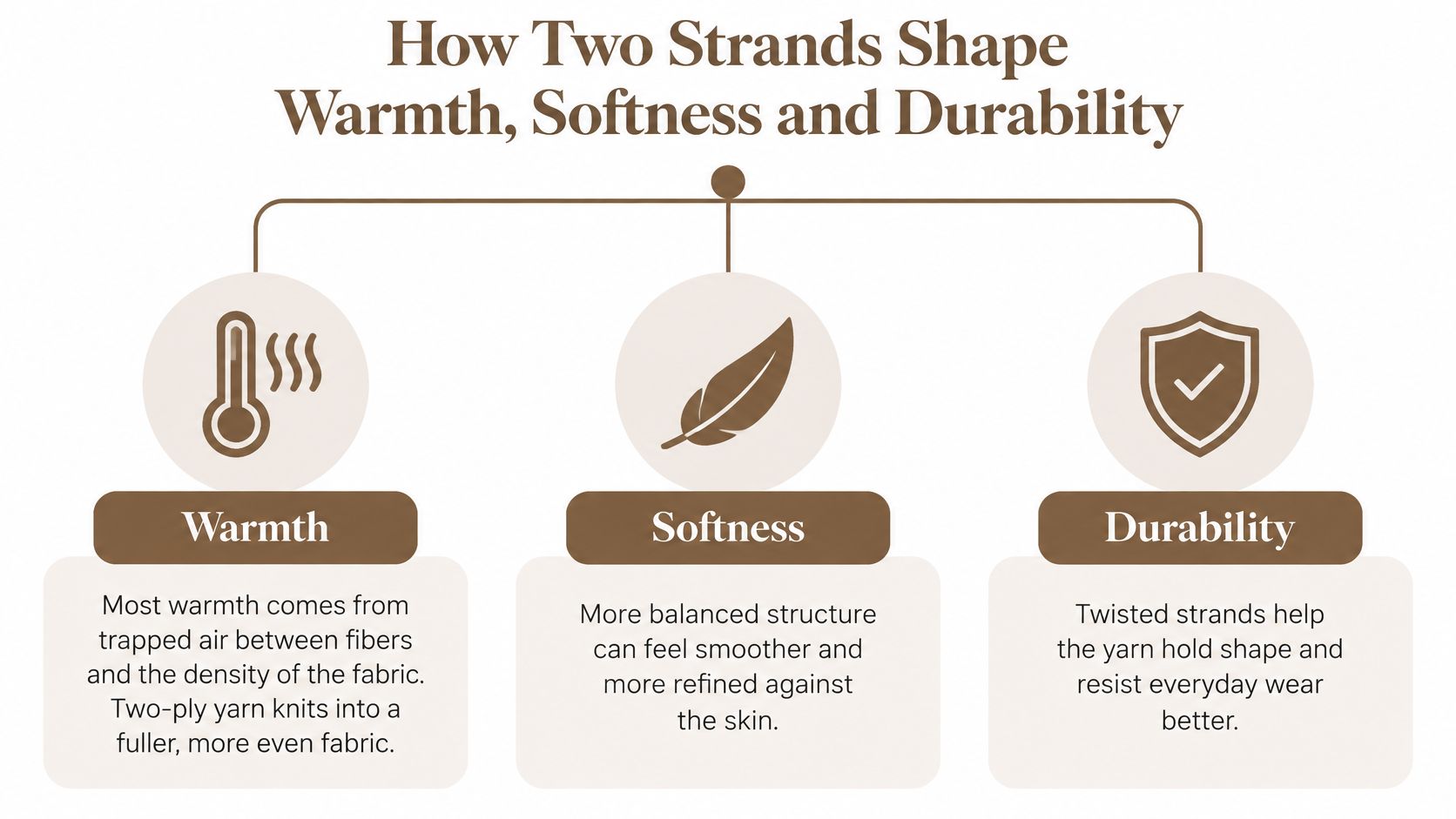
Warmth, softness, and durability have different causes. A construction choice can help one property without establishing the others, which is why a single label claim can't describe overall performance.
This diagram summarizes the structural benefits, but the fiber and fabric specifications still matter.
Warmth and softness have different foundations
Cashmere insulates through the air held within its fiber structure and knitted fabric. A fuller yarn can help create a substantial fabric, but open stitches, thin starting yarns, or a lightweight design can change the result. Sensoire's cashmere assessment guide explains why yarn thickness, gauge, stitch density, and finishing must be considered alongside ply.
Say a maker uses the same cashmere fiber for a fine, closely knitted office sweater and a lofty, open-knit weekend sweater. The garments can feel quite different in weight and warmth even though the fiber specification matches. Wind exposure and the layers worn over them will also affect comfort.
Softness begins with the fiber, particularly its ability to bend against your skin. A peer-reviewed textile study measured white cashmere at 14.64 microns, compared with 20.39 microns for white wool, illustrating the difference in fiber fineness.
Twisting doesn't make those fibers narrower. A balanced yarn may feel smoother than a loose strand, while finishing can create a soft surface that changes your first impression without establishing long-term wear.
Stability isn't the same as a pill-free surface
Twisting component strands together helps distribute handling forces and resist separation. In a well-made knit, that coherence supports dimensional stability, meaning the fabric is better able to retain its intended shape.
Pilling is a different issue. Loose fibers work toward the surface, then friction tangles them into small balls, often beneath the arms or where a bag rubs the hip. Coveti's cashmere gauge guide identifies fibers shorter than approximately 7.5 mm as a significant contributor to pilling.
That doesn't mean every visible pill proves poor quality. It means that fiber length, spinning, surface treatment, and wear conditions deserve attention rather than a promise based solely on construction.
The accompanying video offers another way to visualize cashmere yarn and fabric.
The useful distinction is simple: ply directly shapes yarn structure; fiber selection and knitting largely determine how that structure feels and performs.
Reading Two-Ply Labels Without Being Misled
A product description can be technically accurate and still leave you with the wrong impression. Words such as substantial, premium, and durable need supporting specifications rather than a prominent ply count.
The general definition of a plied yarn is straightforward in Britannica's textile guidance: separate spun yarns are twisted together. That construction doesn't upgrade the underlying cashmere.
Four assumptions to challenge
- Automatically warmer: A lightweight layering piece shouldn't be judged against a dense winter garment by construction alone. Look at the actual fabric and intended use.
- Automatically top grade: Cashmere identity and exceptional fineness aren't interchangeable. A legitimate cashmere garment can still differ noticeably from another in softness.
- Automatically resistant to pilling: A tidy-looking new surface doesn't establish how it will respond to friction. Ask about fiber specifications and any available wear-testing information.
- More plies mean better cashmere: Additional yarn can suit a heavier design, but it can't improve the fibers already spun into it.
The same caution applies to blends. A label describing construction doesn't replace the composition statement, and a soft initial touch doesn't tell you which fibers supply that softness.
Read the rail by intended use
Suppose you're comparing a two-ply cardigan, a two-ply scarf, and a four-ply coat. Start by assigning each a job: the cardigan needs to fit comfortably under your jacket, the scarf needs to fold and drape without crowding your collar, and the coat needs enough body for outerwear.
Then examine the actual fabric. Check whether the cardigan returns to shape after gentle handling, whether the scarf's edges lie neatly, and whether the coat feels comfortable across your shoulders. Don't pull hard on a display garment to test it.
A good label helps you predict use. It shouldn't persuade you to ignore fit, fabric density, or composition.
For online shopping, request missing details through the retailer's support channel and read the return terms before committing. If a listing provides only an appealing adjective and a ply count, you haven't yet received enough information to compare it confidently with a fully specified alternative.
Caring for Two-Ply Cashmere to Limit Pilling and Shrinkage
Care starts before the garment touches water. Read the washing symbols and any written instructions, check for stains, and measure the garment laid flat if you want a reference for reshaping. A stable yarn still needs gentle handling when wet.
For washable cashmere, use cool water and a cashmere-safe detergent. Dissolve the detergent before adding the garment, press the fabric gently through the water, and avoid rubbing, twisting, or vigorous agitation. If the label specifies professional cleaning, don't substitute a home wash without confirming that it's suitable.
Wash gently and support the wet knit
- Rinse without wringing: Support the garment as you lift it, then press out water gently. Don't suspend a saturated sweater by its shoulders.
- Remove excess moisture: Lay it on a clean towel, roll the towel around it, and press rather than twist.
- Reshape flat: Arrange the garment on a dry, flat surface with the cuffs, hem, and seams aligned. Keep it away from direct heat.
- Skip the tumble dryer: Heat and mechanical action can encourage shrinkage and felting. Use the drying method specified for the garment.
The practical details in how to dry sweaters help prevent a careful wash from ending with stretched shoulders or a distorted hem.
Manage friction between washes
Surface fuzz and pills need different treatment from stains. Let the garment dry completely, lay it flat, and remove pills gently with a cashmere comb or a guarded fabric shaver suitable for fine knits. Test a discreet area first and keep the tool away from raised seams.
Don't pull pills off with your fingers, because you may draw more fibers out of the yarn. Reduce repeated rubbing from rough bag straps and give frequently worn pieces a rest between outings.
Fold knitwear for storage rather than leaving it on a hanger. If precise fit matters, check for published shrinkage expectations before purchase, then compare the dry garment with your original measurements after laundering.
Confirm the Ply Before You Buy
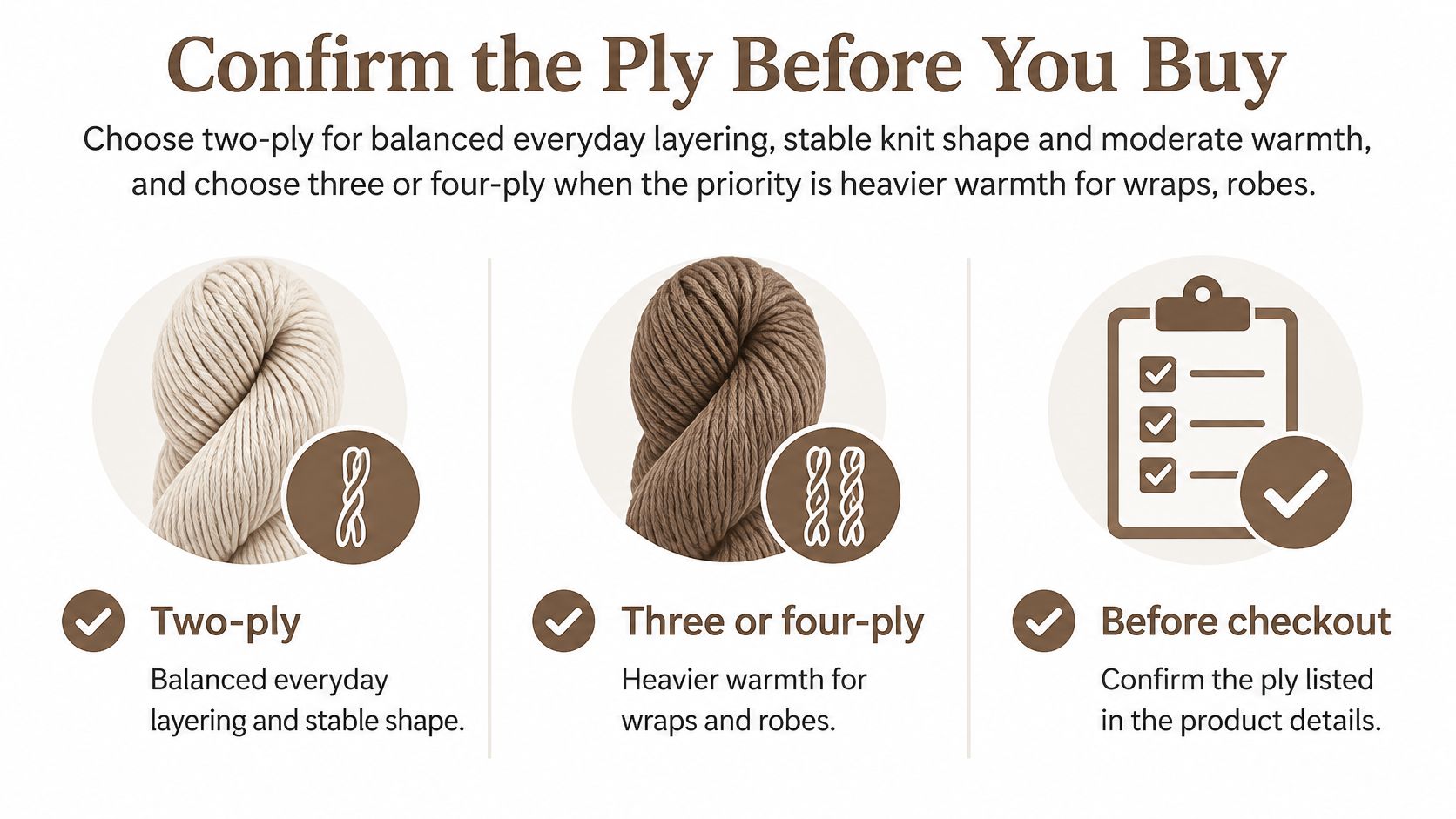
Choose two-ply when you want balanced everyday layering, moderate warmth, and a coherent yarn structure. Consider fuller constructions for wraps, robes, and outerwear when substantial fabric is the priority, but confirm the finished specification rather than buying by number alone.
Our product range illustrates why garment type matters. We offer two-ply hats, gloves, and socks; three-ply shawls, wraps, and ponchos; three- and four-ply scarves, robes, throws, sweaters, and cardigans; and four-ply blankets and overcoats.
Use this visual as a starting point, then check the details of the individual item.
A repeatable label-checking routine
- Find the ply statement. Look in the product specifications rather than assuming a thick appearance means a particular construction.
- Read the fiber composition. Confirm whether you're comparing pure cashmere with pure cashmere or with a blend. Keep composition separate from marketing descriptions.
- Check the stated diameter. If a micron measurement is available, record it beside the product name. Don't infer a measurement from the word luxury.
- Look for fiber-length information. A published length specification or clear explanation of fiber selection is more useful than an unsupported promise that the garment won't pill.
- Compare gauge and finished weight. Use matching garment sizes where possible, and account for length, pockets, collars, and other design features.
- Review care and fit expectations. Confirm the washing method, drying requirements, and any stated shrinkage allowance before deciding whether the item fits your routine.
The guidance on how to choose a high-quality cashmere sweater can help you assess the whole garment rather than one isolated label detail. Our cashmere FAQs also provide information about quality and care.
Pick the products you're considering and record their specifications side by side. Choose the one whose fabric, fit, and maintenance requirements match how you'll wear it, not the one with the largest construction number.
Cashmere Boutique offers cashmere apparel, accessories, and home textiles in constructions suited to different uses, from light accessories to substantial blankets and outerwear. Visit Cashmere Boutique to compare the product details for your shortlist and choose the weight, composition, and care requirements that fit your everyday routine.