
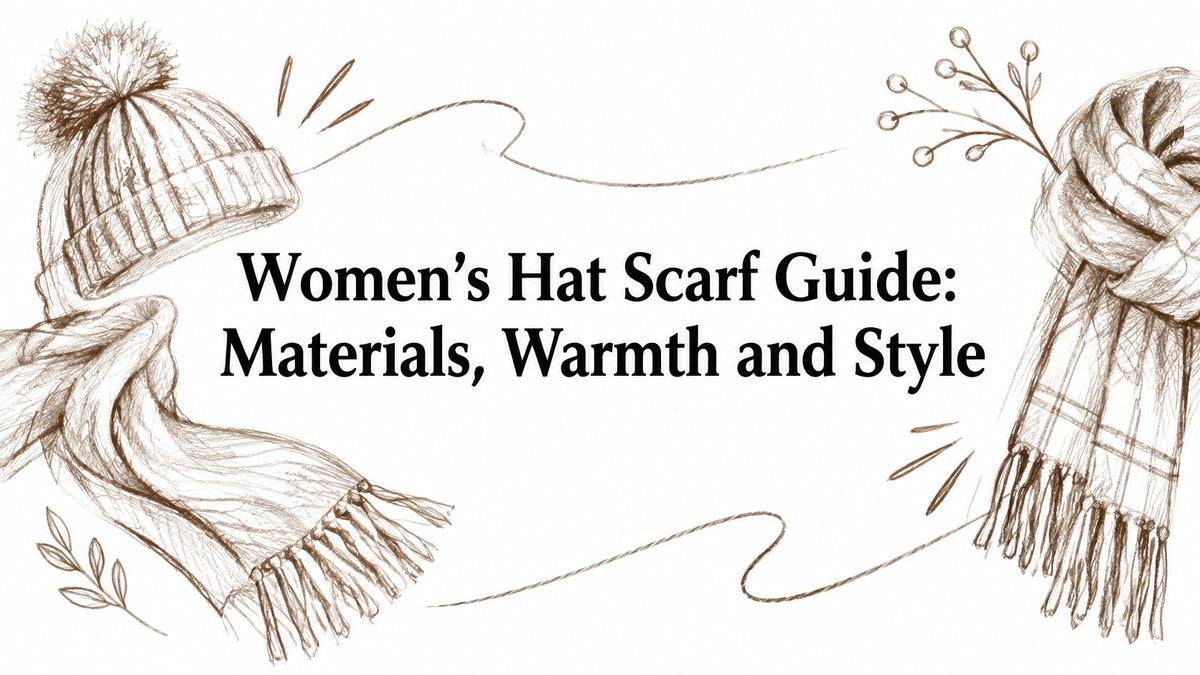
Women's Hat Scarf Guide: Materials, Warmth and Style
Does a matching hat and scarf keep you comfortable, or does it just look coordinated until your forehead starts itching and your neck overheats? Color is the easy part. The better buying decision starts with what touches your skin, how much coverage you need, and whether you'll wear both pieces together.
Treat a women's hat scarf combination as one comfort system, not separate accessories. A beautiful scarf won't rescue a pinching hat, and a thick winter set won't suit every commute. Choose the fiber, construction, shape, and care routine together, then decide which colors deserve space in your wardrobe.
Table of Contents
- Materials That Decide Warmth, Comfort and Care
- Warmth by Temperature, Activity and Coverage
- Lightweight Headwear for Mild and Sunny Days
- Coordinating Hat Shapes and Scarves with Your Coat
- Judging Natural-Fiber Claims and Value Per Wear
- Check Fit and Length Then Choose the Set
Materials That Decide Warmth, Comfort and Care
Women's hat and scarf materials compared
| Material | Warmth for weight | Next-to-skin feel | Pilling and shedding | Care | Best use |
|---|---|---|---|---|---|
| Pure cashmere | Very high | Soft, fine fibers feel light | Low to moderate; shorter fibers can pill | Hand wash or dry clean as labeled | Cold-weather hat and scarf sets |
| Merino wool | High | Fine merino feels soft; coarser wool can itch | Low to moderate; inspect friction areas | Hand wash; machine wash only when permitted | Active and everyday winter wear |
| Cashmere blend | Moderate to high | Softness follows the blend composition | Check the partner fiber and yarn compactness | Often hand wash; check the label | Mild winter and commuting |
| Cotton knit | Low to moderate | Breathable, cool feel | Usually low; loose yarns can fuzz | Machine wash when permitted; reshape | Spring, autumn, and sunny days |
| Acrylic | Moderate | Can feel scratchy against skin | Often prone to persistent pills | Usually machine washable; avoid excessive heat | Budget sets needing frequent washing |
These are buying starting points, not guarantees. Construction can change the result considerably: a compact blend may block drafts better than an airy pure-cashmere knit, while a soft merino hat may feel better than cashmere with a coarse seam across the forehead.
Why fineness matters at the forehead and neck
The technical review Physical Properties of Pashmina Fiber reports a mean cashmere fiber diameter of 16.1 micrometers and explains why a 14–16 micrometer specification is relevant to skin-contact accessories. Fine fibers bend more readily than coarse guard hairs, reducing prickly contact, but shorter fibers can also increase hairiness, migration, and pilling.
That makes micron information useful, not decisive. Read it alongside yarn twist, knit density, finishing, and fiber-length information when available. A luxurious first touch doesn't tell you how the scarf will behave against a coat collar.
For the hat, check the folded edge and interior seams. For the scarf, test the surface against your neck rather than judging softness with your fingertips. Your hands may tolerate a texture that becomes distracting beneath your chin.
Match care to your actual routine
A washable merino or acrylic set can be the practical choice if you're frequently removing sweat, sunscreen, or makeup. Cashmere needs a gentler routine: use an appropriate wool detergent, avoid rubbing or wringing, support the wet fabric, and dry it flat after washing when the label permits.
For mixed wardrobes, Tattoo Golf's guide to how to care for golf hats is a useful companion for performance headwear. Keep those care decisions separate from cashmere care, because a structured sports hat and a soft knit don't need identical handling.
Practical rule: Choose the most comfortable fiber at the skin and the most resilient construction where repeated wear creates friction.
Warmth by Temperature, Activity and Coverage
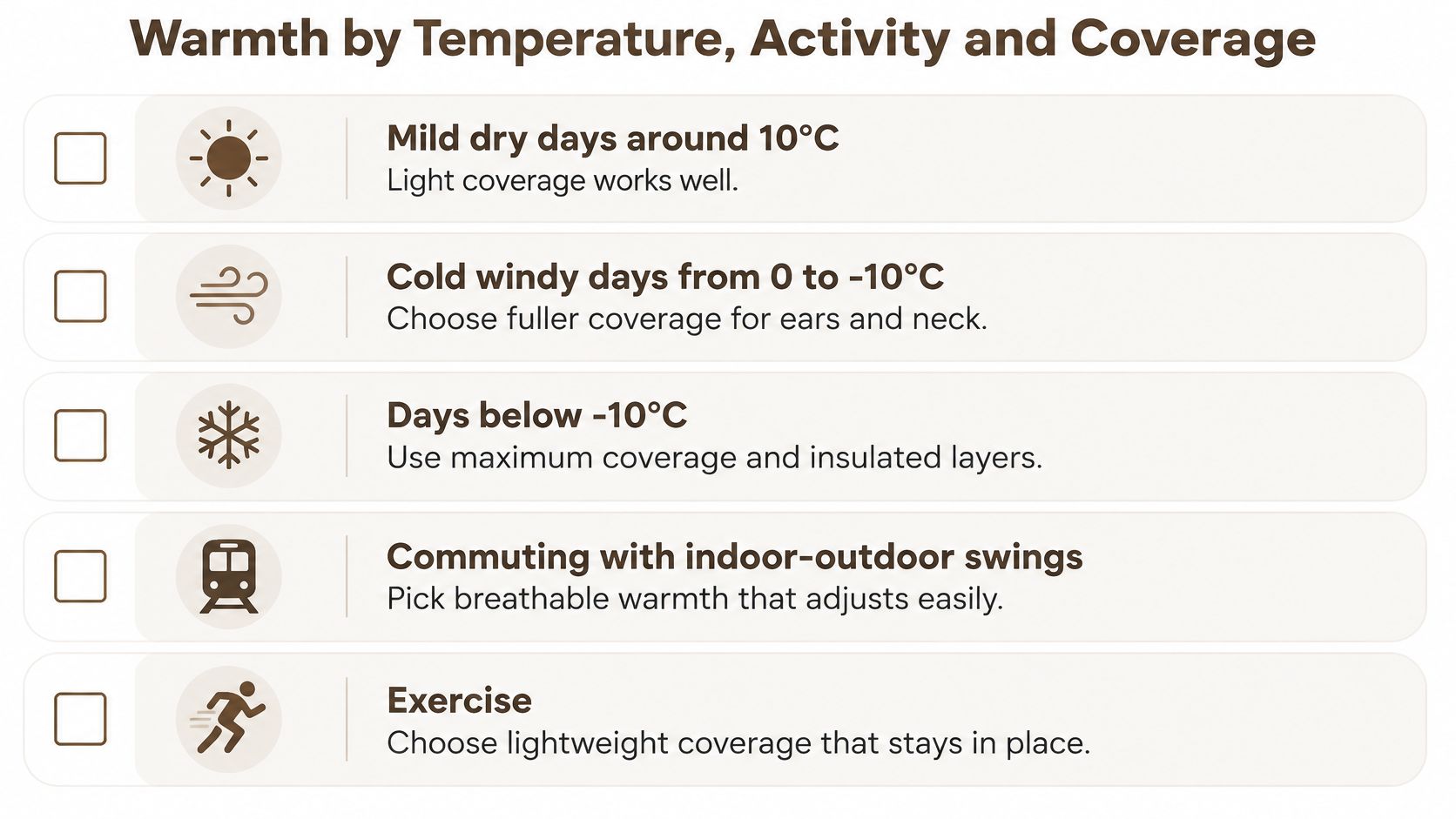
Hat and scarf coverage by temperature and activity
Use these as illustrative outfit choices, not certified temperature ratings. Wind, dampness, time outdoors, and your own cold tolerance change what feels sufficient.
| Conditions | Hat | Scarf | Layering note |
|---|---|---|---|
| Mild and dry | Lightweight knit beanie | Light scarf or loose wrap | Add a clothing layer before adding accessory bulk |
| Cold and windy | Double-layer or dense rib hat | Long scarf covering neck and, when needed, lower face | Protect ears and neck without obstructing vision or breathing |
| Severe cold | Double-layer hat with ear coverage | Generous scarf with overlapping wraps | Insulated outerwear is essential; accessories alone aren't enough |
| Walking or commuting with temperature swings | Close-fitting, low-bulk hat | Adjustable scarf that loosens indoors | Release coverage before you become sweaty |
| Exercise | Moisture-managing knit hat | Thin neck tube or none | Prioritize breathable layers and secure fit |
This visual summarizes the coverage choices.
Coverage matters more than a heat-loss slogan
Your head isn't a uniquely powerful escape route for body heat. Exposed skin loses heat, and a hat helps by covering the crown and ears, just as other clothing protects other exposed areas. A scarf closes the opening between your collar and chin.
Cleveland Clinic's cold-stress guidance recommends hats, scarves, gloves, thick socks, and layered clothing as part of cold-weather protection. A scarf over the nose and mouth can also help warm incoming air, but it isn't medical protection; people with heart or breathing conditions should discuss cold exposure with their clinician.
Leave room to release heat
The head-covering thermal-comfort study found increased sweating and warmer perceived discomfort with head coverage. That's a reason to choose adjustable coverage rather than automatically buying the thickest set.
For a station-to-office commute, a scarf you can open while walking indoors is more useful than a tight arrangement you're reluctant to undo. A funnel-neck cashmere sweater can supply collar coverage beneath your coat, allowing you to choose a less bulky scarf.
Exercise calls for a different compromise. A lightweight knit that stays over your ears is preferable to a heavy hat you repeatedly remove, and a close neck tube avoids loose ends moving around during activity.
For an additional visual reference, watch the video below.
Lightweight Headwear for Mild and Sunny Days
Choose a brimmed straw or cotton sun hat, a lightweight cotton or linen scarf, and a silk-blend wrap for cool interiors or evenings. These pieces solve different problems: the brim supplies shade, the scarf adds adjustable coverage, and the wrap fits easily into a bag.
Look at where the brim casts shade when you wear it. A thick fabric doesn't compensate for a brim that leaves your ears or the back of your neck exposed. An open straw weave can feel airy, but don't assume its appearance proves a particular level of sun protection.
Make the fabric pass these checks
- Breathability: Hold the material, flex it, and try it on. Reject a stiff finish or an enclosed crown that already feels uncomfortable indoors.
- Color and finish: A pale neutral is an easy warm-weather choice, but don't let color distract you from ventilation and coverage.
- Shape after cleaning: Check whether the hat is washable, spot-clean only, or requires specialist cleaning. A packable scarf is useful only if you can maintain it without ruining its drape.
For spring and autumn, keep the combination flexible. A fine-knit beanie handles a cool evening without occupying much bag space, while a light scarf can hang loose indoors and close at the neck outside. Don't buy a winter-weight set merely because the calendar says autumn.
A practical holiday capsule might include a linen scarf and a straw brim for daytime, with a light beanie for a chilly evening. Choose a scarf that folds into your everyday bag rather than a generous wrap you'll leave at your accommodation.
A lightweight accessory you carry is more useful than a warmer one you leave behind.
When a breeze develops, secure the scarf comfortably at the neck rather than adding heavy insulation everywhere. Keep the ends controlled, particularly around bicycles, moving equipment, and crowded transit.
Coordinating Hat Shapes and Scarves with Your Coat
Match visual weight before matching color. Your hat and scarf should work with the volume of your outerwear, not create a separate mass above it. Start with the coat you wear most often, then choose accessories that leave its collar, shoulders, and fastening usable.
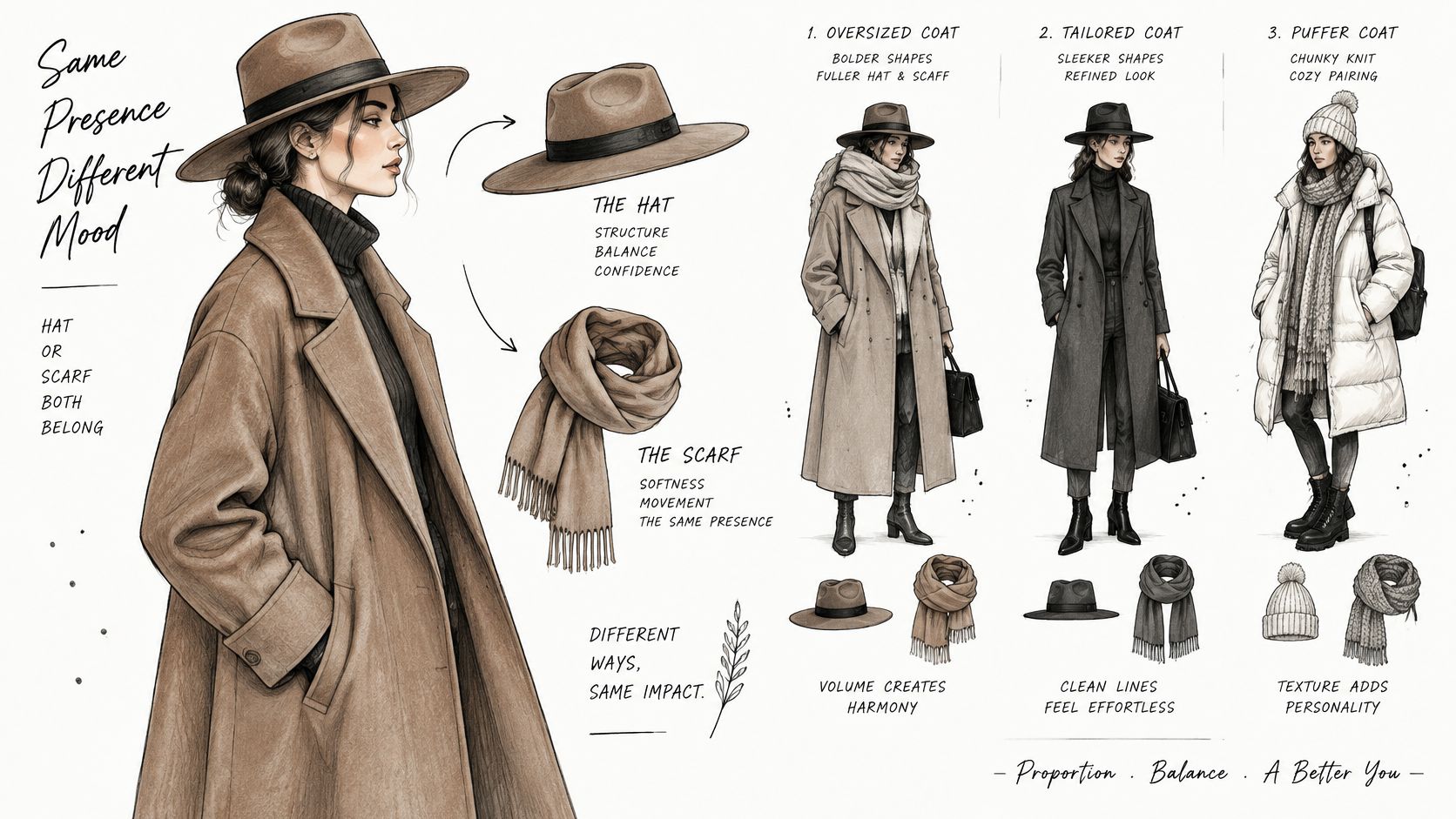
Hat shape and scarf pairing by outfit
| Outfit or coat | Hat shape | Scarf treatment | Why it works |
|---|---|---|---|
| Long wool or cashmere coat | Close-fitting beanie or toque | Long scarf loosely wrapped with ends hanging | Maintains a clean vertical line |
| Puffer or short jacket | Slim beanie or fitted cloche | Shorter scarf with a loose knot | Avoids adding excessive volume over padding |
| Belted trench or tailored coat | Structured felt hat or cloche | Narrow scarf tucked inside the collar | Leaves the shoulders and waist clearly defined |
| Oversized sweater | Ribbed beanie | Chunky scarf in a contrasting texture | Gives soft volume a deliberate, coordinated finish |
| Dress or tailored suit | Brimmed hat or cloche | Slim wrap or silk scarf | Keeps the overall appearance light |
Use the illustration to compare how accessory volume changes with the coat.
Balance shape, texture, and proportion
Keep the strongest volume in a deliberate place. If your coat has a substantial hood or padded collar, use a slimmer scarf rather than forcing a chunky knot beneath your chin. With a clean, collarless coat, a fuller scarf has room to become the focal point.
Use the shoulder line as a proportion check, not a rigid sizing rule. A tall crown and narrow shoulders may look more dramatic than you want, while a close-fitting beanie often gives a quieter outline. Face-shape formulas are less useful than trying the hat with your hair, glasses, and actual coat.
Texture contrast is easier to manage than competing patterns. A smooth coat works well with a ribbed hat, while a textured tweed often benefits from a simpler scarf surface. For dressier layering, the ideas in adding a pashmina shawl to your wardrobe offer an alternative to a conventional knotted scarf.
Stand back from the mirror with the coat fastened. If you notice the knot before your face, reduce its bulk or tuck the ends inside.
Judging Natural-Fiber Claims and Value Per Wear
Consumer interest makes clear labeling important: 59% of surveyed U.S. consumers said they were likely to seek clothing made with microplastic-free fibers, according to Textile World's reporting on natural-fiber preferences. That preference is a reason to inspect composition, not proof that every natural-fiber accessory is the better environmental purchase.
Natural fiber alone doesn't establish sustainability. Processing, blend components, usable lifespan, washing requirements, and repairability all matter. An accessory that feels unpleasant or needs care you won't provide is unlikely to become a long-serving purchase, regardless of its label.
Read the product page like a buyer
- Full composition: Look for named fibers and their proportions, not a cashmere headline that obscures the rest of the blend.
- Useful specifications: Seek micron information where relevant, plus weight, construction, or close-up photographs that help explain substance and texture.
- Care requirements: Decide whether the cleaning routine fits your household before ordering.
- Repair potential: A small snag or loosened seam shouldn't automatically mean replacement. Check whether the construction can be repaired neatly.
- Evidence behind claims: Prefer a clearly explained material or production claim to an unsupported green label.
- Return conditions: Make sure you can assess comfort and fit without being committed to an unsuitable purchase.
Calculate use rather than prestige
Use purchase price divided by expected wears to compare value. For a hypothetical comparison, give the more expensive set a realistic wearing schedule and do the same for the budget option. Don't assume either will last longer because of its price.
Count likely wears. A delicate pale scarf may suit occasional dinners but not your wet-weather commute, while a plainer, washable set may become your daily choice. Cleaning costs and the effort of maintenance belong in the decision too.
Buy the quality you'll use, not the luxury description you'll rarely wear.
A thinner accessory can offer better value than a heavier one if it works across more of your wardrobe. Choose for your routine rather than an imagined winter lifestyle.
Check Fit and Length Then Choose the Set
Make the final choice in a practical order: skin comfort, weather needs, coat compatibility, then value. This prevents an appealing color or discount from deciding everything before you've checked whether the set works.
Start with the fiber where it touches your forehead and neck, then consider how often you'll need to wash it. Choose coverage for the outdoor conditions you face, not the coldest holiday you might take. Finally, try the complete combination with your usual coat and bag.
Test the hat without forcing the fit
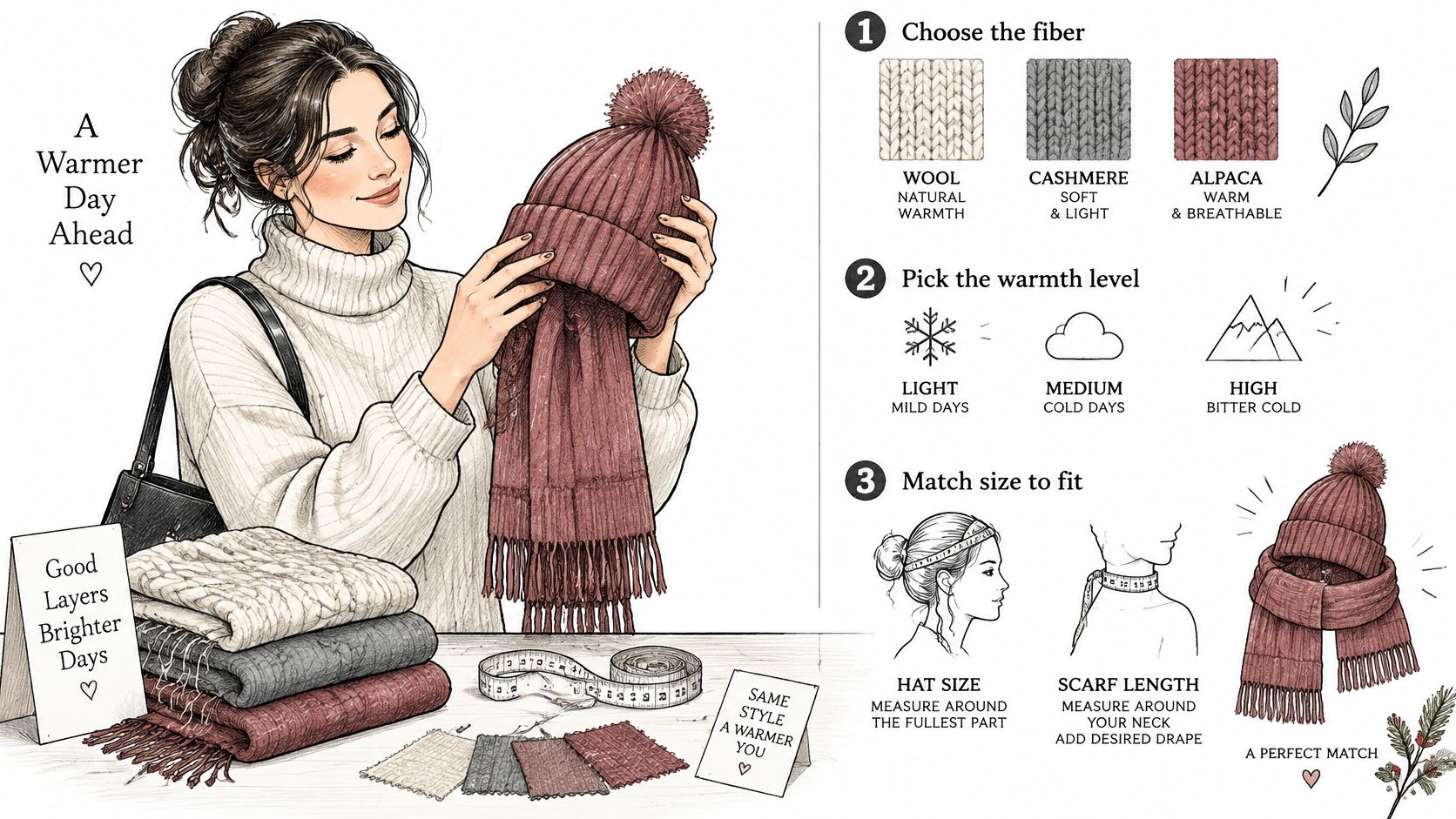
Use a flexible dressmaker's tape around the line where the hat will sit, and compare that measurement with the maker's sizing information. Include your usual hairstyle when trying it on; a bun or thick hair can change how a close-fitting hat settles.
The edge should rest comfortably without pulling upward over your ears. Turn your head, look down, and put your glasses on. A hat that presses painfully at the temples or needs constant adjustment isn't a good fit, even if you like its shape.
Check the inside as carefully as the outside. A bulky seam, firm label, or rough folded edge can spoil an otherwise soft knit.
Confirm the scarf's usable length
Read the listed dimensions rather than judging scale from a photograph. Use a scarf you already own, or a length of ribbon, to test your preferred wrap and the amount of fabric you want left hanging.
For a generous wrap, account for your coat collar and the space needed to move your chin freely. A cashmere blanket scarf offers more styling room, but its extra fabric may be awkward beneath a high, padded neckline.
Use this illustrated checklist while assessing the complete outfit.
At Cashmere Boutique, our pure-cashmere hats collection includes a unisex toque, a reversible toque, and a snood. Our Unisex Pure Cashmere Scarf, Hat and Gloves Set is on sale for $129.00 USD, with a regular price of $259.00 USD, and is available in 8 colors. Treat it as an option to compare on composition, fit, care, and wardrobe usefulness rather than price alone.
Before checking out, save the sizing and care details and read the return conditions. If coordinated colors feel restrictive, choose a neutral hat and let interchangeable scarves provide the variation.
Cashmere Boutique offers pure-cashmere hats, coordinating accessory sets, scarves, and wraps for building a comfortable cold-weather wardrobe. Visit Cashmere Boutique to compare the shapes and compositions, then choose the combination that fits your skin, coat, and everyday weather.